Shredded scrap metal, such as ISRI 211, is a crucial commodity in the recycling industry. Understanding its average density is essential for various reasons, including transportation, pricing, and process optimization. Testing the average density of shredded scrap ISRI 211 involves precise methodologies and considerations to ensure accuracy and reliability. In this blog post, we’ll delve into the methods and factors to consider when testing the average density of shredded scrap ISRI 211.
Understanding What is ISRI 211
ISRI 211 refers to shredded scrap steel, predominantly generated from automobiles and light gauge steel. It typically contains a mix of materials, including steel, non-ferrous metals, plastics, and other contaminants. Given its heterogeneous nature, determining its average density requires meticulous testing procedures.
Methods for Testing Average Density
Displacement Method
This method involves immersing a known volume of shredded scrap ISRI 211 in a liquid and measuring the displacement.
Choose a liquid that does not react with the materials in the scrap and is easily measurable.
Measure the volume of the liquid displaced before and after immersing the shredded scrap. The difference in volumes gives the volume of the shredded scrap.
Divide the mass of the shredded scrap by its volume to obtain the average density.
Gravimetric Method:
In this method, a known mass of shredded scrap ISRI 211 is placed on a balance, and its volume is measured indirectly.
The shredded scrap is compacted as much as possible to eliminate voids.
Measure the mass of the compacted scrap.
Calculate the volume using the dimensions of the container or by measuring the displacement of water when the scrap is submerged.
Divide the mass by the volume to determine the average density.
Factors to Consider while Testing the Average Density of Shredded Scrap ISRI 211
Ensure that the shredded scrap is representative of the entire lot. Random sampling techniques can help achieve this.
Remove any contaminants or materials that are not part of ISRI 211 to obtain accurate results.
Moisture can significantly affect the density of shredded scrap. It is essential to either dry the sample before testing or account for moisture content in calculus
Shredded scrap ISRI 211 may have varying particle sizes, which can impact its density. Consider the particle size distribution when interpreting density measurements.
Density measurements can be influenced by temperature and pressure variations. Standardize these parameters during testing for consistency and accuracy.
ShreddedSteel Scrap ISRI 211 Specification
ISRI 211 is a specific grade of shredded steel scrap that adheres to certain specifications set forth by the Institute of Scrap Recycling Industries (ISRI). These specifications help standardize the quality of shredded steel scrap and facilitate its trade and processing within the recycling industry. Below are the typical specifications for shredded steel scrap ISRI 211:
Composition: Shredded steel scrap ISRI 211 primarily consists of homogeneous iron and steel scrap, which may include automobile bodies and sheet scrap, but should be free of all other materials, except for incidental amounts that might be present in automobiles or automobile parts, such as dirt, glass, rubber, or plastics.
Density: The shredded scrap should have a relatively uniform density. However, slight variations may exist due to the nature of shredding processes and the mix of materials.
Size: The scrap should be processed through a shredding machine, resulting in small, fist-sized or smaller pieces. However, some variations in size are expected within this range.
Magnetic Content: Shredded steel scrap ISRI 211 should be magnetically separated material, primarily consisting of iron and steel. It should exhibit high ferrous content, allowing it to be easily attracted by magnets.
Purity: The shredded scrap should be relatively free of contaminants, such as non-ferrous metals, excessive dirt, or other materials not consistent with steel scrap. However, minor levels of contaminants may be present as long as they do not significantly affect the quality or usability of the material.
Processing: Shredded steel scrap ISRI 211 may undergo further processing steps, such as sorting, cleaning, or compacting, to meet specific customer requirements or quality standards.
It’s essential for buyers and sellers of shredded steel scrap ISRI 211 to verify that the material meets these specifications to ensure its suitability for various applications, such as steelmaking in foundries and steel mills. Adhering to these standards helps maintain consistency in quality, enhances efficiency in recycling processes, and promotes sustainable resource management practices within the scrap metal industry.
ISRI Code List
Each ISRI code corresponds to a specific category of scrap material recognized by the Institute of Scrap Recycling Industries (ISRI). Here’s an explanation for some of the common ISRI codes:
ISRI 200: Heavy Melting Steel (HMS) – This code represents heavy melting steel scrap, typically derived from dismantled structures, vehicles, or machinery. It includes a mix of ferrous materials, such as beams, plates, and structural steel.
ISRI 201: Shredded Scrap – Shredded scrap consists of ferrous scrap that has been processed through a shredder, resulting in small, uniform pieces. It’s commonly used in steelmaking processes due to its ease of handling and melting properties.
ISRI 211: Shredded Scrap – Similar to ISRI 201, ISRI 211 specifically denotes shredded scrap with certain size and density specifications. It’s often used as a raw material in steel mills for producing new steel products.
ISRI 213: No. 1 Dealer Bundles – This code refers to clean, new steel scrap generated by industrial or commercial sources, typically in the form of clean, uncoated steel sheets, bars, or wire.
ISRI 217: HMS Mixed – HMS Mixed represents a mix of heavy melting steel scrap that may contain various grades and sizes of ferrous materials. It’s commonly sourced from demolition projects, industrial machinery, and obsolete equipment.
ISRI 228: Steel Turnings – Steel turnings consist of small, scrap metal pieces generated during machining or manufacturing processes. They’re often collected for recycling due to their high iron content.
ISRI 229: Alloy Scrap – Alloy scrap includes various ferrous materials containing alloying elements such as chromium, nickel, or molybdenum. It’s typically sourced from industrial processes, manufacturing scrap, or end-of-life products.
These ISRI codes serve as standardized identifiers within the scrap recycling industry, facilitating communication and trade among recyclers, scrap processors, and consumers of recycled materials. They help ensure clarity and consistency in the classification and trading of scrap materials, which is essential for efficient recycling operations and sustainable resource management.
As a leading provider of analytical instruments and equipment, Mcneil Instruments offers solutions to fulfill your needs of industries involved in scrap metal recycling, including the testing of shredded steel scrap ISRI 211. With their expertise in analytical technologies and commitment to quality, Mcneil Instruments empowers businesses to accurately assess the average density and other crucial parameters of shredded scrap materials. By utilizing Mcneil Instruments’ advanced instruments and support services, scrap metal recyclers can enhance their operational efficiency, ensure compliance with industry standards, and ultimately contribute to the sustainable management of metal resources. Trust Mcneil Instruments to deliver reliable solutions for your scrap metal analysis needs.
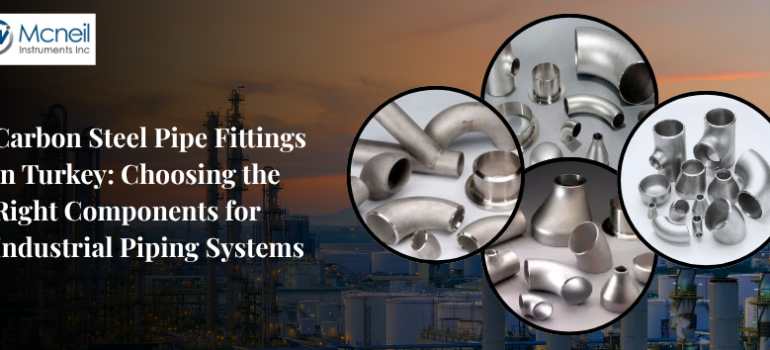
Carbon steel pipe fittings are essential components in industrial piping systems where pipes need to be connected, redirected, branched, reduced, or terminated. Their combination of mechanical strength, pressure-handling capability, weldability, availability, and cost efficiency makes them suitable for a wide range of industrial applications.
For projects in Turkey, selecting the right pipe fitting involves more than choosing a shape. The fitting material, pipe size, schedule, pressure rating, operating temperature, connection method, and service medium all need to be considered. This is particularly important for applications in oil and gas, petrochemical processing, power generation, chemical processing, water treatment, marine facilities, and industrial manufacturing.
Mcneil Instruments supplies carbon steel pipe fittings and other industrial piping components for customers in Turkey, supporting requirements in locations including Istanbul, Kocaeli, Bursa, Sakarya, and Ankara. Its Turkey range includes elbows, tees, reducers, caps, stub ends, couplings, unions, and other pipe fitting configurations.
What Are Carbon Steel Pipe Fittings?
Carbon steel pipe fittings are piping components designed to connect sections of pipe and create functional piping networks. Depending on their geometry, they can change the direction of flow, create branches, connect different pipe diameters, or close the end of a pipeline.
They are commonly manufactured in seamless or welded forms and can be produced according to recognized ASTM, ASME, and MSS specifications.
In an industrial piping system, fittings perform several important functions:
Changing pipeline direction
Connecting multiple pipe sections
Creating branch connections
Transitioning between different pipe sizes
Closing pipeline ends
Providing removable connections for maintenance
Supporting pressure-containing piping systems
The correct fitting must be compatible with the pipe and the operating conditions of the complete system.
Why Are Carbon Steel Pipe Fittings Important for Turkish Industries?
Turkey has a diverse industrial base involving manufacturing, energy, chemical processing, infrastructure, water treatment, marine operations, and other process industries. These applications require piping systems that can withstand mechanical loads and operating pressures while remaining practical to install and maintain.
Carbon steel fittings are often selected when high strength, fabrication compatibility, and economical material selection are important.
For industrial projects, a properly selected fitting can help maintain:
Mechanical integrity
Reliable flow direction
Leak-resistant connections
Consistent dimensional alignment
Easier maintenance
Long-term piping performance
Mcneil Instruments’ Turkey supply network supports industrial requirements in Istanbul as well as major industrial areas such as Kocaeli and Bursa, with supply support extending to Sakarya and Ankara.
Different fitting designs perform different functions within a piping system. Understanding these configurations helps engineers and procurement teams select the appropriate component.
1. Carbon Steel Elbows
Elbows are used when a pipeline needs to change direction.
Common configurations include:
45° elbows
90° elbows
180° elbows
Long-radius elbows
Short-radius elbows
The choice between long-radius and short-radius designs depends on piping layout, flow requirements, available space, and project specifications.
Carbon steel elbows are commonly used in process piping, industrial plants, water systems, power facilities, and oil and gas applications.
2. Carbon Steel Tees
A tee creates a branch connection from a main pipeline. It can divide one flow into two paths or combine flows from different lines.
Common applications include:
Process distribution systems
Water pipelines
Chemical plants
Oil and gas piping
Industrial utility systems
Where different branch sizes are required, reducing tee configurations can be selected according to the piping design.
3. Carbon Steel Crosses
A pipe cross provides four connection points and allows multiple branches to be connected from a single junction.
Cross fittings can be useful where a piping layout requires several directional connections within a compact area.
4. Carbon Steel Reducers
Reducers connect pipes with different nominal diameters.
Two common designs are:
Concentric Reducers
The centerlines of the connected pipes remain aligned. They are commonly used where symmetrical flow transitions are appropriate.
Eccentric Reducers
The centerlines are offset. They can be particularly useful in horizontal piping arrangements where maintaining appropriate flow geometry and avoiding unwanted pockets is important.
5. Carbon Steel Couplings and Unions
Couplings connect straight sections of pipe, while unions provide a connection that can be more readily dismantled for maintenance.
They are useful where piping sections may need to be disconnected during inspection, servicing, or replacement.
6. Carbon Steel Caps and Plugs
Caps and plugs close pipe ends.
Depending on the design, they can be used for:
Permanent termination
Temporary closure
Maintenance isolation
Pipeline fabrication
Equipment connections
7. Carbon Steel Stub Ends
Stub ends are commonly used with lap-joint flange arrangements, particularly where a piping section may need to be frequently dismantled.
They can simplify maintenance and inspection in systems where repeated flange separation is expected.
Carbon Steel Pipe Fitting Grades
Material selection should be based on pressure, temperature, service conditions, and applicable project standards.
Mcneil Instruments identifies the following common materials for carbon steel pipe fittings:
Grade
Typical Selection
ASTM A234 WPB
Pressure piping applications
ASTM A105
Forged fittings and high-pressure systems
ASTM A350 LF2
Low-temperature applications
ASTM A234 WPB Pipe Fittings
ASTM A234 WPB is widely associated with wrought carbon steel and alloy steel fittings for pressure piping applications.
These fittings can be used for connecting piping components in process and industrial systems where the material specification, dimensions, pressure-temperature requirements, and fabrication procedure are appropriately matched to the project.
ASTM A105 Forged Fittings
ASTM A105 is commonly used for forged carbon steel components in pressure-containing applications.
It is particularly relevant where forged construction is preferred for the required pressure and mechanical service conditions.
ASTM A350 LF2 Pipe Fittings
ASTM A350 LF2 is associated with carbon and low-alloy steel forgings intended for low-temperature service.
For applications exposed to lower operating temperatures, material toughness and the applicable impact-testing requirements should be considered during specification.
Stainless Steel Grades Used Alongside Carbon Steel Fittings
The Mcneil Instruments source page also lists 304, 316, 316L, 321 and 347 under its fitting material information. Technically, these are austenitic stainless steel grades rather than carbon steel grades. They may be considered when corrosion resistance or elevated-temperature performance is more important than the cost advantages of carbon steel.
Stainless Steel 304
304 stainless steel offers good general corrosion resistance, weldability, and fabrication characteristics. It is widely used across industrial, chemical, refinery, and water-related applications.
Stainless Steel 316
316 contains molybdenum and generally provides improved resistance to chloride-related corrosion compared with 304. This makes it useful in marine, petrochemical, and other corrosive environments.
Stainless Steel 316L
316L is the low-carbon version of 316. Its lower carbon content makes it particularly useful where welding and resistance to sensitization are important considerations.
Stainless Steel 321
321 is titanium-stabilized stainless steel and is commonly considered for elevated-temperature applications where resistance to intergranular corrosion is important.
Stainless Steel 347
347 is stabilized primarily with niobium and is used in applications requiring good resistance to intergranular corrosion at elevated temperatures.
Therefore, when specifying a fitting for a Turkish industrial project, it is important to distinguish between carbon steel grades such as A234 WPB and A105 and stainless steel grades such as 304, 316 and 316L.
How to Select Carbon Steel Pipe Fittings for Projects in Turkey
Choosing the correct fitting should begin with the complete operating conditions rather than the fitting shape alone.
1. Consider the Pipe Size
The fitting’s nominal pipe size must match the piping system or the required transition.
An incorrect size can cause installation difficulties, alignment problems, flow restrictions, or excessive mechanical stress.
2. Check the Pipe Schedule
Pipe schedule determines wall thickness and is an important part of ensuring compatibility between the pipe and fitting.
The fitting and connected piping should be specified according to the applicable project requirements.
3. Evaluate Pressure Requirements
The fitting must be suitable for the system’s design and operating pressure.
For high-pressure applications, forged or butt-welded configurations may be considered depending on the design and applicable standards.
4. Consider Operating Temperature
Temperature has a direct effect on material performance and pressure-temperature ratings.
For low-temperature applications, materials such as ASTM A350 LF2 may be considered where applicable. For higher-temperature or corrosive environments, alternative alloy or stainless steel materials may be more appropriate.
5. Identify the Process Medium
The fluid or gas passing through the pipeline can significantly influence material selection.
Consider whether the system carries:
Water
Steam
Oil
Natural gas
Hydrocarbons
Chemicals
Compressed air
Process fluids
Corrosive media
6. Select the Connection Method
Common connection methods include:
Butt Weld
Butt-weld fittings provide permanent welded connections and are widely used in pressure and temperature-sensitive industrial piping systems.
Socket Weld
Socket-weld connections are frequently considered for smaller-diameter piping where a strong welded joint is required.
Threaded Connections
Threaded fittings can be useful where easier installation or dismantling is required, subject to pressure, temperature, size, and project specifications.
The Mcneil Instruments product information specifically highlights butt weld, socket weld, and threaded connections as important fitting selection considerations.
Carbon steel pipe fittings can be used across numerous industrial sectors.
Oil and Gas
Oil and gas facilities require reliable piping connections for transporting hydrocarbons and associated fluids.
Fittings can be used across upstream, midstream, and downstream systems, depending on material and design requirements.
Refineries
Refineries contain extensive networks of process, utility, steam, and hydrocarbon piping. Elbows, tees, reducers, caps, and other fittings help create the required piping configuration.
Petrochemical Plants
Petrochemical facilities operate with process fluids under controlled pressure and temperature conditions. Correctly specified fittings are essential to maintaining piping-system integrity.
Power Generation
Carbon steel fittings can be used in utility piping, steam-related systems, boiler connections, water lines, and other plant services where the selected material is appropriate for operating conditions.
Chemical Processing
Chemical plants may require carbon steel or corrosion-resistant alternatives depending on the process medium, concentration, temperature, and pressure.
Water and Wastewater Treatment
Pipe fittings are used in water distribution, treatment, drainage, and utility systems.
Industrial Manufacturing
Manufacturing facilities use piping systems for compressed air, water, steam, fuel, and other process services.
Construction and Infrastructure
Pipe fittings can also form part of mechanical, utility, fire protection, and infrastructure piping systems.
Mcneil Instruments identifies oil and gas, power plants, chemical and petrochemical plants, water and wastewater systems, industrial manufacturing, and construction among the applications for its pipe fittings.
Turkey’s industrial requirements vary by region, so supply flexibility can be important for project procurement.
Istanbul
Istanbul-based industrial and infrastructure projects can require fittings for mechanical, process, utility, and building-related piping systems.
Kocaeli
Kocaeli is an important industrial region, making reliable piping-component supply relevant to chemical, manufacturing, energy, and process facilities.
Bursa
Industrial manufacturing and infrastructure projects in Bursa can require a broad range of pipe fittings for utility and process applications.
Sakarya
For projects in Sakarya, fittings may be required for industrial facilities, infrastructure, and general process piping applications.
Ankara
Ankara projects can include infrastructure, industrial, power, and mechanical piping requirements.
Mcneil Instruments states that it supplies pipe fittings across Istanbul, Kocaeli, Bursa, Sakarya, and Ankara, supporting both routine and bulk requirements.
Installation Considerations for Carbon Steel Pipe Fittings
Correct installation is as important as material selection.
Before installation:
Confirm the fitting size and specification.
Check compatibility with the pipe.
Inspect the fitting for visible damage or dimensional issues.
Clean the connection surfaces.
Use the appropriate welding or joining procedure.
Verify alignment before completing the joint.
Inspect completed connections.
Perform applicable testing according to the project specification.
For welded systems, qualified welding procedures and appropriate inspection practices should be followed.
Benefits of Carbon Steel Pipe Fittings
Carbon steel remains a practical material choice for many industrial piping systems because of its combination of performance and economy.
Key benefits include:
High mechanical strength
Good pressure resistance
Cost efficiency compared with many higher-alloy materials
Broad industrial availability
Compatibility with welding and fabrication
Availability in multiple fitting configurations
Standardized dimensions and specifications
Suitability for a wide range of industrial applications
However, carbon steel should not automatically be selected for every service. Corrosion conditions, operating temperature, process chemistry, and required service life must be evaluated before final material selection.
Mcneil Instruments supplies pipe fittings for industrial applications and supports customers requiring standard as well as customized configurations.
Its Turkey-focused supply information highlights:
Pipe fittings for industrial and infrastructure projects
Elbows, tees, reducers, caps, stub ends, couplings and unions
Standard and customized specifications
Attention to dimensional accuracy and material quality
Quality checks before dispatch
Support for routine and bulk requirements
Supply across Istanbul, Kocaeli, Bursa, Sakarya and Ankara
Export-oriented packaging and documentation
The company also states that its fittings are manufactured and supplied according to recognized national and international standards, with testing and quality checks carried out before dispatch.
Frequently Asked Questions
What are carbon steel pipe fittings used for?
Carbon steel pipe fittings are used to connect, redirect, branch, reduce, or terminate piping systems. They are commonly used in oil and gas, power, chemical, petrochemical, water treatment, manufacturing, and infrastructure applications.
Which carbon steel grades are commonly used for pipe fittings?
Common grades include ASTM A234 WPB, ASTM A105, and ASTM A350 LF2. The appropriate grade depends on pressure, temperature, service conditions, and project specifications.
What is the difference between a carbon steel elbow and tee?
An elbow changes the direction of a pipeline, while a tee creates a branch connection from the main pipe.
When should I use a concentric reducer?
A concentric reducer is used when the connected pipe centerlines need to remain aligned. The final selection should be based on the piping layout and engineering requirements.
Are 304 and 316 carbon steel grades?
No. 304, 316 and 316L are stainless steel grades, not carbon steel grades. They are generally selected when improved corrosion resistance or other stainless-steel properties are required.
How do I choose the right pipe fitting for a Turkish industrial project?
Consider the pipe size, schedule, material, pressure, temperature, process medium, connection method, applicable standards, and installation requirements. These parameters should be checked together rather than selecting a fitting based only on size or shape.
Conclusion
Carbon steel pipe fittings are fundamental components in industrial piping systems, providing reliable connections, directional changes, branch points, size transitions, and pipeline termination.
For projects in Turkey, the right fitting should be selected according to the complete service environment. ASTM A234 WPB, ASTM A105, and ASTM A350 LF2 can address different carbon and low-alloy steel fitting requirements, while stainless steel grades such as 304, 316, 316L, 321, and 347 may be considered where corrosion resistance or elevated-temperature performance calls for stainless materials.
Mcneil Instruments provides pipe fittings for customers across Turkey, including Istanbul, Kocaeli, Bursa, Sakarya, and Ankara, with a range covering elbows, tees, reducers, couplings, unions, caps, plugs, stub ends, and other configurations.
For industrial piping projects, selecting the correct combination of material, fitting type, size, schedule, pressure rating, temperature capability, and connection method is the key to achieving a dependable and maintainable piping system.
Industrial piping systems in Turkey serve a wide range of demanding applications, from petrochemical and chemical processing to marine operations, power generation, oil & gas and water-treatment facilities. These environments can expose piping components to seawater, chlorides, acidic fluids, alkaline solutions, hydrocarbons, elevated temperatures and mechanical stress.
In such conditions, conventional piping materials may not always provide the corrosion resistance, strength and service life required for critical connections. This is where Monel Pipe Fittings can offer an important material solution.
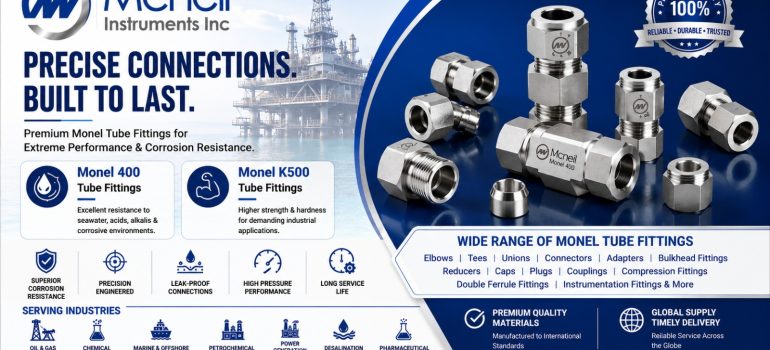
Monel is a family of nickel-copper alloys known for strong resistance to seawater, acids, alkaline environments and other aggressive media. Mcneil Instruments manufactures and supplies Monel 400 and Monel K500 Pipe Fittings for demanding industrial applications, including elbows, tees, reducers, couplings, crosses, caps, plugs and stub ends.
For industrial buyers in Turkey, understanding the differences between Monel 400 and Monel K500, their applications and selection criteria is essential when specifying fittings for corrosive and mechanically demanding piping systems.
Why Monel Pipe Fittings Are Important for Turkish Industries
Turkey has a diverse industrial infrastructure involving manufacturing, energy, chemicals, petrochemicals, marine operations, construction and process industries. Its coastal geography also makes corrosion-resistant materials particularly relevant for marine and offshore-related applications.
Pipe fittings are critical connection components in these systems. They change flow direction, join pipes, create branches, reduce pipe diameter and close piping sections.
When fittings are exposed to aggressive service conditions, material selection becomes particularly important.
Monel Pipe Fittings can provide:
Excellent seawater resistance
Strong resistance to chloride-containing environments
Resistance to acidic and alkaline media
Good mechanical strength
Resistance to corrosion-related degradation
Good performance in marine environments
High durability
Good fabrication characteristics
Long service life in suitable applications
Mcneil Instruments describes Monel fittings as nickel-copper alloy components intended for severe corrosion, temperature and mechanical-stress environments.
Monel Pipe Fittings are piping components manufactured from nickel-copper alloys and used to connect, redirect, branch, reduce or terminate piping systems.
Depending on the configuration, they can be used to:
Change the direction of fluid flow
Connect two pipes
Create branch connections
Transition between different pipe diameters
Close a piping section
Connect piping to other components
Provide specialized piping configurations
Monel fittings are particularly useful where corrosion resistance is a major consideration.
Mcneil Instruments offers Monel fittings in Monel 400 and Monel K500 grades for industrial applications.
Monel 400 Pipe Fittings for Corrosive Applications
Monel 400 Pipe Fittings are manufactured from a nickel-copper alloy known for its resistance to seawater, hydrofluoric acid, sulfuric acid and alkaline environments.
Mcneil Instruments identifies Monel 400 as UNS N04400 and publishes a composition of at least 63% nickel and up to 28% copper, with additional limits for iron, manganese and carbon.
Key Characteristics of Monel 400
Excellent fresh- and salt-water resistance
Good resistance to hydrofluoric acid
Good resistance to sulfuric acid
Resistance to neutral and alkaline solutions
Good mechanical strength
Good weldability
Good fabrication characteristics
Suitable performance at temperatures up to approximately 315°C according to Mcneil’s published product data
Typical Monel 400 Applications
Monel 400 fittings can be considered for:
Marine piping
Seawater systems
Heat exchangers
Chemical processing
Oil & gas systems
Refinery applications
Hydrocarbon processing
Pump and valve connections
Industrial piping systems
For Turkish industries operating near coastal and marine environments, Monel 400 can be particularly relevant where seawater and chloride exposure are important design considerations.
Monel K500 Pipe Fittings for Higher-Strength Applications
Monel K500 Pipe Fittings combine the corrosion resistance characteristics of Monel 400 with higher mechanical strength through precipitation hardening.
Mcneil Instruments identifies Monel K500 as UNS N05500 and lists aluminum and titanium additions that contribute to its increased strength.
Why Choose Monel K500?
Monel K500 offers:
High tensile strength
High yield strength
Excellent seawater resistance
Good performance in marine environments
Resistance to hydrocarbons
Improved wear resistance
Good mechanical durability
Suitability for demanding pump and valve components
Mcneil Instruments publishes a minimum tensile strength of 965 MPa and minimum yield strength of 585 MPa for its K500 pipe-fitting specifications.
Typical Monel K500 Applications
Monel K500 fittings can be considered for:
Offshore equipment
Marine systems
Seawater applications
Oil & gas equipment
Pump components
Valve components
High-strength piping assemblies
Chemical processing equipment
Where both corrosion resistance and higher mechanical strength are required, K500 may be selected instead of Monel 400 when the project specification supports it.
Monel 400 vs Monel K500 Pipe Fittings
Although Monel 400 and Monel K500 belong to the same nickel-copper alloy family, they are not identical materials.
Property
Monel 400
Monel K500
UNS
N04400
N05500
Alloy Type
Nickel-Copper
Precipitation-Hardening Nickel-Copper
Nickel
≥63%
~63%
Copper
≤28%
~28%
Aluminium
—
2.15–3.15%
Titanium
—
0.35–0.85%
Tensile Strength
550–750 MPa
≥965 MPa
Yield Strength
≥240 MPa
≥585 MPa
Elongation
≥30%
≥20%
Hardness
~200 HB
≤328 HB
Published Temperature Range
−200°C to +315°C
−196°C to +315°C
Typical Focus
Corrosion resistance and fabrication
Higher strength, wear resistance and corrosion resistance
The above figures are based on Mcneil Instruments’ published Monel pipe-fitting specifications.
Which Grade Should You Choose?
The correct grade depends on the actual service conditions.
Choose Monel 400 when:
Corrosion resistance is the primary consideration
The application involves seawater or acidic environments
Good ductility and fabrication are important
Moderate mechanical strength is sufficient
Choose Monel K500 when:
Higher tensile and yield strength are required
Wear resistance is important
The component is exposed to higher mechanical loads
Marine or hydrocarbon service requires a stronger nickel-copper alloy
The final material selection should always follow the engineering specification, design conditions and applicable standards.
Turkey’s energy infrastructure includes oil and gas processing, transportation and industrial facilities where piping components may encounter hydrocarbons, pressure and corrosive service conditions.
Monel fittings can be considered for selected applications involving:
Hydrocarbon processing
Refinery piping
Offshore equipment
Marine terminals
Pump systems
Valve assemblies
Seawater-related equipment
The choice between Monel 400 and K500 depends on the required combination of corrosion resistance, mechanical strength, temperature and service conditions.
Monel Fittings for Petrochemical Applications
Petrochemical plants require piping components capable of operating in complex process environments.
Fittings can be exposed to:
Hydrocarbons
Process chemicals
Elevated temperatures
Pressure fluctuations
Corrosive compounds
Mechanical loads
Monel Pipe Fittings can be considered for applications where nickel-copper alloy construction provides an appropriate corrosion-resistance advantage.
Potential applications include:
Process piping
Heat exchangers
Chemical transfer lines
Pumps
Valves
Process equipment connections
Monel Pipe Fittings for Chemical Processing
Chemical-processing environments can be particularly demanding because material compatibility depends heavily on the chemical composition, concentration, temperature and pressure of the process fluid.
Monel 400 is known for resistance to several acidic and alkaline environments, including hydrofluoric acid and sulfuric acid, according to Mcneil Instruments’ product information.
This makes Monel fittings a potential choice for selected chemical-processing applications.
However, material selection should always be verified against the specific chemical service rather than assuming that Monel is suitable for every chemical.
Selecting a Monel fitting requires more than choosing between 400 and K500.
1. Identify the Process Fluid
Determine exactly what the fitting will carry.
Consider:
Chemical composition
Concentration
pH
Chloride content
Water content
Hydrocarbon content
2. Determine Operating Temperature
Temperature affects material performance and should be evaluated together with pressure and process chemistry.
Mcneil Instruments lists an operating range extending to approximately 315°C for both Monel 400 and K500 in its published product specifications.
3. Determine Operating Pressure
The fitting must be appropriate for the piping-system pressure.
Pressure class, wall thickness, fitting design and connection configuration should all be considered.
4. Choose the Alloy
Select Monel 400 or Monel K500 according to the required combination of corrosion resistance, strength, wear resistance and fabrication characteristics.
5. Select the Fitting Type
Determine whether the piping system requires:
Elbows
Tees
Crosses
Reducers
Couplings
Unions
Caps
Plugs
Stub ends
6. Confirm Dimensions
Important dimensional considerations include:
Nominal pipe size
Outside diameter
Wall thickness
End connection
Fitting dimensions
Radius
Overall length
7. Verify Applicable Standards
The fitting should be supplied according to the standard specified for the project.
Mcneil Instruments’ published Monel information references ASTM, ASME, MSS, ISO and DIN requirements across its Monel fitting information.
8. Review Quality Documentation
For industrial projects, buyers may require documentation such as:
Material Test Certificates
Chemical analysis
Mechanical test results
Dimensional inspection
PMI
NDT reports
Heat-treatment records where applicable
Traceability documentation
Documentation requirements should be established before procurement.
What Makes Monel Different from Stainless Steel Pipe Fittings?
Stainless steel and Monel are not interchangeable materials.
Stainless steel can provide excellent corrosion resistance across many industrial applications, but Monel’s nickel-copper composition can provide advantages in selected seawater, chloride, acidic and alkaline environments.
Monel can therefore be considered when the service environment is particularly aggressive and the engineering specification calls for a nickel-copper alloy.
The decision should be based on actual corrosion data, operating conditions, design requirements and lifecycle considerations rather than simply choosing the more expensive alloy.
Why Monel Pipe Fittings Can Be Valuable in Corrosive Environments
The primary reason for selecting Monel is its combination of corrosion resistance and mechanical performance.
Corrosion Resistance
Monel alloys are known for resistance to seawater and various acidic and alkaline environments.
Mechanical Strength
Monel 400 provides useful mechanical strength, while K500 offers substantially higher tensile and yield strength according to Mcneil’s published specifications.
Marine Performance
Monel is well suited to selected marine applications involving seawater and salt exposure.
Durability
Appropriate material selection can help extend component service life and reduce premature replacement in corrosive systems.
Versatility
Monel fittings are available in several configurations, allowing them to be incorporated into different piping arrangements.
Mcneil Instruments manufactures, supplies and exports Monel Pipe Fittings in Monel 400 and Monel K500 grades.
Its product range includes:
Monel Elbows
Monel Tees
Monel Crosses
Monel Reducers
Monel Couplings
Monel Unions
Monel Caps
Monel Plugs
Monel Stub Ends
The company identifies applications across marine, oil & gas, chemical processing and power-generation industries.
For Turkish industrial projects, Mcneil Instruments also maintains a dedicated pipe-fittings presence covering major industrial areas and markets in Turkey. Its Turkey-focused information highlights applications across industrial and infrastructure projects and identifies cities and industrial zones including Istanbul, Kocaeli, Bursa, Sakarya and Ankara.
Related Mcneil Instruments Products
For projects requiring other corrosion-resistant piping components, buyers can also explore Mcneil Instruments’ related:
Monel Tube Fittings
Inconel Pipe Fittings
Hastelloy Pipe Fittings
Stainless Steel Pipe Fittings
Carbon Steel Pipe Fittings
Titanium Pipe Fittings
These materials can be selected according to the specific corrosion, temperature, pressure and mechanical requirements of the application.
When sourcing Monel fittings for Turkey, buyers should evaluate more than price and availability.
Material Verification
Confirm the specified Monel grade and heat/lot traceability.
Dimensional Accuracy
Fittings should conform to the specified dimensional requirements for proper fit-up.
Surface Condition
The surface should be suitable for the intended service and free from unacceptable defects.
Mechanical Properties
Verify that tensile strength, yield strength and elongation meet the applicable specification.
Testing
Depending on the project, testing may include chemical, mechanical, dimensional and non-destructive examinations.
Certification
Request appropriate material and quality documentation before dispatch.
Packaging
Monel fittings should be appropriately protected during storage and transportation to prevent damage and contamination.
Frequently Asked Questions About Monel Pipe Fittings in Turkey
What are Monel Pipe Fittings used for?
Monel Pipe Fittings are used to connect, redirect, branch, reduce or terminate piping systems in applications requiring strong corrosion resistance. Typical industries include marine, oil & gas, chemical processing and power generation.
Which Monel grades does Mcneil Instruments supply?
Mcneil Instruments’ published Monel Pipe Fittings range includes Monel 400 and Monel K500.
What is Monel 400?
Monel 400 is a nickel-copper alloy identified as UNS N04400. Mcneil Instruments publishes it with at least 63% nickel and up to 28% copper and highlights its resistance to seawater, hydrofluoric acid, sulfuric acid and alkaline environments.
What is Monel K500?
Monel K500 is a precipitation-hardening nickel-copper alloy identified as UNS N05500. It combines corrosion resistance with higher mechanical strength than Monel 400.
What is the difference between Monel 400 and K500?
Monel 400 is primarily valued for corrosion resistance, ductility and fabrication characteristics, while K500 provides significantly higher tensile and yield strength along with corrosion resistance.
Are Monel fittings suitable for seawater?
Yes. Monel 400 and K500 are used in selected seawater and marine applications because of their corrosion resistance. Mcneil Instruments specifically identifies seawater and marine environments among their applications.
Can Monel pipe fittings be welded?
Monel 400 has good weldability according to Mcneil Instruments. Welding procedures should nevertheless be selected according to the specific alloy, fitting design and applicable welding specification.
Mcneil Instruments states that custom fabrication and sizing can be provided to match specific project requirements.
Where are Monel fittings used in Turkey?
Potential Turkish applications include marine and shipbuilding facilities, oil & gas operations, petrochemical plants, chemical-processing facilities, power generation and other industrial piping systems where corrosion resistance is important.
How should I select Monel 400 or K500?
Evaluate the process medium, temperature, pressure, corrosion conditions, mechanical loads, wear requirements, fitting configuration and applicable material specification. Monel K500 should be considered when the higher mechanical strength of the precipitation-hardened alloy is required.
Conclusion
Monel Pipe Fittings in Turkey can provide a reliable material option for industrial piping systems exposed to seawater, chlorides, chemicals, hydrocarbons and other demanding service conditions.
The two principal grades offered by Mcneil Instruments—Monel 400 and Monel K500—serve different engineering requirements. Monel 400 offers a strong combination of corrosion resistance, mechanical properties and fabrication characteristics, while Monel K500 provides substantially higher tensile and yield strength while retaining the corrosion-resistant characteristics associated with the nickel-copper alloy family.
For Turkey’s marine, oil & gas, petrochemical, chemical, power and industrial sectors, the correct fitting should be selected based on the actual operating environment rather than material cost alone.
Mcneil Instruments provides Monel elbows, tees, crosses, reducers, couplings, unions, caps, plugs and stub ends, supporting industrial piping requirements with Monel 400 and K500 grades.
Carbon Steel Pipe Fittings in Turkey are widely used across industrial piping, oil and gas, petrochemical, power generation, construction, water treatment, marine, and process industries. These fittings connect pipes, change flow direction, create branches, reduce pipe sizes, and terminate piping systems while providing the mechanical strength required for demanding service conditions. Mcneil Instruments manufactures and supplies Carbon Steel Pipe Fittings in Turkey in different configurations, sizes, grades, and connection types for industrial and process piping applications. Its product range includes elbows, tees, reducers, crosses, couplings, unions, caps, plugs, stub ends, and other fittings. For Turkish EPC contractors, engineering companies, distributors, and industrial buyers, selecting the appropriate carbon steel fitting requires consideration of material grade, pipe size, wall thickness, pressure, temperature, process fluid, connection type, and applicable ASTM/ASME standards.
Carbon Steel Pipe Fittings are piping components manufactured from carbon steel and used to connect and modify sections of a piping system. Depending on their design, they can be used to: Change the direction of flow Connect multiple pipes Reduce or increase pipe diameter Close pipeline ends Connect equipment to piping Facilitate maintenance Create branch connections Common carbon steel pipe fittings include: Elbows Tees Crosses Reducers Couplings Unions Caps Plugs Stub Ends Nipples Adapters Mcneil Instruments’ carbon steel fitting range is designed for industrial piping systems requiring strength, dimensional accuracy, and dependable service.
Why Carbon Steel Pipe Fittings Are Important for Turkish Industries
Turkey has a diverse industrial base covering energy, manufacturing, construction, petrochemicals, marine, infrastructure, and process industries. This creates demand for reliable piping components capable of handling different pressure, temperature, and fluid conditions. Carbon steel is often selected because it offers a practical combination of: Mechanical strength Weldability Fabrication flexibility Durability Cost efficiency Availability Pressure-handling capability However, carbon steel is not suitable for every environment. Where corrosion resistance or extreme temperature performance is required, engineers may specify stainless steel, alloy steel, or specialty alloys instead.
Carbon Steel Pipe Fitting Grades
The appropriate grade depends on the application and service conditions. Mcneil Instruments’ carbon steel product range includes commonly specified materials such as ASTM A234 WPB, ASTM A105, and ASTM A350 LF2, while its broader ASTM pipe-fitting range also includes elevated-temperature grades such as WP11, WP22, and WP91.
ASTM A234 WPB Pipe Fittings
ASTM A234 WPB Pipe Fittings are widely used wrought carbon steel fittings for pressure piping and moderate-to-high-temperature service. Typical applications include: Oil and gas piping Refineries Power plants Petrochemical facilities Process piping Industrial pipelines Mcneil’s published specifications identify ASTM A234 WPB / ASME SA234, with carbon content up to 0.30%, tensile strength of at least 415 MPa, and yield strength of at least 240 MPa. Related Mcneil product: Carbon Steel ASTM A234 WPB Pipe Fittings
ASTM A105 Carbon Steel Fittings
ASTM A105 Pipe Fittings are forged carbon steel components used for high-pressure and elevated-temperature applications. They are suitable for applications involving: Pressure piping Valve connections Oil and gas systems Power plants Industrial equipment Mcneil Instruments publishes ASTM A105 / ASME SA105 fittings with a stated temperature range up to approximately 500°C, subject to the specific application and design requirements. Related Mcneil product: Carbon Steel ASTM A105 Pipe Fittings
Types of Carbon Steel Pipe Fittings
Choosing the right fitting configuration is just as important as choosing the correct material.
Carbon Steel Elbows
Carbon Steel Elbows are used to change the direction of flow. Common configurations include: 45° elbows 90° elbows 180° elbows Long-radius elbows Short-radius elbows They are widely used in industrial piping where directional changes are required.
Carbon Steel Tees
A Carbon Steel Tee provides a branch connection between three sections of piping. They can be used for: Flow distribution Process branching Utility lines Industrial piping Chemical systems Equal and reducing tee configurations can be selected according to the pipe arrangement.
Carbon Steel Crosses
Carbon Steel Cross Fittings provide four connection points and are used where multiple branches are required from a central piping location. They can be useful in complex piping networks and distribution systems.
Carbon Steel Reducers
Carbon Steel Reducers connect pipes of different diameters. Two common configurations are: Concentric Reducer The centerlines remain aligned, providing a symmetrical transition. Eccentric Reducer The centerlines are offset. These reducers can be useful in specific horizontal piping arrangements where maintaining a desired flow or avoiding unwanted pockets is important.
Carbon Steel Couplings & Unions
Carbon Steel Couplings join sections of piping, while unions allow easier disconnection where maintenance or equipment removal is required. These components can be used in industrial and utility piping systems according to the applicable connection design.
Carbon Steel Caps & Plugs
Caps and plugs are used to close pipe ends. They may be installed for: Permanent pipe termination Temporary closure Maintenance Pipeline isolation Future expansion points
Carbon Steel Stub Ends
Carbon Steel Stub Ends are commonly used with lap-joint flange arrangements. They can simplify maintenance where piping sections need to be periodically dismantled.
Carbon Steel Pipe Fittings for Oil & Gas in Turkey
Turkey’s energy infrastructure creates applications for carbon steel fittings in suitable oil and gas pipelines, processing facilities, storage systems, and associated piping infrastructure. Applications can include: Process piping Hydrocarbon transportation Refinery systems Storage facilities Utility piping Pressure systems For corrosive fluids or demanding environments, the engineering team should verify whether carbon steel provides sufficient corrosion resistance or whether another material is required.
Carbon Steel Pipe Fittings for Petrochemical Plants
Petrochemical facilities require extensive networks of interconnected process piping. Carbon steel pipe fittings for petrochemical applications may be used in suitable: Process lines Utility systems Steam systems Hydrocarbon lines Storage systems Equipment connections The fitting grade should be selected according to pressure, temperature, chemical compatibility, and project specifications.
Carbon Steel Fittings for Power Plants in Turkey
Power-generation facilities use piping systems for steam, water, fuel, cooling, compressed air, and other utilities. Carbon steel fittings may be suitable for selected systems where the temperature and pressure fall within the material’s design requirements. For higher-temperature steam applications, alloy steel fittings may be specified instead. Related Mcneil product: Alloy Steel Pipe Fittings
Carbon Steel Pipe Fittings for Chemical Industries
Chemical plants can involve elevated temperatures, pressure, and potentially corrosive process media. Carbon steel fittings can be suitable for compatible applications, but material selection should always consider: Chemical composition Process temperature Operating pressure Corrosion rate Fluid concentration External environmental conditions For highly corrosive applications, stainless steel or nickel-alloy fittings may be more appropriate.
Carbon Steel Fittings for Construction & Infrastructure
Carbon steel fittings are also used in suitable: Industrial construction Utility networks Heating systems Water infrastructure Fire-protection systems Mechanical piping Building services The required fitting grade and connection type depend on the project design and applicable construction standards.
Carbon Steel Pipe Fittings for Marine Applications
Turkey has an established maritime and shipbuilding sector, creating demand for engineered piping components. Carbon steel fittings can be considered for suitable: Marine piping Utility systems Machinery systems Exhaust systems Cooling systems Shipbuilding projects For seawater or highly corrosive environments, however, corrosion-resistant materials should be evaluated.
Carbon Steel Pipe Fittings for Water Treatment
Carbon steel fittings can be used in suitable water and utility systems where corrosion protection and material compatibility are adequately addressed. Potential applications include: Water distribution Industrial water systems Utility piping Treatment facilities Pump connections Process-water systems Water chemistry and corrosion protection should be considered before specifying carbon steel.
Carbon Steel Pipe Fittings Specifications
Depending on the product and project, specifications can include: Parameter Typical Requirement Material Carbon Steel Common Grades ASTM A234 WPB, ASTM A105, ASTM A350 LF2 Manufacturing Forged / Welded / Seamless depending on product Fitting Types Elbows, Tees, Reducers, Caps, Crosses, etc. Connection Butt Weld / Socket Weld / Threaded Size Project dependent Wall Thickness Schedule dependent Standards ASTM / ASME / applicable project standards Testing According to specification Certification MTC / inspection documentation as required Exact dimensions, pressure ratings, schedules, testing requirements, and manufacturing methods should be confirmed for the specific fitting and purchase order. Mcneil’s published product information gives different specifications across its carbon steel fitting ranges.
How to Select Carbon Steel Pipe Fittings for a Turkish Project
Selecting a fitting based only on pipe diameter is not enough.
Identify the Material Grade Confirm whether the project requires: ASTM A234 WPB ASTM A105 ASTM A350 LF2 Another specified grade
Check Pipe Size The fitting must match the pipe’s nominal size and outside diameter.
Confirm Wall Thickness The fitting should be compatible with the pipe schedule and wall thickness.
Determine Pressure Check both operating and design pressure.
Evaluate Temperature The material must maintain suitable performance at the required operating temperature.
Consider the Process Fluid Evaluate whether the system carries: Oil Gas Water Steam Chemicals Hydrocarbons Other process fluids
Select the Connection Depending on the application, specify: Butt weld Socket weld Threaded Flanged
Consider Corrosion Carbon steel may require coatings, corrosion-control measures, or alternative materials in aggressive environments.
Carbon Steel vs Stainless Steel Pipe Fittings
Carbon steel is often selected for strength and cost efficiency, while stainless steel is generally preferred where greater corrosion resistance is required. Factor Carbon Steel Stainless Steel Strength High High Corrosion Resistance Moderate High Cost Generally lower Generally higher Weldability Good Grade dependent High-Temperature Service Grade dependent Grade dependent Typical Uses Oil, gas, construction, utilities Chemical, food, marine, corrosive services For applications requiring stainless steel, Mcneil Instruments also supplies Stainless Steel Pipe Fittings in grades and configurations suited to industrial applications.
Carbon Steel vs Alloy Steel Pipe Fittings
For higher-temperature and high-pressure applications, alloy steel may provide advantages over conventional carbon steel. Mcneil Instruments offers alloy steel grades including WP11, WP22, and WP91 in its broader ASTM fitting range. Related product: Alloy Steel Pipe Fittings This makes it possible to select a fitting material based on the actual operating conditions rather than using carbon steel for every application.
Mcneil Instruments supplies carbon steel pipe fittings for international industrial applications and specifically publishes Turkey-focused information covering sectors such as oil & gas, petrochemical, power generation, chemical processing, construction, marine, and water treatment. Key considerations when sourcing from Mcneil Instruments include: Carbon steel material options Multiple fitting configurations International ASTM and ASME specifications Dimensional accuracy Custom specifications Export packaging Technical documentation Global supply capabilities For Turkish projects, buyers can specify the required material grade, size, schedule, fitting type, connection, quantity, testing, and certification.
Building a Reliable Industrial Piping System
A piping system is made up of more than pipes and fittings. A complete industrial system may require: Pipes → Pipe Fittings → Flanges → Valves → Instrumentation → Supporting Components Each component must be compatible with the design conditions. For example, a system using carbon steel piping may also require Carbon Steel Flanges, suitable valves, and compatible instrumentation. For high-temperature applications, engineers may instead combine alloy steel pipes and fittings with appropriately rated valves and flanges.
Why Quality Matters in Carbon Steel Pipe Fittings
A pipe fitting may be a relatively small component compared with the overall pipeline, but its performance can affect the reliability of the entire system. Important quality factors include: Dimensional Accuracy Correct dimensions help ensure proper alignment and installation. Material Traceability Material documentation helps verify that the supplied fitting corresponds to the specified grade. Surface Quality Proper surface condition helps identify manufacturing defects and supports reliable installation. Testing Testing requirements should be established according to the applicable product standard and project specification. Documentation Industrial projects may require material certificates, inspection reports, test reports, and other documentation.
Conclusion
Carbon Steel Pipe Fittings in Turkey remain an important choice for industrial piping systems because they combine strength, fabrication flexibility, durability, and cost efficiency. From ASTM A234 WPB elbows and tees to ASTM A105 forged fittings, the correct product should always be selected according to the project’s pressure, temperature, pipe dimensions, process medium, connection type, corrosion conditions, and applicable standards. For demanding high-temperature services, engineers can consider suitable alloy steel grades, while corrosive applications may require stainless steel or specialty alloys. Mcneil Instruments supplies carbon steel pipe fittings for Turkey across industrial applications including oil & gas, petrochemical, power generation, chemical processing, construction, marine, and water treatment, providing multiple fitting configurations and material options for project-specific requirements.
Frequently Asked Questions
What are carbon steel pipe fittings used for? Carbon steel pipe fittings connect, redirect, branch, reduce, or terminate piping systems. They are used in suitable oil & gas, petrochemical, power, construction, water, marine, and industrial applications. Which carbon steel grades are commonly used for pipe fittings? Common grades include ASTM A234 WPB, ASTM A105, and ASTM A350 LF2. Other alloyed fitting grades such as WP11, WP22, and WP91 are used for more demanding elevated-temperature applications. What is ASTM A234 WPB? ASTM A234 WPB is a wrought carbon steel specification commonly used for pressure-piping fittings. It provides a combination of strength, weldability, and suitability for moderate-to-high-temperature service. Are carbon steel pipe fittings suitable for Turkish industries? Yes, carbon steel fittings can be suitable for many Turkish industrial applications when correctly selected for pressure, temperature, process fluid, corrosion conditions, and applicable standards. Relevant sectors include oil & gas, petrochemical, power, chemical, construction, marine, and water treatment. What types of carbon steel pipe fittings are available? Common types include elbows, tees, crosses, reducers, couplings, unions, caps, plugs, stub ends, adapters, and nipples. Can Mcneil Instruments supply carbon steel fittings in Turkey? Mcneil Instruments publishes Turkey-focused pipe-fitting information and identifies Turkey among its export markets.
Monel Tube Fittings are widely used in industrial instrumentation and fluid-handling systems where high corrosion resistance, mechanical strength, and reliable performance are required. In Nigeria, these fittings are particularly relevant to coastal oil & gas facilities, water treatment stations, marine systems, chemical processing plants, and offshore applications where chloride-rich environments can create severe corrosion challenges. Mcneil Instruments supplies Monel 400 and Monel K500 Tube Fittings in Nigeria for demanding instrumentation and process applications.
Monel tube fittings are precision-engineered components manufactured from nickel-copper alloys. They are designed to provide secure connections between instrumentation tubing and process systems while offering strong resistance to corrosive environments. Mcneil Instruments offers Monel 400 Tube Fittings and Monel K500 Tube Fittings, with applications including offshore systems, chemical processing, cryogenic pipelines, oil & gas installations, instrumentation, and high-pressure tubing.
Monel 400 Tube Fittings in Nigeria
Monel 400 Tube Fittings are manufactured from UNS N04400 nickel-copper alloy and are known for their corrosion resistance and mechanical strength. According to Mcneil Instruments, Monel 400 offers resistance to seawater, hydrofluoric acid, and sulfuric acid, while maintaining useful strength across cryogenic and elevated-temperature applications. Key Properties of Monel 400 Excellent seawater resistance Strong corrosion resistance Good mechanical strength Good ductility Good weldability Suitable for cryogenic applications Suitable for elevated-temperature service Long-term durability in demanding environments Applications in Nigeria Monel 400 tube fittings can be used in: Coastal oil & gas facilities Offshore platforms Marine systems Water treatment plants Desalination systems Chemical processing Heat exchangers Instrumentation systems Oil & gas pipelines Mcneil specifically identifies coastal oil & gas fields and water treatment stations in Nigeria as applications for its Monel tube fittings.
Monel K500 Tube Fittings in Nigeria
Monel K500 Tube Fittings, manufactured from UNS N05500, provide higher strength and hardness than Monel 400 while retaining strong corrosion resistance. Mcneil Instruments states that Monel K500 uses precipitation hardening to achieve enhanced mechanical performance and is suitable for applications involving mechanical loads and high-pressure tubing. Advantages of Monel K500 Higher tensile strength Higher yield strength Improved hardness Excellent wear resistance Strong corrosion resistance Good fatigue performance Suitable for high-pressure tubing Suitable for saline and hydrocarbon environments Monel K500 Applications Typical applications include: Oilfield equipment Offshore oil & gas Marine equipment Pump components Valve bodies Instrumentation systems High-pressure hydraulic tubing Desalination systems Chemical processing
Monel 400 vs Monel K500 Tube Fittings
Property Monel 400 Monel K500 UNS N04400 N05500 Main Advantage Corrosion resistance Higher strength + corrosion resistance Tensile Strength 550–750 MPa ≥965 MPa Yield Strength ≥240 MPa ≥585 MPa Elongation ≥30% ≥20% Hardness ~200 HB ≤328 HB Temperature Range −200°C to +315°C −196°C to +315°C Typical Applications Marine, chemical, heat exchangers Oilfield, high-pressure tubing, marine equipment The values above reflect the specifications published on Mcneil Instruments’ product page.
Monel Tube Fittings for Oil & Gas Industry in Nigeria
Nigeria’s oil & gas industry includes both onshore and coastal operations where equipment can be exposed to saltwater, moisture, hydrocarbons, chemicals, and demanding operating conditions. Monel tube fittings can be used for suitable: Instrumentation tubing Hydraulic systems Process control systems Oilfield equipment Offshore platforms Chemical injection systems High-pressure tubing Process measurement systems For coastal facilities, Monel’s resistance to chloride-containing environments can make it a suitable material option where the process and engineering specifications call for it. Mcneil specifically identifies Nigerian coastal oil & gas fields as an application for its Monel tube fittings.
Monel Tube Fittings for Water Treatment in Nigeria
Water treatment facilities can expose metal components to moisture, chlorides, chemicals, and other corrosive conditions. Monel 400 and Monel K500 tube fittings can be considered for suitable instrumentation and fluid-control applications where material compatibility has been established. Applications may include: Water treatment instrumentation Seawater systems Desalination equipment Process control tubing Pump systems High-pressure fluid systems Mcneil Instruments specifically lists water treatment stations in Nigeria among the applications it serves with Monel tube fittings.
Monel Tube Fittings for Offshore Applications
Offshore systems require materials capable of handling demanding marine environments. Monel tube fittings can be used in suitable: Offshore platforms Marine manifolds Seawater systems Hydraulic systems Instrumentation systems Oilfield equipment Process control systems Monel 400 is particularly known for seawater corrosion resistance, while Monel K500 provides additional strength for applications subject to higher mechanical loads.
Types of Monel Tube Fittings
Mcneil Instruments supplies a broad range of instrumentation tube fitting configurations. Its tube fitting range includes products such as: Straight Unions Union Elbows Union Tees Union Crosses Reducing Unions Reducing Tees Bulkhead Unions Bulkhead Elbows NPT Connectors Male Connectors Male Elbows Male Bulkhead Connectors Male Branch Tees The exact configuration should be selected according to tube dimensions, connection requirements, pressure rating, and project specifications.
Monel Compression Tube Fittings
Monel Compression Tube Fittings provide mechanical connections for instrumentation and fluid-control tubing without requiring conventional welding. They can be used in: Instrumentation systems Hydraulic tubing Pneumatic systems Process control Oil & gas equipment High-pressure fluid systems Mcneil Instruments describes its Monel tube fittings as precision-engineered compression fittings designed for instrumentation, hydraulic, pneumatic, and process-control applications.
Technical Specifications of Monel 400 Tube Fittings
According to Mcneil Instruments: Parameter Monel 400 UNS N04400 Nickel ≥63% Copper ≤28% Iron ≤2.5% Manganese ≤2% Carbon ≤0.3% Tensile Strength 550–750 MPa Yield Strength ≥240 MPa Elongation ≥30% Hardness ~200 HB Standards ASTM B163 / ASME SB163, B171 Operating Range −200°C to +315°C
Technical Specifications of Monel K500 Tube Fittings
Parameter Monel K500 UNS N05500 Nickel ~63% Copper ~28% Aluminium 2.15–3.15% Titanium 0.35–0.85% Iron ≤2% Tensile Strength ≥965 MPa Yield Strength ≥585 MPa Elongation ≥20% Hardness ≤328 HB Standard ASTM B164 / ASME SB164 Operating Range −196°C to +315°C
How to Select Monel Tube Fittings in Nigeria
Before ordering Monel tube fittings in Nigeria, consider the following:
Material Grade Choose between Monel 400 and Monel K500 according to corrosion, strength, wear, and mechanical requirements.
Tube Size Confirm the outside diameter and wall thickness of the tubing.
Connection Type Specify the required connection, such as NPT or another applicable thread configuration.
Pressure Confirm the system’s operating and design pressure.
Temperature Check normal and maximum operating temperatures.
Process Medium Consider whether the fittings will handle: Seawater Hydrocarbons Chemicals Hydraulic fluids Gas Process fluids
Corrosion Conditions Evaluate chloride exposure, seawater, acids, alkalis, and other corrosive media.
Standards and Certification Confirm the required ASTM, ASME, project, EPC, inspection, and material certification requirements.
Mcneil Instruments supplies Monel 400 and Monel K500 Tube Fittings for demanding industrial applications and specifically identifies Nigeria as an export market serving coastal oil & gas fields and water treatment stations. The product range is positioned around: Precision-machined fittings Corrosion resistance Dimensional accuracy Leak-resistant connections High-pressure applications Instrumentation systems International export support Custom manufacturing capabilities Mcneil Instruments also states that customized tube fittings can be manufactured according to customer drawings, tube sizes, specifications, and thread configurations.
Conclusion
Monel Tube Fittings in Nigeria are suitable for demanding instrumentation and fluid-control applications where corrosion resistance, mechanical strength, and reliable connections are essential. Monel 400 Tube Fittings are particularly suited to corrosive and marine environments, while Monel K500 Tube Fittings offer higher strength and hardness for applications involving greater mechanical loads. For Nigerian oil & gas, offshore, marine, water treatment, chemical processing, and instrumentation applications, Mcneil Instruments supplies Monel 400 and K500 tube fittings according to required material, dimensions, connection configuration, and project specifications.
Frequently Asked Questions
What are Monel Tube Fittings? Monel tube fittings are nickel-copper alloy fittings designed for connecting tubing in instrumentation, hydraulic, pneumatic, and process-control systems. Which Monel grades are available? Mcneil Instruments supplies Monel 400 (UNS N04400) and Monel K500 (UNS N05500) tube fittings. What are Monel 400 Tube Fittings used for? They are used in suitable marine, offshore, chemical processing, desalination, heat exchanger, oil & gas, and instrumentation applications. What is the advantage of Monel K500? Monel K500 provides higher strength, hardness, and wear resistance than Monel 400 while retaining strong corrosion resistance. Are Monel Tube Fittings suitable for Nigerian oil & gas applications? Yes. Mcneil Instruments specifically identifies coastal oil & gas fields in Nigeria as an application for its Monel tube fittings. Are Monel fittings suitable for water treatment plants? They can be used for suitable water treatment and seawater applications where the material is compatible with the actual service conditions. Mcneil identifies water treatment stations in Nigeria among its application markets. Can Mcneil Instruments manufacture customized Monel tube fittings? Yes. Mcneil Instruments states that custom fittings can be manufactured according to customer drawings, tube sizes, specifications, and thread configurations.
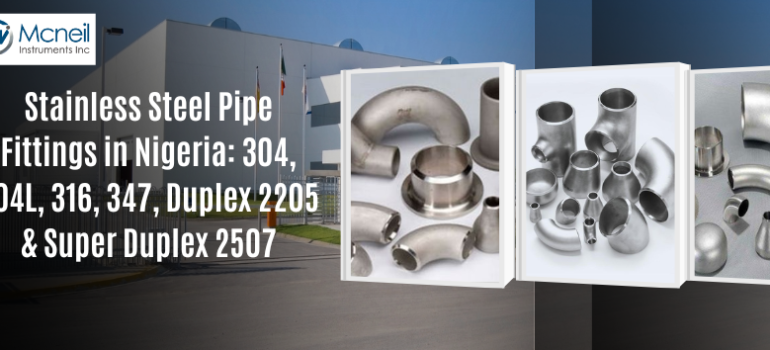
Stainless steel pipe fittings are essential components in industrial piping systems where reliable connections, corrosion resistance, mechanical strength, and long service life are required. In industries across Nigeria, including oil & gas, petrochemical, chemical processing, power generation, marine, water treatment, and food processing, the choice of fitting material can have a direct impact on system performance.
Different operating environments require different stainless steel grades. SS 304, SS 304L, SS 316, SS 347, Duplex 2205, and Super Duplex 2507 pipe fittings offer different combinations of corrosion resistance, strength, temperature capability, and resistance to specific process environments.
Mcneil Instruments supplies stainless steel and duplex pipe fittings for industrial applications, with material selection based on project specifications and operating conditions.
What Are Stainless Steel Pipe Fittings?
Stainless steel pipe fittings are components used to connect, redirect, branch, reduce, or terminate piping systems.
Common stainless steel fittings include:
Elbows
Tees
Reducers
Crosses
Couplings
Unions
Caps
Stub ends
Bends
Nipples
Bushings
Depending on the application, fittings can be supplied in different connection configurations, dimensions, pressure classes, and manufacturing standards.
For Nigerian industrial projects, the appropriate stainless steel grade should be selected according to the process medium, temperature, pressure, corrosion conditions, and applicable project standards.
Stainless Steel 304 Pipe Fittings in Nigeria
Stainless Steel 304 Pipe Fittings are among the most widely used stainless steel fittings for general industrial applications.
SS 304 contains chromium and nickel, providing good corrosion resistance and mechanical performance for a broad range of environments.
Applications of SS 304 Pipe Fittings
SS 304 fittings can be used in:
Food processing plants
Water treatment systems
General chemical processing
Pharmaceutical facilities
Industrial piping
Architectural applications
General process equipment
Benefits of SS 304 Fittings
Good general corrosion resistance
Good mechanical strength
Excellent fabrication characteristics
Good weldability
Easy availability
Suitable for a wide range of industrial applications
SS 304 is often considered when the operating environment does not require the additional corrosion resistance of higher-alloy grades.
Stainless Steel 304L Pipe Fittings in Nigeria
SS 304L Pipe Fittings are the low-carbon version of 304 stainless steel.
The lower carbon content makes 304L particularly useful for welded piping systems because it reduces the risk of carbide precipitation during welding.
Applications
304L pipe fittings are commonly used in:
Process piping
Chemical plants
Food processing
Pharmaceutical industries
Water treatment
Welded stainless steel piping systems
Why Choose 304L?
Key advantages include:
Good corrosion resistance
Excellent weldability
Reduced risk of sensitization after welding
Good mechanical properties
Suitable for fabricated piping systems
For Nigerian projects involving extensive welding, SS 304L can be an appropriate alternative to standard 304 when specified by the engineering design.
Stainless Steel 316 Pipe Fittings in Nigeria
Stainless Steel 316 Pipe Fittings are widely selected when greater corrosion resistance is required.
The presence of molybdenum improves resistance to localized corrosion, particularly in environments containing chlorides.
Applications of SS 316 Fittings
SS 316 pipe fittings are commonly used in:
Oil & gas facilities
Petrochemical plants
Chemical processing
Marine environments
Coastal installations
Pharmaceutical plants
Water treatment systems
Process piping
Advantages of SS 316
Improved corrosion resistance compared with 304
Better resistance to pitting
Good resistance to chloride-containing environments
Good mechanical strength
Excellent weldability
Suitable for demanding industrial applications
For coastal and marine environments in Nigeria, SS 316 may be preferred where chloride exposure is an important design consideration.
Stainless Steel 347 Pipe Fittings in Nigeria
Stainless Steel 347 Pipe Fittings are stabilized austenitic stainless steel fittings designed for applications involving elevated temperatures.
The addition of niobium helps stabilize the material against chromium carbide precipitation.
Applications of SS 347 Fittings
SS 347 fittings can be used in:
High-temperature process piping
Petrochemical plants
Refineries
Heat exchangers
Boiler systems
Exhaust systems
High-temperature industrial equipment
Benefits
Good high-temperature performance
Good oxidation resistance
Suitable for elevated-temperature applications
Good resistance to intergranular corrosion after welding
Good mechanical stability
SS 347 should be considered where elevated temperature and welding conditions make a stabilized stainless steel grade appropriate.
Duplex 2205 Pipe Fittings in Nigeria
Duplex 2205 Pipe Fittings combine characteristics of austenitic and ferritic stainless steels.
Duplex 2205 provides higher strength than conventional austenitic stainless steels and offers strong resistance to several forms of corrosion.
Applications of Duplex 2205 Fittings
Duplex 2205 fittings are commonly used in:
Oil & gas
Offshore facilities
Petrochemical plants
Chemical processing
Desalination plants
Water treatment
Marine applications
High-pressure piping systems
Advantages of Duplex 2205
High mechanical strength
Excellent resistance to chloride stress corrosion cracking
Good pitting resistance
Good corrosion resistance
Suitable for demanding pressure applications
Reduced material thickness may be possible in some designs because of its higher strength
Duplex 2205 is particularly useful when an application requires a combination of high strength and corrosion resistance.
Super Duplex 2507 Pipe Fittings in Nigeria
Super Duplex 2507 Pipe Fittings provide an even higher level of corrosion resistance and strength than standard duplex grades.
Super Duplex 2507 is designed for demanding environments where severe corrosion, chloride exposure, and high mechanical loads are concerns.
Applications of Super Duplex 2507 Fittings
These fittings can be used in:
Offshore oil & gas
Marine applications
Desalination plants
Chemical processing
Petrochemical facilities
Seawater systems
High-pressure process piping
Aggressive chloride environments
Benefits of Super Duplex 2507
Very high mechanical strength
Excellent chloride corrosion resistance
Strong pitting and crevice corrosion resistance
Excellent resistance to stress corrosion cracking
Suitable for demanding marine and offshore environments
For Nigerian offshore and coastal projects, Super Duplex 2507 may be considered where environmental and process conditions exceed the capabilities of conventional stainless steel grades.
SS 304 vs 304L vs 316 vs 347 vs Duplex 2205 vs Super Duplex 2507
Grade
Main Advantage
Typical Applications
SS 304
General corrosion resistance
Food, water, general industrial
SS 304L
Low-carbon, excellent weldability
Welded process piping
SS 316
Improved chloride and pitting resistance
Oil & gas, marine, chemical
SS 347
High-temperature stability
Refineries, heat exchangers, process systems
Duplex 2205
High strength + corrosion resistance
Offshore, oil & gas, chemical
Super Duplex 2507
Very high corrosion resistance and strength
Seawater, offshore, desalination
The most suitable grade depends on the actual operating environment rather than simply choosing the highest-alloy material.
Applications of Stainless Steel Pipe Fittings in Nigeria
Nigeria’s industrial sector includes oil & gas production, refining, petrochemical processing, power generation, water treatment, manufacturing, and marine operations. These industries require piping systems capable of operating reliably under different environmental and process conditions.
Oil & Gas Industry
Stainless steel and duplex fittings can be used in:
Process piping
Hydrocarbon systems
Offshore platforms
Gas processing
Chemical injection systems
High-pressure piping
Duplex and Super Duplex grades can be considered for applications requiring higher strength and corrosion resistance.
Petrochemical Plants
Pipe fittings are used throughout:
Process lines
Heat exchangers
Utility systems
Chemical handling systems
High-temperature piping
SS 316, SS 347, Duplex 2205, and Super Duplex 2507 may be specified depending on the process environment.
Offshore and Marine Applications
Offshore facilities can expose piping systems to moisture and chloride-containing environments.
For demanding marine conditions, Duplex 2205 and Super Duplex 2507 can provide substantially higher resistance than conventional stainless steel grades.
Water Treatment and Desalination
Stainless steel and duplex fittings can be used in:
Water treatment plants
Desalination systems
Pumping systems
Process water lines
Filtration systems
The grade should be selected according to water chemistry and chloride concentration.
Chemical Processing
Chemical plants require careful material selection because process fluids can vary significantly in corrosivity.
Depending on the chemical environment, SS 304, 304L, 316, 347, Duplex 2205, or Super Duplex 2507 may be considered.
How to Select Stainless Steel Pipe Fittings in Nigeria
Choosing the correct fitting grade requires more than identifying the pipe size.
1. Identify the Process Medium
Determine whether the fitting will handle:
Water
Steam
Hydrocarbons
Chemicals
Seawater
Gas
Corrosive process fluids
2. Check Operating Temperature
High-temperature applications may require grades such as SS 347 or another material specifically qualified for the service.
3. Determine Operating Pressure
Confirm the design pressure and select the appropriate fitting class, wall thickness, and connection type.
4. Evaluate Corrosion Conditions
Consider:
Chlorides
Seawater exposure
Pitting
Crevice corrosion
Stress corrosion cracking
Chemical exposure
5. Consider Welding Requirements
For welded systems, low-carbon grades such as 304L may offer advantages depending on the design.
6. Confirm Applicable Standards
The fitting should comply with the required ASTM, ASME, project, EPC, and end-user specifications.
Stainless Steel Pipe Fitting Types
Mcneil Instruments can supply various configurations depending on project requirements.
Common fitting types include:
Stainless Steel Elbows
Used to change the direction of piping, commonly at 45° and 90°.
Stainless Steel Tees
Used to create a branch connection from the main pipeline.
Stainless Steel Reducers
Used to connect pipes with different diameters.
Stainless Steel Crosses
Used when multiple piping branches need to connect at one point.
Stainless Steel Caps
Used to close the end of a pipeline.
Stainless Steel Couplings
Used to connect two sections of pipe.
The required fitting type, dimensions, pressure class, and material grade should be specified during procurement.
Why Choose Duplex Stainless Steel Pipe Fittings?
Duplex grades such as 2205 and 2507 have become important for applications where conventional austenitic stainless steel may not provide the required combination of strength and corrosion resistance.
Their main advantages include:
Higher yield strength
Excellent chloride resistance
Strong resistance to stress corrosion cracking
Good pitting resistance
Reduced wall thickness potential in certain applications
Long-term performance in demanding environments
This makes duplex fittings particularly relevant to oil & gas, offshore, marine, chemical, and desalination applications.
Quality and Inspection of Stainless Steel Fittings
For industrial projects, material quality and traceability are essential.
Depending on project requirements, stainless steel fittings may require:
Chemical composition testing
Mechanical testing
Hardness testing
PMI testing
Dimensional inspection
Visual inspection
Hydrostatic testing where applicable
NDT
Material Test Certificates
Heat-treatment documentation
Traceability documentation
Third-party inspection
For critical Nigerian oil & gas and petrochemical projects, inspection requirements should be established before procurement.
Why Choose Mcneil Instruments for Stainless Steel Pipe Fittings in Nigeria?
Mcneil Instruments supplies stainless steel and duplex pipe fittings for industrial applications, including the following grades:
Stainless Steel 304
Stainless Steel 304L
Stainless Steel 316
Stainless Steel 347
Duplex 2205
Super Duplex 2507
The material can be selected according to the required combination of corrosion resistance, mechanical strength, temperature performance, process conditions, and project specifications.
For Nigerian customers, fittings can be specified according to the required grade, size, schedule, pressure class, connection type, standard, testing, inspection, and certification requirements.
Conclusion
Choosing the correct Stainless Steel Pipe Fittings in Nigeria is essential for building reliable industrial piping systems.
SS 304 and 304L are suitable for many general-purpose and welded applications, while SS 316 provides improved corrosion resistance for more demanding environments. SS 347 is appropriate for selected elevated-temperature applications. For applications requiring higher strength and improved resistance to chloride-related corrosion, Duplex 2205 and Super Duplex 2507 provide advanced material options.
The right fitting should always be selected according to the actual process medium, temperature, pressure, corrosion environment, welding requirements, applicable standards, and service conditions.
Mcneil Instruments supplies SS 304, SS 304L, SS 316, SS 347, Duplex 2205, and Super Duplex 2507 pipe fittings for industrial applications in Nigeria, supporting requirements across oil & gas, petrochemical, chemical, marine, power, water treatment, and other industries.
Frequently Asked Questions
What stainless steel pipe fitting grades are available for Nigerian projects?
Common grades include SS 304, SS 304L, SS 316, SS 347, Duplex 2205, and Super Duplex 2507.
What is the difference between SS 304 and SS 316 pipe fittings?
SS 316 contains molybdenum, which generally provides better resistance to pitting and chloride-related corrosion than SS 304.
Why are 304L pipe fittings used in welded piping?
The lower carbon content of 304L helps reduce the risk of chromium carbide precipitation during welding, making it suitable for many welded stainless steel piping systems.
What are SS 347 pipe fittings used for?
SS 347 fittings are used for applications where elevated-temperature performance and resistance to intergranular corrosion after welding are important.
What are Duplex 2205 pipe fittings used for?
Duplex 2205 fittings are commonly considered for oil & gas, offshore, marine, chemical processing, water treatment, and other applications requiring high strength and corrosion resistance.
When should Super Duplex 2507 be used?
Super Duplex 2507 is designed for highly demanding environments requiring very high strength and corrosion resistance, including offshore, seawater, desalination, and aggressive chloride-containing applications.
Are stainless steel fittings suitable for offshore projects in Nigeria?
Yes, stainless steel and duplex fittings can be used in offshore applications. The grade should be selected based on the specific chloride exposure, process conditions, pressure, temperature, and project specification.
What should be checked before ordering stainless steel pipe fittings?
Buyers should confirm the material grade, pipe size, wall thickness or schedule, fitting type, pressure class, connection type, applicable standard, testing, inspection, certification, and traceability requirements.
Hastelloy Tube Fittings are high-performance instrumentation and tubing components designed for applications where conventional stainless steel and other materials may not provide sufficient resistance to aggressive chemicals, high temperatures, and demanding operating conditions.
For industries in Nigeria, particularly oil & gas, petrochemical processing, chemical manufacturing, power generation, offshore operations, and industrial processing, selecting the right tube fitting material is essential for maintaining leak-free connections and long-term system reliability.
Mcneil Instruments manufactures, supplies, and exports Hastelloy tube fittings for international markets, including Nigeria, with applications across demanding energy and chemical industries.
What Are Hastelloy Tube Fittings?
Hastelloy tube fittings are precision-engineered components manufactured from nickel-based corrosion-resistant alloys. They are used to connect tubing and instrumentation lines while maintaining reliable sealing under pressure and demanding environmental conditions.
Common Hastelloy tube fitting configurations include:
Tube-to-male fittings
Tube-to-female fittings
Tube unions
Elbows
Tees
Reducers
Bulkhead fittings
Instrumentation fittings
Compression fittings
Custom tube fittings
Mcneil Instruments offers Hastelloy tube fittings in different diameters, wall thicknesses, and connection configurations for industrial and instrumentation systems.
Why Are Hastelloy Tube Fittings Important in Nigeria?
Nigeria has major industrial activity across oil & gas, offshore production, petrochemicals, refining, power generation, marine operations, and chemical processing.
These environments can expose tubing systems to:
Corrosive chemicals
Chlorides
Seawater
Sour-gas environments
High temperatures
High pressures
Aggressive process fluids
Humidity and marine exposure
A standard fitting material may not always provide the required service life under such conditions.
Hastelloy alloys are therefore considered for applications where corrosion resistance, mechanical integrity, and reliability are critical.
Mcneil Instruments specifically identifies Nigeria among the markets it serves for Hastelloy tube fittings.
Hastelloy Tube Fitting Grades Available from Mcneil Instruments
Mcneil Instruments offers Hastelloy products in several nickel-based alloy grades, including:
Hastelloy C276
Hastelloy C22
Hastelloy B2
Hastelloy B3
Hastelloy X
Each grade has different alloy chemistry and performance characteristics, so selection should be based on the actual process environment.
Hastelloy C276 Tube Fittings
Hastelloy C276, identified as UNS N10276, is a nickel-molybdenum-chromium alloy widely selected for highly corrosive industrial environments.
Mcneil Instruments lists the composition as approximately:
Nickel: ~57%
Molybdenum: ~16%
Chromium: ~15%
Iron: ≤5%
Cobalt: ≤2.5%
Manganese: ≤1%
Carbon: ≤0.01%
The published specifications include tensile strength of at least 485 MPa, yield strength of at least 170 MPa, and elongation of at least 35%.
Applications
C276 tube fittings are suitable for consideration in:
Chemical processing
Pollution-control systems
Power generation
Marine applications
Industrial process piping
Corrosive instrumentation systems
Its resistance to pitting, crevice corrosion, stress-corrosion cracking, and aggressive oxidizing and reducing environments makes C276 a particularly useful option for severe service.
Hastelloy C22 Tube Fittings
Hastelloy C22 is another nickel-chromium-molybdenum alloy designed for aggressive environments.
Mcneil Instruments lists C22 with approximately:
Nickel: 62%
Chromium: 21–22%
Molybdenum: 12.5–14.5%
Tungsten: 2.5–3.5%
The alloy is described as providing strong resistance to oxidizing and reducing agents and as being suitable for aggressive chemical, marine, and power-generation environments.
For Nigerian applications involving chemical processing, offshore environments, or corrosive process streams, C22 can be considered when its specific corrosion performance matches the operating conditions.
Hastelloy B2 Tube Fittings
Hastelloy B2 is a nickel-molybdenum alloy particularly associated with reducing environments and aggressive acids.
Mcneil Instruments states that B2 tube fittings are used in:
Chemical processing
Desalination
Marine applications
Offshore systems
Power generation
The company also offers B2 fittings in various connection configurations and custom sizes.
B2 can be especially relevant where tubing systems encounter aggressive reducing chemical environments.
Hastelloy B3 Tube Fittings
Hastelloy B3 provides another option for highly corrosive chemical environments.
Mcneil Instruments lists B3 tube fittings for applications including:
Chemical processing
Petrochemical systems
Offshore operations
Marine applications
Pharmaceutical systems
Industrial piping
The fittings can be manufactured in different sizes and connection types according to project requirements.
Hastelloy X Tube Fittings
Hastelloy X is a nickel-chromium-iron-molybdenum alloy designed for high-temperature service.
Mcneil Instruments identifies applications in:
Aerospace
Petrochemical processing
Chemical processing
Furnace systems
Power generation
The alloy is particularly useful where both high-temperature strength and oxidation resistance are important.
Hastelloy Tube Fittings for Nigeria’s Oil & Gas Industry
Oil and gas is one of the most important application areas for corrosion-resistant instrumentation fittings.
Tube fittings may be used in:
Instrumentation lines
Hydraulic systems
Sampling systems
Process-control systems
Chemical injection systems
Offshore platforms
Gas processing facilities
Refinery systems
In offshore environments, the combination of moisture, saltwater, chlorides, process chemicals, and pressure can create demanding corrosion conditions.
Hastelloy fittings can provide an additional level of material resistance where the application requires it.
Hastelloy Tube Fittings for Offshore Applications
Nigeria’s offshore oil and gas infrastructure creates additional material-selection challenges.
Offshore systems can experience exposure to:
Seawater
Chlorides
Humid environments
Hydrocarbons
Sour service conditions
Process chemicals
Hastelloy alloys such as C276 and C22 can be considered for applications where their corrosion resistance is appropriate for the specific operating environment.
The actual alloy should always be selected after reviewing the process chemistry and design conditions.
Hastelloy Tube Fittings for Chemical Processing
Chemical processing systems can expose tubing and instrumentation components to highly aggressive media.
Depending on the chemistry, Hastelloy fittings can be used in systems involving:
Acids
Chlorides
Corrosive process chemicals
Chemical injection systems
Process-control lines
Chemical transfer systems
C276, C22, B2, and B3 offer different corrosion-resistance characteristics, making grade selection particularly important.
Hastelloy Tube Fittings for Power Generation
Power plants contain instrumentation, process-control, steam, water, chemical-treatment, and auxiliary systems.
Hastelloy fittings can be considered where standard stainless steel fittings may not provide adequate corrosion or temperature resistance.
Potential applications include:
Instrumentation systems
Chemical dosing lines
Process monitoring
Water-treatment systems
High-temperature auxiliary systems
Hastelloy Tube Fitting Specifications
Mcneil Instruments’ Nigeria tube-fitting information lists a broad dimensional and material range.
Specification
Available Range / Option
Tube Size
1/16″ OD to 2″ OD
Metric Size
Up to 50 mm OD
Pressure Ratings
Up to 6,000 psi for stainless steel instrumentation fittings
Threads
NPT/NPTF, BSP, JIS PT, SAE, Metric
Materials
Hastelloy, Inconel, Monel, Stainless Steel, Titanium and others
Forms
Seamless, welded & fabricated
Exact pressure ratings and dimensional capabilities depend on the selected material, fitting design, connection type, and product configuration.
Common Hastelloy Tube Fitting Connections
Compression Fittings
Compression fittings provide a mechanical connection without requiring conventional welding and are widely used in instrumentation systems.
Tube Unions
Tube unions connect two sections of tubing while allowing installation and maintenance.
Tube Elbows
Elbows change the direction of tubing while maintaining a compact installation.
Tube Tees
Tees provide branch connections for instrumentation and process tubing.
Tube-to-Male Fittings
These fittings connect tubing directly to a male-threaded port.
Tube-to-Female Fittings
These connect tubing to female-threaded components.
Mcneil Instruments offers these configurations in Hastelloy and other high-performance materials.
Benefits of Hastelloy Tube Fittings
Exceptional Corrosion Resistance
Hastelloy alloys are designed for demanding corrosive environments.
Resistance to Pitting and Crevice Corrosion
Selected Hastelloy grades provide strong resistance to localized corrosion mechanisms.
High-Temperature Capability
Certain grades maintain useful mechanical performance under elevated-temperature conditions.
Reliable Instrumentation Connections
Properly manufactured fittings provide secure connections for process and instrumentation tubing.
Long Service Life
Material resistance can help reduce premature replacement in aggressive environments.
Wide Grade Selection
C276, C22, B2, B3, and X provide options for different combinations of corrosion and temperature requirements.
How to Select Hastelloy Tube Fittings for Nigerian Projects
Material selection should be based on the actual service conditions.
1. Identify the Process Fluid
Determine whether the tubing will carry:
Hydrocarbons
Gas
Chemicals
Water
Seawater
Steam
Hydraulic fluid
2. Determine Chemical Composition
The presence of chlorides, acids, sulfur compounds, and other aggressive chemicals can strongly influence alloy selection.
3. Check Temperature
Establish minimum, normal, and maximum operating temperatures.
4. Check Pressure
Confirm the working and design pressure before selecting the fitting configuration.
5. Select the Appropriate Hastelloy Grade
C276, C22, B2, B3, and X have different compositions and service characteristics.
6. Choose the Connection
Select the appropriate:
NPT/NPTF
BSP
JIS PT
SAE
Metric
connection based on the project requirements.
7. Confirm Documentation
For critical oil & gas and industrial projects, consider requirements for:
Material Test Certificates
PMI
Dimensional inspection
Pressure testing
Traceability
Inspection reports
Certificate of conformity
Hastelloy vs Stainless Steel Tube Fittings
Stainless steel is an excellent material for many applications, but severe chemical conditions can require a more corrosion-resistant alloy.
Factor
Stainless Steel
Hastelloy
General Corrosion Resistance
Good to excellent depending on grade
Excellent for severe environments
Chloride Resistance
Grade dependent
Excellent for selected grades
High-Temperature Performance
Grade dependent
Excellent for selected grades
Chemical Service
Moderate to excellent
Excellent for aggressive environments
Cost
Generally lower
Generally higher
Typical Use
General industrial/instrumentation
Severe chemical and high-performance service
Hastelloy should not automatically replace stainless steel. The appropriate material depends on the actual process environment and lifecycle requirements.
Why Choose Mcneil Instruments for Nigeria?
Mcneil Instruments identifies Nigeria among the countries it serves with Hastelloy tube fittings and states that it supplies corrosion-resistant fittings for demanding energy and chemical applications.
The company offers a broad range of tube fitting materials and configurations, including Hastelloy, Inconel, Monel, stainless steel, titanium, and other alloys.
For Nigerian buyers, this makes the product range relevant to applications across:
Lagos
Port Harcourt
Abuja
Warri
Ibadan
Offshore oil & gas projects
Refinery projects
Chemical processing facilities
Power-generation projects
The company also lists Nigeria, Port Harcourt, Ibadan, and Kano among its international export destinations.
Conclusion
Hastelloy Tube Fittings in Nigeria are a specialized solution for instrumentation and tubing systems exposed to demanding combinations of corrosion, pressure, temperature, and process chemicals.
For Nigerian oil & gas, offshore, petrochemical, chemical, marine, and power-generation industries, selecting the right fitting material can have a direct impact on connection reliability and service life.
Mcneil Instruments offers Hastelloy tube fittings in grades including C276, C22, B2, B3, and X, along with different fitting configurations, connection types, sizes, and customized options.
The right grade should be selected based on process chemistry, chloride exposure, operating temperature, pressure, connection requirements, and applicable project standards rather than choosing an alloy solely by its name.
Frequently Asked Questions
What are Hastelloy tube fittings?
Hastelloy tube fittings are corrosion-resistant nickel-alloy components used to connect tubing in demanding instrumentation and industrial piping systems.
Does Mcneil Instruments supply Hastelloy tube fittings to Nigeria?
Yes. Mcneil Instruments lists Nigeria among its export markets for Hastelloy tube fittings.
Which Hastelloy grades are available?
Mcneil Instruments offers Hastelloy tube and pipe fitting solutions including C276, C22, B2, B3, and X, depending on the product category.
Where are Hastelloy tube fittings used in Nigeria?
They can be used in oil & gas, offshore, petrochemical, chemical processing, power generation, marine, and industrial instrumentation systems.
What is Hastelloy C276 used for?
C276 is used for demanding corrosive environments, including chemical processing, pollution control, marine, power-generation, and industrial applications.
What sizes are available?
Mcneil Instruments’ Nigeria tube-fitting range covers tube sizes from 1/16″ OD to 2″ OD and up to 50 mm OD, with exact availability depending on the selected fitting and material.
What thread types are available?
The listed options include NPT/NPTF, BSP, JIS PT, SAE, and metric tapered/parallel threads.
How do I choose between C276, C22, B2 and B3?
The choice depends primarily on the chemical environment, concentration, temperature, pressure, and corrosion mechanisms involved. A material compatibility review should be performed before final selection.
Stainless Steel 304 Pipe Fittings are among the most widely used stainless steel components for industrial piping systems. Their popularity comes from a practical combination of corrosion resistance, mechanical strength, formability, weldability, and relatively broad service capability. Also identified as SS 304, UNS S30400, and EN 1.4301, Grade 304 belongs to the austenitic stainless steel family. It is used across chemical processing, food and beverage, pharmaceutical, water treatment, oil and gas, architectural, and general industrial piping applications. For pressure piping, ASTM A403/A403M is the relevant ASTM specification covering wrought austenitic stainless steel piping fittings. The current ASTM specification covers fittings produced from materials such as forgings, bars, plates, and seamless or welded tubular products, with requirements for chemical composition, mechanical properties, heat treatment, and examination.
Stainless Steel 304 Pipe Fittings are components used to connect, redirect, branch, reduce, or terminate stainless steel piping systems. They are manufactured in different configurations to accommodate changes in piping direction, diameter, or flow arrangement. Common SS 304 fittings include: 45° elbows 90° elbows Equal tees Reducing tees Concentric reducers Eccentric reducers Cross fittings Pipe caps Stub ends Couplings Unions Nipples Socket weld fittings Threaded fittings Butt weld fittings For pressure piping applications, ASTM A403/A403M establishes requirements for wrought austenitic stainless steel fittings and includes different fitting classes based on construction and nondestructive examination.
SS 304 Composition
The performance of Grade 304 comes from its austenitic chromium-nickel composition. A typical 304 stainless steel chemistry includes: Element Typical Role Chromium Provides corrosion and oxidation resistance Nickel Stabilizes the austenitic structure and contributes to toughness Carbon Controlled to maintain the required material properties Manganese Supports strength and processing characteristics Silicon Used as a deoxidizing and alloying element Phosphorus & Sulfur Controlled as residual/alloying elements Iron Balance The exact chemical limits should always be checked against the applicable material specification and purchase standard rather than relying on generic composition tables. ASTM A403 specifically requires chemical and product analyses for the applicable stainless steel fitting grades.
Why Is Stainless Steel 304 Corrosion Resistant?
One of the main reasons SS 304 is so widely used is its chromium content. Chromium allows stainless steel to develop a thin, protective passive oxide layer on its surface. When the surface is exposed to oxygen, this layer can reform, helping protect the underlying metal from corrosion. This makes SS 304 suitable for many environments involving: Moisture Atmospheric exposure Water Mild chemicals Food-processing fluids General industrial service However, 304 is not universally corrosion-proof. High chloride exposure, certain acids, crevices, deposits, and elevated temperatures can create conditions where another stainless grade or nickel alloy is more appropriate. That distinction matters when selecting fittings for demanding process environments.
Mechanical Properties of SS 304
Stainless Steel 304 provides a useful combination of strength and ductility. Its mechanical performance makes it suitable for piping components that need to withstand: Internal pressure Mechanical loads Thermal expansion Vibration Fabrication stresses Handling and installation forces For fittings manufactured under ASTM A403, tensile and yield testing form part of the specification’s mechanical requirements. Actual minimum mechanical values depend on the applicable product specification, grade, product form, heat treatment, and class.
Important Properties of Stainless Steel 304 Pipe Fittings
Corrosion Resistance SS 304 offers good general corrosion resistance, making it suitable for a broad range of industrial and commercial environments.
Good Strength The alloy provides sufficient mechanical strength for many piping applications when correctly designed and rated.
Excellent Formability 304 can be formed into various fitting geometries, making it practical for elbows, tees, reducers, caps, and other configurations.
Weldability SS 304 has good weldability and can be used in welded piping systems when appropriate welding procedures are followed.
Hygienic Surface Its smooth, cleanable surface makes 304 attractive for food, beverage, pharmaceutical, and sanitary applications.
Durability With suitable material selection and installation, SS 304 fittings can provide long service life in many industrial environments.
Stainless Steel 304 vs 304L
One of the most common questions during material selection is the difference between 304 and 304L. The key distinction is carbon content. 304L has a lower maximum carbon content than standard 304. This can reduce the risk of sensitization during certain welding and thermal exposure conditions. Feature SS 304 SS 304L Basic Alloy Chromium-nickel austenitic stainless steel Low-carbon version of 304 Corrosion Resistance Good Good Weldability Excellent Particularly useful for welded construction Carbon Higher than 304L Lower Typical Use General industrial piping Welded piping and fabrication For welded piping systems, 304L may be preferred where the lower-carbon chemistry provides an advantage. The correct grade should be determined from the project specification and welding requirements.
Stainless Steel 304 vs 316
Another important comparison is SS 304 vs SS 316. The major compositional difference is that 316 contains molybdenum, which generally provides improved resistance to localized corrosion in chloride-containing environments. Feature SS 304 SS 316 General Corrosion Resistance Good Higher Chloride Resistance Moderate Better Molybdenum No intentional Mo addition Yes General Industrial Applications Excellent Excellent Marine/Chloride Exposure Application dependent Often preferred For ordinary industrial environments, SS 304 can be a highly practical option. For more aggressive chloride or marine conditions, 316 or another corrosion-resistant alloy may be more appropriate.
Common Types of SS 304 Pipe Fittings
SS 304 Elbows Elbows change the direction of flow. Common configurations include: 45° elbows 90° elbows Long-radius elbows Short-radius elbows They are used throughout process and utility piping systems. SS 304 Tees Tees create branch connections. They are available as: Equal tees Reducing tees They allow flow to be divided or combined within the piping network. SS 304 Reducers Reducers connect pipes with different diameters. The two common configurations are: Concentric reducer: maintains a common centerline. Eccentric reducer: has offset centerlines and can be selected where drainage, pumping, or installation requirements call for an offset arrangement. SS 304 Caps Caps close the end of a pipe or piping section. They are commonly used for permanent termination and selected pressure-piping applications. SS 304 Stub Ends Stub ends are used with suitable flange arrangements and can simplify certain piping connections. SS 304 Couplings Couplings connect two pipe sections and are available in configurations appropriate to the piping system.
Applications of Stainless Steel 304 Pipe Fittings
SS 304’s balance of corrosion resistance, fabrication characteristics, and cost makes it suitable for a broad range of industries. Food and Beverage Industry Hygiene and cleanability are major considerations in food-processing environments. SS 304 fittings can be used in suitable: Processing lines Water systems Product transfer systems Cleaning systems Utility piping Pharmaceutical Industry Pharmaceutical manufacturing requires materials that can be cleaned effectively and maintained to appropriate sanitary standards. SS 304 can be used for selected utility and process piping applications, subject to the specific hygienic requirements of the system. Chemical Processing SS 304 fittings can be suitable for many mild chemical services. However, the exact chemical concentration, temperature, pressure, and exposure time must be evaluated before specifying 304. Water Treatment SS 304 fittings can be used in appropriate: Water-treatment systems Utility water lines Filtration systems General process-water piping More aggressive water chemistry may require 316 or a higher-alloy material. Oil & Gas SS 304 fittings are used in selected oil and gas utility, process, and instrumentation-related piping systems where their corrosion resistance and mechanical properties meet the application requirements. Construction and Infrastructure Stainless steel fittings are also used in building services, industrial infrastructure, and utility installations where durability and corrosion resistance are important.
Why SS 304 Is Widely Used
The popularity of 304 comes down to balance. It is not necessarily the highest-performing stainless steel grade for every environment. Instead, it offers a combination of properties that works well across a very large range of applications. Broad Corrosion Resistance It performs well in many general atmospheric and industrial environments. Good Fabrication Characteristics 304 can be formed and welded into numerous fitting geometries. Strong Availability Because 304 is widely used globally, it is commonly available in many fitting configurations and dimensions. Good Mechanical Performance It provides the strength and toughness needed for many piping applications. Versatility The same basic alloy can be used across food, chemical, water, pharmaceutical, construction, and general industrial applications.
ASTM A403 for SS 304 Pipe Fittings
For buyers specifying wrought stainless steel pressure-piping fittings, ASTM A403/A403M is an important standard to understand. The current ASTM A403/A403M specification covers wrought austenitic stainless steel fittings for pressure piping applications. It includes requirements concerning material composition, heat treatment, mechanical testing, and visual examination. The standard also identifies different fitting classes for WP grades based on whether construction is seamless or welded and on the applicable nondestructive examination requirements. When purchasing SS 304 fittings, the purchase specification should clearly identify: Material grade Applicable ASTM/ASME standard Fitting type Size Schedule or wall thickness End connection Pressure class where applicable Testing requirements Inspection requirements
How to Select SS 304 Pipe Fittings
Selecting a fitting is more than choosing the correct material grade.
Identify the Fluid Determine what the piping system will carry. For example: Water Air Steam Chemicals Food products Gas Process fluids
Check Temperature Corrosion resistance and mechanical performance can change with temperature. Always evaluate the maximum operating and design temperatures.
Determine Pressure The fitting must be suitable for the system’s design pressure and applicable pressure-temperature rating.
Select the Fitting Type Determine whether you require an: Elbow Tee Reducer Cap Stub end Coupling Cross Union
Choose the Connection Depending on the system, options can include: Butt weld Socket weld Threaded Flanged
Consider Corrosion Conditions Check whether the system involves: Chlorides Acids High temperatures Marine exposure Chemical cleaning Crevice conditions If the environment is too aggressive for 304, a different alloy should be evaluated.
SS 304 Pipe Fittings Quality Inspection
For critical industrial applications, material verification and inspection are important. Depending on the applicable standard and project requirements, inspection may include: Chemical analysis Mechanical testing Dimensional inspection Visual examination Surface inspection Hydrostatic testing where applicable Positive material identification Nondestructive examination Heat-treatment verification Material traceability ASTM A403 requires chemical and product analyses and tensile testing for fittings covered by the specification, along with visual examination for surface discontinuities and mechanical marks.
SS 304 Pipe Fittings: Key Specifications to Confirm
Before placing an order, provide the supplier with the complete technical requirement. Specification What to Confirm Material SS 304 / UNS S30400 Standard ASTM A403/A403M or applicable specification Fitting Elbow, tee, reducer, cap, etc. Size Nominal pipe size Thickness Schedule / wall thickness Connection Butt weld, socket weld, threaded, etc. Construction Seamless or welded where applicable Pressure Design/rating requirement Testing Required inspection and NDE Documentation MTC, PMI, inspection reports, etc. This avoids a common procurement mistake: specifying only “SS 304 fitting” without defining the actual dimensional, pressure, manufacturing, and inspection requirements.
SS 304 Pipe Fittings vs Carbon Steel Fittings
Factor SS 304 Carbon Steel General Corrosion Resistance High Lower Moisture Resistance High Requires protection in many environments Appearance Clean metallic finish Typically requires coating/protection Weldability Good Good General Industrial Use Very broad Very broad Cost Generally higher Generally lower Food/Pharma Suitability Strong Application dependent The right choice depends on the operating environment and total lifecycle requirements rather than purchase price alone.
When Should You Choose SS 304?
SS 304 is a strong candidate when you need: Good general corrosion resistance A widely available stainless grade Good weldability Good formability Durable piping components Hygienic surfaces A practical option for general industrial service It may not be the best choice when the system involves particularly aggressive chloride exposure, highly reducing acids, or other environments where a more specialized alloy is required.
Conclusion
Stainless Steel 304 Pipe Fittings remain one of the most versatile choices for industrial piping because they combine corrosion resistance, mechanical strength, weldability, formability, durability, and broad application flexibility. From elbows and tees to reducers, caps, couplings, and stub ends, SS 304 fittings are available in configurations suited to a wide variety of piping systems. The key is not simply choosing 304 because it is popular. The material should be matched to the fluid, temperature, pressure, corrosion environment, connection type, applicable standards, and inspection requirements. For pressure piping, ASTM A403/A403M provides the relevant framework for wrought austenitic stainless steel fittings, including requirements covering chemical composition, mechanical properties, heat treatment, construction classes, and examination.
Frequently Asked Questions
What are SS 304 pipe fittings? SS 304 pipe fittings are piping components manufactured from 304 austenitic stainless steel and used to connect, redirect, branch, reduce, or terminate piping systems. What is SS 304 also called? SS 304 is commonly identified as UNS S30400 and EN 1.4301. Why is SS 304 used for pipe fittings? It offers a useful combination of general corrosion resistance, strength, weldability, formability, durability, and availability. Are SS 304 fittings corrosion resistant? Yes. SS 304 provides good general corrosion resistance, although its suitability depends on the specific chemical environment. High-chloride or particularly aggressive conditions may require 316 or another higher-alloy material. What is the difference between SS 304 and SS 304L? 304L has a lower carbon content than 304, making it particularly useful for certain welded applications where reduced sensitization risk is important. What is ASTM A403? ASTM A403/A403M is the specification for wrought austenitic stainless steel piping fittings used in pressure piping applications. What types of SS 304 fittings are available? Common types include 90° and 45° elbows, tees, reducers, caps, crosses, stub ends, couplings, unions, socket weld fittings, and butt weld fittings. Are SS 304 fittings suitable for chemical applications? They can be suitable for many chemical services, but the exact chemical composition, concentration, temperature, and operating conditions must be evaluated before selecting 304. What industries use SS 304 pipe fittings? Major applications include food and beverage, pharmaceutical, chemical processing, water treatment, oil and gas, construction, power, and general industrial piping.
Industrial piping systems across the United States often operate under demanding conditions involving high temperatures, pressure, corrosive chemicals, seawater, and cyclic mechanical stress. In such environments, conventional materials may not provide the required combination of strength and corrosion resistance.
Inconel Pipe Fittings are nickel-based alloy fittings developed for these demanding applications. Their resistance to oxidation, corrosion, thermal stress, and high-temperature degradation makes them suitable for critical piping systems across industries such as oil and gas, petrochemical processing, aerospace, power generation, marine engineering, and chemical processing. Mcneil Instruments manufactures and exports Inconel pipe fittings in grades including 600, 625, 718, 725, 800, and 800H.
What Are Inconel Pipe Fittings?
Inconel pipe fittings are high-performance piping components manufactured from nickel-chromium-based alloys. They are used to connect, redirect, reduce, or terminate piping systems carrying fluids or gases under challenging service conditions.
Mcneil Instruments’ range includes:
Inconel 45° Elbows
Inconel 90° Long Radius Elbows
Short Radius Elbows
Equal Tees
Reducing Tees
Crosses
Concentric Reducers
Eccentric Reducers
Pipe Caps
Stub Ends
Couplings
Nipples
Unions
Laterals
Custom Fabricated Pipe Fittings
The fittings are available in seamless, welded, fabricated, threaded, socket weld, and butt-weld configurations depending on the product and project requirements.
Why Inconel Pipe Fittings Are Important for USA Industries
The United States has extensive infrastructure in oil and gas, refining, petrochemicals, chemical processing, aerospace, nuclear power, thermal power, marine engineering, and industrial manufacturing.
Many of these applications involve conditions where material performance is critical.
Inconel alloys offer properties such as:
High-temperature strength
Oxidation resistance
Corrosion resistance
Resistance to pitting and crevice corrosion
Resistance to chloride environments
Resistance to thermal fatigue
Good mechanical strength
Performance under demanding pressure conditions
This makes Inconel fittings a suitable material option for selected critical piping applications.
Inconel 600 Pipe Fittings in USA
Inconel 600 (UNS N06600) is a nickel-chromium alloy known for its resistance to oxidation and corrosion across a broad temperature range.
Mcneil Instruments describes Inconel 600 fittings as suitable for high-temperature and oxidizing environments, including applications involving heat exchangers, furnaces, chemical processing, and nuclear systems.
Typical applications
Chemical processing equipment
Heat exchangers
Furnace components
Nuclear systems
High-temperature piping
Petrochemical equipment
Inconel 625 Pipe Fittings in USA
Inconel 625 (UNS N06625) provides a combination of high strength and corrosion resistance.
Its resistance to chloride attack, pitting, crevice corrosion, and aggressive environments makes it particularly relevant to marine, offshore, chemical, and oil and gas applications.
Typical applications
Offshore platforms
Marine piping
Chemical processing
Oil and gas systems
Seawater applications
Cryogenic systems
Inconel 718 Pipe Fittings in USA
Inconel 718 is a precipitation-hardenable nickel alloy recognized for high mechanical strength, creep resistance, and fatigue resistance.
It is particularly relevant where mechanical performance is critical at elevated temperatures.
Typical applications
Aerospace systems
Gas turbines
Power generation
High-pressure assemblies
Thermal equipment
Mcneil Instruments also supplies Inconel 718 components for aerospace, offshore, nuclear, petrochemical, marine, and power-generation applications.
Inconel 725 Pipe Fittings in USA
Inconel 725 is a high-strength nickel alloy with strong corrosion resistance.
It can be considered for pressure-critical applications where resistance to pitting and crevice corrosion is important.
Typical applications include:
Oilfield equipment
Offshore systems
Subsea applications
Chemical processing
High-pressure piping
Mcneil Instruments includes Inconel 725 among its pipe fitting grades.
Inconel 800 Pipe Fittings in USA
Inconel 800 is designed for elevated-temperature service and provides resistance to oxidation and high-temperature degradation.
It can be used in suitable:
Furnace systems
Petrochemical equipment
Heat exchangers
Refinery systems
High-temperature process piping
Inconel 800H Pipe Fittings in USA
Inconel 800H is intended for applications where prolonged exposure to elevated temperatures makes creep and rupture resistance important.
Potential applications include:
High-temperature process systems
Petrochemical plants
Heat-treatment equipment
Furnace systems
Pressure-containing equipment
Mcneil Instruments lists both Inconel 800 and 800H among its available pipe fitting grades.
Inconel Pipe Fittings for the US Oil & Gas Industry
The US oil and gas sector includes upstream production, midstream transportation, refineries, LNG facilities, and downstream processing.
Inconel fittings can be used in selected applications where piping components are exposed to:
High temperatures
High pressure
Corrosive process fluids
Sour environments
Chlorides
Offshore seawater exposure
Applications can include upstream and downstream oil and gas systems, offshore platforms, process piping, and specialized high-temperature equipment.
Material selection should always be based on the actual process chemistry and operating conditions.
Inconel Pipe Fittings for US Chemical and Petrochemical Plants
Chemical processing can expose piping components to aggressive chemicals and elevated temperatures.
Inconel alloys can provide advantages where corrosion resistance and high-temperature mechanical performance are required.
Potential applications include:
Chemical reactors
Process piping
Heat exchangers
Chemical transfer systems
Petrochemical processing units
High-temperature process equipment
Inconel 600 and 625 are particularly relevant to different chemical-processing environments depending on the process conditions.
Inconel Fittings for Aerospace Applications
The aerospace sector requires materials capable of maintaining mechanical performance under demanding temperature, pressure, and fatigue conditions.
Inconel 718 is particularly associated with high-strength applications such as gas turbines and aerospace systems.
Applications can include:
Aircraft engine systems
Gas turbines
High-temperature assemblies
Fuel systems
Hydraulic systems
Pressure-critical components
Inconel Pipe Fittings for Power Generation
Power-generation facilities operate equipment under elevated temperatures and pressure.
Inconel fittings can be considered for selected:
Boiler systems
Turbine systems
Heat-transfer circuits
High-temperature piping
Gas turbine systems
Nuclear power applications
The appropriate grade depends on the temperature, pressure, process medium, and applicable engineering specification.
Inconel Fittings for Marine and Offshore Applications
Marine environments expose piping components to seawater and chloride-rich conditions.
Inconel 625, for example, provides strong resistance to chloride-related corrosion and is used in marine and offshore applications.
Applications may include:
Offshore platforms
Subsea systems
Marine piping
Seawater systems
Offshore process equipment
Shipboard systems
ASTM and ASME Standards for Inconel Pipe Fittings
Industrial Inconel fittings should be specified according to the appropriate material, manufacturing, dimensional, and pressure requirements.
Mcneil Instruments states that its Inconel pipe fittings are manufactured and tested according to ASTM, ASME, ANSI, DIN, and international standards, depending on the product and application.
Project procurement should verify the exact standard required for:
Material grade
Fitting dimensions
Manufacturing method
Pressure class
Welding
Testing
Inspection
How to Choose Inconel Pipe Fittings for a US Project
Choosing the correct Inconel grade requires more than simply identifying the fitting size.
1. Operating Temperature
Determine normal, maximum, and cyclic operating temperatures.
2. Operating Pressure
Confirm the design and operating pressure of the piping system.
3. Process Chemistry
Review the fluid or gas being transported and identify potential corrosion mechanisms.
4. Corrosion Exposure
Consider:
Chlorides
Acids
Seawater
Oxidizing environments
Sour-gas conditions
High-temperature oxidation
5. Fitting Configuration
Specify whether the system requires:
Elbows
Tees
Reducers
Caps
Stub ends
Couplings
Unions
Custom fittings
6. Connection Type
Confirm whether the application requires:
Butt weld
Socket weld
Threaded
Fabricated
Seamless
7. Inspection Requirements
Critical US projects may require specific testing, documentation, material traceability, or third-party inspection.
Quality and Testing
Quality control is especially important when Inconel fittings are used in critical piping systems.
Depending on the project requirements, inspection may include:
Chemical composition testing
PMI testing
Mechanical testing
Dimensional inspection
Pressure testing
Leak testing
Non-destructive testing
Visual inspection
Material traceability
Mill Test Certificates
Mcneil Instruments states that its manufacturing process includes quality checks, material traceability, and testing aligned with ASTM/ASME and international standards.
Why Source Inconel Pipe Fittings from Mcneil Instruments?
Mcneil Instruments manufactures, supplies, stocks, and exports Inconel pipe fittings in multiple grades.
Its published range includes:
Inconel 600, 625, 718, 725, 800, and 800H.
The company states that its advantages include:
ISO-certified manufacturing
Precision machining
Ready stock availability
Custom manufacturing
Third-party inspection
Mill Test Certificates
Material traceability
International quality standards
Global shipping
Mcneil Instruments also explicitly lists the United States among the countries to which it exports Inconel pipe fittings.
Inconel Pipe Fittings Manufacturer, Supplier & Exporter for USA
For US industrial buyers, EPC contractors, distributors, and procurement teams, the right Inconel fitting should combine the correct alloy grade with the required dimensions, connection type, manufacturing standard, inspection requirements, and documentation.
Mcneil Instruments supplies Inconel pipe fittings from India for international industrial applications, including the United States, with grades and configurations suited to demanding oil and gas, chemical, petrochemical, aerospace, marine, and power-generation applications.
Conclusion
Inconel Pipe Fittings in USA are used in applications where ordinary materials may not provide sufficient resistance to high temperature, corrosion, pressure, and mechanical stress.
The Mcneil Instruments range includes Inconel 600, 625, 718, 725, 800, and 800H, allowing different grades to be selected for different service conditions.
From US oil and gas and petrochemical facilities to aerospace, power generation, chemical processing, marine, and offshore systems, Inconel fittings can provide the high-performance material properties required for demanding piping environments.
The correct grade should always be selected according to the application’s temperature, pressure, process chemistry, corrosion exposure, mechanical requirements, dimensions, and applicable ASTM/ASME specifications.
Frequently Asked Questions
What are Inconel pipe fittings used for?
Inconel pipe fittings are used for demanding piping applications involving high temperatures, pressure, corrosive chemicals, seawater, and mechanical stress across oil and gas, chemical, petrochemical, aerospace, marine, and power industries.
Which Inconel grades does Mcneil Instruments supply?
Are Inconel 625 fittings suitable for marine applications?
Inconel 625 offers strong resistance to chloride, pitting, crevice corrosion, and seawater-related environments, making it suitable for selected marine and offshore applications.
Which Inconel grade is used for aerospace applications?
Inconel 718 is widely associated with high-strength, heat-resistant applications such as aerospace and gas turbine systems. Mcneil Instruments includes 718 among its Inconel fitting grades.
Can Mcneil Instruments supply Inconel pipe fittings to the USA?
Yes. Mcneil Instruments explicitly lists the United States among its export markets for Inconel pipe fittings.
Are custom Inconel pipe fittings available?
Mcneil Instruments states that it offers custom fabrication and sizing for project-specific requirements.
What industries in the USA use Inconel pipe fittings?
Major applications include oil and gas, petrochemical, chemical processing, aerospace, power generation, marine, offshore, and nuclear-related systems.
Turkey is an important industrial and manufacturing hub connecting Europe, Asia, and the Middle East. The country’s growing chemical, petrochemical, marine, food processing, pharmaceutical, energy, water treatment, and manufacturing sectors require piping components capable of delivering reliable performance under demanding operating conditions.
Among the materials used for critical piping systems, Stainless Steel 316 Pipe Fittings are widely valued for their corrosion resistance, mechanical strength, durability, and suitability for aggressive environments.
Mcneil Instruments is a manufacturer, supplier, stockist, and exporter of Stainless Steel 316 Pipe Fittings serving industrial requirements in Turkey and international markets. The company provides precision-engineered fittings in different configurations for applications requiring dependable connections and long service life.
What Are Stainless Steel 316 Pipe Fittings?
Stainless Steel 316 Pipe Fittings are engineered components used to connect, redirect, branch, reduce, or terminate piping systems. They are manufactured from Grade 316 stainless steel, an austenitic stainless steel containing molybdenum.
The addition of molybdenum improves the material’s resistance to pitting and crevice corrosion, particularly in chloride-containing and chemically aggressive environments. This makes SS 316 an appropriate material for applications where standard stainless steel grades may not provide sufficient corrosion resistance.
Mcneil Instruments supplies Stainless Steel 316 Pipe Fittings in configurations including elbows, tees, reducers, caps, crosses, couplings, unions, and stub ends.
Why Choose Stainless Steel 316 Pipe Fittings for Industrial Applications in Turkey?
Industrial facilities in Turkey operate across diverse environments, from coastal and marine locations to chemical processing plants and manufacturing facilities. Selecting the appropriate piping material is therefore essential for system reliability.
1. Excellent Corrosion Resistance
The molybdenum content of Stainless Steel 316 provides enhanced resistance to pitting and crevice corrosion. This is particularly valuable in marine, coastal, chemical, and water-treatment applications.
2. Resistance to Chloride Environments
Facilities exposed to saltwater or chloride-containing fluids can experience accelerated corrosion. SS 316 provides improved resistance in these environments, making it suitable for marine infrastructure, desalination facilities, and coastal industrial projects.
3. High Strength and Durability
SS 316 pipe fittings offer good mechanical strength and durability, allowing them to withstand demanding operating conditions involving pressure, temperature variations, and continuous industrial use.
4. Good Weldability
Stainless Steel 316 can be fabricated and welded for a variety of piping applications. Proper material selection and fabrication practices help maintain system integrity during installation.
5. Hygienic Surface
The clean and non-reactive characteristics of stainless steel make SS 316 suitable for applications where hygiene and material cleanliness are important, including food processing and pharmaceutical manufacturing.
Stainless Steel 316 Pipe Fittings Specifications
Mcneil Instruments manufactures and supplies SS 316 Pipe Fittings according to recognized international specifications.
Specification
Details
Material Grade
Stainless Steel 316
Manufacturing Standard
ASTM A403 / ASME SA403
Size Range
1/2″ NB to 48″ NB
Types
Seamless, Welded, Fabricated
Forms
Elbow, Tee, Reducer, Cap, Stub End, Cross
Schedule
SCH 10 to SCH XXS
Ends
Bevelled, Plain, Threaded
Applicable Standards
ASME B16.9, ASME B16.11, ASME B16.28, MSS-SP-43
These specifications are based on the product information provided by Mcneil Instruments.
Types of Stainless Steel 316 Pipe Fittings Available
Different piping layouts require different fitting configurations. SS 316 fittings can be selected according to the required connection, direction, diameter, and piping design.
Stainless Steel 316 Elbows
Elbows are used to change the direction of fluid flow. They are commonly available in configurations such as 45-degree and 90-degree elbows for industrial piping systems.
Stainless Steel 316 Tees
Tees allow a piping system to branch into another line. They are useful for process piping, utility systems, and fluid distribution networks.
Stainless Steel 316 Reducers
Reducers connect pipes with different diameters. They help transition between pipe sizes while maintaining the required piping configuration.
Stainless Steel 316 Crosses
Cross fittings provide multiple branches from a central connection point and can be used in specialized piping arrangements.
Stainless Steel 316 Caps and Plugs
Caps and plugs are used to close or isolate pipe ends during operation, maintenance, testing, or system modification.
Stainless Steel 316 Stub Ends
Stub ends are commonly used with lap-joint flange arrangements where frequent dismantling of piping connections may be required.
Stainless Steel 316 Couplings and Unions
These fittings are used to join pipe sections and facilitate convenient installation or maintenance depending on the piping configuration.
Mcneil Instruments lists these configurations among its Stainless Steel 316 Pipe Fittings product offerings.
Applications of Stainless Steel 316 Pipe Fittings in Turkey
Turkey’s diversified industrial base creates demand for corrosion-resistant piping components across numerous sectors.
Chemical and Petrochemical Industry
Chemical and petrochemical facilities frequently handle aggressive chemicals, solvents, and corrosive process fluids. Stainless Steel 316 fittings can provide improved resistance in these demanding environments.
Applications include:
Process piping
Chemical transfer systems
Storage facilities
Production units
Utility piping
Petrochemical processing systems
Marine and Shipbuilding Industry
Turkey has an established marine and shipbuilding industry, where piping systems may be exposed to seawater, humidity, and chloride-rich environments.
SS 316 fittings are suitable for applications requiring enhanced resistance to marine corrosion.
Oil and Gas Industry
Oil and gas facilities require dependable piping components for process and auxiliary systems. Stainless Steel 316 fittings can be used in selected applications where corrosion resistance and mechanical durability are important.
Food and Beverage Processing
Hygienic piping is essential in food and beverage manufacturing. Stainless Steel 316 offers a clean, durable material option for process systems where corrosion resistance and hygiene are important considerations.
Pharmaceutical Manufacturing
Pharmaceutical facilities require piping systems that maintain cleanliness and process integrity. SS 316 fittings can be used in suitable process and utility applications.
Water Treatment and Desalination
Water treatment and desalination facilities can expose piping components to moisture, dissolved salts, and corrosive conditions. The enhanced chloride resistance of SS 316 makes it useful for selected water-treatment applications.
Power Generation
Power plants and energy facilities contain numerous piping networks for process fluids, cooling systems, utilities, and other services. Stainless Steel 316 fittings can be selected for applications requiring corrosion resistance and reliable mechanical performance.
Why Mcneil Instruments for Stainless Steel 316 Pipe Fittings in Turkey?
Choosing the right manufacturer and exporter is important for maintaining consistent product quality and dependable project supply.
Mcneil Instruments offers Stainless Steel 316 Pipe Fittings for industrial customers requiring precision-engineered components and international supply capabilities.
Key advantages include:
Stainless Steel 316 material availability
Multiple fitting configurations
Wide dimensional range
Manufacturing according to recognized international standards
Applications across multiple industrial sectors
Export and international supply capabilities
Technical assistance for product selection
Solutions for demanding and corrosive environments
The company also supplies other stainless steel grades and industrial piping products for different application requirements.
How to Select the Right SS 316 Pipe Fittings
Before purchasing Stainless Steel 316 Pipe Fittings for a project in Turkey, buyers should evaluate several technical parameters.
Material Grade
Confirm whether SS 316 is appropriate for the fluid, temperature, pressure, and environmental conditions.
Fitting Type
Select the required configuration, such as elbow, tee, reducer, cap, cross, coupling, union, or stub end.
Pipe Size
The fitting dimensions should correspond correctly with the connected piping system.
Wall Thickness and Schedule
Select the appropriate schedule based on the design pressure, temperature, and applicable engineering requirements.
Manufacturing Standard
Project specifications may require compliance with standards such as ASTM A403 / ASME SA403 and dimensional standards such as ASME B16.9 or other applicable specifications.
End Connection
Depending on the piping design, fittings may require bevelled, plain, threaded, or other specified ends.
Stainless Steel 316 vs Other Stainless Steel Grades
SS 316 is not automatically the best choice for every piping application. Material selection should be based on the actual operating environment.
SS 304 is commonly used for general corrosion-resistant applications, while SS 316 is preferred when greater resistance to chlorides and certain aggressive environments is required.
SS 316L, with its lower carbon content, may be selected for applications where enhanced welding characteristics and reduced risk of sensitization are important.
The correct grade should therefore be selected according to the project’s fluid chemistry, temperature, pressure, fabrication requirements, and applicable standards.
Quality Considerations When Buying Pipe Fittings in Turkey
For industrial projects, purchasing decisions should go beyond price. Buyers should evaluate:
Material traceability
Applicable manufacturing standards
Dimensional accuracy
Surface quality
Required inspection and testing
Documentation and certificates
Manufacturing consistency
Export packaging
Delivery requirements
For critical applications, buyers should clearly communicate project specifications and documentation requirements to the manufacturer before placing an order.
Stainless Steel 316 Pipe Fittings for Turkey’s Growing Industrial Sector
Turkey’s strategic location and diverse industrial economy continue to support demand for reliable piping infrastructure. Industries including chemical processing, petrochemicals, marine engineering, food processing, pharmaceuticals, energy, and water treatment require piping systems that can withstand challenging operating environments.
Stainless Steel 316 Pipe Fittings offer a combination of corrosion resistance, durability, mechanical strength, and hygienic characteristics that makes them suitable for many of these applications.
With a broad range of fitting configurations, sizes, and manufacturing options, Mcneil Instruments supports industrial customers looking for Stainless Steel 316 Pipe Fittings for projects in Turkey and international markets.
Conclusion
Selecting the correct pipe fittings is essential for the safety, reliability, and long-term performance of industrial piping systems. Stainless Steel 316 Pipe Fittings are particularly valuable in applications where resistance to corrosion, chlorides, chemicals, moisture, and demanding operating conditions is required.
From chemical and petrochemical facilities to marine, food processing, pharmaceutical, oil and gas, water treatment, and energy applications, SS 316 fittings can provide a durable connection solution when properly specified for the service environment.
Mcneil Instruments manufactures, supplies, stocks, and exports Stainless Steel 316 Pipe Fittings in various configurations and sizes, supporting industrial requirements in Turkey and other international markets.
For businesses looking for a reliable Stainless Steel 316 Pipe Fittings Manufacturer, Supplier and Exporter in Turkey, Mcneil Instruments provides industrial piping solutions designed around internationally recognized specifications and demanding application requirements.
Frequently Asked Questions
1. Who is a Stainless Steel 316 Pipe Fittings supplier in Turkey?
Mcneil Instruments is a manufacturer, supplier, stockist, and exporter of Stainless Steel 316 Pipe Fittings serving industrial customers in Turkey and international markets.
2. What industries use Stainless Steel 316 Pipe Fittings in Turkey?
SS 316 fittings are used in chemical, petrochemical, marine, shipbuilding, food and beverage, pharmaceutical, oil and gas, water treatment, desalination, power generation, and other industrial applications.
3. What standards are applicable to SS 316 Pipe Fittings?
Mcneil Instruments lists ASTM A403 / ASME SA403 as the manufacturing specification and ASME B16.9, ASME B16.11, ASME B16.28, and MSS-SP-43 among applicable standards.
4. What sizes of SS 316 Pipe Fittings are available?
The listed product range covers sizes from 1/2″ NB to 48″ NB, subject to the specific fitting type and manufacturing requirements.
5. Why is Stainless Steel 316 suitable for marine applications?
The molybdenum content in SS 316 improves resistance to pitting and crevice corrosion, particularly in chloride-containing environments, making it useful for appropriately specified marine and coastal applications.
6. What types of SS 316 fittings can be supplied?
Common configurations include elbows, tees, reducers, caps, crosses, stub ends, couplings, and unions, depending on the required piping arrangement.
Saudi Arabia’s oil and gas, petrochemical, power generation, desalination, marine, and water-treatment industries require piping components that can withstand demanding operating environments. Exposure to seawater, chlorides, high temperatures, pressure, and corrosive process fluids makes material selection particularly important.
Copper Nickel Pipe Fittings are widely considered for applications where corrosion resistance, durability, and reliable performance in marine and water-handling environments are required. Mcneil Instruments offers copper nickel pipe fittings for industrial applications, with the product range covering commonly used Cu-Ni grades and multiple fitting configurations.
What Are Copper Nickel Pipe Fittings?
Copper nickel pipe fittings, also called Cu-Ni or cupronickel pipe fittings, are piping components manufactured from copper-nickel alloys.
They are used to connect, redirect, reduce, or terminate piping systems while providing resistance to corrosion and erosion.
Common types include:
Elbows
Tees
Reducers
Caps
Stub ends
Cross fittings
Couplings
Buttweld fittings
Threaded fittings
Socket weld fittings
These fittings are particularly useful where piping systems are exposed to seawater, saline water, chlorides, or other corrosive environments.
Why Copper Nickel Fittings Are Suitable for Saudi Arabian Industries
Saudi Arabia has extensive industrial infrastructure across the oil and gas, petrochemical, desalination, power, marine, and water-treatment sectors.
Copper nickel alloys can be valuable in applications where corrosion resistance is a major concern.
Key characteristics include:
Excellent resistance to seawater corrosion
Resistance to chloride-containing environments
Natural resistance to marine biofouling
Good thermal conductivity
High durability
Good ductility and toughness
Resistance to erosion-corrosion
These properties make Cu-Ni fittings suitable for selected marine, cooling-water, desalination, and industrial piping systems.
Copper Nickel 90/10 Pipe Fittings
Copper Nickel 90/10 (C70600) contains approximately 90% copper and 10% nickel.
It is one of the most widely used copper-nickel alloys for marine and seawater applications.
Key benefits
Strong seawater corrosion resistance
Good resistance to biofouling
Good ductility
Reliable performance in water systems
Suitable for general marine applications
Typical applications
Seawater piping
Marine cooling systems
Heat exchangers
Condenser systems
Desalination equipment
Water-treatment systems
Mcneil Instruments identifies C70600 90/10 copper nickel as one of its commonly specified grades.
Copper Nickel 70/30 Pipe Fittings
Copper Nickel 70/30 (C71500) contains approximately 70% copper and 30% nickel.
Compared with 90/10 copper nickel, the 70/30 grade offers higher strength and is suited to more demanding service conditions.
Key characteristics
Higher mechanical strength
Excellent corrosion resistance
Strong seawater performance
Good erosion-corrosion resistance
Suitable for demanding marine environments
Typical applications include:
Offshore systems
Desalination plants
Marine piping
Heat exchangers
Condensers
Seawater cooling systems
Mcneil Instruments lists C71500 70/30 copper nickel within its copper nickel pipe fitting range.
90/10 vs 70/30 Copper Nickel
Grade
Composition
Strength
Typical Application
90/10 C70600
90% Cu / 10% Ni
Medium
General marine and seawater systems
70/30 C71500
70% Cu / 30% Ni
Higher
Offshore, desalination and demanding seawater applications
The appropriate grade should be selected according to the actual fluid chemistry, velocity, pressure, temperature, and project specification.
ASTM Standards for Copper Nickel Pipe Fittings
Mcneil Instruments’ published information identifies ASTM B366 / ASME SB366 among the standards associated with its copper nickel pipe fittings. The range includes seamless, welded, and forged forms depending on application requirements.
For procurement in Saudi Arabia, buyers should verify the exact standard required by the EPC contractor, end user, or project specification.
Important parameters include:
Material grade
Nominal size
Wall thickness
Schedule
Fitting configuration
End connection
Pressure rating
Temperature range
Inspection requirements
Types of Copper Nickel Pipe Fittings
Copper Nickel Elbows
Elbows are used to change the direction of flow within a piping system.
Common configurations include:
45° elbows
90° elbows
Long-radius elbows
They are commonly used in seawater, cooling-water, marine, and industrial piping systems.
Copper Nickel Tees
Tees provide branch connections from a primary pipeline.
They can be used to divide or combine process flow in cooling, water-treatment, and industrial systems.
Copper Nickel Reducers
Reducers connect pipes of different diameters.
They can be supplied in configurations such as:
Concentric reducers
Eccentric reducers
Copper Nickel Caps
Caps close the end of a pipeline and can be used during permanent installation or system modification.
Copper Nickel Stub Ends
Stub ends can be used in conjunction with lap-joint flange arrangements where the piping design calls for them.
Copper Nickel Pipe Fittings for Desalination in Saudi Arabia
Desalination is particularly important in Saudi Arabia, where seawater treatment provides a major source of potable and industrial water.
Seawater contains chlorides and other constituents that can create corrosion challenges for piping systems.
Copper nickel alloys are well suited to selected seawater applications because of their corrosion resistance and resistance to marine biofouling.
Applications can include:
Seawater intake systems
Cooling-water systems
Heat exchangers
Condenser systems
Desalination equipment
Water-treatment piping
The final material selection should still be based on the actual water chemistry, flow velocity, temperature, and system design.
Copper Nickel Pipe Fittings for Oil & Gas
Saudi Arabia’s oil and gas industry operates extensive processing and supporting infrastructure.
Copper nickel fittings can be considered for selected applications involving:
Cooling-water systems
Seawater systems
Offshore equipment
Heat exchangers
Condensers
Utility piping
Where hydrocarbons or chemicals are involved, the material must be evaluated against the complete process chemistry rather than selected solely because it is copper nickel.
Copper Nickel Fittings for Power Plants
Power-generation facilities use extensive cooling and heat-transfer systems.
Copper nickel fittings can be used in appropriate:
Condenser systems
Cooling-water lines
Seawater circuits
Heat exchangers
Utility systems
Their thermal conductivity and seawater corrosion resistance can make them useful for heat-transfer applications.
Copper Nickel Fittings for Marine Applications
Marine environments expose piping components to seawater and chloride-rich conditions.
Copper nickel’s natural resistance to marine biofouling and seawater corrosion makes it a commonly considered material for marine piping.
Potential applications include:
Shipbuilding
Marine cooling systems
Offshore platforms
Seawater piping
Firewater systems
Heat exchangers
Desalination systems
Technical Specifications
Based on Mcneil Instruments’ published copper nickel product information, the range includes the following general specifications:
Parameter
Specification
Product
Copper Nickel Pipe Fittings
Grades
C70600 / C71500
Copper Nickel Types
90/10 and 70/30
Standards
ASTM B366 / B467 / ASME SB466
Size Range
½” to 48″ NB
Thickness
SCH 10 to SCH XXS
Forms
Seamless / Welded / Forged
End Connections
Threaded / Socket Weld / Buttweld
Pressure Classes
2000–9000 LBS
Exact availability, dimensions, pressure ratings, and manufacturing form should be confirmed for the specific project requirement.
Quality Testing of Copper Nickel Pipe Fittings
Industrial piping components need to meet the required material and dimensional specifications.
Depending on the project, inspection may include:
Chemical composition analysis
Mechanical testing
Hydrostatic testing
Ultrasonic inspection
Dimensional inspection
Visual inspection
Material identification
Documentation and traceability
For critical Saudi Arabian projects, additional inspection or third-party verification may be required by the purchaser or EPC contractor.
How to Select Copper Nickel Fittings for a Saudi Arabia Project
Before purchasing copper nickel pipe fittings, consider the following.
1. Select the Correct Grade
Choose between 90/10 C70600 and 70/30 C71500 based on the service conditions.
2. Check the Fluid
Determine whether the fitting will handle:
Seawater
Freshwater
Cooling water
Process fluids
Chemicals
Hydrocarbons
3. Evaluate Temperature
Confirm both normal and maximum operating temperatures.
4. Check Pressure
The fitting’s pressure capability must correspond with the piping system’s design requirements.
5. Confirm Dimensions
Specify:
Nominal pipe size
Wall thickness
Schedule
Fitting type
End connection
6. Verify Applicable Standards
Confirm ASTM, ASME, project, EPC, and end-user requirements before procurement.
Why Choose Mcneil Instruments for Copper Nickel Pipe Fittings?
Mcneil Instruments supplies a broad range of industrial pipe and tube fittings and identifies Copper Nickel among its available pipe fitting materials. Its Saudi Arabia-focused product information also covers instrumentation pipe and tube fittings for industries including oil and gas, petrochemical, and other demanding applications.
The company’s published copper nickel range includes 90/10 C70600 and 70/30 C71500, along with multiple fitting types, sizes, connection configurations, and manufacturing forms.
Conclusion
Copper Nickel Pipe Fittings in Saudi Arabia are an important option for piping systems exposed to seawater, chlorides, marine environments, and demanding industrial conditions.
The two principal grades are Copper Nickel 90/10 C70600 and Copper Nickel 70/30 C71500. The former is widely used for general marine and seawater applications, while the latter provides higher strength and is suited to more demanding environments.
For Saudi Arabia’s desalination, oil and gas, petrochemical, power generation, marine, and water-treatment industries, the correct copper nickel fitting should be selected according to the actual operating temperature, pressure, fluid chemistry, flow conditions, dimensions, and applicable standards.
Frequently Asked Questions
What are copper nickel pipe fittings used for?
They are used to connect and redirect piping systems, particularly in applications involving seawater, cooling water, marine environments, desalination, heat exchangers, and industrial process systems.
What copper nickel grades are available?
The commonly used grades are 90/10 C70600 and 70/30 C71500. Mcneil Instruments lists both grades in its published copper nickel pipe fitting range.
Which is stronger, 90/10 or 70/30 copper nickel?
70/30 C71500 generally provides higher strength than 90/10 C70600 and is used for more demanding applications.
Are copper nickel fittings suitable for seawater?
Yes. Copper nickel alloys are known for their resistance to seawater corrosion and marine biofouling, which makes them suitable for many seawater applications when properly designed and installed.
Which industries use copper nickel pipe fittings in Saudi Arabia?
Applications can include oil and gas, desalination, marine, power generation, water treatment, petrochemical, and heat-transfer systems.
What standards are associated with copper nickel pipe fittings?
Mcneil Instruments’ published information references ASTM B366 / B467 / ASME SB466 for its copper nickel product range.
Who supplies copper nickel pipe fittings in Saudi Arabia?
Mcneil Instruments supplies copper nickel and other industrial pipe fitting materials for international industrial applications, including the Saudi Arabian market.
Turkey has a diverse industrial base spanning energy, petrochemicals, manufacturing, construction, power generation, marine industries, and water infrastructure. As these sectors continue to develop and modernize, reliable piping systems remain essential for transporting liquids, gases, steam, and other process media.
At the connection points of these systems, Carbon Steel Pipe Fittings play an important role. Elbows, tees, reducers, caps, couplings, unions, and other fittings help create complete piping networks while maintaining mechanical strength and pressure integrity.
Turkey’s carbon steel pipe fittings market serves applications across oil & gas, chemicals and petrochemicals, construction and infrastructure, and general industrial operations.
For EPC contractors, plant operators, engineering companies, and industrial distributors in Turkey, selecting the right Carbon Steel Pipe Fittings Supplier is therefore an important part of project planning.
What Are Carbon Steel Pipe Fittings?
Carbon steel pipe fittings are components used to connect, redirect, reduce, terminate, or extend sections of carbon steel piping.
They are manufactured in different configurations depending on the requirements of the piping system.
Common examples include:
Elbows
Tees
Reducers
Caps
Couplings
Unions
Crosses
Adapters
Nipples
Stub ends
Forged fittings
Butt weld fittings
The selection depends on pipe size, pressure, temperature, connection method, material specification, and application.
Why Carbon Steel Pipe Fittings Are Important for Turkish Industries
Carbon steel remains an important engineering material because it provides a practical combination of strength, machinability, weldability, and cost efficiency.
In Turkey, industrial demand for pipe fittings is connected to several sectors, including:
Oil & Gas
Carbon steel fittings can be used in pipelines, processing facilities, storage systems, and associated infrastructure where the material is appropriate for the service conditions.
Chemical and Petrochemical Industries
Processing plants require piping systems capable of handling fluids under controlled temperature and pressure conditions.
Power Generation
Carbon steel fittings are used in various utility and process piping systems within power-generation facilities.
Construction and Infrastructure
Industrial and infrastructure projects use pipe fittings in water, heating, utility, fire-protection, and other piping networks.
Marine and Shipbuilding
Turkey’s shipbuilding sector also creates demand for engineered piping components for marine systems.
Water Treatment
Carbon steel fittings can be used in suitable water and utility applications where corrosion protection and material compatibility are adequately addressed.
Mcneil Instruments’ published Turkey-focused pipe fitting information identifies oil & gas, petrochemical, power generation, chemical processing, construction, marine, and water treatment among relevant industrial sectors.
Common Types of Carbon Steel Pipe Fittings
Carbon Steel Elbows
Elbows are used to change the direction of a piping system.
Common configurations include:
45-degree elbows
90-degree elbows
Long-radius elbows
Short-radius elbows
The appropriate elbow depends on the piping layout, flow requirements, pressure conditions, and applicable specifications.
Carbon Steel Tees
A tee creates a branch connection within a piping network.
They are commonly available as:
Equal tees
Reducing tees
Tees are used where process flow needs to be divided or combined.
Carbon Steel Reducers
Reducers connect pipes with different diameters.
Two common types are:
Concentric reducers
Eccentric reducers
The selection depends on the piping arrangement and flow requirements.
Carbon Steel Caps
Caps are used to close the end of a pipe or piping section.
They can be useful during:
Pipeline construction
Equipment connections
Maintenance
Temporary isolation
Permanent piping termination
Carbon Steel Couplings
Couplings connect two sections of pipe or tubing.
They are commonly used in applications where a straight connection is required.
Butt Weld vs Forged Carbon Steel Fittings
One of the important decisions when purchasing carbon steel fittings is selecting the appropriate fitting manufacturing and connection type.
Butt Weld Fittings
Butt weld fittings are welded directly to the pipe.
Typical examples include:
Elbows
Tees
Reducers
Caps
Stub ends
They are commonly used in process and industrial piping systems where permanent welded connections are required.
Forged Fittings
Forged fittings are manufactured through a forging process and are available in configurations such as:
Socket weld fittings
Threaded fittings
Couplings
Unions
Adapters
Nipples
The appropriate type depends on the system design, pressure requirements, pipe dimensions, and applicable engineering standards.
Mcneil Instruments identifies both butt weld and forged fitting categories within its industrial pipe fitting range.
How to Select Carbon Steel Pipe Fittings for a Turkish Industrial Project
Buying fittings based only on nominal pipe size is not enough.
Several technical factors should be evaluated.
1. Material Specification
Confirm the required carbon steel grade and applicable ASTM, ASME, or project-specific specification.
Material selection should be based on operating conditions rather than simply choosing the lowest-cost option.
2. Pipe Size
The fitting must correspond to the outside diameter and nominal pipe size of the connecting pipe.
Incorrect sizing can create installation problems and compromise the piping system.
3. Wall Thickness and Schedule
The fitting should be compatible with the pipe wall thickness and system design.
Schedule requirements may vary according to:
Operating pressure
Temperature
Pipe size
Design code
Application
4. Pressure Rating
The fitting must be capable of handling the design and operating pressure of the system.
For high-pressure applications, the pressure class and applicable standards should be confirmed before procurement.
5. Operating Temperature
Temperature can influence material strength and long-term performance.
Fittings should therefore be selected according to the maximum and minimum operating temperatures specified by the engineering team.
6. Connection Type
Determine whether the project requires:
Butt weld
Socket weld
Threaded
Flanged
Other specified connections
The connection must correspond to the piping design.
7. Corrosion Conditions
Carbon steel is not universally suitable for every corrosive environment.
Where the process medium or external environment presents a significant corrosion risk, engineers may specify stainless steel, alloy steel, or another corrosion-resistant material.
Protective coatings or other corrosion-control measures may also be required depending on the application.
Why Quality Matters in Carbon Steel Fittings
Pipe fittings are small compared with many pieces of industrial equipment, but they are critical pressure-bearing components within piping networks.
Poor-quality or incorrectly specified fittings can contribute to:
Leakage
Premature failure
Installation problems
Increased maintenance
Unplanned downtime
Safety concerns
Modern industrial procurement therefore places increasing emphasis on pressure integrity, standards compliance, inspection, and system reliability.
A reliable supplier should be able to provide fittings that meet the required technical specification rather than simply supplying a visually similar component.
Material Documentation and Traceability
For industrial projects, documentation can be just as important as the physical product.
Depending on the project requirements, buyers may need:
Material Test Certificates
Heat number traceability
Chemical composition
Mechanical test results
Dimensional inspection
Pressure testing
PMI where specified
Third-party inspection
Certificate of conformity
Documentation requirements should be agreed upon before the purchase order is finalized.
This is especially important for EPC projects where materials may need to pass formal inspection and approval before installation.
Why Supplier Reliability Matters in Turkey
Turkey’s position between Europe, Asia, and the Middle East makes it an important industrial and logistics market. Its steel pipe and tube sector serves applications ranging from oil & gas and petrochemicals to power generation, mechanical engineering, transportation, and construction.
For Turkish buyers, choosing a supplier should therefore involve more than comparing prices.
Important supplier-selection factors include:
Manufacturing Capability
Can the supplier provide the required fitting type and material grade?
Product Range
Can one supplier support multiple fitting configurations?
Quality Control
Does the supplier have appropriate inspection and testing procedures?
Documentation
Can the required certificates and traceability records be provided?
Export Experience
Can the supplier manage international packaging, documentation, and shipment requirements?
Custom Requirements
Can the supplier accommodate project-specific dimensions or configurations where required?
Carbon Steel Fittings for Oil & Gas Applications
Oil & gas remains one of the major application areas for carbon steel pipe fittings.
Piping systems in this sector may transport:
Crude oil
Natural gas
Refined products
Water
Steam
Process fluids
Fittings must be selected according to the actual service conditions, applicable codes, pressure requirements, temperature, and fluid compatibility.
Because oil & gas projects typically involve strict engineering specifications, procurement teams should confirm all requirements before placing an order.
Carbon steel fittings can be suitable for many applications when their material and design are compatible with the process conditions.
The fitting specification should always be determined by the engineering requirements of the individual system.
Carbon Steel Fittings for Power Plants
Power plants use interconnected piping networks for:
Water
Steam
Fuel
Cooling systems
Compressed air
Utility services
Carbon steel fittings may be specified for suitable systems depending on temperature, pressure, and fluid conditions.
For high-temperature steam applications, however, engineers may specify alloy steel or other materials where required.
Carbon Steel Fittings for Water Infrastructure
Turkey’s ongoing infrastructure development also creates demand for piping components used in water and utility systems. Market research identifies construction and infrastructure as one of the application segments for carbon steel pipe fittings in Turkey.
The suitability of carbon steel depends on the water chemistry, corrosion protection, pressure, and design requirements.
Benefits of Carbon Steel Pipe Fittings
When correctly specified, carbon steel fittings offer several practical advantages.
Strength
Carbon steel provides good mechanical strength for many industrial piping applications.
Cost Efficiency
Compared with many specialty alloys, carbon steel can provide an economical solution for suitable service environments.
Fabrication
Carbon steel can be fabricated and welded using established industrial processes.
Availability
Standard carbon steel fittings are widely used across industrial piping applications.
Versatility
They can be used across multiple sectors when the material is appropriate for the operating conditions.
Why Turkish Buyers Should Consider Long-Term Supplier Relationships
Industrial piping projects rarely involve a single purchase.
A contractor or plant operator may require fittings for:
New construction
Expansion projects
Plant modifications
Maintenance
Shutdowns
Replacement
Emergency repairs
Working with a dependable supplier can simplify repeat procurement because specifications, documentation requirements, and quality expectations are already established.
This can help reduce the time spent qualifying a new supplier for every project.
Mcneil Instruments manufactures and supplies industrial pipe fittings for applications requiring strength, dimensional accuracy, pressure resistance, and dependable service.
Its published Turkey-focused information covers pipe fittings for sectors including oil & gas, petrochemical, power generation, chemical processing, construction, marine, and water treatment.
The company’s fitting range includes:
Butt weld fittings
Forged fittings
Socket weld fittings
Threaded fittings
Couplings
Unions
Adapters
Nipples
Stub ends
Custom-designed fittings
For Turkish industrial buyers, the ability to source multiple fitting configurations from one experienced supplier can simplify procurement for complex piping projects.
Building Reliable Piping Systems in Turkey
A successful piping project depends on more than selecting a pipe.
Each component must work together according to the project’s engineering requirements.
For this reason, carbon steel pipe fittings should be selected based on:
Material
Size
Schedule
Pressure
Temperature
Connection type
Applicable standards
Process conditions
Inspection requirements
Getting these factors right from the beginning can help reduce installation issues and future maintenance problems.
Conclusion
Turkey’s growing industrial, energy, infrastructure, marine, and manufacturing sectors continue to create demand for reliable piping components. Carbon steel pipe fittings remain an important choice for many applications because of their combination of strength, versatility, fabrication characteristics, and cost efficiency.
However, the right fitting is not simply the cheapest or most readily available option.
For industrial projects, buyers need to consider material specification, dimensions, pressure rating, temperature, connection type, standards, testing, and traceability.
Choosing a dependable Carbon Steel Pipe Fittings Supplier in Turkey can make procurement more predictable and help EPC contractors, distributors, and plant operators maintain the quality and reliability expected from modern industrial piping systems.
Mcneil Instruments provides carbon steel and other industrial pipe fittings for demanding applications, with a product range covering butt weld, forged, socket weld, threaded, and other fitting configurations.
Frequently Asked Questions
What are carbon steel pipe fittings used for?
Carbon steel pipe fittings are used to connect, redirect, reduce, extend, and terminate piping systems. They are widely used in oil & gas, petrochemical, power, construction, water, marine, and general industrial applications.
Which carbon steel fittings are commonly used?
Common types include elbows, tees, reducers, caps, couplings, unions, adapters, nipples, crosses, and stub ends.
How do I choose the right carbon steel fitting?
Consider the material grade, pipe size, wall thickness, pressure rating, operating temperature, connection type, process medium, applicable standards, and inspection requirements.
Are carbon steel fittings suitable for all applications?
No. Material suitability depends on the operating environment. Highly corrosive or extreme-temperature applications may require stainless steel, alloy steel, or specialty alloys.
Why is documentation important when buying industrial fittings?
Material certificates, traceability, inspection records, and other documentation help verify that the supplied fittings comply with project and engineering requirements.
Why choose Mcneil Instruments for Turkey?
Mcneil Instruments offers a broad range of industrial pipe fittings and supports applications across oil & gas, petrochemical, power, chemical processing, construction, marine, and water-treatment sectors.
Industrial projects across the Gulf region depend on a steady flow of specialized piping components, instrumentation materials, valves, fittings, and other critical equipment. In sectors such as oil and gas, petrochemicals, refineries, power generation, desalination, and chemical processing, even a small delay in receiving one essential component can affect installation schedules and commissioning timelines.
The current disruption to shipping routes in and around the Gulf has made this challenge more significant. Recent reports indicate that vessel traffic through the Strait of Hormuz has fallen substantially below normal pre-war levels, creating additional uncertainty for maritime logistics, delivery schedules, and freight movement.
For projects requiring specialized materials such as Inconel Pipe Fittings, relying entirely on just-in-time procurement can therefore create unnecessary exposure to logistics delays.
Maintaining ready stock of Inconel Pipe Fittings can provide an important buffer. Instead of waiting for a new manufacturing cycle and international shipment, project teams can source critical fittings from available inventory and keep installation work moving.
Why Gulf Supply Chains Are Facing Greater Pressure
The Gulf is a major center for energy, petrochemical, refining, marine, and industrial activity. A large proportion of industrial equipment and raw materials used in these projects moves through international shipping networks.
When conflict or geopolitical instability affects important maritime routes, several parts of the procurement process can be affected simultaneously.
Longer Transit Times
Ships may be forced to alter routes or wait for safer operating conditions, increasing transportation times.
Freight Uncertainty
Changes in vessel availability, routing, insurance requirements, and operating risks can affect transportation costs and delivery schedules.
Procurement Delays
A component that would normally arrive within a predictable lead time may suddenly require significantly more time.
Manufacturing Dependencies
If the required fitting is not already available, the buyer may need to wait for material procurement, manufacturing, inspection, certification, and shipment.
Project Schedule Impact
A missing piping component can prevent a particular section of a pipeline or process system from being completed, potentially affecting downstream installation and commissioning activities.
UNCTAD has highlighted the importance of the Strait of Hormuz to global maritime trade, while recent shipping developments demonstrate how geopolitical disruptions can quickly affect vessel movements.
Inconel Pipe Fittings are nickel-based alloy components used in applications where high-temperature strength and corrosion resistance are important.
They are commonly considered for demanding environments involving:
High temperatures
Aggressive chemicals
Chloride exposure
Oxidizing conditions
Thermal cycling
High-pressure process systems
Nickel alloys are specifically used in applications where ordinary materials may not provide the required combination of corrosion resistance and high-temperature performance. ASTM’s current B462 specification, for example, covers nickel-alloy forged fittings and related components intended for corrosive, high-temperature service.
Because these are specialized engineering components, procurement cannot always be treated like buying a standard commodity fitting.
The required grade, dimensions, schedule, pressure class, connection type, specification, and certification must match the project requirement.
How Ready Stock Helps Reduce Project Delays
Maintaining ready inventory does not eliminate every supply-chain risk, but it can significantly reduce dependence on new production and long-distance transportation for urgent requirements.
1. Shorter Procurement Lead Times
If the required Inconel Pipe Fitting is already available in stock, the project does not necessarily need to wait for the complete manufacturing cycle.
The procurement process can move directly toward inspection, documentation, dispatch, and delivery.
This can be particularly valuable when a project is approaching a scheduled installation or commissioning milestone.
2. Protection Against Manufacturing Delays
Without ready stock, a new order may involve multiple stages:
Raw material → Manufacturing → Heat treatment → Machining → Inspection → Certification → Packing → Shipping → Delivery
Any disruption at one stage can affect the final delivery date.
Ready stock reduces the number of stages that need to be completed after the order is placed.
3. Reduced Exposure to Shipping Disruptions
The Gulf’s dependence on maritime logistics means international shipping disruptions can have consequences for industrial procurement.
Current conditions around the Strait of Hormuz demonstrate how quickly vessel movements can change during geopolitical disruptions. Reuters reported on August 11, 2026 that only six vessels passed through the strait on the previous day, compared with a pre-war norm of roughly 130 to 140 vessels.
Having critical fittings available before a disruption becomes a procurement emergency can reduce dependence on uncertain shipping windows.
4. Better Support for Shutdown and Maintenance Projects
Refinery and petrochemical maintenance projects often operate within tightly controlled shutdown windows.
When equipment is taken offline, installation teams may have a limited period to complete piping modifications, replacements, and repairs.
A missing fitting can create a disproportionate problem.
Ready stock can help reduce the possibility of this chain reaction.
5. Faster Response to Emergency Requirements
Industrial facilities can experience unexpected requirements due to:
Damaged fittings
Maintenance work
Corrosion-related replacement
Design modifications
Construction changes
Expansion projects
Commissioning requirements
If suitable Inconel fittings are already available, procurement teams have an immediate sourcing option instead of starting the entire purchasing cycle from the beginning.
6. Improved Project Procurement Planning
Ready stock can also be used as part of a broader inventory strategy.
Project teams can identify components that are:
Critical
A missing component can stop installation or commissioning.
Long Lead
The component requires significant time to manufacture and deliver.
Specialized
The component is manufactured from an uncommon material or requires specific dimensions and certifications.
High Risk
The component is particularly vulnerable to transportation or geopolitical disruptions.
Inconel Pipe Fittings can fall into several of these categories depending on the project specification.
Which Inconel Fittings Should Be Considered for Stock?
The appropriate stock profile depends on the application and project requirements. Common fitting configurations can include:
Inconel Elbows
Inconel Tees
Inconel Crosses
Inconel Reducers
Inconel Couplings
Inconel Unions
Inconel Caps
Inconel Plugs
Inconel Stub Ends
Inconel Socket Weld Fittings
Inconel Threaded Fittings
Inconel Butt Weld Fittings
For specialized projects, the inventory strategy should be based on historical consumption, project drawings, maintenance requirements, and expected replacement demand rather than simply stocking every possible configuration.
Choosing the Right Inconel Grade
Ready stock is only useful if the material actually matches the application.
Different Inconel grades provide different combinations of strength, corrosion resistance, temperature performance, and fabrication characteristics.
Inconel 600
Known for its resistance to oxidation and corrosion and used in applications involving elevated temperatures and aggressive environments.
Inconel 625
Offers a combination of high strength and corrosion resistance and is widely used in demanding chemical, marine, offshore, and process applications.
Inconel 718
Known for high mechanical strength and creep resistance, making it suitable for specialized high-performance applications.
The final grade should always be selected according to the project’s technical specification and operating conditions.
Ready Stock vs Just-in-Time Procurement
Factor
Ready Stock
Just-in-Time Procurement
Immediate availability
High, if the required item is stocked
Low
Exposure to shipping delays
Lower
Higher
Manufacturing lead time
Often avoided for stocked items
Usually required
Emergency requirements
Easier to address
More difficult
Inventory cost
Higher
Lower
Project schedule protection
Stronger
More dependent on logistics
Best suited for
Critical and long-lead components
Predictable routine requirements
The objective is not necessarily to replace just-in-time procurement completely.
A better strategy can be to maintain strategic stock for critical components while continuing planned procurement for routine requirements.
How EPC Contractors Can Build a Strategic Inconel Inventory
A practical approach starts with identifying the components that could create the greatest project impact if unavailable.
Step 1: Identify Critical Components
Review piping drawings, bill of materials, maintenance records, and project schedules.
Step 2: Identify Long-Lead Materials
Highlight materials that require specialized manufacturing or international sourcing.
Step 3: Analyze Historical Consumption
Look at previous maintenance and replacement requirements to determine which fittings are regularly needed.
Step 4: Define Minimum Stock Levels
Establish minimum quantities for critical grades, sizes, and configurations.
Step 5: Verify Material Documentation
Stock should be accompanied by appropriate material identification and project-required documentation.
Step 6: Review Inventory Regularly
Avoid holding obsolete or project-specific fittings indefinitely. Inventory should be reviewed as project requirements change.
The Importance of Material Traceability
For specialized alloy fittings, having the physical component available is only part of the procurement requirement.
Project teams may also require documentation such as:
Material Test Certificates
Heat Number Traceability
Chemical Composition
Mechanical Test Results
Dimensional Inspection Reports
PMI Reports
Hydrostatic Test Reports where applicable
Third-Party Inspection Documentation where specified
For critical applications, procurement teams should confirm documentation requirements before accepting stock.
This helps prevent a situation where a fitting is physically available but cannot be released for installation because its material documentation does not satisfy the project specification.
Why Gulf Projects Should Consider Strategic Stock
The recent disruption to Gulf shipping illustrates an important procurement lesson: availability itself has become a risk-management consideration.
Shipping disruptions do not necessarily mean that every industrial component will become unavailable. However, uncertainty can make traditional lead-time assumptions less reliable.
Maritime risk around the Strait of Hormuz and Red Sea has already become an important consideration for supply-chain resilience planning.
For critical industrial components, strategic inventory can therefore act as a buffer between the project schedule and external logistics conditions.
Mcneil Instruments and Inconel Pipe Fittings
Mcneil Instruments supplies Inconel Pipe Fittings for demanding industrial applications where corrosion resistance, high-temperature performance, and reliable mechanical properties are important.
Its Inconel product range is positioned for applications across industries such as:
Oil & Gas
Petrochemical
Chemical Processing
Power Generation
Marine
Offshore
Refineries
Industrial Process Systems
For Gulf projects, sourcing specialized fittings from an experienced manufacturer and supplier can help procurement teams evaluate material grades, fitting configurations, specifications, documentation, and availability before placing an order.
Conclusion
Gulf industrial projects operate in an environment where supply-chain reliability can directly affect project schedules. Recent disruptions around major maritime routes have demonstrated how quickly geopolitical developments can affect shipping activity and create uncertainty for international procurement.
For specialized components such as Inconel Pipe Fittings, maintaining strategic ready stock can reduce dependence on new manufacturing cycles and uncertain transportation schedules.
The most effective approach is not simply to stock large quantities. It is to identify critical, specialized, and long-lead components, maintain appropriate inventory levels, verify material traceability, and establish dependable supplier relationships.
For EPC contractors, refineries, petrochemical plants, oil & gas companies, and other industrial facilities across the Gulf, this approach can provide an additional layer of protection against unexpected procurement delays and help keep critical project activities moving.
Frequently Asked Questions
Why are Inconel Pipe Fittings important for Gulf industries?
They are used in demanding industrial environments where corrosion resistance, high-temperature performance, and mechanical reliability are important.
How can ready stock reduce project delays?
Ready stock can eliminate or reduce the need to wait for a new manufacturing cycle and can provide an alternative when international shipping schedules become uncertain.
Should every Inconel fitting be kept in stock?
No. Strategic stock should focus on critical, frequently required, specialized, or long-lead components relevant to the facility or project.
What should buyers verify before purchasing stocked Inconel fittings?
Buyers should verify the alloy grade, dimensions, schedule or pressure class, fitting configuration, applicable ASTM/ASME specification, material traceability, inspection requirements, and required certification.
Is ready stock a replacement for normal procurement?
Not necessarily. A combination of planned procurement and strategic inventory is generally more practical than relying exclusively on either approach.
In industrial piping systems, the pipe itself is only one part of the equation. The joints, connections, directional changes, branches, and terminations also need to withstand pressure, temperature, corrosion, and continuous operation. This is whereStainless Steel Pipe Fittings play an essential role.
Stainless steel pipe fittings are precision-engineered components used to connect, redirect, branch, reduce, or terminate piping systems. Their combination of corrosion resistance, mechanical strength, temperature stability, weldability, and long service life makes them suitable for demanding industries ranging from oil and gas to pharmaceuticals and food processing.
Mcneil Instruments is a manufacturer, supplier, stockist, and exporter of Stainless Steel Pipe Fittings in India, offering fittings in grades including SS 304, 304L, 316, 316L, 321, 347, Duplex 2205, Super Duplex 2507, 17-4PH, and 15-5PH.
What Are Stainless Steel Pipe Fittings?
Stainless Steel Pipe Fittings are components installed between sections of pipe or at the end of a piping system to control its configuration and maintain a secure flow path.
Depending on the piping design, fittings can be used to:
Change the direction of flow
Create branches
Connect different pipe diameters
Join straight sections of pipe
Close pipeline ends
Connect piping to other components
Facilitate maintenance and dismantling
In critical piping systems, fitting selection is just as important as pipe selection because joints must maintain structural integrity and prevent leakage during operation.
Why Are Stainless Steel Pipe Fittings Preferred?
Stainless steel provides a useful combination of mechanical strength, corrosion resistance, temperature stability, and fabrication characteristics.
The key advantages of Stainless Steel Pipe Fittings include:
Excellent Corrosion Resistance
Stainless steel fittings can perform reliably in environments exposed to moisture, chemicals, chlorides, and other corrosive media, depending on the selected grade.
High Temperature Resistance
Suitable grades can be used in elevated-temperature piping systems, including steam, boiler, heat exchanger, and process applications.
High Mechanical Strength
Stainless steel fittings provide the structural strength required for demanding pressure systems.
Excellent Weldability
Many stainless steel grades can be welded and fabricated for permanent piping assemblies.
Hygienic Surface
Smooth stainless steel surfaces are suitable for industries where cleanliness and contamination control are important.
Long Service Life
Their corrosion resistance and durability can reduce maintenance requirements and replacement frequency.
Types of Stainless Steel Pipe Fittings
Different fittings perform different functions within an industrial piping network.
Stainless Steel Elbows
Elbow fittings are used to change the direction of fluid flow. Common configurations include 45° and 90° elbows.
They are widely used where piping layouts require directional changes while maintaining a controlled flow path.
Stainless Steel Tees
Tees are used to create a branch connection within a pipeline.
They allow process flow to be distributed into two directions and are commonly used in process plants and utility systems.
Stainless Steel Reducers
Reducers connect pipes with different diameters.
They are commonly available as:
Concentric reducers
Eccentric reducers
The appropriate configuration depends on the piping layout and flow requirements.
Stainless Steel Couplings
Couplings join two sections of pipe in a straight line.
They can be useful for pipeline extensions, repairs, and maintenance applications.
Stainless Steel Caps & Plugs
Caps and plugs are used to close the end of a pipeline.
They can be used for:
Pipeline isolation
Pressure testing
Temporary closure
System termination
Stainless Steel Stub Ends
Stub ends are commonly used with lap joint flanges, particularly in piping systems where regular dismantling or maintenance is required.
Manufacturing Standards for Stainless Steel Pipe Fittings
International standards help ensure dimensional consistency, material integrity, and compatibility with industrial piping systems.
Mcneil Instruments lists the following standards for its stainless steel pipe fittings:
ASTM A403
ASME B16.9
ASME B16.11
ASME B16.28
MSS-SP-43
EN standards
DIN standards
ISO standards
ASTM A403 is specified for stainless steel wrought fittings, while ASME B16.9 covers factory-made butt weld fittings. ASME B16.11 covers forged socket weld and threaded fittings, and ASME B16.28 covers short-radius elbows.
Stainless Steel Pipe Fitting Grades
Choosing the correct stainless steel grade is critical because different operating environments require different combinations of corrosion resistance, temperature capability, strength, and weldability.
Mcneil Instruments offers a broad range of stainless steel and high-performance stainless grades.
Stainless Steel 304 Pipe Fittings
Versatile Grade for General Industrial Applications
SS 304 Pipe Fittings are widely used because of their corrosion resistance, durability, weldability, and versatility.
The source specifies an approximate composition of 18% chromium and 8% nickel, making SS 304 suitable for general industrial and commercial applications.
Applications
Oil & gas
Chemical processing
Food processing
Water treatment
General pressure piping
Key Features
Excellent corrosion resistance
Good oxidation resistance
Good weldability
Good formability
Hygienic and easy to clean
Cost-effective austenitic stainless steel option
Mcneil Instruments lists SS 304 fittings in sizes from 1/2″ NB to 48″ NB, with seamless, welded, and fabricated options.
Stainless Steel 304L Pipe Fittings
Low-Carbon Grade for Welded Systems
SS 304L Pipe Fittings are the low-carbon version of SS 304. The lower carbon content improves weldability and helps reduce the risk of intergranular corrosion after welding.
The source specifies a maximum carbon content of 0.03%.
Applications
Chemical processing
Petrochemical plants
Pharmaceutical facilities
Food & beverage systems
Sanitary piping
Key Features
Excellent weldability
Improved resistance to intergranular corrosion
High strength
Good formability
Suitable for clean and sanitary environments
Stainless Steel 316 Pipe Fittings
Enhanced Corrosion Resistance for Aggressive Environments
SS 316 Pipe Fittings contain molybdenum, which enhances their resistance to chlorides and aggressive chemical environments.
They are particularly suitable for applications where pitting and crevice corrosion are concerns.
Applications
Marine systems
Chemical processing
Pharmaceutical plants
Food & beverage facilities
High-temperature process systems
Key Features
Superior corrosion resistance
Excellent chemical resistance
Strong performance in chloride environments
Good weldability
High mechanical strength
Stainless Steel 316L Pipe Fittings
Low-Carbon Solution for Corrosive and Hygienic Applications
SS 316L Pipe Fittings combine the corrosion resistance of 316 with the improved weldability associated with a low-carbon grade.
They are particularly useful where welding, cleanliness, corrosion resistance, and long-term durability are all important.
Applications
Pharmaceutical manufacturing
Food & beverage processing
Petrochemical plants
Marine applications
Process piping
Key Features
Excellent corrosion resistance
Improved weldability
Reduced risk of carbide precipitation during welding
Strong chloride resistance
Suitable for high-pressure and temperature applications
Stainless Steel 321 Pipe Fittings
Titanium-Stabilized Grade for High-Temperature Applications
SS 321 Pipe Fittings are titanium-stabilized austenitic stainless steel fittings designed for applications involving elevated temperatures.
The source identifies SS 321 as suitable for environments involving exposure to the chromium carbide precipitation range of approximately 427–816°C.
Applications
Aerospace
Heat exchangers
Chemical processing plants
Refineries
Pressure vessels
Exhaust manifolds
Expansion joints
Key Features
Excellent high-temperature performance
Resistance to intergranular corrosion
Good structural stability after welding
Strong mechanical properties
Suitable for high-temperature and high-stress applications
Stainless Steel 347 Pipe Fittings
High-Temperature Stability with Niobium Stabilization
SS 347 Pipe Fittings are niobium-stabilized austenitic stainless steel fittings designed for high-temperature service.
The stabilization helps reduce carbide precipitation during welding and supports structural integrity during prolonged thermal exposure.
Applications
Aerospace
Chemical manufacturing
Petroleum refining
Power generation
Boiler systems
Heat exchangers
Key Features
Excellent high-temperature resistance
Good oxidation resistance
High creep strength
Strong thermal stability
Excellent resistance to intergranular corrosion
Duplex 2205 Pipe Fittings
High Strength and Corrosion Resistance
Duplex 2205 Pipe Fittings combine austenitic and ferritic stainless steel characteristics to provide high mechanical strength along with strong corrosion resistance.
Mcneil Instruments identifies Duplex 2205 as a nitrogen-enhanced duplex stainless steel with resistance to pitting, crevice corrosion, and stress corrosion cracking.
Applications
Chemical processing
Marine systems
Oil & gas
Desalination plants
High-performance process piping
Key Features
High mechanical strength
Excellent corrosion resistance
Strong resistance to stress corrosion cracking
Suitable for demanding marine environments
Suitable for high-pressure applications
Mcneil Instruments lists Duplex 2205 fittings in sizes from 1/2″ NB to 24″ NB under ASTM A815 / ASME SA815.
Super Duplex 2507 Pipe Fittings
For Highly Corrosive and High-Pressure Environments
Super Duplex 2507 Pipe Fittings are designed for extremely demanding applications where high strength and corrosion resistance are required simultaneously.
The source highlights their performance against chloride-induced corrosion and identifies applications including offshore platforms, petrochemical plants, and heat exchangers.
Applications
Offshore platforms
Petrochemical plants
Heat exchangers
Marine systems
High-pressure process systems
Key Features
Exceptional strength
Excellent chloride corrosion resistance
High corrosion resistance
Suitable for aggressive environments
Long-term durability
Mcneil Instruments lists Super Duplex 2507 under ASTM A815 / ASME SA815, with sizes from 1/2″ NB to 24″ NB.
17-4PH Stainless Steel Pipe Fittings are precipitation-hardening stainless steel components designed for applications where high strength, toughness, and corrosion resistance are required.
The source identifies applications in aerospace, marine, chemical, pressure, and structural systems.
Key Features
High strength
Good corrosion resistance
Excellent toughness
Heat-treatable
Suitable for demanding mechanical applications
Mcneil Instruments lists UNS S17400 under ASTM A182 / ASME SA182, with solution-treated and aged conditions from H900 to H1150.
Stainless Steel 15-5PH Pipe Fittings
High Strength with Improved Toughness
15-5PH Stainless Steel Pipe Fittings are martensitic precipitation-hardening stainless steel fittings designed for high-strength and demanding mechanical applications.
The source notes improved toughness and transverse properties compared with 17-4PH.
Applications
Aerospace
Nuclear industries
Petrochemical plants
High-pressure systems
Structural applications
Key Features
High mechanical strength
Good corrosion resistance
Excellent mechanical performance
Low-temperature heat treatment capability
Mcneil Instruments lists UNS S15500 under ASTM A564 / ASME SA564, with conditions from H900 to H1150.
Stainless Steel Pipe Fittings: Grade Comparison
Grade
Primary Advantage
Typical Applications
SS 304
Versatility and corrosion resistance
General industrial, food, water treatment
SS 304L
Improved weldability
Chemical, pharmaceutical, sanitary systems
SS 316
Chloride and chemical resistance
Marine, chemical, pharmaceutical
SS 316L
Corrosion resistance with improved weldability
Marine, pharmaceutical, petrochemical
SS 321
High-temperature stability
Refineries, heat exchangers, aerospace
SS 347
High-temperature and intergranular corrosion resistance
Power, refining, chemical processing
Duplex 2205
High strength and corrosion resistance
Oil & gas, marine, desalination
Super Duplex 2507
Extreme corrosion resistance and strength
Offshore, petrochemical, heat exchangers
17-4PH
High strength and toughness
Aerospace, marine, chemical
15-5PH
High strength and improved toughness
Aerospace, nuclear, petrochemical
The appropriate grade should always be selected according to actual fluid chemistry, pressure, temperature, environmental exposure, connection method, and applicable project standards.
How Stainless Steel Pipe Fittings Are Installed
Proper installation begins with understanding the requirements of the piping system.
Step 1: Determine the Piping Requirements
Identify:
Pipe diameter
Wall thickness
Fluid or gas
Operating pressure
Operating temperature
Environmental exposure
Step 2: Select the Appropriate Fitting
Choose the fitting type and stainless steel grade according to the system requirements.
Step 3: Select the Connection Method
Common options include:
Butt weld
Socket weld
Threaded connections
Butt weld fittings are suitable for permanent high-pressure systems, while threaded fittings can offer easier dismantling and maintenance. Socket weld fittings are commonly used in compact, high-strength assemblies.
Step 4: Inspect and Test the Joint
After installation, the system should be checked for leakage, pressure resistance, dimensional accuracy, and overall connection integrity.
Applications of Stainless Steel Pipe Fittings
Stainless steel pipe fittings are used across a broad range of industries.
Oil & Gas
They are used in upstream, midstream, and downstream systems where pressure and corrosion resistance are critical.
Chemical & Petrochemical
Stainless steel fittings provide reliable connections in systems exposed to aggressive chemicals and elevated temperatures.
Power Generation
Applications include boilers, heat exchangers, steam lines, and other process systems.
Food & Beverage
Stainless steel fittings are preferred for hygienic fluid handling and systems requiring cleanable surfaces.
Pharmaceutical Manufacturing
They support contamination-controlled process and fluid transfer systems.
Water Treatment & Desalination
Duplex and Super Duplex grades are particularly useful where salinity, moisture, and corrosion create demanding service conditions.
Marine & Offshore
Stainless steel and high-performance duplex grades can provide resistance to harsh marine environments and saltwater exposure.
Mcneil Instruments offers a broad range of stainless steel pipe fitting grades and configurations for industrial applications.
The company’s product range covers SS 304, 304L, 316, 316L, 321, 347, Duplex 2205, Super Duplex 2507, 17-4PH, and 15-5PH. The fittings are available in different forms, sizes, schedules, connection configurations, and manufacturing conditions according to the grade and application.
Mcneil Instruments also highlights capabilities including:
Manufacturing and supply
Stock availability
Global export
Material testing
Dimensional inspection
International standards compliance
Custom requirements
For critical industrial projects, selecting the right material, fitting configuration, and applicable standard is essential for achieving reliable long-term piping performance.
Conclusion
Stainless Steel Pipe Fittings are essential components in modern industrial piping systems, providing secure connections while helping systems withstand pressure, temperature, corrosion, and demanding operating conditions.
The right grade depends on the application. SS 304 and 304L are versatile options for general industrial and hygienic applications. SS 316 and 316L provide enhanced resistance to chlorides and aggressive environments. SS 321 and 347 are suitable for elevated-temperature service, while Duplex 2205 and Super Duplex 2507 offer higher strength and corrosion resistance for demanding applications. 17-4PH and 15-5PH provide high-strength precipitation-hardening options for specialized applications.
Whether the requirement is for Stainless Steel Elbows, Tees, Reducers, Couplings, Caps, Plugs, Stub Ends, Buttweld Pipe Fittings, Socket Weld Fittings, or Threaded Fittings, choosing the correct material grade and manufacturing standard is essential for safe and reliable operation.
Mcneil Instruments provides a comprehensive range of stainless steel pipe fittings for oil & gas, chemical, petrochemical, pharmaceutical, food processing, marine, water treatment, desalination, and power generation applications.
The United States is home to some of the world’s most advanced industries, including oil & gas, petrochemicals, aerospace, power generation, pharmaceuticals, semiconductor manufacturing, LNG processing, marine engineering, and chemical processing. These industries require instrumentation components capable of operating reliably under high pressure, elevated temperatures, and corrosive environments.
Incoloy Tube Fittings are engineered to meet these demanding requirements. Manufactured from nickel-iron-chromium alloys, they provide outstanding corrosion resistance, oxidation resistance, high-temperature strength, and leak-proof sealing performance. Their ability to maintain structural integrity in aggressive industrial environments makes them one of the preferred choices for precision instrumentation systems.
Mcneil Instruments is a trusted manufacturer, supplier, and exporter of Incoloy Tube Fittings for the USA, delivering premium-quality Incoloy 800, Incoloy 800H, Incoloy 825, and Incoloy 925 Tube Fittings to industries across Texas, California, Houston, Chicago, Colorado, Pennsylvania, Louisiana, Ohio, New Jersey, and other major industrial regions in the United States.
Why Industries in the USA Choose Incoloy Tube Fittings
Industrial plants across the USA operate in environments where tubing systems are exposed to corrosive chemicals, pressure fluctuations, and high operating temperatures. Incoloy tube fittings are selected because they offer:
• Exceptional corrosion resistance
• Excellent oxidation resistance
• High-temperature stability
• Leak-proof double ferrule sealing
• Superior mechanical strength
• High-pressure performance
• Excellent vibration resistance
• Long operational life
• Reduced maintenance costs
These properties make Incoloy tube fittings suitable for demanding instrumentation and fluid handling applications.
Mcneil Instruments manufactures a comprehensive range of Incoloy tube fittings for industrial instrumentation systems.
The product range includes:
• Incoloy 800 Tube Fittings
• Incoloy 800H Tube Fittings
• Incoloy 825 Tube Fittings
• Incoloy 925 Tube Fittings
• Incoloy Double Ferrule Tube Fittings
• Incoloy Single Ferrule Tube Fittings
• Incoloy Compression Tube Fittings
• Incoloy Tube Elbows
• Incoloy Tube Tees
• Incoloy Tube Crosses
• Incoloy Tube Unions
• Incoloy Bulkhead Unions
• Incoloy Male Connectors
• Incoloy Female Connectors
• Incoloy Adapters
• Incoloy Reducers
• Incoloy Tube Caps
• Incoloy Tube Plugs
• Custom Incoloy Tube Fittings
Every fitting is precision-machined to ensure excellent dimensional accuracy, leak-free performance, and reliable operation in critical industrial systems.
Incoloy 800 Tube Fittings
Excellent Performance for High-Temperature Applications
Incoloy 800 is designed for elevated-temperature service and offers excellent resistance to oxidation and carburization.
Applications
• Heat Exchangers
• Industrial Furnaces
• Petrochemical Plants
• Thermal Processing Equipment
Benefits
• Excellent oxidation resistance
• Superior mechanical strength
• Long service life
Incoloy 800H Tube Fittings
Improved Creep Strength for Continuous Service
Incoloy 800H is engineered for prolonged operation at elevated temperatures where creep resistance is essential.
Applications
• Steam Generation Systems
• Boilers
• Reformers
• High-Temperature Process Plants
Advantages
• Enhanced creep resistance
• Excellent thermal stability
• Reliable high-temperature performance
Incoloy 825 Tube Fittings
Outstanding Corrosion Resistance
Incoloy 825 contains molybdenum and copper, providing exceptional resistance to acidic and chloride-containing environments.
Applications
• Chemical Processing
• Offshore Oil & Gas
• Acid Handling Systems
• Marine Engineering
Benefits
• Excellent resistance to sulfuric and phosphoric acids
• Superior chloride corrosion resistance
• Outstanding durability
Incoloy 925 Tube Fittings
High Strength for Critical Industrial Applications
Incoloy 925 combines corrosion resistance with excellent mechanical properties, making it suitable for demanding pressure systems.
Applications
• Offshore Platforms
• Downhole Equipment
• Hydraulic Systems
• Process Instrumentation
Advantages
• High tensile strength
• Excellent stress corrosion cracking resistance
• Reliable performance in aggressive environments
Types of Incoloy Tube Fittings
Mcneil Instruments manufactures a complete range of instrumentation tube fittings.
Compression Tube Fittings
Designed for secure, leak-proof tubing connections.
Double Ferrule Tube Fittings
Provide excellent sealing performance under high pressure and vibration.
Single Ferrule Tube Fittings
Suitable for general industrial instrumentation applications.
Tube Elbows
Available for efficient directional changes within tubing systems.
Tube Tees
Used for branching instrumentation tubing networks.
Tube Unions
Provide secure tube-to-tube connections.
Bulkhead Unions
Ideal for panel-mounted instrumentation installations.
Male & Female Connectors
Connect tubing to threaded process equipment.
Reducers & Adapters
Enable smooth transitions between different tube sizes and thread types.
Mcneil Instruments supplies Incoloy Tube Fittings to industries throughout the United States, including:
• Texas
• California
• Houston
• Chicago
• Colorado
• Pennsylvania
• Ohio
• Louisiana
• New Jersey
• Michigan
• Florida
• Washington
With efficient logistics, export documentation, and international packaging standards, Mcneil Instruments ensures timely deliveries for industrial projects across the USA.
Industrial Applications in the USA
Mcneil Instruments Incoloy Tube Fittings are widely used in:
Oil & Gas
• Offshore Platforms
• Refineries
• LNG Facilities
Chemical Processing
• Acid Transfer Systems
• Reactor Instrumentation
• Process Plants
Power Generation
• Boiler Instrumentation
• Steam Systems
• Turbine Controls
Aerospace
• Hydraulic Systems
• Fuel Distribution
• High-Temperature Applications
Pharmaceutical Industry
• Clean Process Systems
• Precision Fluid Handling
Semiconductor Manufacturing
• High-Purity Gas Distribution
• Process Instrumentation
• Ultra-Clean Fluid Systems
Quality Assurance
Every Incoloy Tube Fitting manufactured by Mcneil Instruments undergoes comprehensive inspection and testing, including:
• Positive Material Identification (PMI)
• Hydrostatic Testing
• Pressure Testing
• Mechanical Testing
• Chemical Analysis
• Dimensional Inspection
• Surface Finish Inspection
• Leak Testing
• Material Traceability Verification
• Third-Party Inspection
These rigorous quality procedures ensure compliance with international manufacturing standards and consistent performance in critical industrial applications.
Why Choose Mcneil Instruments for the USA?
Industries across the United States trust Mcneil Instruments because of:
• Complete range of Incoloy grades
• Precision CNC machining
• International ASTM & ASME compliance
• Leak-proof double ferrule technology
• Strict quality inspections
• Competitive export pricing
• Reliable worldwide shipping
• Experienced technical support
With nearly four decades of manufacturing expertise, Mcneil Instruments continues to supply high-performance Incoloy Tube Fittings that meet the demanding requirements of American industries.
Conclusion
For industrial instrumentation systems operating in demanding environments across the USA, Incoloy Tube Fittings provide exceptional corrosion resistance, leak-free sealing, and long-term operational reliability. Their outstanding performance under high temperatures, pressure, and corrosive service conditions makes them an ideal choice for critical fluid handling systems.
Whether your project requires Incoloy 800 Tube Fittings, Incoloy 800H Tube Fittings, Incoloy 825 Tube Fittings, Incoloy 925 Tube Fittings, Double Ferrule Tube Fittings, Compression Tube Fittings, Tube Elbows, Tube Tees, Tube Unions, Bulkhead Unions, Connectors, Adapters, Reducers, Tube Caps, or Tube Plugs, Mcneil Instruments is your trusted supplier and exporter of premium-quality Incoloy Tube Fittings for the USA, delivering precision-engineered products that comply with international standards and the performance expectations of modern American industries.
Industrial piping systems are designed to withstand demanding operating conditions, including high pressure, fluctuating temperatures, and continuous fluid transportation. Choosing the correct tube fittings plays a vital role in maintaining safety, efficiency, and long-term system reliability.
Carbon Steel ASTM A234 Tube Fittings are among the most trusted piping components used across industrial sectors due to their excellent mechanical strength, durability, and cost-effectiveness. Manufactured for moderate and high-temperature service, these fittings provide dependable performance in critical process piping systems.
Mcneil Instruments is a leading manufacturer and supplier of premium Carbon Steel ASTM A234 Tube Fittings, offering precision-engineered products that comply with international quality standards for various industrial applications.
What Are Carbon Steel ASTM A234 Tube Fittings?
ASTM A234 is an internationally recognized specification covering wrought carbon steel and alloy steel fittings intended for pressure piping and pressure vessel applications.
These fittings are designed to connect, redirect, reduce, or terminate pipelines while maintaining structural integrity under challenging operating conditions.
They are widely used where strength, reliability, and economical performance are essential.
Why Carbon Steel ASTM A234 Tube Fittings Are Preferred
Industrial facilities continue to rely on ASTM A234 tube fittings because they provide an ideal balance between performance and affordability.
Major Advantages
✔ High mechanical strength
✔ Excellent pressure handling capability
✔ Outstanding durability
✔ Superior impact resistance
✔ Easy fabrication and welding
✔ Cost-effective piping solution
✔ Long operational service life
✔ Excellent dimensional accuracy
✔ Reliable leak-proof connections
Understanding ASTM A234 Material Grades
Different grades under ASTM A234 are designed for specific operating conditions.
ASTM A234 WPB Tube Fittings
ASTM A234 WPB is the most commonly used carbon steel grade for pressure piping systems.
Mcneil Instruments manufactures a comprehensive range of ASTM A234 tube fittings suitable for numerous industrial piping requirements.
Product Range Includes
90° Elbows
45° Elbows
180° Return Bends
Equal Tees
Reducing Tees
Concentric Reducers
Eccentric Reducers
Crosses
Pipe Caps
Stub Ends
Couplings
Unions
Branch Connections
Socket Weld Tube Fittings
Threaded Tube Fittings
Butt Weld Tube Fittings
Custom Fabricated Tube Fittings
Features of Carbon Steel ASTM A234 Tube Fittings
Every fitting is engineered to deliver consistent performance under demanding industrial conditions.
Product Features
High tensile strength
Excellent ductility
Superior pressure resistance
Good weldability
Accurate dimensional tolerances
Smooth internal flow characteristics
Excellent fatigue resistance
Long operational lifespan
Resistance to mechanical stress
Suitable for large-diameter piping systems
ASTM A234 Tube Fittings vs Other Materials
Material
Primary Benefit
Ideal Applications
Carbon Steel ASTM A234
High strength & economical
Oil & Gas, Power Plants, Water Pipelines
Stainless Steel
Superior corrosion resistance
Chemical, Food & Pharmaceutical Industries
Alloy Steel
High-temperature performance
Refineries, Petrochemicals, Boilers
Applications of Carbon Steel ASTM A234 Tube Fittings
Mcneil Instruments supplies tube fittings used in a wide variety of industrial sectors.
Industries Served
Oil & Gas Processing
Petrochemical Plants
Power Generation Stations
Chemical Manufacturing
Water Treatment Facilities
Pipeline Construction
Refineries
Boiler Manufacturing
Pressure Vessel Systems
Industrial Fabrication
HVAC Projects
Marine Engineering
Pulp & Paper Industry
Sugar Processing Plants
Fertilizer Plants
Infrastructure Projects
Fire Protection Systems
Cement Industry
Mining Operations
Engineering Procurement Projects
Benefits of Carbon Steel ASTM A234 Tube Fittings
Compared to many alternative piping materials, ASTM A234 fittings provide outstanding operational value.
Business Advantages
🌍 Cost-efficient piping solution
⚙ Excellent pressure handling
🛡 Strong mechanical performance
📈 Reliable long-term operation
💰 Reduced replacement costs
🚀 High structural stability
🔧 Easy installation and maintenance
🏭 Suitable for demanding industrial environments
Manufacturing Process at Mcneil Instruments
Every Carbon Steel ASTM A234 Tube Fitting is manufactured using advanced production techniques to ensure precision and consistency.
Manufacturing Steps
Selection of certified raw materials
Hot forging and forming
Precision machining
Heat treatment (where required)
Dimensional calibration
Surface finishing
Final inspection
Packaging and dispatch
How to Select the Right Carbon Steel ASTM A234 Tube Fittings
Selecting suitable tube fittings requires evaluating both operational and environmental factors.
Consider Before Purchasing
Operating pressure
Working temperature
Pipeline size
Wall thickness
Connection type
Fluid characteristics
Industry standards
Installation method
Corrosion exposure
Maintenance requirements
Project budget
Expected service life
For standard industrial pressure systems, ASTM A234 WPB Tube Fittings are the preferred choice due to their excellent balance of strength, durability, and affordability.
Why Choose Mcneil Instruments?
Mcneil Instruments manufactures high-performance Carbon Steel ASTM A234 Tube Fittings that meet stringent international quality requirements.
Our Strengths
✔ Premium quality raw materials
✔ Advanced manufacturing technology
✔ ASTM, ASME & ANSI compliance
✔ Experienced engineering team
✔ Wide inventory availability
✔ Custom manufacturing solutions
✔ Competitive pricing
✔ Timely global deliveries
✔ Dedicated technical support
Quality Control & Inspection
Every tube fitting undergoes multiple quality checks before shipment to ensure reliable field performance.
Testing Procedures
Raw Material Verification
Positive Material Identification (PMI)
Hydrostatic Testing
Mechanical Property Testing
Chemical Composition Analysis
Hardness Testing
Dimensional Inspection
Visual Examination
Surface Finish Inspection
Non-Destructive Testing (when specified)
Material Test Certificates (MTC) are supplied upon customer request.
Industrial organizations continue to choose ASTM A234 tube fittings because they provide:
Exceptional mechanical strength
Reliable pressure performance
Easy welding and fabrication
Economical lifecycle cost
Long service life
Consistent dimensional accuracy
Minimal maintenance requirements
Excellent structural reliability
Compatibility with international piping standards
Dependable performance in critical applications
Maintenance Tips for Longer Service Life
Proper maintenance helps maximize the lifespan of carbon steel tube fittings.
Best Practices
Regular visual inspections
Monitor operating pressure
Protect against external corrosion
Apply suitable protective coatings where necessary
Perform periodic leak testing
Replace damaged fittings immediately
Maintain proper pipeline alignment
Follow recommended installation procedures
Conclusion
Carbon Steel ASTM A234 Tube Fittings remain one of the most dependable and economical choices for industrial piping systems operating under pressure and moderate to high temperatures. Their exceptional mechanical strength, ease of fabrication, and long operational life make them suitable for industries ranging from oil & gas and power generation to water treatment and infrastructure development.
Whether your project requires elbows, tees, reducers, caps, or customized fittings, Mcneil Instruments delivers precision-manufactured Carbon Steel ASTM A234 Tube Fittings that comply with international standards and provide outstanding reliability in demanding industrial environments.
Frequently Asked Questions (FAQs)
1. What is ASTM A234 used for?
ASTM A234 specifies carbon steel and alloy steel wrought fittings used in pressure piping systems operating at moderate and elevated temperatures.
2. What are Carbon Steel ASTM A234 Tube Fittings used for?
They are used to connect, redirect, reduce, branch, or terminate pipelines in industrial process systems.
3. Which industries commonly use ASTM A234 Tube Fittings?
Oil & gas, petrochemical, power generation, chemical processing, water treatment, refineries, marine engineering, infrastructure, and heavy manufacturing industries.
4. Which is the most commonly used ASTM A234 grade?
ASTM A234 WPB is the most widely used grade because of its excellent strength, weldability, and economical cost.
5. Can Mcneil Instruments manufacture customized ASTM A234 Tube Fittings?
Yes. Mcneil Instruments manufactures customized tube fittings in various sizes, schedules, pressure ratings, and specifications according to project requirements.
6. Why should customers choose Mcneil Instruments?
Mcneil Instruments offers precision-engineered products, strict quality control, international standard compliance, competitive pricing, fast deliveries, worldwide exports, and dedicated technical support.
Industrial piping systems used in oil & gas, petrochemical processing, offshore platforms, power generation, marine engineering, aerospace, and chemical manufacturing often operate under harsh conditions where high temperatures, corrosive media, and extreme pressure are constant challenges. Selecting the right pipe fittings is essential for ensuring safety, minimizing maintenance, and achieving long-term operational reliability. Inconel Pipe Fittings are among the most dependable solutions for these demanding applications. Manufactured from nickel-chromium-based superalloys, they provide outstanding resistance to oxidation, carburization, pitting, crevice corrosion, chloride attack, and thermal fatigue while maintaining exceptional mechanical strength at elevated temperatures. Mcneil Instruments is a trusted manufacturer, supplier, exporter, and stockist of Inconel Pipe Fittings, offering precision-engineered fittings manufactured to ASTM, ASME, ANSI, MSS, and DIN standards. With decades of manufacturing expertise and a strong global supply network, Mcneil Instruments delivers reliable piping solutions for critical industrial applications worldwide.
What Are Inconel Pipe Fittings?
Inconel Pipe Fittings are nickel alloy piping components designed to connect, redirect, branch, reduce, or terminate pipelines carrying corrosive chemicals, steam, hydrocarbons, process gases, and high-temperature fluids. These fittings maintain their structural integrity even under continuous exposure to:
High temperatures
Aggressive chemicals
Oxidizing atmospheres
Marine environments
High-pressure systems
Thermal cycling Their excellent corrosion resistance and superior mechanical properties make them the preferred choice for mission-critical piping systems.
Benefits of Inconel Pipe Fittings
Industries worldwide choose Inconel Pipe Fittings because they provide:
Exceptional corrosion resistance
Excellent oxidation resistance
Outstanding creep resistance
High tensile and yield strength
Superior fatigue resistance
Excellent weldability
Long service life
Low maintenance requirements These properties improve plant reliability while reducing downtime and lifecycle costs.
Mcneil Instruments manufactures and supplies a complete range of Inconel Pipe Fittings for high-performance industrial piping systems. The product portfolio includes:
Inconel 600 Pipe Fittings
Inconel 601 Pipe Fittings
Inconel 625 Pipe Fittings
Inconel 718 Pipe Fittings
Inconel 725 Pipe Fittings
Inconel X750 Pipe Fittings
Inconel 800 Pipe Fittings
Inconel 800H Pipe Fittings
Inconel 800HT Pipe Fittings
Inconel Buttweld Pipe Fittings
Inconel Socket Weld Pipe Fittings
Inconel Threaded Pipe Fittings
Custom Inconel Pipe Fittings Mcneil Instruments manufactures fittings with precision machining, excellent dimensional accuracy, and strict quality control to ensure leak-free performance in demanding industrial environments.
Inconel 600 Pipe Fittings
Excellent Resistance to Heat and Corrosion
Inconel 600 is widely used where excellent oxidation resistance and high-temperature performance are required. Applications
Chemical Processing
Heat Treatment Equipment
Nuclear Plants
Furnace Components Key Benefits
Excellent oxidation resistance
High-temperature stability
Good weldability
Long operating life
Inconel 625 Pipe Fittings
Outstanding Performance in Marine and Offshore Applications
Inconel 625 contains molybdenum and niobium, providing superior resistance to seawater corrosion and aggressive chemicals. Applications
Offshore Platforms
Marine Systems
Petrochemical Plants
LNG Facilities Advantages
Excellent chloride resistance
High fatigue strength
Outstanding corrosion resistance
Inconel 718 Pipe Fittings
Exceptional Strength for Critical Pressure Systems
Inconel 718 is engineered for applications involving high pressure, elevated temperatures, and cyclic loading. Applications
Aerospace
Gas Turbines
Power Plants
High-Pressure Process Lines Features
Excellent creep resistance
High tensile strength
Superior fatigue performance
Inconel 725 Pipe Fittings
Ideal for Sour Oil & Gas Service
Inconel 725 offers excellent resistance to stress corrosion cracking and harsh offshore environments. Applications
Offshore Oil & Gas
Subsea Equipment
Chemical Injection Systems
Inconel 800, 800H & 800HT Pipe Fittings
Reliable Long-Term High-Temperature Performance
These grades are designed for prolonged service under elevated temperatures. Benefits
Mcneil Instruments Inconel Pipe Fittings are widely used in:
Oil & Gas
Refineries
Offshore Platforms
LNG Plants
Petrochemical Industry
Process Units
Reactor Systems
High-Temperature Pipelines
Chemical Processing
Acid Handling Systems
Corrosive Fluid Transfer
Heat Exchanger Networks
Marine Industry
Shipbuilding
Seawater Cooling Systems
Offshore Structures
Aerospace
Engine Components
Fuel Systems
Exhaust Assemblies
Power Generation
Boilers
Steam Pipelines
Turbine Installations
Quality Assurance
Every Inconel Pipe Fitting manufactured by Mcneil Instruments undergoes rigorous quality inspections, including:
PMI Testing
Hydrostatic Testing
Mechanical Testing
Chemical Analysis
Ultrasonic Testing
Dimensional Inspection
Hardness Testing
Visual Inspection
Material Traceability Verification
Third-Party Inspection These inspection procedures ensure compliance with international quality standards before every shipment.
Why Choose Mcneil Instruments?
Customers worldwide rely on Mcneil Instruments because of:
Complete range of Inconel grades
ASTM and ASME compliant manufacturing
Advanced production facilities
Premium-quality raw materials
Strict quality assurance
Customized engineering solutions
Ready stock for fast deliveries
Global export capability
Dedicated technical support With nearly four decades of engineering expertise, Mcneil Instruments continues to supply high-performance piping solutions that meet the requirements of critical industrial projects worldwide.
Industrial piping and instrumentation systems often operate in demanding environments where high temperatures, pressure variations, and corrosive chemicals can rapidly deteriorate ordinary materials. Choosing the right tube fittings is essential for maintaining leak-free performance, ensuring workplace safety, and extending the life of critical equipment.
Incoloy Tube Fittings have become a preferred solution across industries due to their exceptional corrosion resistance, superior mechanical strength, and excellent performance under elevated temperatures. Designed to withstand harsh industrial conditions, these fittings provide reliable connections for tubing systems used in chemical processing, offshore installations, power generation, and other demanding applications.
Mcneil Instruments is a leading manufacturer, supplier, and exporter of premium-quality Incoloy Tube Fittings, manufactured using international quality standards to deliver unmatched durability, precision, and performance for industrial fluid handling systems worldwide.
Why Incoloy Tube Fittings Are Preferred for Industrial Applications
Industrial operations require tubing systems that perform consistently even under severe operating conditions.
Key Advantages
✔ Outstanding corrosion resistance
✔ Excellent oxidation resistance
✔ Superior high-temperature strength
✔ High pressure handling capability
✔ Excellent mechanical properties
✔ Leak-free tubing connections
✔ Long operational lifespan
✔ Low maintenance requirements
✔ Reliable performance in aggressive environments
✔ Cost-effective lifecycle solution
What Are Incoloy Tube Fittings?
Incoloy Tube Fittings are precision-engineered connectors manufactured from Incoloy nickel-iron-chromium alloys, specifically developed for applications involving high temperatures, corrosive chemicals, seawater, and oxidizing environments.
These fittings create secure, leak-proof tubing connections while maintaining structural integrity even under extreme operating pressures and temperatures.
Because of their exceptional resistance to oxidation, carburization, sulfidation, and chloride-induced corrosion, Incoloy Tube Fittings are widely used in industries where equipment reliability is critical.
Features of Incoloy Tube Fittings
Mcneil Instruments manufactures Incoloy Tube Fittings with advanced engineering and strict quality control to ensure superior performance.
Key Features
• Excellent corrosion resistance
• Outstanding resistance to oxidation
• Superior mechanical strength
• Excellent creep resistance
• High-temperature durability
• Precision machining
• Leak-tight sealing performance
• Excellent dimensional accuracy
• Smooth internal flow characteristics
• Long maintenance-free service life
Types of Incoloy Tube Fittings
Mcneil Instruments manufactures a comprehensive range of Incoloy Tube Fittings suitable for instrumentation and industrial piping systems.
Our Product Range Includes
• Incoloy Tube Elbows
• Incoloy Tube Tees
• Incoloy Tube Crosses
• Incoloy Tube Unions
• Incoloy Male Connectors
• Incoloy Female Connectors
• Incoloy Bulkhead Unions
• Incoloy Reducers
• Incoloy Adapters
• Incoloy Tube Caps
• Incoloy Tube Plugs
• Incoloy Ferrule Tube Fittings
• Incoloy Compression Tube Fittings
• Incoloy Instrumentation Tube Fittings
• Incoloy Double Ferrule Tube Fittings
• Incoloy Single Ferrule Tube Fittings
• Custom Incoloy Tube Fittings
Common Grades of Incoloy Tube Fittings
Different Incoloy grades are selected depending on operating conditions and industrial requirements.
Grade
Major Advantage
Common Applications
Incoloy 800 Tube Fittings
High-temperature oxidation resistance
Heat exchangers, furnaces
Incoloy 800H Tube Fittings
Improved creep strength
Power plants, petrochemical plants
Incoloy 800HT Tube Fittings
Excellent thermal stability
High-temperature processing units
Incoloy 825 Tube Fittings
Superior corrosion resistance
Chemical processing, marine applications
Applications of Incoloy Tube Fittings
Mcneil Instruments supplies premium-quality Incoloy Tube Fittings for a wide range of industrial sectors.
Widely Used In
Oil & Gas Industry
Petrochemical Plants
Chemical Processing Plants
Power Generation
Heat Exchanger Systems
Offshore Platforms
Marine Engineering
Nuclear Power Plants
Desalination Plants
Fertilizer Industry
Pharmaceutical Manufacturing
Pulp & Paper Industry
Instrumentation Systems
Hydraulic Systems
Process Automation
Refineries
Boiler Manufacturing
LNG Processing Plants
Pressure Instrumentation
Industrial Fluid Distribution Systems
Benefits of Using Incoloy Tube Fittings
Compared to conventional tubing materials, Incoloy Tube Fittings deliver exceptional operational and economic advantages.
Business Benefits
🌍 Exceptional corrosion resistance
⚙ Superior high-temperature performance
🛡 Leak-proof tubing connections
📈 Increased equipment reliability
💰 Lower maintenance expenses
🚀 Longer service life
🔧 Easy installation and replacement
🌡 Excellent oxidation resistance
🏭 Improved process efficiency
✅ Reduced downtime
Why Incoloy Tube Fittings Are Ideal for Harsh Environments
Industries operating in corrosive and high-temperature environments require materials capable of maintaining structural integrity over long periods.
Industrial companies worldwide continue to rely on Incoloy Tube Fittings because they provide:
Superior corrosion resistance
Outstanding thermal stability
Reliable leak-proof performance
Excellent mechanical strength
Long operational life
Reduced maintenance requirements
Enhanced process safety
Excellent lifecycle value
Consistent performance under extreme conditions
Global Industrial Demand for Incoloy Tube Fittings
With industries increasingly operating under demanding temperatures and corrosive environments, the demand for high-performance tube fittings continues to grow.
Incoloy Tube Fittings have become an essential component in modern industrial infrastructure because they help improve system efficiency, reduce maintenance costs, and ensure uninterrupted plant operations.
Their exceptional durability and reliability make them one of the most trusted solutions for critical instrumentation and fluid handling systems worldwide.
Conclusion
Selecting premium-quality Incoloy Tube Fittingsis essential for achieving reliable, leak-free, and long-lasting industrial tubing systems. Their exceptional resistance to corrosion, oxidation, and high temperatures makes them suitable for some of the world’s most demanding industrial applications.
Whether your project involves chemical processing, power generation, offshore installations, instrumentation systems, or refinery operations, Mcneil Instrumentsmanufactures precision-engineered Incoloy Tube Fittings designed to meet international standards while delivering consistent performance, durability, and safety.
Frequently Asked Questions (FAQs)
1. What are Incoloy Tube Fittings?
Incoloy Tube Fittings are high-performance tubing connectors manufactured from nickel-iron-chromium alloys that provide exceptional corrosion resistance, high-temperature strength, and leak-proof connections for industrial systems.
2. Which industries commonly use Incoloy Tube Fittings?
They are widely used in oil & gas, petrochemical, chemical processing, power generation, marine engineering, offshore platforms, pharmaceuticals, fertilizer plants, instrumentation systems, and heat exchanger applications.
3. What are the advantages of Incoloy Tube Fittings?
They offer excellent corrosion resistance, oxidation resistance, high-temperature performance, long service life, leak-proof sealing, superior mechanical strength, and low maintenance requirements.
4. Which Incoloy grade is best for corrosive environments?
Incoloy 825 Tube Fittings are widely preferred for highly corrosive environments because of their outstanding resistance to acids, seawater, and chloride-containing media.
5. Can Mcneil Instruments manufacture custom Incoloy Tube Fittings?
Yes. Mcneil Instruments manufactures customized Incoloy Tube Fittings in various sizes, pressure ratings, configurations, and specifications according to customer requirements.
6. Why choose Mcneil Instruments for Incoloy Tube Fittings?
Industrial piping systems operating in extreme temperatures, corrosive environments, and high-pressure conditions demand materials that deliver exceptional reliability and long service life. In industries such as oil & gas, offshore, petrochemicals, chemical processing, aerospace, marine, and power generation, ordinary stainless steel fittings may not provide the required resistance against aggressive chemicals, oxidation, or thermal fatigue.
This is where Inconel Pipe Fittings become the preferred solution. Manufactured from premium nickel-chromium alloys, Inconel pipe fittings offer superior resistance to corrosion, oxidation, carburization, and high-temperature creep while maintaining excellent mechanical strength. Their ability to perform under the harshest industrial environments makes them ideal for critical piping systems where safety and performance are paramount.
Mcneil Instruments is a leading manufacturer, supplier, exporter, and stockist of Inconel Pipe Fittings, offering precision-engineered buttweld, socket weld, and threaded fittings in multiple Inconel grades. The company manufactures fittings in accordance with international ASTM, ASME, ANSI, and DIN standards for demanding industrial applications worldwide.
What Are Inconel Pipe Fittings?
Inconel Pipe Fittings are nickel-based alloy components used to connect, redirect, reduce, or terminate pipelines carrying corrosive chemicals, steam, gases, and high-temperature fluids.
These fittings are engineered to withstand:
• Extreme temperatures
• High-pressure systems
• Oxidizing environments
• Chloride-rich media
• Acidic chemicals
• Marine conditions
Unlike conventional steel fittings, Inconel maintains excellent strength and corrosion resistance even after prolonged exposure to elevated temperatures.
Why Choose Inconel Pipe Fittings?
Industries worldwide rely on Inconel Pipe Fittings because of their outstanding performance characteristics.
Exceptional Corrosion Resistance
Resists pitting, crevice corrosion, oxidation, and chemical attack in highly aggressive environments.
High-Temperature Performance
Maintains strength and structural stability at temperatures exceeding 1000°C depending on the alloy grade.
Excellent Mechanical Strength
Provides superior tensile strength, fatigue resistance, and durability under continuous pressure.
Outstanding Oxidation Resistance
Performs exceptionally well in furnace, boiler, and heat-treatment applications.
Long Service Life
Reduces maintenance costs and minimizes unplanned downtime.
Mcneil Instruments Inconel Pipe Fittings are widely used across various industries.
Oil & Gas
• Refineries
• Offshore Platforms
• LNG Facilities
Petrochemical Industry
• Chemical Processing Units
• High-Temperature Pipelines
• Reactor Systems
Marine & Offshore
• Seawater Systems
• Shipbuilding
• Offshore Structures
Aerospace
• Engine Components
• Fuel Systems
• High-Performance Fluid Lines
Power Generation
• Boilers
• Steam Lines
• Turbine Installations
Chemical Processing
• Acid Handling Systems
• Corrosive Fluid Transfer
• Heat Exchangers
Quality Assurance
Every Inconel Pipe Fitting manufactured by Mcneil Instruments undergoes comprehensive quality inspections, including:
• PMI Testing
• Hydrostatic Testing
• Mechanical Testing
• Chemical Analysis
• Dimensional Inspection
• Hardness Testing
• Visual Inspection
• Material Traceability
• Third-Party Inspection
These testing procedures ensure every fitting complies with international quality standards before dispatch.
Why Choose Mcneil Instruments?
Industries worldwide trust Mcneil Instruments because of:
• Complete range of Inconel grades
• International manufacturing standards
• Precision engineering
• Premium nickel alloy raw materials
• Strict quality control
• Ready stock for quick deliveries
• Global export network
• Technical application support
Mcneil Instruments supplies high-performance Inconel pipe fittings designed to deliver leak-free, long-lasting performance in the world’s most demanding industrial environments.
Conclusion
For applications involving high temperatures, corrosive chemicals, aggressive marine environments, and extreme operating pressures, Inconel Pipe Fittings offer unmatched durability, corrosion resistance, and mechanical strength. Their ability to maintain performance under the toughest conditions makes them the preferred choice across critical industries worldwide.
Whether your project requires Inconel 600 Pipe Fittings, Inconel 625 Pipe Fittings, Inconel 718 Pipe Fittings, Inconel 725 Pipe Fittings, Inconel 800 Pipe Fittings, Inconel 800H Pipe Fittings, Inconel Elbows, Tees, Reducers, End Caps, Stub Ends, Socket Weld Fittings, Threaded Fittings, or Buttweld Pipe Fittings, Mcneil Instruments delivers precision-engineered solutions manufactured to international standards for dependable industrial performance.
Industrial piping systems demand components that offer exceptional durability, corrosion resistance, and long-term reliability. Selecting the right pipe fittings is essential to ensure leak-free connections, improved operational efficiency, and lower maintenance costs across industries.
Mcneil Instruments is a trusted manufacturer and supplier of premium-quality Stainless Steel 304 Pipe Fittings, Stainless Steel 304L Pipe Fittings, and Stainless Steel 347 Pipe Fittings, manufactured according to international quality standards for industrial, commercial, and process piping applications.
Why Stainless Steel Pipe Fittings Are Preferred in Industrial Piping
Modern industries require piping systems capable of handling pressure, temperature fluctuations, corrosive media, and continuous operation.
Key Benefits
✔ Excellent corrosion resistance
✔ High mechanical strength
✔ Outstanding durability
✔ Excellent weldability
✔ Leak-proof connections
✔ High-pressure capability
✔ Long service life
✔ Low maintenance requirements
✔ Cost-effective industrial solution
Understanding Stainless Steel Pipe Fitting Grades
Stainless Steel 304 Pipe Fittings
Stainless Steel 304 Pipe Fittings are the most commonly used austenitic stainless steel fittings, offering excellent corrosion resistance, good mechanical strength, and outstanding fabrication properties.
Key Features
Excellent corrosion resistance
Superior weldability
High strength
Excellent formability
Hygienic surface finish
Long operational life
Common Applications
Food Processing Plants
Chemical Processing
Water Treatment
Pharmaceutical Industry
General Industrial Piping
HVAC Systems
Stainless Steel 304L Pipe Fittings
Stainless Steel 304L Pipe Fittingscontain lower carbon content than 304, making them ideal for welded applications where carbide precipitation must be minimized.
Advantages
Improved weldability
Better corrosion resistance after welding
Reduced carbide precipitation
Excellent fabrication properties
Long service life
Widely Used In
Process Piping
Chemical Plants
Pressure Vessels
Pharmaceutical Equipment
Food Processing
Fabricated Piping Systems
Stainless Steel 347 Pipe Fittings
Stainless Steel 347 Pipe Fittings are stabilized with niobium, providing exceptional resistance to intergranular corrosion and high-temperature oxidation.
Benefits
Superior high-temperature performance
Excellent oxidation resistance
High creep strength
Excellent thermal stability
Outstanding corrosion resistance
Applications
Heat Exchangers
Power Generation Plants
Refineries
Petrochemical Plants
Boiler Systems
Aerospace Components
Types of Stainless Steel Pipe Fittings
Mcneil Instruments manufactures a complete range of stainless steel pipe fittings for industrial piping systems.
Our product range includes:
Elbows
Tees
Reducers
Stub Ends
Pipe Caps
Crosses
Couplings
Unions
Nipples
Bushings
Socket Weld Fittings
Threaded Pipe Fittings
Butt Weld Pipe Fittings
Equal Tees
Reducing Tees
Long Radius Elbows
Short Radius Elbows
Custom Pipe Fittings
Stainless Steel 304 vs 304L vs 347 Pipe Fittings
Grade
Major Advantage
Best Applications
Stainless Steel 304 Pipe Fittings
General corrosion resistance
Food processing, water treatment, industrial piping
Stainless Steel 304L Pipe Fittings
Excellent weldability
Fabricated piping, pressure vessels, chemical plants
Stainless Steel 347 Pipe Fittings
High-temperature strength
Refineries, power plants, petrochemical industries
Applications of Stainless Steel Pipe Fittings
Our Stainless Steel 304 Pipe Fittings, Stainless Steel 304L Pipe Fittings, and Stainless Steel 347 Pipe Fittings are widely used in:
Oil & Gas Industry
Petrochemical Plants
Chemical Processing
Power Generation
Water Treatment Plants
Marine Engineering
Pharmaceutical Industry
Food & Beverage Processing
Pulp & Paper Industry
Heat Exchanger Manufacturing
LNG Plants
Fertilizer Industry
Industrial Automation
Process Equipment
Pressure Piping Systems
Benefits of Stainless Steel Pipe Fittings
Compared with conventional piping materials, stainless steel pipe fittings provide several operational advantages.
Industrial customers continue to choose stainless steel pipe fittings because they deliver:
Long operational life
Superior corrosion resistance
Reliable leak-proof performance
Excellent mechanical strength
Reduced maintenance costs
Easy installation
Better lifecycle value
Consistent industrial performance
Conclusion
Selecting the right pipe fittings is essential for building efficient and reliable industrial piping systems. Whether your project requires Stainless Steel 304 Pipe Fittings for general-purpose applications, Stainless Steel 304L Pipe Fittingsfor superior weldability, or Stainless Steel 347 Pipe Fittings for high-temperature service, choosing the correct grade ensures long-term performance and operational efficiency.
Mcneil Instruments manufactures premium-quality stainless steel pipe fittings engineered to meet international standards and deliver dependable performance across diverse industrial applications.
Frequently Asked Questions (FAQs)
1. What is the difference between Stainless Steel 304, 304L, and 347 Pipe Fittings?
Stainless Steel 304 is ideal for general industrial use, 304L offers better weldability due to its lower carbon content, while 347 provides superior high-temperature strength and resistance to intergranular corrosion.
2. Which industries commonly use Stainless Steel Pipe Fittings?
Oil & gas, chemical processing, petrochemical, food processing, pharmaceutical, marine, power generation, water treatment, and industrial manufacturing.
3. Which stainless steel grade is best for welded piping systems?
Stainless Steel 304L Pipe Fittings are recommended because their low carbon content minimizes carbide precipitation during welding.
4. Why are Stainless Steel 347 Pipe Fittings used in high-temperature applications?
They are stabilized with niobium, providing excellent oxidation resistance, thermal stability, and high-temperature strength.
5. Does Mcneil Instruments manufacture customized stainless steel pipe fittings?
Yes. We manufacture customized stainless steel pipe fittings in various sizes, schedules, pressure ratings, and specifications based on customer requirements.
Premium Nickel Alloy Tube Fittings for Corrosion-Resistant Instrumentation Systems
Industrial instrumentation systems operating in corrosive environments demand tube fittings that offer exceptional sealing performance, superior mechanical strength, and long-term durability. Monel tube fittings are widely recognized for their outstanding resistance to seawater, chemicals, alkalis, and harsh industrial conditions, making them the preferred choice across numerous industries.
Mcneil Instruments is a trusted manufacturer and supplier of Monel 400 Tube Fittings and Monel K500 Tube Fittings, offering precision-engineered compression fittings for instrumentation, hydraulic, pneumatic, and process control applications. Manufactured using premium nickel-copper alloys, our fittings ensure reliable performance even under extreme pressure and challenging operating conditions.
Why Choose Mcneil Instruments?
Selecting premium tube fittings is essential for maintaining leak-free systems, reducing maintenance costs, and maximizing operational efficiency. Mcneil Instruments combines advanced manufacturing technology with stringent quality standards to deliver products that exceed customer expectations.
Why Industries Trust Us
✔ Precision-machined Monel tube fittings
✔ High corrosion and erosion resistance
✔ Excellent dimensional accuracy
✔ Leak-proof double ferrule design
✔ Superior pressure handling capability
✔ International quality standards
✔ Fast production and delivery
✔ Worldwide export support
Our products are engineered to provide dependable performance in the most demanding industrial environments.
Our Monel Tube Fittings Range
Monel 400 Tube Fittings
Monel 400 is a solid-solution nickel-copper alloy known for its remarkable resistance to seawater, acids, alkalis, and reducing environments.
Key Features
Excellent corrosion resistance
Outstanding seawater resistance
High mechanical strength
Superior thermal conductivity
Excellent weldability
Long service life
Applications
Marine Engineering
Offshore Platforms
Chemical Processing Plants
Desalination Systems
Heat Exchangers
Oil & Gas Pipelines
Monel K500 Tube Fittings
Monel K500 enhances the properties of Monel 400 by providing greater strength, hardness, and wear resistance while maintaining excellent corrosion resistance.
Advantages
Higher tensile strength
Exceptional wear resistance
Excellent fatigue performance
Improved hardness
Outstanding corrosion protection
Reliable long-term durability
Common Applications
Pump Shafts
Marine Equipment
Chemical Processing
Oilfield Equipment
Instrumentation Systems
High-Pressure Hydraulic Lines
Types of Monel Tube Fittings We Manufacture
Mcneil Instruments manufactures an extensive selection of Monel tube fittings suitable for instrumentation and fluid control systems.
Our product range includes:
Compression Tube Fittings
Double Ferrule Tube Fittings
Tube Unions
Union Elbows
Male Elbows
Female Elbows
Equal Tees
Branch Tees
Bulkhead Unions
Tube Connectors
Male Connectors
Female Connectors
Tube Adapters
Reducers
Tube Caps
Tube Plugs
Couplings
Instrumentation Tube Fittings
Each fitting is manufactured to provide secure, vibration-resistant, and leak-proof connections.
Key Features of Monel Tube Fittings
Mcneil Instruments designs Monel tube fittings to meet the highest industrial performance standards.
Product Highlights
✔ Exceptional corrosion resistance
✔ High-pressure capability
✔ Excellent mechanical strength
✔ Precision-machined components
✔ Leak-free sealing performance
✔ Excellent resistance to seawater
✔ Long operational life
✔ Easy installation
✔ Low maintenance requirements
✔ Suitable for critical instrumentation systems
Available Sizes & Configurations
Our Monel tube fittings are available in a wide variety of configurations to suit different industrial applications.
Available in:
1/8″ to 2″ Tube Sizes
Metric Sizes
BSP Threads
NPT Threads
Socket Weld Connections
Custom Configurations
Custom dimensions are also available as per customer specifications.
Industries We Serve
Mcneil Instruments supplies Monel tube fittings to industries where corrosion resistance and reliability are critical.
Major Industries
Oil & Gas
Petrochemical Plants
Marine & Offshore
Shipbuilding
Chemical Processing
Power Generation
Pharmaceutical Industry
Water Treatment Plants
Desalination Facilities
Instrumentation Systems
Hydraulic Equipment
Food Processing
Fertilizer Plants
LNG Projects
International Standards
All Monel tube fittings are manufactured according to globally accepted quality specifications.
Standards
ASTM Standards
ASME Standards
ANSI Standards
DIN Standards
ISO Standards
BS Standards
Every fitting is produced with strict dimensional accuracy and quality assurance.
Advantages of Using Monel Tube Fittings
Compared to conventional stainless steel fittings, Monel alloys provide significantly better performance in corrosive and marine environments.
Business Benefits
🌊 Outstanding seawater resistance
⚙ Superior mechanical strength
🛡 Excellent corrosion protection
📈 Longer equipment life
💰 Reduced maintenance costs
🚀 Improved operational efficiency
🌍 Reliable performance in harsh environments
Quality Assurance at Mcneil Instruments
Quality is the foundation of every product manufactured by Mcneil Instruments.
Each Monel tube fitting undergoes rigorous inspection before dispatch.
Quality Tests Include
Raw Material Inspection
PMI Testing
Hydrostatic Testing
Dimensional Inspection
Pressure Testing
Chemical Analysis
Mechanical Testing
Surface Finish Inspection
Visual Examination
Material Test Certificates (MTC) are supplied upon customer request.
Why Customers Choose Mcneil Instruments
Thousands of customers rely on Mcneil Instruments for premium-quality Monel tube fittings because of our commitment to quality and customer satisfaction.
Our Strengths
✔ Premium-grade raw materials
✔ Modern manufacturing facility
✔ Experienced engineering team
✔ Competitive pricing
✔ Large inventory
✔ Quick delivery
✔ Customized solutions
✔ Technical support
Benefits of Choosing Our Monel Tube Fittings
When you choose Mcneil Instruments, you receive products designed for maximum efficiency and long-term performance.
Our experts are ready to assist you with product specifications, pricing, technical support, and bulk order requirements.
Frequently Asked Questions (FAQs)
1. What is the difference between Monel 400 and Monel K500 tube fittings?
Monel 400 offers excellent corrosion resistance, while Monel K500 provides higher strength, improved hardness, and better wear resistance, making it ideal for more demanding applications.
2. Where are Monel tube fittings commonly used?
Monel tube fittings are widely used in marine, offshore, chemical processing, oil & gas, desalination, hydraulic systems, and instrumentation industries.
3. What types of Monel tube fittings does Mcneil Instruments manufacture?