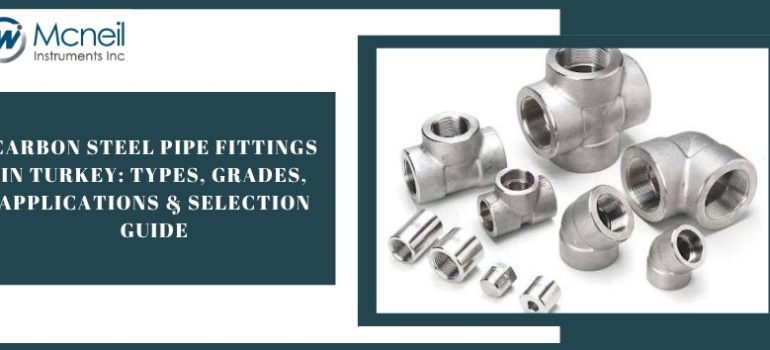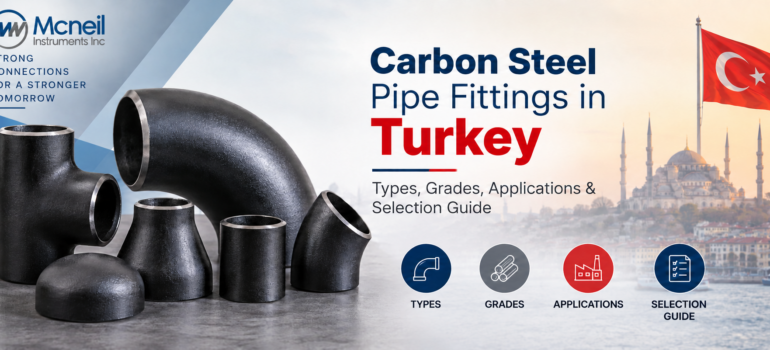
Carbon Steel Pipe Fittings in Turkey: Types, Grades, Applications & Selection Guide
Carbon steel pipe fittings are essential components in industrial piping systems where pipes need to be connected, redirected, branched, reduced, or terminated. Their combination of mechanical strength, pressure-handling capability, weldability, availability, and cost efficiency makes them suitable for a wide range of industrial applications.
For projects in Turkey, selecting the right pipe fitting involves more than choosing a shape. The fitting material, pipe size, schedule, pressure rating, operating temperature, connection method, and service medium all need to be considered. This is particularly important for applications in oil and gas, petrochemical processing, power generation, chemical processing, water treatment, marine facilities, and industrial manufacturing.
Mcneil Instruments supplies carbon steel pipe fittings and other industrial piping components for customers in Turkey, supporting requirements in locations including Istanbul, Kocaeli, Bursa, Sakarya, and Ankara. Its Turkey range includes elbows, tees, reducers, caps, stub ends, couplings, unions, and other pipe fitting configurations.
What Are Carbon Steel Pipe Fittings?
Carbon steel pipe fittings are piping components designed to connect sections of pipe and create functional piping networks. Depending on their geometry, they can change the direction of flow, create branches, connect different pipe diameters, or close the end of a pipeline.
They are commonly manufactured in seamless or welded forms and can be produced according to recognized ASTM, ASME, and MSS specifications.
In an industrial piping system, fittings perform several important functions:
- Changing pipeline direction
- Connecting multiple pipe sections
- Creating branch connections
- Transitioning between different pipe sizes
- Closing pipeline ends
- Providing removable connections for maintenance
- Supporting pressure-containing piping systems
The correct fitting must be compatible with the pipe and the operating conditions of the complete system.
Why Are Carbon Steel Pipe Fittings Important for Turkish Industries?
Turkey has a diverse industrial base involving manufacturing, energy, chemical processing, infrastructure, water treatment, marine operations, and other process industries. These applications require piping systems that can withstand mechanical loads and operating pressures while remaining practical to install and maintain.
Carbon steel fittings are often selected when high strength, fabrication compatibility, and economical material selection are important.
For industrial projects, a properly selected fitting can help maintain:
- Mechanical integrity
- Reliable flow direction
- Leak-resistant connections
- Consistent dimensional alignment
- Easier maintenance
- Long-term piping performance
Mcneil Instruments’ Turkey supply network supports industrial requirements in Istanbul as well as major industrial areas such as Kocaeli and Bursa, with supply support extending to Sakarya and Ankara.
Types of Carbon Steel Pipe Fittings
Different fitting designs perform different functions within a piping system. Understanding these configurations helps engineers and procurement teams select the appropriate component.
1. Carbon Steel Elbows
Elbows are used when a pipeline needs to change direction.
Common configurations include:
- 45° elbows
- 90° elbows
- 180° elbows
- Long-radius elbows
- Short-radius elbows
The choice between long-radius and short-radius designs depends on piping layout, flow requirements, available space, and project specifications.
Carbon steel elbows are commonly used in process piping, industrial plants, water systems, power facilities, and oil and gas applications.
2. Carbon Steel Tees
A tee creates a branch connection from a main pipeline. It can divide one flow into two paths or combine flows from different lines.
Common applications include:
- Process distribution systems
- Water pipelines
- Chemical plants
- Oil and gas piping
- Industrial utility systems
Where different branch sizes are required, reducing tee configurations can be selected according to the piping design.
3. Carbon Steel Crosses
A pipe cross provides four connection points and allows multiple branches to be connected from a single junction.
Cross fittings can be useful where a piping layout requires several directional connections within a compact area.
4. Carbon Steel Reducers
Reducers connect pipes with different nominal diameters.
Two common designs are:
Concentric Reducers
The centerlines of the connected pipes remain aligned. They are commonly used where symmetrical flow transitions are appropriate.
Eccentric Reducers
The centerlines are offset. They can be particularly useful in horizontal piping arrangements where maintaining appropriate flow geometry and avoiding unwanted pockets is important.
5. Carbon Steel Couplings and Unions
Couplings connect straight sections of pipe, while unions provide a connection that can be more readily dismantled for maintenance.
They are useful where piping sections may need to be disconnected during inspection, servicing, or replacement.
6. Carbon Steel Caps and Plugs
Caps and plugs close pipe ends.
Depending on the design, they can be used for:
- Permanent termination
- Temporary closure
- Maintenance isolation
- Pipeline fabrication
- Equipment connections
7. Carbon Steel Stub Ends
Stub ends are commonly used with lap-joint flange arrangements, particularly where a piping section may need to be frequently dismantled.
They can simplify maintenance and inspection in systems where repeated flange separation is expected.
Carbon Steel Pipe Fitting Grades
Material selection should be based on pressure, temperature, service conditions, and applicable project standards.
Mcneil Instruments identifies the following common materials for carbon steel pipe fittings:
| Grade | Typical Selection |
| ASTM A234 WPB | Pressure piping applications |
| ASTM A105 | Forged fittings and high-pressure systems |
| ASTM A350 LF2 | Low-temperature applications |
ASTM A234 WPB Pipe Fittings
ASTM A234 WPB is widely associated with wrought carbon steel and alloy steel fittings for pressure piping applications.
These fittings can be used for connecting piping components in process and industrial systems where the material specification, dimensions, pressure-temperature requirements, and fabrication procedure are appropriately matched to the project.
ASTM A105 Forged Fittings
ASTM A105 is commonly used for forged carbon steel components in pressure-containing applications.
It is particularly relevant where forged construction is preferred for the required pressure and mechanical service conditions.
ASTM A350 LF2 Pipe Fittings
ASTM A350 LF2 is associated with carbon and low-alloy steel forgings intended for low-temperature service.
For applications exposed to lower operating temperatures, material toughness and the applicable impact-testing requirements should be considered during specification.
Stainless Steel Grades Used Alongside Carbon Steel Fittings
The Mcneil Instruments source page also lists 304, 316, 316L, 321 and 347 under its fitting material information. Technically, these are austenitic stainless steel grades rather than carbon steel grades. They may be considered when corrosion resistance or elevated-temperature performance is more important than the cost advantages of carbon steel.
Stainless Steel 304
304 stainless steel offers good general corrosion resistance, weldability, and fabrication characteristics. It is widely used across industrial, chemical, refinery, and water-related applications.
Stainless Steel 316
316 contains molybdenum and generally provides improved resistance to chloride-related corrosion compared with 304. This makes it useful in marine, petrochemical, and other corrosive environments.
Stainless Steel 316L
316L is the low-carbon version of 316. Its lower carbon content makes it particularly useful where welding and resistance to sensitization are important considerations.
Stainless Steel 321
321 is titanium-stabilized stainless steel and is commonly considered for elevated-temperature applications where resistance to intergranular corrosion is important.
Stainless Steel 347
347 is stabilized primarily with niobium and is used in applications requiring good resistance to intergranular corrosion at elevated temperatures.
Therefore, when specifying a fitting for a Turkish industrial project, it is important to distinguish between carbon steel grades such as A234 WPB and A105 and stainless steel grades such as 304, 316 and 316L.
How to Select Carbon Steel Pipe Fittings for Projects in Turkey
Choosing the correct fitting should begin with the complete operating conditions rather than the fitting shape alone.
1. Consider the Pipe Size
The fitting’s nominal pipe size must match the piping system or the required transition.
An incorrect size can cause installation difficulties, alignment problems, flow restrictions, or excessive mechanical stress.
2. Check the Pipe Schedule
Pipe schedule determines wall thickness and is an important part of ensuring compatibility between the pipe and fitting.
The fitting and connected piping should be specified according to the applicable project requirements.
3. Evaluate Pressure Requirements
The fitting must be suitable for the system’s design and operating pressure.
For high-pressure applications, forged or butt-welded configurations may be considered depending on the design and applicable standards.
4. Consider Operating Temperature
Temperature has a direct effect on material performance and pressure-temperature ratings.
For low-temperature applications, materials such as ASTM A350 LF2 may be considered where applicable. For higher-temperature or corrosive environments, alternative alloy or stainless steel materials may be more appropriate.
5. Identify the Process Medium
The fluid or gas passing through the pipeline can significantly influence material selection.
Consider whether the system carries:
- Water
- Steam
- Oil
- Natural gas
- Hydrocarbons
- Chemicals
- Compressed air
- Process fluids
- Corrosive media
6. Select the Connection Method
Common connection methods include:
Butt Weld
Butt-weld fittings provide permanent welded connections and are widely used in pressure and temperature-sensitive industrial piping systems.
Socket Weld
Socket-weld connections are frequently considered for smaller-diameter piping where a strong welded joint is required.
Threaded Connections
Threaded fittings can be useful where easier installation or dismantling is required, subject to pressure, temperature, size, and project specifications.
The Mcneil Instruments product information specifically highlights butt weld, socket weld, and threaded connections as important fitting selection considerations.
Applications of Carbon Steel Pipe Fittings in Turkey
Carbon steel pipe fittings can be used across numerous industrial sectors.
Oil and Gas
Oil and gas facilities require reliable piping connections for transporting hydrocarbons and associated fluids.
Fittings can be used across upstream, midstream, and downstream systems, depending on material and design requirements.
Refineries
Refineries contain extensive networks of process, utility, steam, and hydrocarbon piping. Elbows, tees, reducers, caps, and other fittings help create the required piping configuration.
Petrochemical Plants
Petrochemical facilities operate with process fluids under controlled pressure and temperature conditions. Correctly specified fittings are essential to maintaining piping-system integrity.
Power Generation
Carbon steel fittings can be used in utility piping, steam-related systems, boiler connections, water lines, and other plant services where the selected material is appropriate for operating conditions.
Chemical Processing
Chemical plants may require carbon steel or corrosion-resistant alternatives depending on the process medium, concentration, temperature, and pressure.
Water and Wastewater Treatment
Pipe fittings are used in water distribution, treatment, drainage, and utility systems.
Industrial Manufacturing
Manufacturing facilities use piping systems for compressed air, water, steam, fuel, and other process services.
Construction and Infrastructure
Pipe fittings can also form part of mechanical, utility, fire protection, and infrastructure piping systems.
Mcneil Instruments identifies oil and gas, power plants, chemical and petrochemical plants, water and wastewater systems, industrial manufacturing, and construction among the applications for its pipe fittings.
Carbon Steel Pipe Fittings for Istanbul, Kocaeli, Bursa, Sakarya and Ankara
Turkey’s industrial requirements vary by region, so supply flexibility can be important for project procurement.
Istanbul
Istanbul-based industrial and infrastructure projects can require fittings for mechanical, process, utility, and building-related piping systems.
Kocaeli
Kocaeli is an important industrial region, making reliable piping-component supply relevant to chemical, manufacturing, energy, and process facilities.
Bursa
Industrial manufacturing and infrastructure projects in Bursa can require a broad range of pipe fittings for utility and process applications.
Sakarya
For projects in Sakarya, fittings may be required for industrial facilities, infrastructure, and general process piping applications.
Ankara
Ankara projects can include infrastructure, industrial, power, and mechanical piping requirements.
Mcneil Instruments states that it supplies pipe fittings across Istanbul, Kocaeli, Bursa, Sakarya, and Ankara, supporting both routine and bulk requirements.
Installation Considerations for Carbon Steel Pipe Fittings
Correct installation is as important as material selection.
Before installation:
- Confirm the fitting size and specification.
- Check compatibility with the pipe.
- Inspect the fitting for visible damage or dimensional issues.
- Clean the connection surfaces.
- Use the appropriate welding or joining procedure.
- Verify alignment before completing the joint.
- Inspect completed connections.
- Perform applicable testing according to the project specification.
For welded systems, qualified welding procedures and appropriate inspection practices should be followed.
Benefits of Carbon Steel Pipe Fittings
Carbon steel remains a practical material choice for many industrial piping systems because of its combination of performance and economy.
Key benefits include:
- High mechanical strength
- Good pressure resistance
- Cost efficiency compared with many higher-alloy materials
- Broad industrial availability
- Compatibility with welding and fabrication
- Availability in multiple fitting configurations
- Standardized dimensions and specifications
- Suitability for a wide range of industrial applications
However, carbon steel should not automatically be selected for every service. Corrosion conditions, operating temperature, process chemistry, and required service life must be evaluated before final material selection.
Why Choose Mcneil Instruments for Pipe Fittings in Turkey?
Mcneil Instruments supplies pipe fittings for industrial applications and supports customers requiring standard as well as customized configurations.
Its Turkey-focused supply information highlights:
- Pipe fittings for industrial and infrastructure projects
- Elbows, tees, reducers, caps, stub ends, couplings and unions
- Standard and customized specifications
- Attention to dimensional accuracy and material quality
- Quality checks before dispatch
- Support for routine and bulk requirements
- Supply across Istanbul, Kocaeli, Bursa, Sakarya and Ankara
- Export-oriented packaging and documentation
The company also states that its fittings are manufactured and supplied according to recognized national and international standards, with testing and quality checks carried out before dispatch.
Frequently Asked Questions
What are carbon steel pipe fittings used for?
Carbon steel pipe fittings are used to connect, redirect, branch, reduce, or terminate piping systems. They are commonly used in oil and gas, power, chemical, petrochemical, water treatment, manufacturing, and infrastructure applications.
Which carbon steel grades are commonly used for pipe fittings?
Common grades include ASTM A234 WPB, ASTM A105, and ASTM A350 LF2. The appropriate grade depends on pressure, temperature, service conditions, and project specifications.
What is the difference between a carbon steel elbow and tee?
An elbow changes the direction of a pipeline, while a tee creates a branch connection from the main pipe.
When should I use a concentric reducer?
A concentric reducer is used when the connected pipe centerlines need to remain aligned. The final selection should be based on the piping layout and engineering requirements.
Are 304 and 316 carbon steel grades?
No. 304, 316 and 316L are stainless steel grades, not carbon steel grades. They are generally selected when improved corrosion resistance or other stainless-steel properties are required.
How do I choose the right pipe fitting for a Turkish industrial project?
Consider the pipe size, schedule, material, pressure, temperature, process medium, connection method, applicable standards, and installation requirements. These parameters should be checked together rather than selecting a fitting based only on size or shape.
Conclusion
Carbon steel pipe fittings are fundamental components in industrial piping systems, providing reliable connections, directional changes, branch points, size transitions, and pipeline termination.
For projects in Turkey, the right fitting should be selected according to the complete service environment. ASTM A234 WPB, ASTM A105, and ASTM A350 LF2 can address different carbon and low-alloy steel fitting requirements, while stainless steel grades such as 304, 316, 316L, 321, and 347 may be considered where corrosion resistance or elevated-temperature performance calls for stainless materials.
Mcneil Instruments provides pipe fittings for customers across Turkey, including Istanbul, Kocaeli, Bursa, Sakarya, and Ankara, with a range covering elbows, tees, reducers, couplings, unions, caps, plugs, stub ends, and other configurations.
For industrial piping projects, selecting the correct combination of material, fitting type, size, schedule, pressure rating, temperature capability, and connection method is the key to achieving a dependable and maintainable piping system.