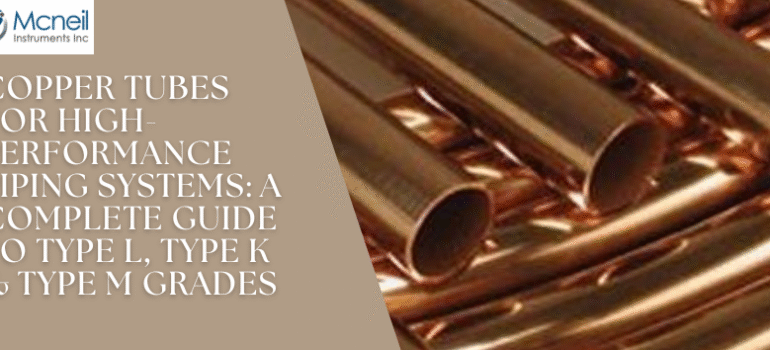
Copper Tubes for High-Performance Piping Systems: A Complete Guide to Type L, Type K & Type M Grades

Introduction: The Gold Standard for Reliability and Versatility

When a piping system demands durability, thermal efficiency, corrosion resistance, and long-term reliability, copper becomes the natural choice. Copper tubes are the backbone of plumbing networks, HVAC lines, medical gas pipelines, refrigeration systems, desalination units, and industrial heat exchangers.

For decades, engineers across sectors—from construction and energy to pharmaceuticals and marine—have relied on copper due to its excellent workability, long lifespan, and compatibility with a wide range of fluids and gases.

With various grades like Type L, Type K, and Type M, each offering unique pressure ratings and wall thicknesses, choosing the right copper tube plays a critical role in system safety and efficiency. This blog provides a complete breakdown of copper tube grades and explains why Mcneil Instruments is a trusted global manufacturer, supplier, and exporter.

What Are Copper Tubes?

Copper tubes are precision-engineered cylindrical components used to transport liquids and gases safely across industrial and commercial systems.

They are valued for:

  • Superior corrosion resistance in water, brine, and mild chemicals
  • High thermal conductivity ideal for heating, cooling, and refrigeration
  • Excellent hygiene making them suitable for medical and food-grade applications
  • Ease of bending, soldering, and forming, ensuring design flexibility
  • Long service life, often exceeding 50 years in ideal conditions

Understanding Copper Tube Grades: Type L, Type K & Type M

1. Copper Tube Type L

Medium wall thickness suitable for both residential and industrial systems.

Applications:

  • Plumbing networks
  • Medical gas pipelines
  • HVAC system lines

Why Type L?

  • Balanced strength and flexibility
  • Ideal for pressure-bearing applications
  • Blue color code

2. Copper Tube Type K

The thickest and strongest grade of copper tubing.

Applications:

  • Underground water lines
  • High-pressure HVAC systems
  • Industrial gas transport

Why Type K?

  • Highest corrosion and pressure resistance
  • Suitable for extreme conditions
  • Green color code

3. Copper Tube Type M

A thinner and more economical option for light-duty applications.

Applications:

  • Low-pressure plumbing
  • Residential water supply
  • General-purpose fluid transport

Why Type M?

  • Lightweight and easy to install
  • Cost-effective for non-critical systems
  • Red color code

Technical Specifications of Copper Tubes

PropertyType LType KType M
Wall ThicknessMediumHeavyThin
Pressure RatingMedium–HighHighestLow–Medium
Tensile Strength210–250 MPa240–280 MPa200–230 MPa
Temperature Limit-200°C to +200°C-200°C to +250°C-200°C to +200°C
Corrosion ResistanceHighVery HighModerate–High

All tubes adhere to:

  • ASTM B88
  • ASME Standards
  • ASTM B280 for refrigeration applications

Types of Copper Tubes Offered by Mcneil Instruments

  • Seamless Copper Tubes
  • Refrigeration Copper Tubes (AC, HVAC)
  • Medical Gas Copper Tubes
  • L-Type/LWC (Level Wound Coil) Copper Tubes
  • Straight Length Copper Tubes
  • Pancake Coils
  • Copper Plumbing Tubes
  • Custom OD/ID Tubes for OEM applications

Every tube is manufactured with tight dimensional accuracy, smooth internal surfaces, and verified metallurgical properties.

Key Applications Across Industries

HVAC & Refrigeration

Air conditioning lines, condenser tubes, evaporator coils

Plumbing & Water Supply

Municipal lines, household plumbing, commercial water systems

Medical & Healthcare

Medical gas pipelines compliant with international hygiene standards

Aerospace & Marine

Corrosion-resistant piping for fuel systems and brine circulation

Chemical & Energy

Heat exchangers, solar heaters, industrial cooling systems

Automotive & Electronics

Transformer cooling, electrical bus bars, precision tubing

Why Standards & Certification Matter

Copper tubes must meet global norms to ensure safe transport of medical gases, refrigerants, drinking water, and industrial fluids.

Mcneil Instruments complies with:

  • ASTM B88 / B75
  • ASME Standards
  • ASTM B280 (HVAC-R)
  • EN, DIN & ISO Standards
  • EN 10204 3.1 / 3.2 Test Certificates

Each batch undergoes:

  • Eddy current testing
  • Hydrostatic pressure testing
  • Dimensional checks
  • Microstructure analysis
  • Surface finish inspection
  • Positive material identification (PMI)

Global Supply Network: Mcneil Instruments Across Continents

Middle East

  • Saudi Arabia: Plumbing & refinery cooling lines
  • UAE: HVAC megaprojects, district cooling networks
  • Qatar & Kuwait: Desalination & petrochemical pipelines

Europe

  • Germany, France & Italy: OEM manufacturing, refrigeration units
  • UK: Medical gas installations and R&D labs

Asia-Pacific

  • Singapore, Malaysia, Japan: Semiconductor and electronic cooling systems
  • China, South Korea: HVAC-R mass manufacturing

Africa

  • South Africa, Nigeria, Egypt: Commercial plumbing & industrial cooling

Americas

  • USA: Medical gas pipelines, HVAC-R systems
  • Canada: Cold climate heating systems
  • Brazil: Food processing and industrial cooling lines

Mcneil Instruments has built a global reputation through consistent quality, project-level expertise, and timely supply.

Why Choose Mcneil Instruments?

  • ISO-certified manufacturing
  • Decades of experience in copper metallurgy
  • Precision-engineered tubes for critical applications
  • Custom sizes, large-scale orders, and OEM supply
  • Strict quality assurance and global logistics capability

Conclusion: Precision Copper Tubes Built for Long-Term Performance

Copper tubes remain one of the most reliable and efficient piping materials across HVAC, medical, industrial, and infrastructure applications. Whether you need Type L for balanced performance, Type K for high-pressure durability, or Type M for economical installations, selecting the right grade ensures system longevity and safety.

As a leading manufacturer, supplier, and exporter, Mcneil Instruments provides world-class copper tubing solutions trusted across industries and continents. Our products combine strict quality, dimensional accuracy, and superior metallurgical performance — delivering reliability for the most demanding applications.

Read More
How Best Quality of Copper Tubes are made and their 3 best tubes

How Best Quality Copper Tubes are made and their 3 best tubes

The manufacturing process of copper tubes involves several steps, and different methods are depending on the type of tube required. Here’s a general overview of the manufacturing process for seamless copper tubes:

Extraction of Copper: Copper is typically extracted from copper ores through processes like mining and smelting to obtain copper concentrate.

Casting and Forming: The extracted copper is melted in a furnace and cast into cylindrical billets or logs. These logs are then hot extruded to form tube-like shapes. This extrusion process involves forcing the copper through a die, giving it the desired shape and dimensions.

Drawing: The extruded tubes are drawn through a series of dies to further reduce their diameter and thickness. This process is repeated several times until the tubes reach the desired dimensions. Drawing also imparts additional strength and improves the surface finish of the tubes.

Annealing: After the drawing process, the tubes undergo annealing. Annealing involves heating the tubes to a specific temperature and then slowly cooling them. This step helps relieve stresses generated during the manufacturing process, enhances the tubes’ ductility, and improves their mechanical properties.

Cleaning and Coating: The tubes are thoroughly cleaned to remove any residues or impurities. Depending on the application, the tubes may be coated or treated with substances to prevent corrosion.

Cutting and Packaging: The tubes are cut into specific lengths based on customer requirements. The final step involves packaging the tubes for distribution.

It’s important to note that for some applications, such as in air conditioning and refrigeration, copper tubes may also be manufactured through a process called “tube drawing.” In this method, a copper billet is pierced to create a hollow tube, which is then drawn through a series of dies to achieve the desired dimensions.

The manufacturing process may vary for welded or brazed copper tubes, where the tube is formed by welding or brazing a flat strip of copper into a tubular shape.

Quality control measures are implemented throughout the manufacturing process to ensure that the copper tubes meet industry standards and specifications.

What are the three common types of copper tube?

The three common types of copper tubes are categorized based on their wall thickness, and they are known as Type K, Type L, and Type M. These types are widely used in various applications, particularly in plumbing and HVAC systems. Here’s an overview of each type:

Type K Copper Tube:

Description: Type K is the thickest-walled copper tube among the common types. It has a green stripe or color code to distinguish it.

Application: Type K is often used in applications where high durability and resistance to external pressure are required. It is commonly used for water distribution systems, especially in underground installations.

Common Use Cases: Municipal water supply lines, underground water service lines.

Type L Copper Tube:

Description: Type L has a medium wall thickness and is easily identified by its blue stripe or color code.

Application: Type L is suitable for both interior and exterior applications. It offers a good balance between strength and cost-effectiveness.

Common Use Cases: Residential and commercial plumbing, water distribution systems, heating systems.

Type M Copper Tube:

Description: Type M has the thinnest walls among the common types and is marked with a red stripe or color code.

Application: Type M is cost-effective and is commonly used in applications where pressure is not as high. It is suitable for residential plumbing.

Common Use Cases: Domestic water service lines, refrigeration, air conditioning.

These types are standardized by industry organizations such as ASTM International and the American Water Works Association (AWWA). The specifications for each type include the dimensions, thickness, and other mechanical properties, ensuring that they meet specific requirements for their intended applications.

Specifications and Standards of Good Quality Copper Tubes

Quality copper tubes typically adhere to specific specifications and standards to ensure their performance and durability. Here are some common specifications for quality copper tubes:

  1. ASTM B88: This is the standard specification for seamless copper water tube, suitable for general plumbing and similar applications. It covers various dimensions, tolerances, and requirements for seamless copper tubes used in water distribution systems.
  2. ASTM B280: This specification covers seamless copper tube for air conditioning and refrigeration systems. It includes requirements for dimensions, tolerances, mechanical properties, and cleanliness of the tubes to ensure their suitability for use in HVACR applications.
  3. ASTM B75: This specification covers seamless copper tube for use in plumbing applications. It includes requirements for dimensions, tolerances, mechanical properties, and chemical composition of the tubes to ensure their quality and performance in plumbing systems.
  4. EN 1057: This European standard specifies requirements for copper and copper alloys seamless, round tubes for water and gas in sanitary and heating applications. It covers dimensions, tolerances, mechanical properties, and testing methods for copper tubes used in plumbing and heating systems.
  5. JIS H3300: This Japanese Industrial Standard specifies seamless copper and copper alloy tubes for general use. It includes requirements for dimensions, tolerances, mechanical properties, and chemical composition of the tubes used in various applications, including plumbing, HVAC, and industrial processes.
  6. BS EN 12735-1: This British standard specifies copper and copper alloy seamless, round tubes for general purposes. It covers requirements for dimensions, tolerances, mechanical properties, and testing methods for copper tubes used in a wide range of applications.

In addition to these specifications, quality copper tubes may also be certified by organizations such as the International Organization for Standardization (ISO) or the Copper Development Association (CDA) to ensure compliance with industry standards and regulations.

When purchasing copper tubes, it’s essential to verify that they meet the required specifications for your specific application to ensure their quality, performance, and longevity. Working with reputable suppliers and manufacturers who provide certified products can help ensure that you receive high-quality copper tubes that meet your needs and standards.

Read More