Stainless Steel 304L Pipe Fittings – Manufacturer, Supplier & Exporter | Mcneil Instruments India
Introduction
In industries where reliability, corrosion resistance, and cleanliness define system efficiency, Stainless Steel 304L Pipe Fittings remain one of the most trusted choices worldwide.
At Mcneil Instruments India, we specialize in the manufacturing, supplying, and exporting of SS 304L Pipe Fittings that meet stringent international standards for mechanical strength, metallurgical integrity, and dimensional precision.
Our fittings are designed for demanding sectors — chemical plants, power stations, food & beverage units, oil & gas refineries, marine systems, and pharmaceutical facilities — where consistent performance under pressure and temperature extremes is critical.
Manufactured under ASTM A403 / ASME B16.9 / MSS-SP43 / DIN standards, each product undergoes 100% inspection and hydrostatic testing before dispatch. Whether it’s a seamless elbow or a welded tee, Mcneil’s Stainless Steel 304L Pipe Fittings ensure leak-proof joints, uniform flow, and long-term structural stability.
Understanding Stainless Steel 304L – Composition and Metallurgical Behavior
Stainless Steel 304L (UNS S30403 / Werkstoff 1.4306) is a low-carbon modification of the standard 304 stainless steel — the “L” indicating a maximum carbon content of 0.03%. This small adjustment dramatically enhances resistance to intergranular corrosion and sensitization during welding or high-temperature exposure.
Microstructure and Alloy Design
SS 304L is an austenitic chromium-nickel alloy, stabilized by a homogeneous microstructure that retains ductility and toughness across a broad temperature range. The alloy achieves its corrosion resistance through:
- 18–20% Chromium (Cr): Forms a passive oxide layer that resists oxidation and surface scaling.
- 8–12% Nickel (Ni): Improves toughness, formability, and pitting resistance.
- Low Carbon (<0.03%): Prevents chromium carbide precipitation at grain boundaries.
This balance of chemistry makes 304L ideal for welded assemblies, pressure piping, and clean processing systems where long-term corrosion resistance and cleanliness are vital.
Detailed Chemical Composition
| Element | Content (%) | Role / Benefit |
| Carbon (C) | ≤ 0.03 | Reduces carbide precipitation and improves weld corrosion resistance |
| Manganese (Mn) | ≤ 2.00 | Improves hot workability and strength |
| Silicon (Si) | ≤ 1.00 | Enhances oxidation resistance during high-temperature service |
| Chromium (Cr) | 18.0 – 20.0 | Provides corrosion and oxidation resistance |
| Nickel (Ni) | 8.0 – 12.0 | Enhances ductility, toughness, and chloride resistance |
| Phosphorus (P) | ≤ 0.045 | Controlled to prevent brittleness |
| Sulfur (S) | ≤ 0.03 | Improves machinability within limits |
| Iron (Fe) | Balance | Matrix metal providing structural strength |
Mechanical & Physical Properties
| Property | Metric Value | Significance |
| Tensile Strength | ≥ 485 MPa | High load-bearing capacity |
| Yield Strength (0.2% Offset) | ≥ 170 MPa | Resists deformation under stress |
| Elongation | ≥ 35% | Ensures ductility and flexibility |
| Hardness (HRB) | ≤ 90 | Ideal for machining and forming |
| Modulus of Elasticity | 193 GPa | High rigidity under mechanical stress |
| Density | 8.00 g/cm³ | Indicates structural mass |
| Thermal Conductivity | 16.2 W/m·K | Maintains dimensional stability |
| Melting Range | 1400–1450°C | Suitable for high-temperature use |
The low carbon content allows SS 304L to be welded, cold-formed, or machined without compromising corrosion resistance — a crucial advantage over 304 in fabrication-heavy applications.
Corrosion & Heat Resistance
304L stainless steel performs exceptionally in oxidizing, mildly reducing, and slightly acidic environments.
It resists oxidation up to 870°C (1600°F) in intermittent service and up to 925°C (1700°F) in continuous service.
Resistance Profile
- General Corrosion: Excellent resistance in atmospheric and freshwater environments.
- Intergranular Corrosion: Superior immunity post-welding due to low carbon.
- Pitting/Crevice Corrosion: Effective in chloride solutions below 200 ppm.
- Stress Corrosion Cracking: Resists cracking under neutral or slightly oxidizing conditions.
This makes 304L fittings suitable for welded piping, heat exchangers, dairy processing units, and chemical transport systems.
Manufacturing & Production Standards
At Mcneil Instruments India, all 304L pipe fittings are manufactured under controlled metallurgical and mechanical conditions to ensure consistency.
Production Process
- Raw Material Procurement: Certified stainless steel billets and pipes from trusted mills.
- Forming: Hot or cold forming using hydraulic presses and bending equipment.
- Heat Treatment: Solution annealing at 1010–1120°C, followed by rapid quenching to restore corrosion resistance.
- Machining & Beveling: CNC-machined ends for precise fit-up and smooth welding.
- Pickling & Passivation: Removal of scale and oxide layer using nitric acid solution for surface purity.
- Inspection & Testing: Each batch undergoes stringent quality checks (dimensional, hydrostatic, ultrasonic, and PMI tests).
Our fittings are certified under ASTM A403 WP304L, ASME B16.9, and MSS-SP43, ensuring global compatibility and code compliance.
Range of Stainless Steel 304L Pipe Fittings
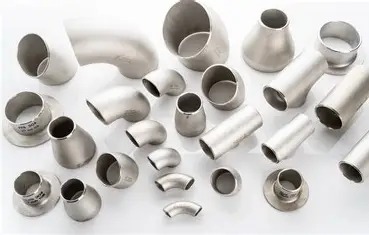
Mcneil Instruments manufactures and exports a comprehensive lineup of 304L fittings, available in Seamless, Welded, and Fabricated forms.
1. SS 304L Elbows
- Types: 45°, 90°, 180°; Long Radius (LR) and Short Radius (SR)
- Purpose: Divert pipeline flow at defined angles
- Applications: Condensate lines, chemical process loops
2. SS 304L Tees
- Types: Equal Tee, Reducing Tee
- Function: Distributes or collects fluid from pipeline branches
- Applications: Manifold and mixing operations
3. SS 304L Reducers
- Variants: Concentric & Eccentric
- Use: Connect pipes of unequal diameters while maintaining smooth flow
4. SS 304L Buttweld Fittings
- Provide permanent joints with uniform wall thickness and pressure integrity
- Ideal for steam, gas, and high-pressure hydraulic systems
5. SS 304L Stub Ends
- Used with lap joint flanges for quick assembly/disassembly
- Common in systems requiring frequent inspection
6. SS 304L End Caps
- Close the end of the pipe, ensuring tight seals
- Protect internal components from dirt and moisture
7. SS 304L Pipe Bends
- Custom radius bends up to 10D, ensuring minimal pressure drop
- Manufactured by cold forming or induction bending
Available Dimensions:
- Size Range: 1/8″ NB to 36″ NB
- Schedules: SCH 5s, 10s, 40s, 80s, 160s, XXS
- Standards: ASME / DIN / JIS / MSS / ISO
Dimensional & Tolerance Standards
| Standard | Type | Scope |
| ASME B16.9 | Factory-made buttweld fittings | Seamless & welded fittings up to 48” |
| ASTM A403 | Material specification | WP304L grade for wrought fittings |
| MSS SP-43 | Light-wall fittings | Ideal for thin-wall stainless pipelines |
| DIN 2605, 2615, 2616 | German standard | Radius and dimensional control |
Testing & Quality Assurance
Each SS 304L Pipe Fitting passes through multi-stage inspection protocols under the supervision of trained quality engineers.
Quality Checks Include:
- Hydrostatic Testing – To verify pressure containment integrity.
- Pneumatic Leak Test – Ensures airtight sealing capability.
- Positive Material Identification (PMI) – Confirms correct alloy grade.
- Dimensional Inspection – Verifies compliance with ASME tolerances.
- Intergranular Corrosion Test (IGC) – Confirms resistance after welding.
- Flattening & Bending Test – Validates ductility and structural soundness.
- Surface Finish Inspection – Ensures 150-grit minimum clean finish.
Certificates provided: EN 10204 3.1 / 3.2, Mill Test Certificates, and Third-Party Inspection Reports (TPI).
Applications of Stainless Steel 304L Pipe Fittings
Mcneil’s 304L fittings are installed in industrial projects globally where both sanitation and corrosion resistance are mandatory.
| Industry | Applications |
| Chemical Processing | Acid and alkali lines, solvent handling systems |
| Oil & Gas | Process piping, storage tank connections |
| Power Generation | Feedwater lines, condensate systems |
| Food & Beverage | Dairy, brewery, and bottling lines |
| Pharmaceutical | CIP/SIP lines, sterile process systems |
| Water Treatment | RO and desalination piping |
| Marine Engineering | Saltwater pipelines and ballast systems |
Advantages of SS 304L Pipe Fittings
- Weld Integrity: No carbide precipitation during welding.
- Enhanced Corrosion Resistance: Stable passive film prevents oxidation.
- Dimensional Stability: Maintains structure under cyclic stress.
- Low Maintenance: Resists fouling, scaling, and corrosion.
- Aesthetic & Hygienic: Smooth polished finish for clean systems.
- Versatility: Suitable for cryogenic, ambient, and elevated temperatures.
- Cost Efficiency: Long service life minimizes replacement cost.
Why Mcneil Instruments India
With over two decades of metallurgical expertise, Mcneil Instruments India is an ISO 9001:2015 certified manufacturer offering end-to-end solutions — from design and forging to finishing and global dispatch.
Key Strengths
- Compliance with ASTM, ASME, DIN, and ISO standards
- Advanced in-house forming, machining, and heat-treatment facilities
- Custom-engineered fittings as per client drawings
- Third-party inspection from agencies like BV, SGS, TUV, DNV
- Worldwide supply network with on-time delivery assurance
Every Mcneil product is built to perform — precisely machined, tested, and documented for traceability and reliability.
Handling & Maintenance Tips
To extend the life of SS 304L fittings:
- Clean periodically using mild alkaline or non-chloride cleaners.
- Avoid contact with carbon steel tools or contaminants.
- Store in dry, covered areas to prevent surface rust.
- Ensure proper torque during installation to prevent stress cracking.
- Perform regular visual inspection and hydro-testing during shutdowns.
Conclusion
Stainless Steel 304L Pipe Fittings represent a perfect combination of strength, ductility, and corrosion resistance, making them indispensable for industries requiring dependable flow control systems.
Their low-carbon chemistry ensures weld stability, while their chromium-nickel composition provides long-term durability across corrosive and hygienic environments.
At Mcneil Instruments India, we don’t just supply fittings — we deliver precision-engineered flow solutions that meet the highest global standards of performance, reliability, and consistency.
Contact our technical sales team today to request a detailed quote or engineering datasheet for your project specifications.
Frequently Asked Questions (FAQ)
1. What is the difference between 304 and 304L stainless steel?
304L contains lower carbon (≤0.03%) compared to standard 304 (≤0.08%), improving weldability and preventing intergranular corrosion after welding.
2. Are SS 304L pipe fittings suitable for marine use?
Yes, they provide excellent resistance against seawater corrosion and scaling in marine atmospheres.
3. What are the standard sizes available for SS 304L fittings?
From 1/8” NB to 36” NB in seamless and welded types, available across schedules SCH 5 to SCH 160.
4. Do Mcneil fittings meet ASTM A403 WP304L specifications?
Yes, all products are manufactured in full compliance with ASTM A403 WP304L, ASME B16.9, and MSS-SP43 standards.
5. Can 304L be used for high-temperature applications?
Yes, it operates effectively up to 870°C (intermittent) and 925°C (continuous) without loss of corrosion resistance.