Stainless Steel ASTM Pipe Fittings Supplier, Manufacturer & Exporter: Premium Piping Solutions by Mcneil Instruments
Introduction: The Role of Stainless Steel ASTM Pipe Fittings in Modern Industry
In industrial piping systems that handle critical fluids and gases, the quality and performance of pipe fittings can make the difference between safe, reliable operation and costly downtime or failure. Whether in chemical plants, oil and gas facilities, pharmaceuticals, power generation, water treatment, or food and beverage processing, piping components must meet stringent standards for strength, corrosion resistance, and dimensional accuracy.
Stainless steel ASTM pipe fittings are engineered to meet these challenges. They are precision-manufactured components designed to connect, redirect, branch, or terminate stainless pipes in systems that demand durability and safety. As a leading manufacturer, supplier, and exporter, Mcneil Instruments delivers comprehensive stainless steel ASTM pipe fittings that conform to international standards and perform reliably in the most demanding environments.
This blog explores what stainless steel ASTM pipe fittings are, their key material grades and applications, technical specifications, benefits, and why industries around the world — including those in the USA, Europe, Africa, and Asia — choose Mcneil Instruments as their trusted provider.
Understanding Stainless Steel ASTM Pipe Fittings
Stainless steel ASTM pipe fittings are components designed to join sections of pipe, change flow direction, adapt pipe sizes, or cap pipe ends, while providing a secure and leak-proof connection. These fittings are manufactured according to ASTM (American Society for Testing and Materials) standards, ensuring conformity with internationally recognized material and performance criteria.
These fittings are usually supplied in seamless or welded form, depending on the grade and application, and are commonly used in high-purity and high-pressure systems where corrosion resistance and mechanical strength are priorities.
Key Stainless Steel Grades for ASTM Pipe Fittings
Mcneil Instruments supplies pipe fittings in a wide range of stainless steel grades to meet diverse industrial requirements. Some of the most popular grades include:
1. Stainless Steel ASTM A403 WP304 Pipe Fittings
304 stainless steel is the most widely used general-purpose austenitic grade. It provides excellent corrosion resistance, formability, and weldability.
Applications:
- Water treatment lines
- Food and beverage systems
- General industrial piping
Key Characteristics:
- Excellent resistance to rust and corrosion
- Good weldability and ductility
- Suitable for a wide range of temperatures
2. Stainless Steel ASTM A403 WP316 Pipe Fittings
316 stainless steel enhances corrosion resistance with the addition of molybdenum, making it suitable for chloride-rich or aggressive environments.
Applications:
- Petrochemical piping
- Marine environments
- Chemical processing
Key Characteristics:
- Better pitting and crevice corrosion resistance, especially in chloride environments
- High strength at elevated temperatures
3. Stainless Steel ASTM A403 WP316L Pipe Fittings
316L is a low-carbon variant of 316, optimized for enhanced weldability and reduced carbide precipitation during welding.
Applications:
- Pharmaceutical and sanitary systems
- High-temperature welding applications
Key Characteristics:
- Improved weldability
- Reduced risk of sensitization in welded components
4. Stainless Steel ASTM A403 WP321 Pipe Fittings
WP321 is stabilized with titanium to resist intergranular corrosion, especially in high-temperature environments.
Applications:
- Heat exchangers
- Exhaust systems
- Chemical processing
Key Characteristics:
- Enhanced high-temperature performance
- Excellent resistance to intergranular corrosion
5. Stainless Steel ASTM A403 WP347 Pipe Fittings
WP347 is stabilized with niobium and offers similar benefits to WP321, with improved mechanical stability.
Applications:
- High-temperature steam systems
- Refineries and petrochemical units
Key Characteristics:
- Superior stabilization at high temperatures
- Reliable corrosion resistance under thermal cycling
Types of Stainless Steel ASTM Pipe Fittings Offered
Mcneil Instruments manufactures the following types of stainless steel ASTM pipe fittings:
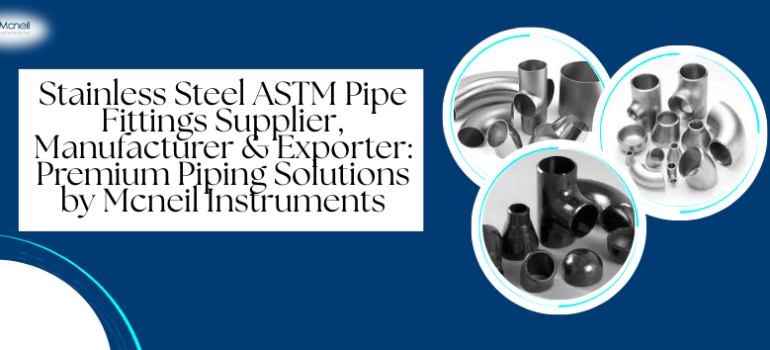
- Elbows (45°, 90°, 180°) — change direction in piping systems
- Tees & Crosses — enable branching and distribution
- Reducers (Concentric & Eccentric) — adapt between different pipe sizes
- Caps & Plugs — terminate pipe ends securely
- Stub Ends & Lap Joint Fittings — for easy flange connections
- Custom Machined Fittings — engineered to project-specific dimensions
Each fitting is precision manufactured, inspected, and tested for dimensional accuracy and mechanical performance.
Technical Specifications and Standards
Below is an overview of typical technical specifications for Mcneil Instruments’ stainless steel ASTM pipe fittings.
Material & Standards Compliance
| Standard | Description |
| ASTM A403 | Standard Specification for Wrought Austenitic Stainless Steel Pipe Fittings |
| ASME B16.9 | Factory-Made Wrought Buttwelding Fittings |
| ASME B16.11 | Forged Fittings, Socket-Welding and Threaded |
| ISO & DIN | Additional standards supported upon request |
Dimensions & Size Range
| Parameter | Details |
| Size Range | 1/2″ NB to 48″ NB (custom sizes available) |
| Wall Thickness | SCH 10S to SCH XXS (depending on grade and application) |
| Connection Type | Buttweld, Socket Weld, Threaded (as required) |
| Ends | Beveled, Plain, Threaded |
Mcneil Instruments supports tailored sizing for specific engineer designs or unique industrial applications.
Mechanical Properties (Typical by Grade)
| Grade | Tensile Strength | Yield Strength | Elongation | Corrosion Resistance |
| WP304 | 515 MPa | 205 MPa | ≥ 40% | Excellent |
| WP316 | 515 MPa | 205 MPa | ≥ 40% | Very High |
| WP316L | 485 MPa | 170 MPa | ≥ 40% | Very High |
| WP321 | 515 MPa | 205 MPa | ≥ 35% | High (High Temp) |
| WP347 | 515 MPa | 205 MPa | ≥ 35% | High (Thermal Cycling) |
Note: Actual property values may vary slightly depending on manufacturing processes and certifications; full testing reports are supplied with each batch.
Benefits of Stainless Steel ASTM Pipe Fittings
Stainless steel ASTM pipe fittings offer distinct advantages:
- Superior corrosion resistance — ideal for aggressive or marine environments
- Long service life — minimal maintenance and replacement costs
- High strength and durability — withstand pressure and temperature variation
- Excellent hygiene properties — ideal for food, pharmaceutical, and sanitary systems
- Thermal stability — suitable for steam, hot water, and industrial utilities
- Compatibility with global standards — simplifies compliance for international projects
These benefits make stainless steel ASTM fittings a preferred choice for industries seeking reliability and regulatory alignment.
Applications Across Industries
Stainless steel ASTM pipe fittings from Mcneil Instruments are used across a wide range of industrial sectors:
Oil & Gas and Petrochemical
Corrosion-resistant fittings are critical in sour gas, hydrocarbon processing, and marine terminal pipelines.
Chemical and Process Industries
Resistant to acidic or alkaline environments; ideal for chemical feeds and process piping.
Water Treatment and Utilities
Used in clean water systems, desalination plants, wastewater treatment, and municipal supply lines.
Food, Beverage & Pharmaceuticals
Sanitary standards make stainless steel essential for sanitary and high-purity systems.
Power Generation
Steam distribution lines, cooling systems and high-temperature circuits require dependable fittings with thermal endurance.
Construction & HVAC
Used in heating, ventilation, air conditioning systems that demand corrosion resistance and long life.
Quality Assurance and Testing
Mcneil Instruments ensures that every stainless steel ASTM pipe fitting undergoes rigorous testing and quality control:
- Material Test Certificates (MTCs) compliant with EN 10204 3.1 / 3.2
- Positive Material Identification (PMI)
- Hydrostatic & Pneumatic Pressure Testing
- Non-Destructive Testing (NDT) — Radiography / Ultrasonic
- Dimensional Inspection (ASME B16.9 / B16.11)
These protocols guarantee that fittings meet the mechanical and chemical specifications required by global industries.
Why Choose Mcneil Instruments — Manufacturer, Supplier & Exporter
Global Quality Standards
Mcneil Instruments adheres to ASTM, ASME, ISO, and international specifications — ensuring products meet rigorous compliance.
Diverse Product Range
From standard stainless steel grades (304, 316) to stabilized and specialty grades (321, 347), the range addresses diverse industrial environments.
Custom Engineering Support
Mcneil Instruments offers tailored solutions based on project specifications, including non-standard sizes and complex configurations.
Reliable Supply Chain
As a trusted supplier and exporter, Mcneil Instruments manages logistics, documentation, export compliance, and on-time delivery to global destinations.
Technical Assistance
Engineering support, material selection guidance, and compliance documentation help buyers make informed decisions and streamline procurement.
Conclusion: Stainless Steel ASTM Pipe Fittings for Reliable Flow Systems
Stainless steel ASTM pipe fittings are foundational components for industrial piping systems that demand durability, corrosion resistance, and compliance with global standards. Whether for oil and gas infrastructure in Houston, chemical plants in Europe, water treatment systems in Africa, or pharmaceutical facilities in Asia, these fittings ensure reliable, long-term performance.
As a seasoned manufacturer, supplier, and exporter, Mcneil Instruments delivers premium stainless steel ASTM pipe fittings that withstand challenging service environments, meet technical requirements, and support operational excellence.