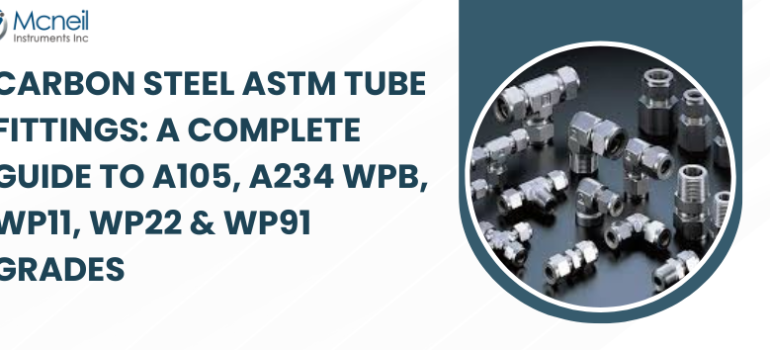
Carbon Steel ASTM Tube Fittings: A Complete Guide to A105, A234 WPB, WP11, WP22 & WP91 Grades
Introduction — Critical Connectors for Industrial Piping Systems
In any industrial piping network, whether it’s transporting steam in power plants, chemical feeds in petrochemical plants, water in treatment facilities, or hydrocarbons in oil and gas refineries, tube fittings are essential. They join sections of pipe and tubing, adapt changes in direction or diameter, and provide secure, leak-proof connections in demanding environments.
Carbon steel ASTM tube fittings — manufactured under stringent industry standards — provide a robust and reliable solution for medium and high pressure, elevated temperature, and corrosive conditions. As a leading manufacturer, supplier, and exporter, Mcneil Instruments offers a complete range of these fittings in different grades, each engineered to support specific industrial requirements.
This guide covers the most commonly used carbon steel tube fitting grades:
- ASTM A105
- ASTM A234 WPB
- ASTM A234 WP11
- ASTM A234 WP22
- ASTM A234 WP91
We will explore their chemical and mechanical properties, applications, specifications, and differences — helping engineers and buyers make informed decisions.
Standard Overview — What Is ASTM Tube Fitting Material?
Carbon steel tube fittings covered in this guide adhere to recognized ASTM and ASME specifications. These standards define acceptable chemical compositions, mechanical properties, and performance criteria. The most relevant standards include:
- ASTM A105 – Forged carbon steel for moderate and high-temperature service.
- ASTM A234 WPB / WP11 / WP22 / WP91 – Carbon and alloy steel buttweld tube fittings designed for elevated temperature and pressure services.
These fittings are typically produced via forging and machining to achieve uniform strength and dimensional accuracy.
Types of Carbon Steel Tube Fittings
Before diving into grades, here are the common tube fittings typically offered by Mcneil Instruments :
- Elbows (45°, 90°) – change direction of flow.
- Tees & Crosses – branch flows or connect three/four lines.
- Reducers (Concentric & Eccentric) – join two sizes of piping.
- Caps & Plugs – close pipe ends.
- Couplings & Adapters – join sections in different configurations.
- Custom Machined Fittings – for special application requirements.
Each fitting type is produced to match the required grade, wall thickness, and dimensional tolerance.
Grade Profiles
1. ASTM A105 Tube Fittings
ASTM A105 is a forged carbon steel grade commonly used for moderate and high-temperature applications. These fittings offer good weldability and mechanical strength.
Chemical Composition (Typical)
| Element | Composition (%) |
| Carbon (C) | 0.35 max |
| Manganese (Mn) | 0.60–1.05 |
| Phosphorus (P) | 0.035 max |
| Sulfur (S) | 0.040 max |
| Silicon (Si) | 0.10–0.35 |
Applications:
- Pressure and high-temperature services
- Refining and petrochemical plants
- Boiler systems
2. ASTM A234 WPB Tube Fittings
ASTM A234 WPB represents the most widely used grade of carbon steel buttweld fittings. These are suitable for moderate temperature and standard industrial applications.
Key Features:
- Excellent weldability
- Reliable performance in conventional process systems
- Cost-effective for standard applications
Applications:
- Pipeline connections in general plant services
- Low/medium temperature fluid lines
- HVAC systems
3. ASTM A234 WP11 Tube Fittings
ASTM A234 WP11 fittings are made from carbon steel alloyed with chromium and molybdenum, giving them better resistance in higher temperature environments compared to WPB.
Applications:
- High temperature steam lines
- Industrial boilers
- Medium-pressure systems requiring oxidation resistance
4. ASTM A234 WP22 Tube Fittings
ASTM A234 WP22 is a higher alloy grade than WP11, with improved creep and oxidation resistance. These tube fittings perform better under sustained high temperatures and pressures.
Applications:
- Superheaters and reheaters
- High-pressure steam piping
- Chemical processing lines
5. ASTM A234 WP91 Tube Fittings
ASTM A234 WP91 fittings represent one of the most advanced carbon steel grades. They are engineered for extreme conditions involving both high temperature and pressure.
Key Advantages:
- Superior creep strength
- High mechanical toughness
- Reliability in prolonged elevated temperature service
Applications:
- High-pressure boiler systems
- Thermal power plant piping
- Heavy industrial applications
Mechanical Properties Comparison
The following table summarizes typical mechanical properties for these carbon steel fitting grades:
| Property | A105 | A234 WPB | A234 WP11 | A234 WP22 | A234 WP91 |
| Tensile Strength (min) | ≥ 485 MPa | ≥ 415 MPa | ≥ 415 MPa | ≥ 520 MPa | ≥ 620 MPa |
| Yield Strength (min) | ≥ 240 MPa | ≥ 240 MPa | ≥ 205 MPa | ≥ 310 MPa | ≥ 415 MPa |
| Elongation (%) | ~20–25 | ~22 | ~22 | ~22 | ~20 |
Note: Actual mechanical values depend on manufacturing process, heat treatment, and test outcomes.
Chemical Composition Overview
Different grades are alloyed with varying levels of chromium, molybdenum and other elements to enhance high-temperature strength and corrosion resistance.
| Grade | Key Alloying Elements |
| A105 | Carbon, Manganese |
| WPB | Carbon, Manganese |
| WP11 | Cr, Mo |
| WP22 | Higher Cr, Mo |
| WP91 | Cr, Mo with added elements for creep strength |
Dimensions & Wall Thickness Standards
Carbon steel ASTM tube fittings are typically produced according to ASME B16.9 and/or ASME B16.11 dimensional standards. These define fitting geometry based on Nominal Pipe Size (NPS) and Schedule (SCH) designations.
Typical Size Range
- 1/2″ NB to 48″ NB or larger (depending on product)
- Wall thicknesses: SCH 10 to SCH XXS
- Fittings manufactured for both buttweld and socket-weld connections
Certifications & Quality Assurance
Mcneil Instruments ensures that all carbon steel ASTM tube fittings meet rigorous quality parameters. Each product undergoes:
- Material Test Certificates (MTCs) (EN 10204 3.1 / 3.2)
- Positive Material Identification (PMI)
- Hydrostatic Pressure Testing
- Dimensional Inspection
- Weld Integrity & Hardness Tests
This makes them suitable for critical industrial services where safety and reliability are non-negotiable.
Applications Across Industries
Carbon steel ASTM tube fittings are used in:
- Oil & Gas Production & Refining
Fittings in crude handling, steam systems, gas lines - Power Plants & Boilers
High temperature steam lines, superheated fluid circuits - Petrochemical & Chemical Processing
Process piping with elevated temperature and pressure - Industrial Manufacturing
Heavy equipment cooling lines, process fluid transportation - Water Treatment & Infrastructure
Main lines, distribution systems, plant utilities
Each grade has its niche depending on operational temperature, pressure, and fluid characteristics.
Why Choose Mcneil Instruments — Manufacturer, Supplier & Exporter
Mcneil Instruments stands out due to:
- Broad Product Range: Comprehensive offering covering all major ASTM carbon steel grades from A105 to WP91.
- Global Standards Compliance: Manufacturing to ASTM, ASME, and international norms.
- Quality Tracking & Documentation: Full traceability with certified test reports.
- Custom Solutions: Machined fittings tailored to unique project needs.
- Export Capability: Serving global markets with expertise in packaging, logistics, and export documentation.
This combination makes Mcneil Instruments a reliable partner for global EPC contractors, industrial end-users, and procurement teams.
Conclusion — Fit for Purpose and Built to Last
Choosing the right carbon steel ASTM tube fitting is a key engineering decision. Each grade — from A105 through A234 WPB, WP11, WP22, and WP91 — is designed for specific use cases ranging from general service to high temperature and high pressure.
As industries in oil & gas, power, petrochemical, and manufacturing continue to evolve, having a supplier that delivers quality, consistency, and certified performance is essential. Mcneil Instruments meets these expectations as a trusted manufacturer, supplier, and exporter, offering tube fittings designed for performance, longevity, and project success.