Introduction: Excellence in Corrosion-Resistant Engineering
In industries where harsh chemicals, corrosive gases, and extreme conditions are a daily challenge, the choice of pipe fittings can make the difference between reliability and failure. From chemical processing to marine engineering and power generation, pipe fittings must ensure leak-proof performance, durability, and compliance with international standards.
Among high-performance alloys, Hastelloy pipe fittings stand out for their exceptional resistance to corrosion, oxidation, and stress cracking. Their use in critical process industries highlights their importance in building safe, efficient, and long-lasting piping systems. As global projects become increasingly demanding, engineers and procurement professionals seek trusted suppliers who can deliver certified Hastelloy fittings.
This blog explores the properties, technical specifications, applications, and global supply chain of Hastelloy pipe fittings and how Mcneil Instruments has established itself as a leading manufacturer, supplier, and exporter in India.
What are Hastelloy Pipe Fittings?
Hastelloy is a family of nickel-based alloys primarily composed of nickel, molybdenum, and iron, with chromium and other elements added to enhance corrosion resistance. Hastelloy pipe fittings are designed for aggressive chemical environments, where conventional stainless steel or alloy fittings may fail.
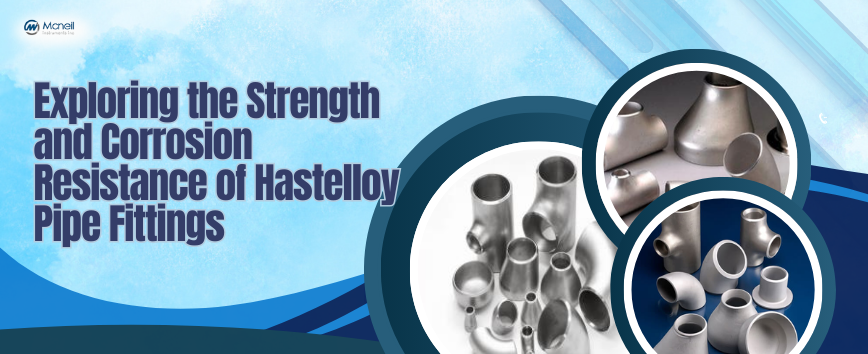
These fittings are available in multiple types—elbows, tees, reducers, couplings, crosses, and caps—used to connect, divert, or terminate fluid systems. Their unmatched ability to resist hydrochloric acid, sulfuric acid, phosphoric acid, and seawater makes them a preferred choice across industries such as chemical plants, oil & gas, power generation, and marine infrastructure.
Key Features of Hastelloy Pipe Fittings
- Superior resistance to strong oxidizers and reducing agents
- Excellent performance under high pressure and temperature
- Prevents localized corrosion like pitting and stress corrosion cracking
- High tensile strength ensures long service life
- Available in seamless, welded, and fabricated forms
Technical Specifications of Hastelloy Pipe Fittings
| Specification | Details |
| Standards Compliance | ASTM B366, ASME SB366, ANSI, DIN, ISO |
| Grades Available | Hastelloy C22, C276, B2, X, G30 |
| Size Range | 1/8″ to 48″ NB |
| Types | Elbows, Tees, Reducers, Couplings, Caps, Crosses |
| Forms | Seamless, Welded, Fabricated |
| Pressure Rating | Class 2000 to 9000 |
| Temperature Range | -196°C to +980°C |
Mechanical Properties of Hastelloy Pipe Fittings
| Property | Value (Typical) |
| Tensile Strength | ≥ 690 MPa |
| Yield Strength | ≥ 283 MPa |
| Elongation (%) | 40 |
| Hardness | ≤ 95 HRB |
| Corrosion Resistance | Excellent against acids, seawater, and oxidizers |
Common Applications of Hastelloy Pipe Fittings
Hastelloy fittings are used in industries where corrosion resistance and durability are essential.
- Chemical Processing Plants – For handling hydrochloric, sulfuric, and nitric acids
- Oil & Gas Refineries – In piping systems exposed to sour gas and aggressive fluids
- Power Generation – Especially in nuclear plants and high-temperature steam lines
- Marine & Offshore Engineering – Resistant to seawater and saline environments
- Pharmaceutical Industry – For sterile and chemically aggressive production processes
- Pulp & Paper Industry – Withstands bleaching chemicals and process fluids
How to Choose the Right Hastelloy Grade?
- Hastelloy C22: Best for chemical processing with excellent resistance to oxidizers
- Hastelloy C276: Known for its versatility in harsh chemical environments
- Hastelloy B2: Suitable for reducing environments, strong resistance to hydrochloric acid
- Hastelloy X: Ideal for high-temperature applications, especially in aerospace and gas turbines
- Hastelloy G30: Excellent resistance to phosphoric acid and oxidizing media
Global Reach of Mcneil Instruments: Hastelloy Pipe Fittings
Mcneil Instruments supplies certified Hastelloy pipe fittings to industries worldwide, ensuring consistent quality and compliance.
- Middle East (Saudi Arabia, UAE, Qatar, Kuwait) – Petrochemical plants and refineries
- Africa (Nigeria, Ghana, Egypt) – Oil, gas, and mining sectors
- USA (Texas, Chicago, California) – Nuclear power, chemical, and aerospace industries
- Europe (Germany, UK, Italy) – Industrial manufacturing and marine projects
- Asia-Pacific (Singapore, Malaysia, Brazil, India) – Marine engineering, paper mills, and chemical units
Certifications and Testing
Every Hastelloy fitting from Mcneil Instruments undergoes rigorous testing to ensure safety and global compliance:
- Material Test Certificates (EN 10204 3.1/3.2)
- Hydrostatic and Pneumatic Testing
- Non-Destructive Testing (NDT: Ultrasonic, Radiographic)
- Corrosion Testing in Aggressive Media
- ISO 9001:2015 Certified Facilities
Future Trends in Hastelloy Pipe Fittings
With the increasing demand for green energy, hydrogen, and advanced chemical processing, Hastelloy fittings are expected to play a critical role in ensuring safe and efficient operations. Future innovations will likely focus on advanced coatings, enhanced creep resistance, and integration with smart monitoring systems to extend service life.
Conclusion: Reliable Fittings for Harsh Environments
Hastelloy pipe fittings are indispensable in industries where extreme conditions challenge material performance. Their superior corrosion resistance, compliance with global standards, and adaptability across industries make them the gold standard in piping solutions.
As a trusted Hastelloy pipe fittings manufacturer, supplier, and exporter in India, Mcneil Instruments delivers high-quality, certified products that meet international standards and project-specific requirements. Whether for a chemical plant in Saudi Arabia, a nuclear facility in the USA, or a marine project in Singapore, our fittings are engineered for durability, safety, and precision.