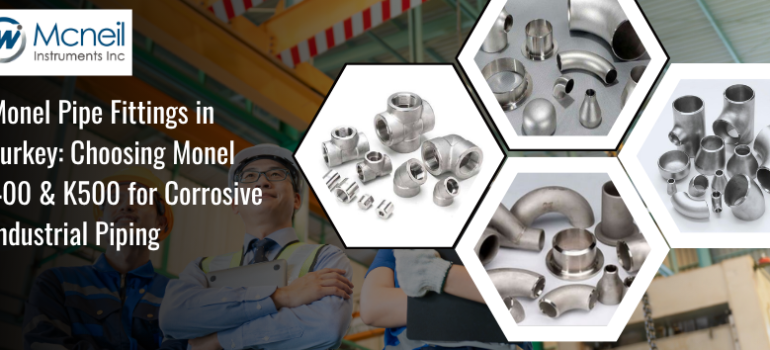
Monel Pipe Fittings in Turkey: Choosing Monel 400 & K500 for Corrosive Industrial Piping

Industrial piping systems in Turkey serve a wide range of demanding applications, from petrochemical and chemical processing to marine operations, power generation, oil & gas and water-treatment facilities. These environments can expose piping components to seawater, chlorides, acidic fluids, alkaline solutions, hydrocarbons, elevated temperatures and mechanical stress.

In such conditions, conventional piping materials may not always provide the corrosion resistance, strength and service life required for critical connections. This is where Monel Pipe Fittings can offer an important material solution.

Monel is a family of nickel-copper alloys known for strong resistance to seawater, acids, alkaline environments and other aggressive media. Mcneil Instruments manufactures and supplies Monel 400 and Monel K500 Pipe Fittings for demanding industrial applications, including elbows, tees, reducers, couplings, crosses, caps, plugs and stub ends.

For industrial buyers in Turkey, understanding the differences between Monel 400 and Monel K500, their applications and selection criteria is essential when specifying fittings for corrosive and mechanically demanding piping systems.

Why Monel Pipe Fittings Are Important for Turkish Industries

Turkey has a diverse industrial infrastructure involving manufacturing, energy, chemicals, petrochemicals, marine operations, construction and process industries. Its coastal geography also makes corrosion-resistant materials particularly relevant for marine and offshore-related applications.

Pipe fittings are critical connection components in these systems. They change flow direction, join pipes, create branches, reduce pipe diameter and close piping sections.

When fittings are exposed to aggressive service conditions, material selection becomes particularly important.

Monel Pipe Fittings can provide:

  • Excellent seawater resistance
  • Strong resistance to chloride-containing environments
  • Resistance to acidic and alkaline media
  • Good mechanical strength
  • Resistance to corrosion-related degradation
  • Good performance in marine environments
  • High durability
  • Good fabrication characteristics
  • Long service life in suitable applications

Mcneil Instruments describes Monel fittings as nickel-copper alloy components intended for severe corrosion, temperature and mechanical-stress environments.

What Are Monel Pipe Fittings?

Monel Pipe Fittings are piping components manufactured from nickel-copper alloys and used to connect, redirect, branch, reduce or terminate piping systems.

Depending on the configuration, they can be used to:

  • Change the direction of fluid flow
  • Connect two pipes
  • Create branch connections
  • Transition between different pipe diameters
  • Close a piping section
  • Connect piping to other components
  • Provide specialized piping configurations

Monel fittings are particularly useful where corrosion resistance is a major consideration.

Mcneil Instruments offers Monel fittings in Monel 400 and Monel K500 grades for industrial applications.

Monel 400 Pipe Fittings for Corrosive Applications

Monel 400 Pipe Fittings are manufactured from a nickel-copper alloy known for its resistance to seawater, hydrofluoric acid, sulfuric acid and alkaline environments.

Mcneil Instruments identifies Monel 400 as UNS N04400 and publishes a composition of at least 63% nickel and up to 28% copper, with additional limits for iron, manganese and carbon.

Key Characteristics of Monel 400

  • Excellent fresh- and salt-water resistance
  • Good resistance to hydrofluoric acid
  • Good resistance to sulfuric acid
  • Resistance to neutral and alkaline solutions
  • Good mechanical strength
  • Good weldability
  • Good fabrication characteristics
  • Suitable performance at temperatures up to approximately 315°C according to Mcneil’s published product data

Typical Monel 400 Applications

Monel 400 fittings can be considered for:

  • Marine piping
  • Seawater systems
  • Heat exchangers
  • Chemical processing
  • Oil & gas systems
  • Refinery applications
  • Hydrocarbon processing
  • Pump and valve connections
  • Industrial piping systems

For Turkish industries operating near coastal and marine environments, Monel 400 can be particularly relevant where seawater and chloride exposure are important design considerations.

Monel K500 Pipe Fittings for Higher-Strength Applications

Monel K500 Pipe Fittings combine the corrosion resistance characteristics of Monel 400 with higher mechanical strength through precipitation hardening.

Mcneil Instruments identifies Monel K500 as UNS N05500 and lists aluminum and titanium additions that contribute to its increased strength.

Why Choose Monel K500?

Monel K500 offers:

  • High tensile strength
  • High yield strength
  • Excellent seawater resistance
  • Good performance in marine environments
  • Resistance to hydrocarbons
  • Improved wear resistance
  • Good mechanical durability
  • Suitability for demanding pump and valve components

Mcneil Instruments publishes a minimum tensile strength of 965 MPa and minimum yield strength of 585 MPa for its K500 pipe-fitting specifications.

Typical Monel K500 Applications

Monel K500 fittings can be considered for:

  • Offshore equipment
  • Marine systems
  • Seawater applications
  • Oil & gas equipment
  • Pump components
  • Valve components
  • High-strength piping assemblies
  • Chemical processing equipment

Where both corrosion resistance and higher mechanical strength are required, K500 may be selected instead of Monel 400 when the project specification supports it.

Monel 400 vs Monel K500 Pipe Fittings

Although Monel 400 and Monel K500 belong to the same nickel-copper alloy family, they are not identical materials.

PropertyMonel 400Monel K500
UNSN04400N05500
Alloy TypeNickel-CopperPrecipitation-Hardening Nickel-Copper
Nickel≥63%~63%
Copper≤28%~28%
Aluminium—2.15–3.15%
Titanium—0.35–0.85%
Tensile Strength550–750 MPa≥965 MPa
Yield Strength≥240 MPa≥585 MPa
Elongation≥30%≥20%
Hardness~200 HB≤328 HB
Published Temperature Range−200°C to +315°C−196°C to +315°C
Typical FocusCorrosion resistance and fabricationHigher strength, wear resistance and corrosion resistance

The above figures are based on Mcneil Instruments’ published Monel pipe-fitting specifications.

Which Grade Should You Choose?

The correct grade depends on the actual service conditions.

Choose Monel 400 when:

  • Corrosion resistance is the primary consideration
  • The application involves seawater or acidic environments
  • Good ductility and fabrication are important
  • Moderate mechanical strength is sufficient

Choose Monel K500 when:

  • Higher tensile and yield strength are required
  • Wear resistance is important
  • The component is exposed to higher mechanical loads
  • Marine or hydrocarbon service requires a stronger nickel-copper alloy

The final material selection should always follow the engineering specification, design conditions and applicable standards.

Types of Monel Pipe Fittings Available

Different piping layouts require different fitting configurations.

Mcneil Instruments offers a range of Monel pipe fittings including elbows, tees, crosses, reducers, couplings, unions, caps, plugs and stub ends.

Monel Elbows

Monel Elbows are used to change the direction of piping.

Common configurations include:

  • 45° elbows
  • 90° elbows
  • Long-radius elbows
  • Short-radius elbows

They can be used in marine, chemical, oil & gas and process piping systems where corrosion resistance is required.

Monel Tees

Monel Tees create a branch connection from the main pipeline.

They can be used for:

  • Process branches
  • Instrument connections
  • Chemical piping
  • Marine piping
  • Hydrocarbon systems

Monel Crosses

Monel Cross Fittings allow multiple piping branches to be connected at a common point.

They can be useful in specialized process and distribution systems.

Monel Reducers

Monel Reducers connect pipes with different diameters while providing a controlled transition between sizes.

Available designs can include:

  • Concentric reducers
  • Eccentric reducers

Monel Couplings and Unions

Couplings and unions are used to connect piping sections.

They can provide practical connection and maintenance options for suitable piping systems.

Monel Caps and Plugs

Monel Caps and Plugs are used to close pipe ends or unused connections.

They can be useful in:

  • Pipeline termination
  • Equipment connections
  • Maintenance arrangements
  • Future expansion points

Monel Stub Ends

Monel Stub Ends can be used with lap-joint flange assemblies.

They are useful where frequent dismantling, alignment or maintenance is required.

Monel Pipe Fittings for Turkey’s Oil & Gas Industry

Turkey’s energy infrastructure includes oil and gas processing, transportation and industrial facilities where piping components may encounter hydrocarbons, pressure and corrosive service conditions.

Monel fittings can be considered for selected applications involving:

  • Hydrocarbon processing
  • Refinery piping
  • Offshore equipment
  • Marine terminals
  • Pump systems
  • Valve assemblies
  • Seawater-related equipment

The choice between Monel 400 and K500 depends on the required combination of corrosion resistance, mechanical strength, temperature and service conditions.

Monel Fittings for Petrochemical Applications

Petrochemical plants require piping components capable of operating in complex process environments.

Fittings can be exposed to:

  • Hydrocarbons
  • Process chemicals
  • Elevated temperatures
  • Pressure fluctuations
  • Corrosive compounds
  • Mechanical loads

Monel Pipe Fittings can be considered for applications where nickel-copper alloy construction provides an appropriate corrosion-resistance advantage.

Potential applications include:

  • Process piping
  • Heat exchangers
  • Chemical transfer lines
  • Pumps
  • Valves
  • Process equipment connections

Monel Pipe Fittings for Chemical Processing

Chemical-processing environments can be particularly demanding because material compatibility depends heavily on the chemical composition, concentration, temperature and pressure of the process fluid.

Monel 400 is known for resistance to several acidic and alkaline environments, including hydrofluoric acid and sulfuric acid, according to Mcneil Instruments’ product information.

This makes Monel fittings a potential choice for selected chemical-processing applications.

However, material selection should always be verified against the specific chemical service rather than assuming that Monel is suitable for every chemical.

Monel Fittings for Marine and Shipbuilding Applications

Turkey has an important maritime and shipbuilding industry, making corrosion-resistant materials relevant for marine piping and equipment.

Marine systems can involve continuous exposure to:

  • Seawater
  • Salt spray
  • Chlorides
  • Humidity
  • Marine atmospheres

Monel 400 and K500 are particularly relevant to applications where resistance to seawater and marine corrosion is important.

Possible applications include:

  • Seawater piping
  • Marine pumps
  • Valves
  • Heat exchangers
  • Shipbuilding equipment
  • Offshore systems
  • Marine manifolds

Mcneil Instruments identifies marine and seawater applications among the key uses of its Monel fittings.

Monel Pipe Fittings for Power Generation

Power plants use extensive piping networks for steam, cooling water, fuel, process fluids and auxiliary systems.

Depending on the service, Monel fittings can be considered for applications involving:

  • Cooling systems
  • Water systems
  • Chemical treatment systems
  • Heat exchangers
  • Specialized process piping
  • Corrosive fluid systems

The fitting grade should be selected based on the specific temperature, pressure and fluid conditions.

How to Select Monel Pipe Fittings for Industrial Projects in Turkey

Selecting a Monel fitting requires more than choosing between 400 and K500.

1. Identify the Process Fluid

Determine exactly what the fitting will carry.

Consider:

  • Chemical composition
  • Concentration
  • pH
  • Chloride content
  • Water content
  • Hydrocarbon content

2. Determine Operating Temperature

Temperature affects material performance and should be evaluated together with pressure and process chemistry.

Mcneil Instruments lists an operating range extending to approximately 315°C for both Monel 400 and K500 in its published product specifications.

3. Determine Operating Pressure

The fitting must be appropriate for the piping-system pressure.

Pressure class, wall thickness, fitting design and connection configuration should all be considered.

4. Choose the Alloy

Select Monel 400 or Monel K500 according to the required combination of corrosion resistance, strength, wear resistance and fabrication characteristics.

5. Select the Fitting Type

Determine whether the piping system requires:

  • Elbows
  • Tees
  • Crosses
  • Reducers
  • Couplings
  • Unions
  • Caps
  • Plugs
  • Stub ends

6. Confirm Dimensions

Important dimensional considerations include:

  • Nominal pipe size
  • Outside diameter
  • Wall thickness
  • End connection
  • Fitting dimensions
  • Radius
  • Overall length

7. Verify Applicable Standards

The fitting should be supplied according to the standard specified for the project.

Mcneil Instruments’ published Monel information references ASTM, ASME, MSS, ISO and DIN requirements across its Monel fitting information.

8. Review Quality Documentation

For industrial projects, buyers may require documentation such as:

  • Material Test Certificates
  • Chemical analysis
  • Mechanical test results
  • Dimensional inspection
  • PMI
  • NDT reports
  • Heat-treatment records where applicable
  • Traceability documentation

Documentation requirements should be established before procurement.

What Makes Monel Different from Stainless Steel Pipe Fittings?

Stainless steel and Monel are not interchangeable materials.

Stainless steel can provide excellent corrosion resistance across many industrial applications, but Monel’s nickel-copper composition can provide advantages in selected seawater, chloride, acidic and alkaline environments.

Monel can therefore be considered when the service environment is particularly aggressive and the engineering specification calls for a nickel-copper alloy.

The decision should be based on actual corrosion data, operating conditions, design requirements and lifecycle considerations rather than simply choosing the more expensive alloy.

Why Monel Pipe Fittings Can Be Valuable in Corrosive Environments

The primary reason for selecting Monel is its combination of corrosion resistance and mechanical performance.

Corrosion Resistance

Monel alloys are known for resistance to seawater and various acidic and alkaline environments.

Mechanical Strength

Monel 400 provides useful mechanical strength, while K500 offers substantially higher tensile and yield strength according to Mcneil’s published specifications.

Marine Performance

Monel is well suited to selected marine applications involving seawater and salt exposure.

Durability

Appropriate material selection can help extend component service life and reduce premature replacement in corrosive systems.

Versatility

Monel fittings are available in several configurations, allowing them to be incorporated into different piping arrangements.

Mcneil Instruments – Monel Pipe Fittings for Turkey

Mcneil Instruments manufactures, supplies and exports Monel Pipe Fittings in Monel 400 and Monel K500 grades.

Its product range includes:

  • Monel Elbows
  • Monel Tees
  • Monel Crosses
  • Monel Reducers
  • Monel Couplings
  • Monel Unions
  • Monel Caps
  • Monel Plugs
  • Monel Stub Ends

The company identifies applications across marine, oil & gas, chemical processing and power-generation industries.

For Turkish industrial projects, Mcneil Instruments also maintains a dedicated pipe-fittings presence covering major industrial areas and markets in Turkey. Its Turkey-focused information highlights applications across industrial and infrastructure projects and identifies cities and industrial zones including Istanbul, Kocaeli, Bursa, Sakarya and Ankara.

Related Mcneil Instruments Products

For projects requiring other corrosion-resistant piping components, buyers can also explore Mcneil Instruments’ related:

  • Monel Tube Fittings
  • Inconel Pipe Fittings
  • Hastelloy Pipe Fittings
  • Stainless Steel Pipe Fittings
  • Carbon Steel Pipe Fittings
  • Titanium Pipe Fittings

These materials can be selected according to the specific corrosion, temperature, pressure and mechanical requirements of the application.

Quality Considerations When Buying Monel Pipe Fittings

When sourcing Monel fittings for Turkey, buyers should evaluate more than price and availability.

Material Verification

Confirm the specified Monel grade and heat/lot traceability.

Dimensional Accuracy

Fittings should conform to the specified dimensional requirements for proper fit-up.

Surface Condition

The surface should be suitable for the intended service and free from unacceptable defects.

Mechanical Properties

Verify that tensile strength, yield strength and elongation meet the applicable specification.

Testing

Depending on the project, testing may include chemical, mechanical, dimensional and non-destructive examinations.

Certification

Request appropriate material and quality documentation before dispatch.

Packaging

Monel fittings should be appropriately protected during storage and transportation to prevent damage and contamination.

Frequently Asked Questions About Monel Pipe Fittings in Turkey

What are Monel Pipe Fittings used for?

Monel Pipe Fittings are used to connect, redirect, branch, reduce or terminate piping systems in applications requiring strong corrosion resistance. Typical industries include marine, oil & gas, chemical processing and power generation.

Which Monel grades does Mcneil Instruments supply?

Mcneil Instruments’ published Monel Pipe Fittings range includes Monel 400 and Monel K500.

What is Monel 400?

Monel 400 is a nickel-copper alloy identified as UNS N04400. Mcneil Instruments publishes it with at least 63% nickel and up to 28% copper and highlights its resistance to seawater, hydrofluoric acid, sulfuric acid and alkaline environments.

What is Monel K500?

Monel K500 is a precipitation-hardening nickel-copper alloy identified as UNS N05500. It combines corrosion resistance with higher mechanical strength than Monel 400.

What is the difference between Monel 400 and K500?

Monel 400 is primarily valued for corrosion resistance, ductility and fabrication characteristics, while K500 provides significantly higher tensile and yield strength along with corrosion resistance.

Are Monel fittings suitable for seawater?

Yes. Monel 400 and K500 are used in selected seawater and marine applications because of their corrosion resistance. Mcneil Instruments specifically identifies seawater and marine environments among their applications.

Can Monel pipe fittings be welded?

Monel 400 has good weldability according to Mcneil Instruments. Welding procedures should nevertheless be selected according to the specific alloy, fitting design and applicable welding specification.

What types of Monel fittings are available?

Mcneil Instruments lists elbows, tees, crosses, reducers, couplings, unions, caps, plugs and stub ends.

Are custom Monel fittings available?

Mcneil Instruments states that custom fabrication and sizing can be provided to match specific project requirements.

Where are Monel fittings used in Turkey?

Potential Turkish applications include marine and shipbuilding facilities, oil & gas operations, petrochemical plants, chemical-processing facilities, power generation and other industrial piping systems where corrosion resistance is important.

How should I select Monel 400 or K500?

Evaluate the process medium, temperature, pressure, corrosion conditions, mechanical loads, wear requirements, fitting configuration and applicable material specification. Monel K500 should be considered when the higher mechanical strength of the precipitation-hardened alloy is required.

Conclusion

Monel Pipe Fittings in Turkey can provide a reliable material option for industrial piping systems exposed to seawater, chlorides, chemicals, hydrocarbons and other demanding service conditions.

The two principal grades offered by Mcneil Instruments—Monel 400 and Monel K500—serve different engineering requirements. Monel 400 offers a strong combination of corrosion resistance, mechanical properties and fabrication characteristics, while Monel K500 provides substantially higher tensile and yield strength while retaining the corrosion-resistant characteristics associated with the nickel-copper alloy family.

For Turkey’s marine, oil & gas, petrochemical, chemical, power and industrial sectors, the correct fitting should be selected based on the actual operating environment rather than material cost alone.

Mcneil Instruments provides Monel elbows, tees, crosses, reducers, couplings, unions, caps, plugs and stub ends, supporting industrial piping requirements with Monel 400 and K500 grades.

Read More

When Corrosion Wins, Monel Doesn’t: Why Indiana Industries Trust Monel Pipe Fittings for Extreme Conditions

Introduction: Not All Failures Are Visible—Corrosion Is the Silent One

Here’s the thing—most industrial failures don’t happen suddenly. They build up over time through corrosion, chemical exposure, and material fatigue.

In Indiana’s industries—especially chemical processing, power, and manufacturing—this is a real challenge. That’s exactly why Monel pipe fittings are used. A reliable manufacturer, supplier, and exporter ensures these fittings deliver durability, corrosion resistance, and long-term performance where standard materials fail.

Across Indiana, industries rely on experienced Monel pipe fittings manufacturers, suppliers, and exporters to maintain safe and efficient systems.

What Are Monel Pipe Fittings?

Monel pipe fittings are components made from a nickel-copper alloy, designed for high-performance piping systems exposed to harsh environments.

They are used to connect, control, and redirect flow in systems where corrosion resistance and strength are critical.

Common Types

• Elbows (45°, 90°, 180°)
• Tees and crosses
• Reducers
• Caps and stub ends
• Couplings and adapters

A trusted supplier and exporter ensures availability across all configurations and sizes.

Why Monel Is Different from Standard Alloys

Let’s break it down—Monel isn’t just another metal. Its performance comes from its composition:

• High nickel content provides structural strength
• Copper enhances corrosion resistance
• Stable under both acidic and alkaline environments

Monel alloys are known to resist corrosion from seawater, acids, and aggressive chemicals—often outperforming stainless steel in extreme environments.

Technical Specifications Table

ParameterSpecification
Product TypeMonel Pipe Fittings
StandardsASTM B366 / ASME SB366
GradesMonel 400, Monel K500
Size Range½″ to 48″ NB
ThicknessSCH 10 to SCH XXS
TypeSeamless / Welded / Forged
Pressure RatingUp to 6000 PSI
End ConnectionsThreaded / Buttweld / Socket Weld

Leading manufacturers, suppliers, and exporters ensure these fittings meet global industrial standards.

Key Properties of Monel Pipe Fittings

Corrosion Resistance

• Resistant to acids like hydrochloric and sulfuric
• Performs well in seawater and chemical environments

High Strength

• Stronger than many conventional alloys
• Maintains integrity under pressure

Thermal Stability

• Performs in high-temperature environments
• Retains properties across temperature ranges

Ductility & Workability

• Easy to fabricate and weld
• Maintains flexibility even at low temperatures

Grade Comparison Table

GradeKey FeatureStrengthCorrosion ResistanceBest Application
Monel 400Excellent corrosion resistanceHighVery HighChemical & marine
Monel K500Added strength with aluminum & titaniumVery HighVery HighHigh-stress systems

Monel K500 offers enhanced strength while maintaining corrosion resistance, making it suitable for demanding applications.

Additional Performance Comparison Table

FactorMonelStainless SteelCarbon Steel
Corrosion ResistanceVery HighHighLow
StrengthHighMediumMedium
CostHighMediumLow
Service LifeVery LongLongModerate

Monel is more expensive, but its durability and resistance make it the preferred choice for critical applications.

Why Monel Pipe Fittings Are Critical in Indiana

Indiana industries deal with:

• Chemical exposure in processing plants
• High-pressure systems in manufacturing
• Continuous operational cycles
• Risk of corrosion-related failure

Monel fittings solve these problems by offering:
• Long service life
• Resistance to aggressive chemicals
• Stability under pressure and heat

That’s why industries prefer sourcing from trusted manufacturers, suppliers, and exporters.

Industrial Applications in Indiana

Monel pipe fittings are widely used across industries:

Chemical Processing
Handles acids and corrosive fluids

Oil & Gas Industry
Pipelines and offshore systems

Power Generation
High-temperature and pressure systems

Marine & Coastal Applications
Seawater handling and cooling systems

Industrial Manufacturing
Fluid transfer and control systems

Monel fittings are especially useful in environments involving seawater, acids, and hydrocarbon processing.

Manufacturing Process

Top manufacturers, suppliers, and exporters follow strict production standards:

Process Flow

• Nickel-copper alloy preparation
• Forging or machining
• Heat treatment
• Precision finishing
• Surface treatment
• Final inspection

This ensures durability, precision, and long service life.

Key Advantages of Monel Pipe Fittings

Exceptional Corrosion Resistance
Ideal for harsh chemical environments

High Strength
Handles pressure and stress

Thermal Stability
Performs in extreme temperatures

Durability
Long service life

Low Maintenance
Reduces operational costs

These benefits make them a preferred choice from leading manufacturers, suppliers, and exporters.

Quality Testing and Assurance

To ensure reliability, fittings undergo strict testing:

• Hydrostatic testing
• Ultrasonic inspection
• Chemical composition analysis
• Mechanical testing
• Dimensional verification

A trusted manufacturer and exporter ensures every fitting meets industrial standards.

Conclusion

Monel pipe fittings are designed for industries where corrosion, pressure, and reliability are constant challenges.

In Indiana, where industrial systems demand durability and performance, working with a trusted manufacturer, supplier, and exporter ensures long-term efficiency and safety.

If your systems operate in harsh environments, choosing the right Monel pipe fittings supplier and exporter is what keeps your operations running without failure.

Read More

Mcneil Instruments Monel Pipe Fittings – High-Performance Corrosion Resistant Solutions

Introduction

In industries where corrosion resistance and durability are critical, selecting the right material for piping systems becomes essential. Monel, a nickel-copper alloy known for its exceptional resistance to corrosion, is widely used in marine, chemical, and oil & gas applications.

Mcneil Instruments Monel Pipe Fittings are engineered to meet these demanding requirements with precision, strength, and reliability. Designed for high-performance environments, these fittings ensure long-term durability and efficient fluid flow in even the harshest conditions.

If you are looking for premium Monel pipe fittings, Mcneil Instruments offers a trusted solution backed by quality manufacturing and industry expertise.

Why Choose Mcneil Instruments Monel Pipe Fittings

Choosing the right manufacturer plays a crucial role in the performance of your piping system. Mcneil Instruments has established itself as a reliable supplier of high-quality pipe fittings that meet global standards.

Key Highlights

✔ High corrosion resistance for extreme environments
✔ Manufactured using premium Monel alloy
✔ Precision engineering for leak-proof performance
✔ Long service life with minimal maintenance
✔ Suitable for multiple industrial applications

Mcneil Instruments focuses not just on product quality but also on long-term performance and reliability.

What Are Monel Pipe Fittings?

Monel pipe fittings are components used to connect, control, and direct the flow of fluids within piping systems. Made from a nickel-copper alloy, these fittings offer excellent resistance to:

● Seawater corrosion

● Acidic and alkaline environments

● High temperatures

● Stress corrosion cracking

Because of these properties, Monel fittings are widely used in industries where standard materials fail under extreme conditions.

Types of Monel Pipe Fittings Offered by Mcneil Instruments

Mcneil Instruments provides a wide range of Monel pipe fittings designed for various industrial requirements.

1. Elbows

Used to change the direction of flow, elbows are available in different angles such as 45° and 90°. Mcneil Instruments ensures precise curvature for smooth flow and minimal pressure loss.

2. Tees

Tees are used to branch the pipeline into two directions. These fittings are essential in systems where fluid needs to be distributed efficiently.

3. Reducers

Reducers help in connecting pipes of different diameters. Mcneil Instruments manufactures both concentric and eccentric reducers for different flow requirements.

4. Couplings

Couplings are used to join two pipes together securely. They provide strong connections that withstand pressure and temperature variations.

5. Caps and End Closures

These fittings are used to seal the ends of pipes, ensuring safety and preventing leakage in the system.

Applications of Monel Pipe Fittings

Thanks to their exceptional properties, Mcneil Instruments Monel Pipe Fittings are used across multiple industries.

Major Applications

● Oil & Gas Industry

● Chemical Processing Plants

● Marine and Shipbuilding

● Power Generation Plants

● Heat Exchangers

● Offshore Engineering

Their ability to perform under harsh environments makes them a preferred choice for critical applications.

Key Features of Mcneil Instruments Monel Pipe Fittings

Superior Corrosion Resistance

Monel alloy offers outstanding resistance to corrosion, especially in seawater and chemical environments. This ensures longer service life and reduced maintenance costs.

High Strength and Durability

These fittings are designed to withstand high pressure and temperature conditions, making them suitable for demanding industrial operations.

Excellent Fabrication Properties

Monel fittings from Mcneil Instruments are easy to weld, fabricate, and install, ensuring smooth integration into piping systems.

Leak-Proof and Precision Engineered

Each fitting is manufactured with precision to ensure tight connections, preventing leakage and ensuring system efficiency.

Advantages of Using Monel Pipe Fittings

Choosing Monel fittings over other materials provides several advantages:

● ✔ Longer lifespan compared to standard materials

● ✔ Reduced maintenance and replacement costs

● ✔ Excellent resistance to oxidation and corrosion

● ✔ Reliable performance in extreme environments

● ✔ High return on investment

Mcneil Instruments ensures that every product delivers maximum value and performance.

Why Industries Trust Mcneil Instruments

Mcneil Instruments has built a strong reputation in the market due to its commitment to quality and customer satisfaction.

Reasons to Choose Mcneil Instruments

● Proven industry experience

● Strict quality control standards

● Wide product range

● Timely delivery

● Customer-focused approach

Their expertise ensures that clients receive products that meet international standards and industrial requirements.

Results You Can Expect

With Mcneil Instruments Monel Pipe Fittings, industries can achieve:

📊 Improved system efficiency
📉 Reduced downtime and maintenance
💪 Enhanced durability and strength
🌊 Superior corrosion resistance
🚀 Long-term operational reliability

Conclusion

When it comes to high-performance piping solutions, Mcneil Instruments Monel Pipe Fittings stand out as a reliable and durable choice. Designed for extreme conditions and engineered with precision, these fittings ensure safety, efficiency, and long-lasting performance.

If your industry demands corrosion-resistant, high-strength piping components, Mcneil Instruments is the partner you can trust.

FAQ Section

1. What are Monel pipe fittings used for?

They are used in industries requiring corrosion-resistant piping systems such as marine, chemical, and oil & gas.

2. Why choose Monel over stainless steel?

Monel offers better resistance to seawater and chemical corrosion.

3. Are Mcneil Instruments Monel fittings durable?

Yes, they are designed for long-term use in extreme conditions.

4. What industries use Monel pipe fittings?

Oil & gas, marine, chemical, and power industries commonly use them.

5. Do these fittings require maintenance?

They require minimal maintenance due to their corrosion resistance.

6. Why choose Mcneil Instruments?

Because of their quality manufacturing, reliability, and industry expertise.

Read More

Industrial Tubes, Pipe Fittings, Tube Fittings & Valve Fittings in Michigan

Complete Engineering Flow Solutions by Mcneil Instruments

Strengthening Michigan’s Industrial Infrastructure with Precision Components


Michigan has long been recognized as one of America’s most powerful industrial states. From the automotive assembly lines of Detroit to chemical plants, power generation facilities, refineries, heavy equipment manufacturing units, and water treatment plants — industrial performance in Michigan depends heavily on reliable piping and flow control systems.

At the heart of these systems are four essential components:

  • Industrial Tubes
  • Pipe Fittings
  • Tube Fittings
  • Valve Fittings

Mcneil Instruments stands as a trusted manufacturer, supplier, and exporter of these critical components in Michigan, delivering precision-engineered solutions built for durability, safety, and long-term operational excellence.

This comprehensive guide covers every detail — from materials and specifications to applications, quality standards, and performance benefits — giving you a complete understanding of industrial tubing and fitting solutions available in Michigan.


1. Industrial Tubes in Michigan – The Foundation of Fluid Systems

What Are Industrial Tubes?

Industrial tubes are hollow cylindrical components designed to transport fluids, gases, chemicals, steam, hydraulic oil, and other media across industrial systems. Unlike general pipes, tubes are often manufactured with tighter tolerances and smoother finishes for precision applications.

They are critical in industries where pressure integrity, corrosion resistance, and dimensional accuracy are non-negotiable.


Types of Industrial Tubes Offered

1.1 Stainless Steel Tubes

  • Grades: 304, 304L, 316, 316L
  • Excellent corrosion resistance
  • Ideal for chemical and marine environments
  • High-temperature capability

1.2 Duplex & Super Duplex Tubes

  • Higher strength than austenitic stainless steel
  • Superior resistance to stress corrosion cracking
  • Perfect for offshore and high-pressure systems

1.3 Seamless Tubes

  • Manufactured without welding joints
  • Stronger pressure resistance
  • Preferred for critical applications

1.4 Welded Tubes

  • Cost-effective
  • Suitable for moderate pressure applications
  • Smooth surface finish

1.5 Instrumentation Tubing

  • Tight tolerance manufacturing
  • Used in control panels and measurement systems
  • High purity for sensitive environments

Key Features of Mcneil Industrial Tubes

  • High tensile strength
  • Precision outer and inner diameter control
  • Smooth internal surface for optimized flow
  • Resistance to scaling and oxidation
  • Leak-proof structure under high pressure
  • Compliance with ASTM, ASME, and international standards

Applications of Industrial Tubes in Michigan

Michigan industries rely on high-quality tubing in:

  • Automotive manufacturing plants
  • Oil & Gas refineries
  • Power generation stations
  • Chemical processing plants
  • Food processing facilities
  • Pharmaceutical production
  • Hydraulic systems
  • HVAC systems
  • Water treatment facilities

Why Tube Quality Matters

Poor-quality tubes can result in:

  • Pressure drops
  • Leakages
  • Corrosion damage
  • Operational shutdown
  • Safety hazards

Mcneil Instruments ensures strict inspection procedures, dimensional checks, pressure testing, and material verification to eliminate such risks.


2. Pipe Fittings in Michigan – Structural Connectivity for Industrial Pipelines

Understanding Pipe Fittings

Pipe fittings are mechanical components used to connect pipe sections, change direction, control flow paths, and adapt pipe diameters within a system.

Without precision pipe fittings, even the strongest pipes cannot form a secure or reliable network.


Types of Pipe Fittings Available

2.1 Elbows

  • 90° and 45°
  • Used for directional change
  • Available in long and short radius

2.2 Tees

  • Equal tees
  • Reducing tees
  • Allows flow division or merging

2.3 Reducers

  • Concentric reducers
  • Eccentric reducers
  • Connect different pipe diameters

2.4 Couplings

  • Full coupling
  • Half coupling
  • Used for pipe extensions

2.5 Caps & Plugs

  • Seal pipe ends
  • Provide maintenance access

Materials Used

  • Stainless Steel
  • Carbon Steel
  • Alloy Steel
  • Duplex Steel

Each material is selected based on application pressure, temperature, and environmental exposure.


Performance Benefits

  • High-pressure resistance
  • Corrosion resistance
  • Precise threading
  • Dimensional accuracy
  • Long service life

Industrial Applications in Michigan

Pipe fittings are widely used in:

  • Energy plants
  • Automotive fluid systems
  • Municipal water lines
  • Petrochemical industries
  • Heavy equipment manufacturing
  • Marine and offshore applications

Quality Assurance

Mcneil Instruments follows strict manufacturing protocols including:

  • Chemical composition testing
  • Hydrostatic pressure testing
  • Dimensional inspection
  • Surface finish analysis
  • Third-party certification

3. Tube Fittings in Michigan – Precision for Instrumentation & High-Pressure Systems

What Are Tube Fittings?

Tube fittings are specialized connectors designed to join tubing systems, especially in high-pressure, vibration-sensitive, and instrumentation environments.

They are critical in preventing leakage and ensuring safety in fluid control systems.


Types of Tube Fittings

3.1 Compression Fittings

  • Tight sealing through compression
  • Easy installation
  • No welding required

3.2 Double Ferrule Fittings

  • Enhanced grip and sealing
  • High-pressure capability
  • Ideal for critical systems

3.3 Bulkhead Fittings

  • Secure tubing through panels
  • Used in instrumentation setups

3.4 Union Connectors

  • Straight unions
  • Union elbows
  • Union tees

Advantages of Mcneil Tube Fittings

  • Excellent vibration resistance
  • Leak-proof sealing technology
  • Reusable and easy to assemble
  • High mechanical strength
  • Wide temperature tolerance

Common Applications

  • Hydraulic systems
  • Pneumatic control systems
  • Oil and gas instrumentation
  • Chemical dosing systems
  • Analytical laboratories
  • Power plant instrumentation

Importance of Precision Engineering

A minor leak in instrumentation lines can cause:

  • System malfunction
  • Pressure imbalance
  • Safety hazards
  • Costly downtime

Mcneil Instruments ensures micron-level precision in machining and finishing processes to guarantee reliability.


4. Valve Fittings in Michigan – Intelligent Flow Control

The Role of Valve Fittings

Valve fittings regulate and control the movement of fluids within industrial systems. They ensure operational efficiency and safety across pipelines.


Types of Valve Fittings

4.1 Ball Valve Fittings

  • Quick shut-off capability
  • Low torque operation
  • Durable sealing

4.2 Needle Valve Fittings

  • Precise flow control
  • Ideal for low flow rates

4.3 Check Valve Fittings

  • Prevent backflow
  • Protect system integrity

4.4 Instrumentation Valves

  • High precision
  • Suitable for measurement systems

Key Features

  • Corrosion resistance
  • High-pressure compatibility
  • Smooth operational mechanism
  • Long service life
  • Low maintenance

Applications Across Michigan Industries

  • Oil pipelines
  • Chemical plants
  • Automotive cooling systems
  • Power plants
  • Gas distribution systems

5. Manufacturing Excellence & Engineering Standards

Mcneil Instruments maintains world-class manufacturing infrastructure featuring:

  • CNC machining
  • Precision forging
  • Advanced threading technology
  • Automated welding systems
  • Surface treatment facilities

Compliance & Certifications

Products comply with:

  • ASTM standards
  • ASME specifications
  • ISO quality management systems
  • Pressure vessel standards

Every product batch undergoes rigorous inspection and documentation before delivery.


6. Logistics & Supply Chain Strength in Michigan

Mcneil Instruments ensures:

  • Timely dispatch
  • Secure packaging
  • Bulk supply capability
  • Custom specification production
  • Technical documentation support

We support small-scale projects and large industrial contracts alike.


7. Benefits of Sourcing Complete Solutions from One Supplier

Instead of managing multiple vendors, Michigan industries can source:

  • Tubes
  • Pipe Fittings
  • Tube Fittings
  • Valve Fittings

From a single reliable partner.

This ensures:

  • Material consistency
  • Faster project execution
  • Reduced procurement complexity
  • Cost optimization
  • Better quality control

8. Commitment to Long-Term Industrial Partnerships

Mcneil Instruments focuses on:

  • Customer satisfaction
  • Technical consultation
  • After-sales support
  • Custom engineering solutions
  • Sustainable manufacturing practices

We don’t just supply components — we build long-term industrial partnerships.


Conclusion: Michigan’s Trusted Industrial Tubing & Fittings Partner

From precision stainless steel tubes to heavy-duty pipe fittings and advanced valve fittings, Mcneil Instruments delivers engineered excellence across Michigan’s industrial sectors.

Our products are designed to handle high pressure, extreme temperatures, corrosive environments, and demanding operational conditions.

For industries that prioritize safety, durability, efficiency, and compliance — Mcneil Instruments is the dependable partner of choice in Michigan.


Request a Quote for Industrial Tubes & Fittings in Michigan

Looking for a reliable supplier for your next industrial project?

 ✔ Bulk orders
✔ Custom specifications
✔ Fast Michigan delivery
✔ Competitive pricing
✔ Certified quality products

Contact Mcneil Instruments today and get a tailored quote within 24 hours.


Read More
Pipe fittings are essential components that influence system safety, efficiency, and long-term performance. Choosing the right manufacturer ensures both operational reliability and cost savings. Mcneil Instruments supplies premium pipe fittings in Indiana — engineered for resilience, precision, and industrial performance. From project planning to system execution, our fittings deliver dependable results you can trust.

Mcneil Instruments Pipe Fittings in Indiana: Engineered for Strength, Safety & Performance

Introduction: Delivering Trusted Pipe Fittings Solutions Across Indiana

In industrial and infrastructure systems, pipe fittings are more than simple connectors — they are critical components that ensure leak-proof joins, controlled flow direction, and durability under extreme service conditions. Whether in oil refineries, power plants, chemical facilities, or water treatment systems, the quality of pipe fittings directly impacts safety, efficiency, and longevity.

Indiana’s thriving industrial hub demands high-quality piping components capable of withstanding pressure variations, temperature extremes, and corrosive media. Mcneil Instruments, a globally recognized pipe fittings manufacturer, supplier, and exporter in Indiana, delivers precision-engineered solutions trusted by industries throughout the region and around the world.


What Are Pipe Fittings?

Pipe fittings are mechanical accessories used to connect straight pipe sections, alter flow direction, adapt pipe size, or seal off fluid pathways. While basic in concept, they must meet high standards of strength and precision to function reliably in critical systems.

Well-engineered pipe fittings:

✔ Ensure secure, leak-free connections
✔ Maintain structural integrity under pressure
✔ Adapt pipe networks to complex layouts
✔ Support dimensional accuracy in installations
✔ Boost system reliability and safety

Mcneil Instruments manufactures pipe fittings using advanced production processes to deliver superior performance for industrial applications.


Key Industries in Indiana That Use Pipe Fittings

Indiana’s industrial ecosystem spans multiple sectors that rely on quality pipe fittings from Mcneil Instruments:

✔ Oil & Gas processing and distribution
✔ Petrochemical and chemical manufacturing
✔ Power generation and utilities
✔ Water & wastewater treatment
✔ Steel and heavy manufacturing
✔ Construction and infrastructure
✔ HVAC and mechanical installations
✔ Marine and industrial fabrication

These industries require fittings capable of handling high pressures, fluid velocities, and corrosive environments while maintaining operational reliability.


Types of Pipe Fittings Offered by Mcneil Instruments

Mcneil Instruments supplies an extensive range of industrial pipe fittings designed to meet international standards and project specifications:

● Buttweld Pipe Fittings – Elbows, tees, reducers, caps
● Forged Fittings – Socket weld & threaded
● Flanges – Weld neck, slip-on, blind, lap joint
● Couplings & Unions – Secure transitional connections
● Adapters & Reducers – Size and type adaptation
● Tees, Crosses & Elbows – Flow direction control
● Custom-Engineered Fittings tailored to project needs

Every fitting is manufactured for dimensional precision, pressure handling capacity, and long service performance.


Material Grades & Performance Benefits

To meet varied industrial requirements, Mcneil Instruments pipe fittings are available in a range of premium materials:

Stainless Steel Fittings

✔ Superior corrosion resistance
✔ Outstanding strength and thermal stability
✔ Ideal for chemical, marine, and outdoor applications

Carbon Steel Fittings

✔ Cost-effective and reliable
✔ Excellent mechanical performance
✔ Suitable for moderate and high-pressure systems

Alloy Steel Fittings

✔ Enhanced strength at high temperatures
✔ Excellent resistance to stress and cyclic loading

Duplex & Nickel Alloys

✔ Exceptional corrosion resistance
✔ Ideal for aggressive environments and high-risk applications

Choosing the right material ensures a longer service life, reduced maintenance, and improved system safety.


Technical Advantages of Mcneil Instruments Pipe Fittings

Mcneil Instruments pipe fittings are engineered for reliability and performance:

✔ High dimensional precision for proper fit
✔ Smooth interior surfaces to reduce flow turbulence
✔ Superior corrosion and oxidation resistance
✔ High tensile strength and impact resistance
✔ Compatibility with welding and installation methods
✔ Pressure-rated designs for safe operations

These technical attributes make our pipe fittings suitable for demanding industrial environments.


Manufacturing Excellence & Quality Assurance

Quality is at the heart of Mcneil Instruments’ manufacturing process. Each pipe fitting undergoes multiple stages of inspection and testing:

🌟 Raw material verification and certification
🌟 Advanced forging, forming, and machining
🌟 Dimensional and tolerance checks
🌟 Hydrostatic and pressure testing
🌟 Non-Destructive Testing (NDT) – radiographic & ultrasonic
🌟 Surface finishing and protective treatment
🌟 Final inspection before dispatch

All fittings supplied in Indiana meet global standards and performance benchmarks.


Why Quality Pipe Fittings Matter in Indiana

Indiana’s industrial and infrastructure projects operate under complex conditions — from high temperatures and pressures to corrosive and abrasive environments. Inferior pipe fittings can cause:

⚠ Leakage and fluid loss
⚠ Pressure instability
⚠ Increased maintenance costs
⚠ Production downtime
⚠ Safety hazards

Investing in precision-engineered pipe fittings from Mcneil Instruments ensures reliable, efficient, and safe system performance.


Benefits of Choosing Mcneil Instruments Pipe Fittings

For Industrial Operators

✔ Improved system reliability
✔ Reduced downtime and maintenance
✔ Enhanced safety and compliance
✔ Longer service life
✔ Consistent operational performance

For Engineers & Project Leaders

✔ Compliance with international standards
✔ Custom solutions for complex systems
✔ Accurate dimensional performance
✔ Timely delivery and support
✔ Cost-effective solutions

Mcneil Instruments focuses on delivering value-driven solutions optimized for your project requirements.


Why Mcneil Instruments Stands Out in Indiana

Mcneil Instruments is a recognized global supplier trusted for both standard and specialized piping components. Our strengths include:

✅ International quality manufacturing
✅ Advanced production and inspection technology
✅ Broad product range and customization options
✅ Robust export and logistics support
✅ Dedicated technical consultation
✅ Competitive pricing and delivery reliability

We ensure every fitting supports your system’s performance and safety goals.


Conclusion: Superior Pipe Fittings for Industrial Success in Indiana

Pipe fittings are essential components that influence system safety, efficiency, and long-term performance. Choosing the right manufacturer ensures both operational reliability and cost savings.

Mcneil Instruments supplies premium pipe fittings in Indiana — engineered for resilience, precision, and industrial performance. From project planning to system execution, our fittings deliver dependable results you can trust.

👉 Partner with Mcneil Instruments for pipe fittings built for excellence, engineered for the future.

Read More
ASTM A182 is a globally recognized specification for forged or rolled alloy steel fittings suitable for high-temperature and high-pressure service.

Mcneil Instrument India – Leading Alloy Steel ASTM A182 Pipe Fittings Manufacturer, Supplier & Global Exporter

Introduction

In high-pressure piping systems, every connection matters — and the integrity of the entire flow network often depends on the precision, durability, and metallurgical strength of the pipe fittings used. Alloy Steel ASTM A182 Pipe Fittings are engineered to withstand extreme pressure, temperature variations, corrosive environments, and mechanical stress, making them essential for critical industries where safety and reliability cannot be compromised.

At Mcneil Instrument India, we specialize in the manufacturing and global supply of premium-quality Alloy Steel ASTM A182 Forged & Buttweld Pipe Fittings. Designed with high-temperature tensile robustness, corrosion protection, and dimensional accuracy, our fittings ensure long-lasting performance in refineries, power plants, chemical processing units, offshore systems, and heavy industrial environments.

Our product range includes Elbows, Tees, Reducers, Caps, Couplings, Crosses, Unions, Nipples, Olets, Swage Nipples, and Custom-Engineered Fittings, available across ASTM A182 grades F5, F9, F11, F12, F22, F91, and other alloy steel specifications depending on application requirements.


What Are Alloy Steel ASTM A182 Pipe Fittings?

ASTM A182 is a globally recognized specification for forged or rolled alloy steel fittings suitable for high-temperature and high-pressure service.

These fittings provide:

  • Superior mechanical strength
  • High heat resistance (up to 600–650°C+)
  • Excellent corrosion and oxidation resistance
  • Structural integrity under thermal cycling & pressure fluctuations

They are widely used for connecting, branching, terminating, and changing the flow direction in pipelines handling steam, gases, hydrocarbons, chemicals, and high-pressure fluids.

Mcneil Instrument India manufactures Alloy Steel A182 fittings in compliance with ASME, ANSI, MSS-SP, and international dimensional standards including ASME B16.11, ASME B16.9, B16.5, and B16.25.


Types of Alloy Steel ASTM A182 Pipe Fittings Manufactured

1. Buttweld Pipe Fittings (ASME B16.9)

  • Elbows (45°/90°/180°)
  • Reducers (Concentric/Eccentric)
  • Tees (Equal & Reducing)
  • Caps
  • Crosses

Applications: High-pressure pipelines, steam lines, boilers, petrochemical processing.

2. Forged Socket Weld & Threaded Fittings (ASME B16.11)

  • Couplings
  • Unions
  • Nipples
  • Elbows & Tees
  • Bushings
  • Plugs

Applications: Compact high-strength connections in oil & gas, instrumentation, and power plants.

3. Branch Fittings (Olets)

  • Weldolet, Threadolet, Sockolet
  • Sweepolet, Latrolet, Elbolet

Applications: Safe branch connections on run pipes without welding defects.

4. Custom Machined Alloy Steel Fittings

Manufactured as per:

  • Customer drawings
  • Isometric diagrams
  • P&ID requirements
  • Special pressure ratings (Class 2000, 3000, 6000, 9000)

Material Grades Available

Alloy Steel ASTM A182 pipe fittings are available in:

Low Alloy Grades

  • A182 F1
  • A182 F2

Chromium-Molybdenum Grades

  • A182 F5 / F9
  • A182 F11 / F12
  • A182 F22 (2.25Cr-1Mo)
  • A182 F91 (9Cr-1Mo-V)

Key Characteristics

GradeKey FeaturesSuitable Applications
A182 F11 / F22Excellent creep strength, pressure resistanceSteam lines, boilers, power plants
A182 F5 / F9High-temperature resistancePetrochemical cracking, refinery heaters
A182 F91Exceptional oxidation & fatigue resistanceUltra-supercritical power plants

All materials undergo chemical, mechanical, and microstructural testing to ensure conformance with ASTM A182 requirements.


Mechanical & Performance Advantages

✔ High-temperature stability up to 600–650°C+
✔ Excellent fatigue resistance under pressure cycles
✔ Superior creep strength
✔ Oxidation & corrosion resistance for harsh media
✔ Precise dimensional tolerance for leak-free joints
✔ High tensile & yield strength for safety
✔ Long-lasting performance under thermal stress


Manufacturing Process at Mcneil Instrument India

Our production facilities follow stringent international protocols and quality control systems.

1. Raw Material Testing

  • Positive Material Identification (PMI)
  • Chemical analysis (spectrometer)
  • Mechanical property verification
  • Microstructure evaluation

2. Forging / Hot Forming

High-temperature forging ensures:

  • Improved grain flow
  • Increased toughness
  • Structural stability

3. Machining & Shaping

CNC machining ensures:

  • Accurate wall thickness
  • Precision dimensions
  • Smooth internal flow characteristics

4. Heat Treatment

Performed as per grade:

  • Normalizing
  • Annealing
  • Quenching & tempering

Enhances:

  • Hardness consistency
  • Tensile strength
  • Stress relief

5. Surface Treatment

  • Black oxide coating
  • Anti-corrosion oiling
  • Sandblasting
  • Pickling & passivation

6. Quality Inspection

Every fitting undergoes:

  • Dimensional checks
  • Hydrostatic test
  • Hardness test
  • Impact test
  • NDT (UT/RT/MT/PT)
  • Surface & visual examination

All fittings are supplied with EN 10204 3.1 MTC and TPI approval on request.


Technical Specifications

  • Standard: ASTM A182, ASME B16.11, ASME B16.9
  • Size Range: ½” to 48” (or custom)
  • Pressure Ratings: Class 2000, 3000, 6000, 9000
  • Dimensions: As per MSS-SP-75, SP-79, SP-97
  • Surface Finish: Black, pickled, sandblasted, oil-coated
  • End Connections: Beveled, threaded, socket weld
  • Tolerances: As per ASME B16.9 / custom

Industrial Applications

Mcneil Alloy Steel ASTM A182 fittings are widely used in:

  • Refineries & Petrochemical Plants
  • Thermal & Nuclear Power Plants
  • Boilers & Steam Lines
  • Oil & Gas Transmission Pipelines
  • Fertilizer & Chemical Processing Units
  • Offshore & Marine Engineering
  • Heat Exchangers & Pressure Vessels
  • Hydrocarbon Processing Units

Ideal for:

  • High temperature
  • High pressure
  • Corrosive fluid environments
  • Hydrogen-rich atmospheres
  • Thermal cycling

Quality Certifications

  • ISO 9001:2015 Certified
  • PED / IBR compliance (where required)
  • EN 10204 3.1 MTC
  • Full traceability

Testing Includes:

  • PMI Test
  • Mechanical Test
  • Hardness Test
  • Impact Test
  • Hydrostatic / Pneumatic Test
  • NDT (RT/UT/MT/PT)
  • Surface Roughness Check

Why Choose Mcneil Instrument India?

✔ Wide range of ASTM A182 grades (F5 to F91)
✔ Precision-forged, heat-treated, & tested pipe fittings
✔ Perfect dimensional accuracy & high strength
✔ Custom manufacturing as per drawing
✔ Global export to Middle East, Europe, Africa, Asia
✔ Competitive pricing with fast delivery
✔ 100% traceable & certified products

We supply fittings engineered for uncompromised safety, durability, and heavy-duty performance.


Maintenance & Handling Guidelines

  • Store in a clean, dry environment
  • Keep away from moisture to avoid surface oxidation
  • For high-temperature applications, inspect periodically
  • Replace fittings with visible deformation or corrosion
  • Follow proper torqueing and welding practices

Conclusion

Alloy Steel ASTM A182 Pipe Fittings are indispensable components in high-pressure and high-temperature piping systems. At Mcneil Instrument India, each fitting is manufactured with strict metallurgical control, precision engineering, and advanced forging techniques to guarantee exceptional performance under demanding industrial conditions.

Whether for refineries, power plants, petrochemical units, offshore systems, or chemical processing lines — Mcneil provides world-class alloy steel fittings trusted globally for reliability, strength, and longevity.


Frequently Asked Questions (FAQ)

1. What grades of ASTM A182 alloy steel are available?

F5, F9, F11, F12, F22, F91, and other chromium-molybdenum alloy grades.

2. Are these pipe fittings suitable for high-temperature service?

Yes. Many grades (F11, F22, F91) are designed for temperatures up to 600–650°C+.

3. Do you offer forged and buttweld fittings?

Yes. We manufacture both ASME B16.11 forged and ASME B16.9 buttweld fittings.

4. Can fittings be customized?

Yes — fully customized as per drawings, isometric sketches, or application requirements.

5. Are fittings supplied with test certificates?

Yes — all products come with MTC EN 10204 3.1, and TPI reports on request.

Read More

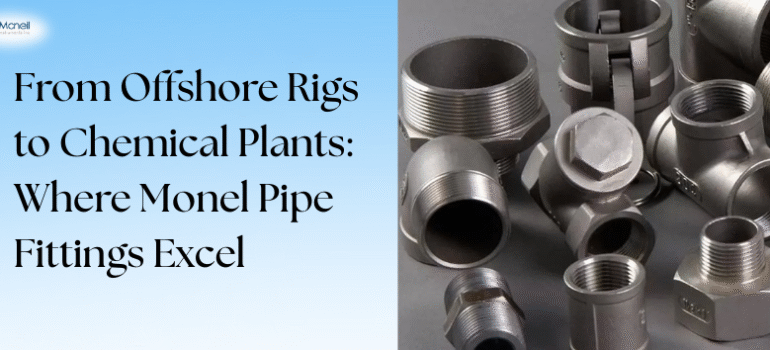
From Offshore Rigs to Chemical Plants: Where Monel Pipe Fittings Excel

Introduction: The Backbone of Corrosion-Resistant Piping Solutions

In industries where seawater, acidic environments, and extreme conditions are common, the material choice for pipe fittings becomes critical. From offshore oil platforms to chemical processing and marine engineering, pipe fittings must guarantee long-term reliability and leak-proof performance. Monel pipe fittings, made from a nickel-copper alloy, are globally recognized for their exceptional corrosion resistance, toughness, and mechanical strength across diverse industrial applications.

With increasing globalization and complex procurement networks, engineers and buyers face the challenge of selecting fittings that not only meet ASTM/ASME international standards but also align with project-specific requirements. This blog provides an in-depth overview of Monel pipe fittings, their properties, specifications, uses, and why Mcneil Instruments is a trusted manufacturer, supplier, and exporter in India.

What are Monel Pipe Fittings?

Monel is a family of nickel-copper alloys (commonly Monel 400 and Monel K500) known for their excellent resistance to seawater, hydrofluoric acid, alkalis, and stress cracking. Unlike many stainless steels, Monel maintains its strength across a wide range of temperatures, from cryogenic levels to elevated conditions.

Monel pipe fittings are available in forms such as elbows, tees, reducers, couplings, crosses, and stub ends, providing reliable connections in demanding systems. Their ability to resist chloride stress corrosion cracking makes them invaluable in marine, oil & gas, desalination, and chemical processing industries.

Key Features of Monel Pipe Fittings

  • Excellent resistance to seawater and marine environments
  • Superior resistance to acids and alkalis, especially hydrofluoric acid
  • Strong mechanical strength at both sub-zero and high temperatures
  • Leak-proof design for critical industrial applications
  • Long-lasting durability, reducing maintenance costs

Importance of Standards in Monel Pipe Fittings

Just as alloy steel pipes follow ASTM A335/ASME SA335 standards, Monel fittings must comply with stringent international norms to ensure performance and reliability.

Why standards matter:

  • Consistency: Guarantees uniform dimensions and performance.
  • Safety: Prevents leaks and failures in critical applications.
  • Compliance: Ensures global acceptance in major projects.
  • Reliability: Meets project specifications for durability under stress.

Technical Specifications of Monel Pipe Fittings

SpecificationDetails
Standards ComplianceASTM B366, ASME SB564, MSS SP-43, ISO, DIN
Grades AvailableMonel 400, Monel K500
Size Range½″ to 24″ (custom sizes available)
Pressure RatingSuitable for high-pressure and marine service
Temperature Range-196°C to +550°C
Forms AvailableElbows, Tees, Reducers, Stub Ends, Crosses, Couplings

Mechanical Properties of Monel Pipe Fittings

PropertyMonel 400Monel K500
Tensile Strength≥ 550 MPa≥ 790 MPa
Yield Strength≥ 240 MPa≥ 550 MPa
Elongation (%)3020
Hardness (HRB)≤ 85≤ 100
Corrosion ResistanceExcellent in marine and alkaline mediaOutstanding with added strength and hardness

Common Applications of Monel Pipe Fittings

Monel 400 Pipe Fittings:

  • Marine engineering and seawater piping
  • Offshore drilling platforms
  • Pump shafts and condenser systems
  • Heat exchangers in corrosive environments

Monel K500 Pipe Fittings:

  • Oil & gas exploration systems
  • Pump and valve components requiring higher strength
  • Fasteners and couplings in marine and aerospace applications
  • Chemical processing units handling strong alkalis and acids

How to Choose the Right Monel Fittings

  • Marine applications: Choose Monel 400 for its exceptional resistance to seawater.
  • High-strength needs: Opt for Monel K500, offering improved mechanical strength.
  • Chemical plants: Use Monel fittings in systems handling acids, alkalis, or brine.
  • Cryogenic applications: Monel retains toughness at extremely low temperatures.

Global Reach of Mcneil Instruments: Monel Pipe Fittings

Mcneil Instruments is a globally recognized manufacturer, supplier, and exporter of Monel pipe fittings, serving critical industries across continents:

  • In Saudi Arabia & UAE, supplied for petrochemical refineries and offshore drilling.
  • In Qatar & Kuwait, exported for desalination plants and chemical projects.
  • In Nigeria & Ghana, used in mining, seawater cooling, and water treatment systems.
  • In the USA (Texas, Chicago), trusted in oil & gas and marine sectors.
  • In Brazil, Malaysia, and Singapore, integrated into pulp & paper, desalination, and marine engineering projects.

Certifications and Testing

Every Monel pipe fitting manufactured by Mcneil Instruments undergoes rigorous quality control:

  • Material Test Certificates (EN 10204 3.1/3.2)
  • Hydrostatic and Pneumatic Testing
  • Non-Destructive Testing (Ultrasonic, Radiography)
  • API, ASTM, ASME Compliance
  • ISO 9001:2015 Certified Facilities

Future Trends in Monel Pipe Fittings

With industries advancing toward renewable energy, offshore engineering, and advanced chemical processing, the demand for Monel alloys is expected to grow. Enhanced machining techniques and precision manufacturing are enabling fittings with longer service life and greater efficiency in extreme environments.

Conclusion: Durable Fittings for Critical Environments

Monel pipe fittings provide unmatched reliability in industries where seawater, alkalis, and acids pose severe challenges. By combining superior mechanical properties with international certifications, Mcneil Instruments ensures durable and leak-proof solutions trusted across global industries.As one of the leading Monel pipe fittings manufacturers, suppliers, and exporters in India,Mcneil Instruments delivers precision-engineered products designed to meet the toughest industrial requirements, from offshore platforms to chemical reactors.

Read More