Introduction: The Simplicity of a Perfect Seal
Think of the simple act of turning a tap at home instant control over water flow with a slight twist. In industries, this same concept is scaled up, often involving extremely high pressures, corrosive fluids, or gases critical to operations. This is where ball valves prove indispensable. They are among the most widely used flow control devices in modern piping systems due to their ability to offer quick shut-off, minimal leakage, and exceptional durability.
Mcneil Instruments, one of the most trusted ball valve manufacturers, suppliers, and exporters in India, specializes in creating high-performance valves designed for industries that demand precision and reliability. This blog will help you understand what ball valves are, how they function, their key components, types, and how to select the right one for your application.
What is a Ball Valve?
A ball valve is a quarter-turn device designed to regulate the flow of liquids or gases. At its core, it consists of a spherical ball with a hollow bore. When the handle is rotated 90 degrees, the ball aligns its bore with the flow path to allow passage, or turns perpendicular to stop it completely.
Ball valves are preferred for their simplicity, tight shut-off capability, and low pressure drop compared to many other valve types. They are especially useful in high-pressure and high-temperature systems, offering longevity even in harsh conditions.
Key Benefits of Ball Valves include:
- Quick quarter-turn operation for instant on/off control
- Superior sealing properties that minimize leakage
- Simple structure with fewer moving parts, reducing wear
- Unrestricted flow in full-port designs
Key Components of a Ball Valve
Ball valves achieve their performance through a combination of essential components, each engineered to withstand industrial stresses.
The body houses the internal elements and is available in materials like stainless steel, brass, or special alloys for corrosive environments. The ball itself may come in full port, reduced port, or V-port designs, affecting flow capacity and control precision. Around this ball lies the seat, commonly made from PTFE or PEEK, creating a leak-proof seal.
The stem connects the ball to the handle, transferring torque for rotation. The handle, a simple lever or actuator, allows operators to open or close the valve quickly even under demanding conditions.
Types of Ball Valves Available
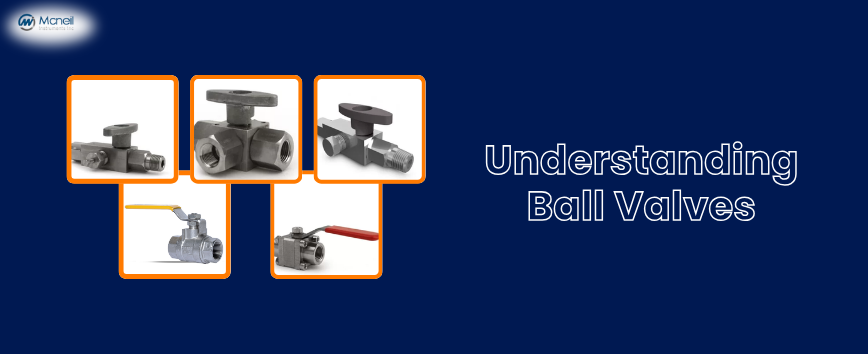
Mcneil Instruments offers a wide range of ball valves tailored to different applications and industries. Each type varies in design, pressure rating, temperature capability, and mounting style.
Key Types of Ball Valves
- Type A: Low to medium pressure ball valve, 1/4″–2″, up to 2000 psi, -40°C to 230°C
- Type B: Three-piece screw-together, 1/2″–2″, 1000–3000 psi, -40°C to 150°C
- Type PB: High-pressure valve, up to 6000 psi, for demanding industrial use
- Type S: Bolt-together design, interchangeable and actuator-friendly
- Type UE & UB: Compact, high-pressure valves, up to 10,000 psi
- Type 3-Way & 4-Way Diverter Valves: For safe high-pressure line diversion
- Type Centurion™: Engineered for natural gas vehicle loading
- Type 3T: High-pressure diverting valves for liquid and gas media
How to Choose the Right Ball Valve
Selecting the correct ball valve requires assessing several factors. First, define the application type whether on/off, throttling, or diversion. Determine the operating pressure and temperature limits to ensure compatibility with system demands. For media that is corrosive, abrasive, or hazardous, material choice becomes critical, stainless steel and exotic alloys offer superior resistance.
Flow capacity also matters: full-port ball valves ensure minimal pressure loss, while reduced-port types provide cost efficiency where flow is not critical. Maintenance considerations are essential for industries requiring continuous operation; three-piece ball valves allow quick servicing without removing the entire assembly.
Ball Valve Specifications
Below are the typical specifications of ball valves offered by Mcneil Instruments:
| Parameter | Details |
| Connection Sizes | 1/4″ to 2 1/2″ |
| Pressure Rating | Up to 10,000 psi |
| Temperature Range | -40°C to 230°C (depending on series) |
| End Connections | Threaded, Socket Weld, Butt Weld, Panel Mount |
| Standards Compliance | ASTM, ASME, ISO |
Mechanical Properties of Ball Valves
| Property | Value |
| Tensile Strength | 485 MPa (min) |
| Yield Strength | 275 MPa (min) |
| Elongation | ≥ 30% |
| Hardness | ≤ 90 HRB |
Applications of Ball Valves
Ball valves are widely used across industries due to their reliability and ease of integration:
- Oil & gas pipelines for high-pressure isolation
- Petrochemical plants managing corrosive fluids
- Power generation systems handling steam and boiler feed lines
- Food and pharmaceutical processing with hygienic designs
- Water treatment and desalination plants requiring durable flow control
Global Reach of Mcneil Instruments
As a leading manufacturer, supplier, and exporter of ball valves in India, Mcneil Instruments delivers to industries across the globe. Our valves are widely utilized in Saudi Arabia, Qatar, Kuwait, Nigeria, Ghana, Texas, Chicago, Malaysia, Singapore, and Brazil, meeting international standards such as ASTM, ASME, and ISO.
Conclusion:
A ball valve may seem like a small component in a complex system, but its role in ensuring operational safety, efficiency, and continuity cannot be overstated. By choosing the right type, material, and configuration, industries can minimize downtime and enhance performance.Mcneil Instruments stands as a reliable partner, offering precision-engineered, certified ball valves designed to meet global demands. For expert guidance, custom solutions, or a complete product range, connect with our team today.