Industrial piping systems used in refineries, power plants, petrochemical facilities, and process industries must withstand demanding operating conditions. Selecting the right pipe fittings is essential for maintaining system integrity, supporting reliable fluid flow, and reducing the risk of leakage or premature failure. ASTM A234 WPB pipe fittings are widely used in carbon steel piping systems designed for moderate and elevated-temperature service.
At Mcneil Instruments, we understand the importance of selecting pipe fittings that meet project specifications, material requirements, and applicable industry standards. In this guide, we explore the properties, applications, selection considerations, and quality requirements of ASTM A234 WPB pipe fittings for demanding industrial piping systems.
ASTM A234/A234M is a material specification covering wrought carbon steel and alloy steel piping fittings for moderate- and elevated-temperature service. Grade WPB is a commonly specified carbon steel grade used in industrial pressure piping applications. Depending on the applicable product standard and design, these fittings are available in configurations such as elbows, tees, reducers, and caps.
ASTM A234 WPB fittings are commonly selected for piping systems carrying water, steam, oil, gas, and other compatible process fluids. Their suitability depends on operating pressure, temperature, fluid characteristics, piping design, and the relevant engineering code.
Mechanical strength Carbon steel WPB fittings provide mechanical properties suited to many industrial pressure-piping applications. The fitting grade, wall thickness, dimensions, and design conditions must be considered together to ensure the completed system meets its requirements.
Suitability for elevated temperatures ASTM A234 covers fittings intended for moderate- and elevated-temperature service. However, the allowable operating temperature and pressure depend on the material properties at the design temperature, the applicable piping code, and the complete system design.
Multiple fitting configurations Different fitting configurations help engineers design piping layouts that accommodate changes in direction, branch connections, and pipe diameter. Elbows: Change the direction of flow. Tees: Create branch connections. Reducers: Connect pipes of different diameters. Caps: Close the end of a pipe.
Compatibility with industrial piping systems ASTM A234 WPB fittings can be specified for compatible carbon steel piping systems when the material, dimensions, joining method, and design requirements align. Material compatibility and corrosion protection should be evaluated for the specific service.
Key industrial applications of ASTM A234 WPB pipe fittings
Oil and gas industry WPB fittings are used in suitable process and utility piping systems for transporting compatible fluids. Selection depends on pressure, temperature, corrosion conditions, and project specifications.
Power generation In power plants, carbon steel fittings may be used in steam, water, and auxiliary piping systems when their design conditions fall within the permitted material limits.
Petrochemical processing ASTM A234 WPB fittings support process piping layouts that require directional changes, branch connections, and transitions between pipe sizes.
Industrial utilities Compatible WPB fittings can be used in selected water, air, and other utility piping applications, subject to the operating conditions and applicable standards.
Before purchasing fittings for high-pressure or elevated-temperature piping, engineers and procurement teams should evaluate the following factors.
Operating pressure and temperature: Confirm the design pressure and design temperature of the complete piping system. Do not select fittings based on material grade alone.
Dimensions and wall thickness: Check nominal pipe size, schedule, fitting dimensions, end preparation, and dimensional tolerances against the piping drawings and applicable standards.
Applicable standards: ASTM A234/A234M specifies material requirements, while dimensional and design requirements are governed by the relevant product standards and piping code. ASME B16.9 is commonly relevant to factory-made wrought butt-welding fittings.
Material traceability: Review material test certificates and product markings to verify the specified grade and traceability requirements.
Inspection and testing: Confirm the required mechanical tests, heat treatment, dimensional inspections, and any additional examinations specified by the purchase order or applicable standard.
Corrosion and fluid compatibility: Evaluate the fluid composition, moisture, contaminants, and operating environment to determine whether carbon steel is appropriate and whether additional corrosion protection is necessary.
Quality assurance and procurement considerations
Reliable sourcing involves more than confirming the grade name. Buyers should verify the manufacturer’s documentation, product dimensions, material identification, inspection requirements, and compliance with the project specification.
For critical services, additional testing or third-party inspection may be required by the purchaser, engineering contractor, or applicable code. Requirements should be established before ordering to avoid delays during inspection and installation.
Mcneil Instruments supports industrial buyers looking for pipe fittings that meet defined project requirements. Procurement teams should provide the required grade, size, schedule, fitting type, quantity, applicable standards, and inspection documentation when requesting a quotation.
Conclusion
ASTM A234 WPB pipe fittings are an established option for many carbon steel piping systems operating under moderate and elevated temperatures. Their suitability for high-pressure applications depends on the complete engineering design, including material properties, dimensions, temperature-dependent pressure limits, fluid compatibility, and applicable codes.
By evaluating these factors and verifying material documentation, industrial buyers can make more informed procurement decisions. Mcneil Instruments can assist customers in identifying pipe fitting requirements in line with their project specifications.
Mcneil Instruments supports industrial piping projects with pipe fitting solutions aligned with customer specifications and application requirements. Contact our team to discuss your required fitting types, sizes, schedules, material documentation, and inspection requirements.
Request a quotation today and share your project specifications with Mcneil Instruments for assistance with your carbon steel pipe fitting requirements.
Frequently asked questions
What is ASTM A234 WPB used for? ASTM A234 WPB specifies wrought carbon steel fittings used in pressure piping and pressure-vessel fabrication for moderate- and elevated-temperature service.
Are ASTM A234 WPB fittings suitable for high-pressure applications? They can be used in appropriately engineered pressure-piping systems. Suitability depends on the design pressure, temperature, fitting dimensions, material properties, and applicable piping code.
What types of fittings are available in ASTM A234 WPB? Common configurations include elbows, tees, reducers, and caps. Availability and dimensional requirements depend on the applicable fitting standard and manufacturer.
Which standard applies to ASTM A234 WPB butt-weld fittings? ASTM A234/A234M covers the material specification. ASME B16.9 commonly covers dimensions and tolerances for factory-made wrought butt-welding fittings. Other fitting types may require different standards.
Can ASTM A234 WPB fittings be used in steam lines? Yes, in suitable steam piping applications when the grade and fitting design meet the specified pressure, temperature, and code requirements.
What documents should buyers request when purchasing WPB fittings? Depending on the project, buyers may request material test certificates, grade and heat-number traceability, dimensional inspection records, test reports, and any specified third-party inspection documentation.
How do I choose the right ASTM A234 WPB fitting size? Confirm the nominal pipe size, schedule, fitting configuration, end connection, and applicable dimensional standard using the approved piping drawings and project specifications.
What is the difference between ASTM A234 WPB and ASTM A105? ASTM A234 WPB is used for wrought carbon steel piping fittings, while ASTM A105 covers carbon steel forgings for piping applications, including many forged flanges and fittings. They are different material specifications and are not interchangeable solely by name.
Industrial piping systems often operate in environments where moisture, chemicals, elevated temperatures, and aggressive process fluids can affect the performance and service life of piping components. Choosing the right material is essential for maintaining operational reliability, reducing maintenance requirements, and supporting safe fluid handling.
SS 316L pipe fittings are widely used in industrial applications that require good corrosion resistance, durability, and reliable performance. Made from low-carbon austenitic stainless steel containing chromium, nickel, and molybdenum, SS 316L offers improved resistance to pitting and crevice corrosion compared with conventional SS 304 in many environments.
For industries such as chemical processing, pharmaceuticals, food processing, marine operations, and industrial instrumentation, selecting suitable pipe fittings is an important part of designing dependable piping systems.
Mcneil Instruments Inc. provides instrumentation products and solutions for industrial applications where reliable connections and appropriate material selection are essential.
SS 316L pipe fittings are piping components manufactured from 316L-grade stainless steel. The term “L” indicates a low carbon content, typically limited to 0.03% maximum by weight under common material specifications.
These fittings are used to connect pipes, change flow direction, create branches, or adapt connections between different piping components. Depending on the design, common fitting types include elbows, tees, reducers, couplings, caps, and other connection components.
SS 316L contains molybdenum, which helps improve resistance to localized corrosion, particularly pitting and crevice corrosion, in many environments. Its low carbon content also helps reduce the risk of sensitization during welding.
The exact performance of an SS 316L fitting depends on the manufacturing standard, surface condition, fabrication method, operating conditions, and chemicals it encounters.
Key Benefits of SS 316L Pipe Fittings
Excellent Corrosion Resistance One of the main advantages of SS 316L pipe fittings is their resistance to corrosion in a wide range of industrial environments. The chromium content supports the formation of a protective passive layer, while molybdenum improves resistance to localized corrosion.
These properties make SS 316L a suitable candidate for many chemical processing systems, industrial fluid-handling installations, and applications exposed to moisture and certain corrosive substances.
However, SS 316L is not resistant to every chemical or concentration. Chloride-rich environments, certain acids, and stagnant conditions may cause corrosion and require a detailed material compatibility assessment.
2. Low Carbon Content for Welded Applications SS 316L has a maximum carbon content of 0.03% under common specifications. This low carbon content helps minimize carbide precipitation and the associated risk of intergranular corrosion in welded components.
As a result, SS 316L is frequently selected for fabricated piping systems where welding is required. Appropriate welding procedures, filler materials, and post-fabrication cleaning remain important for achieving the required corrosion performance.
3. Durability and Mechanical Strength Industrial piping components must withstand operating pressure, mechanical loading, temperature fluctuations, and normal service stresses.
SS 316L offers a useful combination of strength, ductility, and durability for many industrial applications. The suitability of an individual fitting must still be verified against its dimensions, wall thickness, design standard, pressure rating, and operating temperature.
4. Suitability for Hygienic Applications SS 316L is used in many pharmaceutical, food processing, beverage, and biotechnology applications because of its corrosion resistance and suitability for hygienic equipment designs.
Where cleanliness and contamination control are important, the fitting’s surface finish, weld quality, cleanability, and applicable sanitary standards must also be considered. The material grade alone does not guarantee hygienic compliance.
5. Reduced Maintenance Requirements Using a corrosion-resistant material that matches the operating environment can help reduce premature component deterioration and maintenance interruptions.
SS 316L pipe fittings can support reliable service in compatible environments when correctly specified, installed, and maintained. Actual maintenance requirements depend on process conditions, system design, fluid chemistry, and operating practices.
Industrial Applications of SS 316L Pipe Fittings
Chemical Processing Industry Chemical plants use piping components to transport process fluids, connect equipment, and support fluid-handling operations. SS 316L may be suitable for selected applications involving moisture and certain corrosive chemicals.
Before choosing fittings, engineers should evaluate chemical composition, concentration, temperature, pressure, and the possibility of pitting or stress corrosion cracking.
Pharmaceutical and Biotechnology Industry Pharmaceutical and biotechnology facilities require piping systems that support cleanliness, process reliability, and contamination control.
SS 316L is used in selected process equipment, tubing systems, and associated connections. The required surface finish, material traceability, fabrication quality, and hygienic design should be specified according to the application.
Food and Beverage Processing Food and beverage manufacturing often requires corrosion-resistant components that can withstand frequent cleaning and exposure to process fluids.
SS 316L may be appropriate for certain production and cleaning systems. Buyers should confirm compatibility with cleaning chemicals, sanitizing agents, temperature cycles, and the required food-contact or sanitary standards.
Marine and Coastal Applications Marine installations and coastal facilities may expose piping systems to moisture and chloride-containing environments. SS 316L generally provides better resistance to pitting than SS 304, but it can still experience localized corrosion in seawater and other high-chloride conditions.
For severe seawater exposure, engineers should evaluate whether a higher-alloy stainless steel, duplex stainless steel, or another corrosion-resistant material is more appropriate.
Oil, Gas, and Industrial Instrumentation Industrial instrumentation systems often use small-bore piping and tubing connections for process measurement, sampling, and fluid control.
SS 316L fittings may be selected for suitable applications involving process instrumentation, chemical handling, and industrial fluid systems. Correct connection geometry, pressure ratings, material compatibility, and installation procedures are essential for reliable operation.
SS 316L vs. SS 304 Pipe Fittings: What Is the Difference?
SS 304 and SS 316L are both austenitic stainless steels, but their alloy compositions and corrosion performance differ.
SS 304 generally provides good corrosion resistance for many general-purpose applications. SS 316L contains molybdenum, which typically improves resistance to pitting and crevice corrosion in chloride-containing environments. Its low carbon content also makes it a useful option for welded applications.
SS 316L is often preferred when the process environment requires greater resistance to localized corrosion. However, it is not automatically the best choice for every application, and its performance depends on the actual service conditions.
When comparing these grades, buyers should consider corrosion risks, operating temperature, mechanical requirements, fabrication method, relevant standards, and total lifecycle cost.
How to Select the Right SS 316L Pipe Fittings
Choosing the correct pipe fitting requires more than selecting a stainless steel grade. Industrial buyers and engineers should evaluate the following factors.
Material grade and certification: Confirm that the fitting meets the required SS 316L material specification. Request material test certificates and traceability documentation where required.
Fitting type and dimensions: Specify whether you need elbows, tees, reducers, couplings, or other fittings. Confirm nominal pipe size, outside diameter where applicable, wall thickness, schedule, and dimensional tolerances.
Connection type: Identify the required connection, such as butt weld, socket weld, threaded, or another specified configuration.
Pressure and temperature requirements: Verify that the fitting is rated for the intended operating and design conditions under the applicable standard.
Corrosion compatibility: Assess the process fluid, chemical concentration, chloride content, temperature, and exposure conditions before finalizing the material.
Applicable standards: Confirm the relevant dimensional, manufacturing, testing, and inspection requirements for the intended application.
Supplier support: Evaluate product documentation, traceability, quality controls, technical assistance, and delivery capabilities before placing an order.
A structured selection process helps reduce the risk of material mismatch and supports reliable piping system performance.
Selecting suitable instrumentation and piping components is important for industrial operations that depend on reliable process connections.
Mcneil Instruments Inc. serves industrial instrumentation requirements and helps customers explore products suited to their application needs. When enquiring about SS 316L pipe fittings, buyers should share the required grade, fitting type, dimensions, connection details, quantity, applicable standards, and operating conditions.
Providing these details helps establish the technical requirements for a quotation and product suitability review. Confirm availability, certification, specifications, and delivery timelines directly with the supplier.
Conclusion
SS 316L pipe fittings are an important option for industrial piping systems that require corrosion resistance, durability, and dependable performance. Their low carbon content and molybdenum-bearing composition make them particularly useful in many welded and corrosive-service applications.
From chemical processing and pharmaceutical manufacturing to food processing and industrial instrumentation, the correct fitting selection depends on the process environment, pressure and temperature requirements, connection design, and applicable standards.
For reliable results, evaluate the complete operating conditions rather than relying on the material grade alone.
Looking for SS 316L pipe fittings for your industrial application? Contact McNeil Instruments Inc. to discuss your requirements, request a quotation, and confirm suitable product specifications.
Need SS 316L Pipe Fittings for Corrosive Industrial Environments?
Choose the right material for your process requirements. Contact McNeil Instruments Inc. to discuss your fitting specifications, request a quotation, and confirm product availability for your application.
What are SS 316L pipe fittings? SS 316L pipe fittings are connection components made from low-carbon austenitic stainless steel containing chromium, nickel, and molybdenum. They are used to connect piping sections, change flow direction, and create branches in compatible industrial systems.
Why is SS 316L used in corrosive environments? SS 316L contains molybdenum, which generally improves resistance to pitting and crevice corrosion compared with SS 304 in many environments. Its performance still depends on the chemical composition, concentration, temperature, and exposure conditions.
What is the difference between SS 316 and SS 316L? SS 316L has a lower maximum carbon content, typically 0.03%, compared with the commonly specified 0.08% maximum for SS 316. The lower carbon content helps reduce sensitization and intergranular corrosion risks during welding.
Are SS 316L pipe fittings suitable for chemical processing? Yes, SS 316L is suitable for many chemical processing applications, provided the specific chemicals, concentrations, temperatures, and operating conditions are compatible with the material.
Can SS 316L pipe fittings be used in marine environments? SS 316L can be used in some marine and coastal applications, but prolonged exposure to seawater and high chloride concentrations can cause pitting and crevice corrosion. Severe marine applications may require alternative materials.
What types of SS 316L pipe fittings are available? Common fitting types include elbows, tees, reducers, couplings, caps, and other connection components. Availability depends on the supplier’s product range, dimensions, connection type, and applicable specifications.
How do I choose the right SS 316L pipe fittings? Consider the material specification, pipe dimensions, connection type, pressure rating, operating temperature, chemical compatibility, manufacturing standards, and material certification requirements.
Are SS 316L pipe fittings suitable for pharmaceutical applications? SS 316L is widely used in selected pharmaceutical and biotechnology equipment. The fitting must also meet the application’s surface finish, cleanability, fabrication, documentation, and hygienic design requirements.
What information is required to request a quotation? Provide the required material grade, fitting type, size, schedule or wall thickness where applicable, connection type, quantity, standards, certification requirements, and intended operating conditions.
Where can I enquire about SS 316L pipe fittings? Contact Mcneil Instruments Inc. through its website at https://www.mcneilinstruments.com/ to discuss your industrial instrumentation and fitting requirements and confirm product availability.
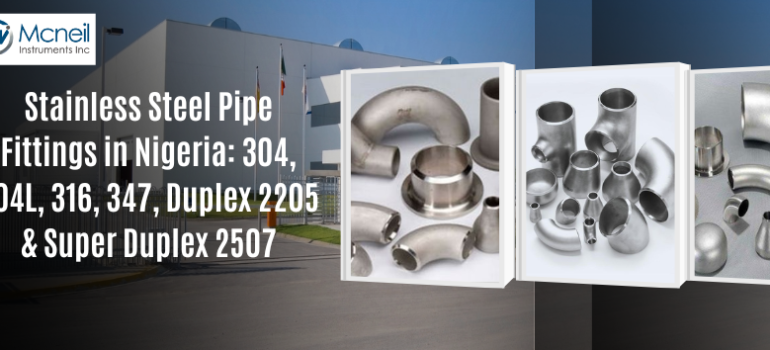
Stainless steel pipe fittings are essential components in industrial piping systems where reliable connections, corrosion resistance, mechanical strength, and long service life are required. In industries across Nigeria, including oil & gas, petrochemical, chemical processing, power generation, marine, water treatment, and food processing, the choice of fitting material can have a direct impact on system performance.
Different operating environments require different stainless steel grades. SS 304, SS 304L, SS 316, SS 347, Duplex 2205, and Super Duplex 2507 pipe fittings offer different combinations of corrosion resistance, strength, temperature capability, and resistance to specific process environments.
Mcneil Instruments supplies stainless steel and duplex pipe fittings for industrial applications, with material selection based on project specifications and operating conditions.
What Are Stainless Steel Pipe Fittings?
Stainless steel pipe fittings are components used to connect, redirect, branch, reduce, or terminate piping systems.
Common stainless steel fittings include:
Elbows
Tees
Reducers
Crosses
Couplings
Unions
Caps
Stub ends
Bends
Nipples
Bushings
Depending on the application, fittings can be supplied in different connection configurations, dimensions, pressure classes, and manufacturing standards.
For Nigerian industrial projects, the appropriate stainless steel grade should be selected according to the process medium, temperature, pressure, corrosion conditions, and applicable project standards.
Stainless Steel 304 Pipe Fittings in Nigeria
Stainless Steel 304 Pipe Fittings are among the most widely used stainless steel fittings for general industrial applications.
SS 304 contains chromium and nickel, providing good corrosion resistance and mechanical performance for a broad range of environments.
Applications of SS 304 Pipe Fittings
SS 304 fittings can be used in:
Food processing plants
Water treatment systems
General chemical processing
Pharmaceutical facilities
Industrial piping
Architectural applications
General process equipment
Benefits of SS 304 Fittings
Good general corrosion resistance
Good mechanical strength
Excellent fabrication characteristics
Good weldability
Easy availability
Suitable for a wide range of industrial applications
SS 304 is often considered when the operating environment does not require the additional corrosion resistance of higher-alloy grades.
Stainless Steel 304L Pipe Fittings in Nigeria
SS 304L Pipe Fittings are the low-carbon version of 304 stainless steel.
The lower carbon content makes 304L particularly useful for welded piping systems because it reduces the risk of carbide precipitation during welding.
Applications
304L pipe fittings are commonly used in:
Process piping
Chemical plants
Food processing
Pharmaceutical industries
Water treatment
Welded stainless steel piping systems
Why Choose 304L?
Key advantages include:
Good corrosion resistance
Excellent weldability
Reduced risk of sensitization after welding
Good mechanical properties
Suitable for fabricated piping systems
For Nigerian projects involving extensive welding, SS 304L can be an appropriate alternative to standard 304 when specified by the engineering design.
Stainless Steel 316 Pipe Fittings in Nigeria
Stainless Steel 316 Pipe Fittings are widely selected when greater corrosion resistance is required.
The presence of molybdenum improves resistance to localized corrosion, particularly in environments containing chlorides.
Applications of SS 316 Fittings
SS 316 pipe fittings are commonly used in:
Oil & gas facilities
Petrochemical plants
Chemical processing
Marine environments
Coastal installations
Pharmaceutical plants
Water treatment systems
Process piping
Advantages of SS 316
Improved corrosion resistance compared with 304
Better resistance to pitting
Good resistance to chloride-containing environments
Good mechanical strength
Excellent weldability
Suitable for demanding industrial applications
For coastal and marine environments in Nigeria, SS 316 may be preferred where chloride exposure is an important design consideration.
Stainless Steel 347 Pipe Fittings in Nigeria
Stainless Steel 347 Pipe Fittings are stabilized austenitic stainless steel fittings designed for applications involving elevated temperatures.
The addition of niobium helps stabilize the material against chromium carbide precipitation.
Applications of SS 347 Fittings
SS 347 fittings can be used in:
High-temperature process piping
Petrochemical plants
Refineries
Heat exchangers
Boiler systems
Exhaust systems
High-temperature industrial equipment
Benefits
Good high-temperature performance
Good oxidation resistance
Suitable for elevated-temperature applications
Good resistance to intergranular corrosion after welding
Good mechanical stability
SS 347 should be considered where elevated temperature and welding conditions make a stabilized stainless steel grade appropriate.
Duplex 2205 Pipe Fittings in Nigeria
Duplex 2205 Pipe Fittings combine characteristics of austenitic and ferritic stainless steels.
Duplex 2205 provides higher strength than conventional austenitic stainless steels and offers strong resistance to several forms of corrosion.
Applications of Duplex 2205 Fittings
Duplex 2205 fittings are commonly used in:
Oil & gas
Offshore facilities
Petrochemical plants
Chemical processing
Desalination plants
Water treatment
Marine applications
High-pressure piping systems
Advantages of Duplex 2205
High mechanical strength
Excellent resistance to chloride stress corrosion cracking
Good pitting resistance
Good corrosion resistance
Suitable for demanding pressure applications
Reduced material thickness may be possible in some designs because of its higher strength
Duplex 2205 is particularly useful when an application requires a combination of high strength and corrosion resistance.
Super Duplex 2507 Pipe Fittings in Nigeria
Super Duplex 2507 Pipe Fittings provide an even higher level of corrosion resistance and strength than standard duplex grades.
Super Duplex 2507 is designed for demanding environments where severe corrosion, chloride exposure, and high mechanical loads are concerns.
Applications of Super Duplex 2507 Fittings
These fittings can be used in:
Offshore oil & gas
Marine applications
Desalination plants
Chemical processing
Petrochemical facilities
Seawater systems
High-pressure process piping
Aggressive chloride environments
Benefits of Super Duplex 2507
Very high mechanical strength
Excellent chloride corrosion resistance
Strong pitting and crevice corrosion resistance
Excellent resistance to stress corrosion cracking
Suitable for demanding marine and offshore environments
For Nigerian offshore and coastal projects, Super Duplex 2507 may be considered where environmental and process conditions exceed the capabilities of conventional stainless steel grades.
SS 304 vs 304L vs 316 vs 347 vs Duplex 2205 vs Super Duplex 2507
Grade
Main Advantage
Typical Applications
SS 304
General corrosion resistance
Food, water, general industrial
SS 304L
Low-carbon, excellent weldability
Welded process piping
SS 316
Improved chloride and pitting resistance
Oil & gas, marine, chemical
SS 347
High-temperature stability
Refineries, heat exchangers, process systems
Duplex 2205
High strength + corrosion resistance
Offshore, oil & gas, chemical
Super Duplex 2507
Very high corrosion resistance and strength
Seawater, offshore, desalination
The most suitable grade depends on the actual operating environment rather than simply choosing the highest-alloy material.
Applications of Stainless Steel Pipe Fittings in Nigeria
Nigeria’s industrial sector includes oil & gas production, refining, petrochemical processing, power generation, water treatment, manufacturing, and marine operations. These industries require piping systems capable of operating reliably under different environmental and process conditions.
Oil & Gas Industry
Stainless steel and duplex fittings can be used in:
Process piping
Hydrocarbon systems
Offshore platforms
Gas processing
Chemical injection systems
High-pressure piping
Duplex and Super Duplex grades can be considered for applications requiring higher strength and corrosion resistance.
Petrochemical Plants
Pipe fittings are used throughout:
Process lines
Heat exchangers
Utility systems
Chemical handling systems
High-temperature piping
SS 316, SS 347, Duplex 2205, and Super Duplex 2507 may be specified depending on the process environment.
Offshore and Marine Applications
Offshore facilities can expose piping systems to moisture and chloride-containing environments.
For demanding marine conditions, Duplex 2205 and Super Duplex 2507 can provide substantially higher resistance than conventional stainless steel grades.
Water Treatment and Desalination
Stainless steel and duplex fittings can be used in:
Water treatment plants
Desalination systems
Pumping systems
Process water lines
Filtration systems
The grade should be selected according to water chemistry and chloride concentration.
Chemical Processing
Chemical plants require careful material selection because process fluids can vary significantly in corrosivity.
Depending on the chemical environment, SS 304, 304L, 316, 347, Duplex 2205, or Super Duplex 2507 may be considered.
How to Select Stainless Steel Pipe Fittings in Nigeria
Choosing the correct fitting grade requires more than identifying the pipe size.
1. Identify the Process Medium
Determine whether the fitting will handle:
Water
Steam
Hydrocarbons
Chemicals
Seawater
Gas
Corrosive process fluids
2. Check Operating Temperature
High-temperature applications may require grades such as SS 347 or another material specifically qualified for the service.
3. Determine Operating Pressure
Confirm the design pressure and select the appropriate fitting class, wall thickness, and connection type.
4. Evaluate Corrosion Conditions
Consider:
Chlorides
Seawater exposure
Pitting
Crevice corrosion
Stress corrosion cracking
Chemical exposure
5. Consider Welding Requirements
For welded systems, low-carbon grades such as 304L may offer advantages depending on the design.
6. Confirm Applicable Standards
The fitting should comply with the required ASTM, ASME, project, EPC, and end-user specifications.
Stainless Steel Pipe Fitting Types
Mcneil Instruments can supply various configurations depending on project requirements.
Common fitting types include:
Stainless Steel Elbows
Used to change the direction of piping, commonly at 45° and 90°.
Stainless Steel Tees
Used to create a branch connection from the main pipeline.
Stainless Steel Reducers
Used to connect pipes with different diameters.
Stainless Steel Crosses
Used when multiple piping branches need to connect at one point.
Stainless Steel Caps
Used to close the end of a pipeline.
Stainless Steel Couplings
Used to connect two sections of pipe.
The required fitting type, dimensions, pressure class, and material grade should be specified during procurement.
Why Choose Duplex Stainless Steel Pipe Fittings?
Duplex grades such as 2205 and 2507 have become important for applications where conventional austenitic stainless steel may not provide the required combination of strength and corrosion resistance.
Their main advantages include:
Higher yield strength
Excellent chloride resistance
Strong resistance to stress corrosion cracking
Good pitting resistance
Reduced wall thickness potential in certain applications
Long-term performance in demanding environments
This makes duplex fittings particularly relevant to oil & gas, offshore, marine, chemical, and desalination applications.
Quality and Inspection of Stainless Steel Fittings
For industrial projects, material quality and traceability are essential.
Depending on project requirements, stainless steel fittings may require:
Chemical composition testing
Mechanical testing
Hardness testing
PMI testing
Dimensional inspection
Visual inspection
Hydrostatic testing where applicable
NDT
Material Test Certificates
Heat-treatment documentation
Traceability documentation
Third-party inspection
For critical Nigerian oil & gas and petrochemical projects, inspection requirements should be established before procurement.
Why Choose Mcneil Instruments for Stainless Steel Pipe Fittings in Nigeria?
Mcneil Instruments supplies stainless steel and duplex pipe fittings for industrial applications, including the following grades:
Stainless Steel 304
Stainless Steel 304L
Stainless Steel 316
Stainless Steel 347
Duplex 2205
Super Duplex 2507
The material can be selected according to the required combination of corrosion resistance, mechanical strength, temperature performance, process conditions, and project specifications.
For Nigerian customers, fittings can be specified according to the required grade, size, schedule, pressure class, connection type, standard, testing, inspection, and certification requirements.
Conclusion
Choosing the correct Stainless Steel Pipe Fittings in Nigeria is essential for building reliable industrial piping systems.
SS 304 and 304L are suitable for many general-purpose and welded applications, while SS 316 provides improved corrosion resistance for more demanding environments. SS 347 is appropriate for selected elevated-temperature applications. For applications requiring higher strength and improved resistance to chloride-related corrosion, Duplex 2205 and Super Duplex 2507 provide advanced material options.
The right fitting should always be selected according to the actual process medium, temperature, pressure, corrosion environment, welding requirements, applicable standards, and service conditions.
Mcneil Instruments supplies SS 304, SS 304L, SS 316, SS 347, Duplex 2205, and Super Duplex 2507 pipe fittings for industrial applications in Nigeria, supporting requirements across oil & gas, petrochemical, chemical, marine, power, water treatment, and other industries.
Frequently Asked Questions
What stainless steel pipe fitting grades are available for Nigerian projects?
Common grades include SS 304, SS 304L, SS 316, SS 347, Duplex 2205, and Super Duplex 2507.
What is the difference between SS 304 and SS 316 pipe fittings?
SS 316 contains molybdenum, which generally provides better resistance to pitting and chloride-related corrosion than SS 304.
Why are 304L pipe fittings used in welded piping?
The lower carbon content of 304L helps reduce the risk of chromium carbide precipitation during welding, making it suitable for many welded stainless steel piping systems.
What are SS 347 pipe fittings used for?
SS 347 fittings are used for applications where elevated-temperature performance and resistance to intergranular corrosion after welding are important.
What are Duplex 2205 pipe fittings used for?
Duplex 2205 fittings are commonly considered for oil & gas, offshore, marine, chemical processing, water treatment, and other applications requiring high strength and corrosion resistance.
When should Super Duplex 2507 be used?
Super Duplex 2507 is designed for highly demanding environments requiring very high strength and corrosion resistance, including offshore, seawater, desalination, and aggressive chloride-containing applications.
Are stainless steel fittings suitable for offshore projects in Nigeria?
Yes, stainless steel and duplex fittings can be used in offshore applications. The grade should be selected based on the specific chloride exposure, process conditions, pressure, temperature, and project specification.
What should be checked before ordering stainless steel pipe fittings?
Buyers should confirm the material grade, pipe size, wall thickness or schedule, fitting type, pressure class, connection type, applicable standard, testing, inspection, certification, and traceability requirements.
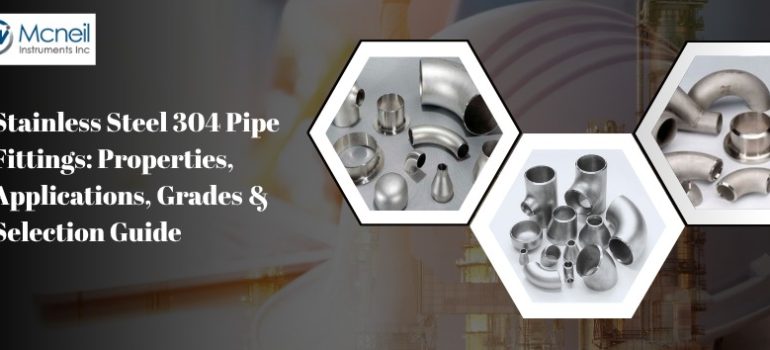
Stainless Steel 304 Pipe Fittings are among the most widely used stainless steel components for industrial piping systems. Their popularity comes from a practical combination of corrosion resistance, mechanical strength, formability, weldability, and relatively broad service capability. Also identified as SS 304, UNS S30400, and EN 1.4301, Grade 304 belongs to the austenitic stainless steel family. It is used across chemical processing, food and beverage, pharmaceutical, water treatment, oil and gas, architectural, and general industrial piping applications. For pressure piping, ASTM A403/A403M is the relevant ASTM specification covering wrought austenitic stainless steel piping fittings. The current ASTM specification covers fittings produced from materials such as forgings, bars, plates, and seamless or welded tubular products, with requirements for chemical composition, mechanical properties, heat treatment, and examination.
Stainless Steel 304 Pipe Fittings are components used to connect, redirect, branch, reduce, or terminate stainless steel piping systems. They are manufactured in different configurations to accommodate changes in piping direction, diameter, or flow arrangement. Common SS 304 fittings include: 45° elbows 90° elbows Equal tees Reducing tees Concentric reducers Eccentric reducers Cross fittings Pipe caps Stub ends Couplings Unions Nipples Socket weld fittings Threaded fittings Butt weld fittings For pressure piping applications, ASTM A403/A403M establishes requirements for wrought austenitic stainless steel fittings and includes different fitting classes based on construction and nondestructive examination.
SS 304 Composition
The performance of Grade 304 comes from its austenitic chromium-nickel composition. A typical 304 stainless steel chemistry includes: Element Typical Role Chromium Provides corrosion and oxidation resistance Nickel Stabilizes the austenitic structure and contributes to toughness Carbon Controlled to maintain the required material properties Manganese Supports strength and processing characteristics Silicon Used as a deoxidizing and alloying element Phosphorus & Sulfur Controlled as residual/alloying elements Iron Balance The exact chemical limits should always be checked against the applicable material specification and purchase standard rather than relying on generic composition tables. ASTM A403 specifically requires chemical and product analyses for the applicable stainless steel fitting grades.
Why Is Stainless Steel 304 Corrosion Resistant?
One of the main reasons SS 304 is so widely used is its chromium content. Chromium allows stainless steel to develop a thin, protective passive oxide layer on its surface. When the surface is exposed to oxygen, this layer can reform, helping protect the underlying metal from corrosion. This makes SS 304 suitable for many environments involving: Moisture Atmospheric exposure Water Mild chemicals Food-processing fluids General industrial service However, 304 is not universally corrosion-proof. High chloride exposure, certain acids, crevices, deposits, and elevated temperatures can create conditions where another stainless grade or nickel alloy is more appropriate. That distinction matters when selecting fittings for demanding process environments.
Mechanical Properties of SS 304
Stainless Steel 304 provides a useful combination of strength and ductility. Its mechanical performance makes it suitable for piping components that need to withstand: Internal pressure Mechanical loads Thermal expansion Vibration Fabrication stresses Handling and installation forces For fittings manufactured under ASTM A403, tensile and yield testing form part of the specification’s mechanical requirements. Actual minimum mechanical values depend on the applicable product specification, grade, product form, heat treatment, and class.
Important Properties of Stainless Steel 304 Pipe Fittings
Corrosion Resistance SS 304 offers good general corrosion resistance, making it suitable for a broad range of industrial and commercial environments.
Good Strength The alloy provides sufficient mechanical strength for many piping applications when correctly designed and rated.
Excellent Formability 304 can be formed into various fitting geometries, making it practical for elbows, tees, reducers, caps, and other configurations.
Weldability SS 304 has good weldability and can be used in welded piping systems when appropriate welding procedures are followed.
Hygienic Surface Its smooth, cleanable surface makes 304 attractive for food, beverage, pharmaceutical, and sanitary applications.
Durability With suitable material selection and installation, SS 304 fittings can provide long service life in many industrial environments.
Stainless Steel 304 vs 304L
One of the most common questions during material selection is the difference between 304 and 304L. The key distinction is carbon content. 304L has a lower maximum carbon content than standard 304. This can reduce the risk of sensitization during certain welding and thermal exposure conditions. Feature SS 304 SS 304L Basic Alloy Chromium-nickel austenitic stainless steel Low-carbon version of 304 Corrosion Resistance Good Good Weldability Excellent Particularly useful for welded construction Carbon Higher than 304L Lower Typical Use General industrial piping Welded piping and fabrication For welded piping systems, 304L may be preferred where the lower-carbon chemistry provides an advantage. The correct grade should be determined from the project specification and welding requirements.
Stainless Steel 304 vs 316
Another important comparison is SS 304 vs SS 316. The major compositional difference is that 316 contains molybdenum, which generally provides improved resistance to localized corrosion in chloride-containing environments. Feature SS 304 SS 316 General Corrosion Resistance Good Higher Chloride Resistance Moderate Better Molybdenum No intentional Mo addition Yes General Industrial Applications Excellent Excellent Marine/Chloride Exposure Application dependent Often preferred For ordinary industrial environments, SS 304 can be a highly practical option. For more aggressive chloride or marine conditions, 316 or another corrosion-resistant alloy may be more appropriate.
Common Types of SS 304 Pipe Fittings
SS 304 Elbows Elbows change the direction of flow. Common configurations include: 45° elbows 90° elbows Long-radius elbows Short-radius elbows They are used throughout process and utility piping systems. SS 304 Tees Tees create branch connections. They are available as: Equal tees Reducing tees They allow flow to be divided or combined within the piping network. SS 304 Reducers Reducers connect pipes with different diameters. The two common configurations are: Concentric reducer: maintains a common centerline. Eccentric reducer: has offset centerlines and can be selected where drainage, pumping, or installation requirements call for an offset arrangement. SS 304 Caps Caps close the end of a pipe or piping section. They are commonly used for permanent termination and selected pressure-piping applications. SS 304 Stub Ends Stub ends are used with suitable flange arrangements and can simplify certain piping connections. SS 304 Couplings Couplings connect two pipe sections and are available in configurations appropriate to the piping system.
Applications of Stainless Steel 304 Pipe Fittings
SS 304’s balance of corrosion resistance, fabrication characteristics, and cost makes it suitable for a broad range of industries. Food and Beverage Industry Hygiene and cleanability are major considerations in food-processing environments. SS 304 fittings can be used in suitable: Processing lines Water systems Product transfer systems Cleaning systems Utility piping Pharmaceutical Industry Pharmaceutical manufacturing requires materials that can be cleaned effectively and maintained to appropriate sanitary standards. SS 304 can be used for selected utility and process piping applications, subject to the specific hygienic requirements of the system. Chemical Processing SS 304 fittings can be suitable for many mild chemical services. However, the exact chemical concentration, temperature, pressure, and exposure time must be evaluated before specifying 304. Water Treatment SS 304 fittings can be used in appropriate: Water-treatment systems Utility water lines Filtration systems General process-water piping More aggressive water chemistry may require 316 or a higher-alloy material. Oil & Gas SS 304 fittings are used in selected oil and gas utility, process, and instrumentation-related piping systems where their corrosion resistance and mechanical properties meet the application requirements. Construction and Infrastructure Stainless steel fittings are also used in building services, industrial infrastructure, and utility installations where durability and corrosion resistance are important.
Why SS 304 Is Widely Used
The popularity of 304 comes down to balance. It is not necessarily the highest-performing stainless steel grade for every environment. Instead, it offers a combination of properties that works well across a very large range of applications. Broad Corrosion Resistance It performs well in many general atmospheric and industrial environments. Good Fabrication Characteristics 304 can be formed and welded into numerous fitting geometries. Strong Availability Because 304 is widely used globally, it is commonly available in many fitting configurations and dimensions. Good Mechanical Performance It provides the strength and toughness needed for many piping applications. Versatility The same basic alloy can be used across food, chemical, water, pharmaceutical, construction, and general industrial applications.
ASTM A403 for SS 304 Pipe Fittings
For buyers specifying wrought stainless steel pressure-piping fittings, ASTM A403/A403M is an important standard to understand. The current ASTM A403/A403M specification covers wrought austenitic stainless steel fittings for pressure piping applications. It includes requirements concerning material composition, heat treatment, mechanical testing, and visual examination. The standard also identifies different fitting classes for WP grades based on whether construction is seamless or welded and on the applicable nondestructive examination requirements. When purchasing SS 304 fittings, the purchase specification should clearly identify: Material grade Applicable ASTM/ASME standard Fitting type Size Schedule or wall thickness End connection Pressure class where applicable Testing requirements Inspection requirements
How to Select SS 304 Pipe Fittings
Selecting a fitting is more than choosing the correct material grade.
Identify the Fluid Determine what the piping system will carry. For example: Water Air Steam Chemicals Food products Gas Process fluids
Check Temperature Corrosion resistance and mechanical performance can change with temperature. Always evaluate the maximum operating and design temperatures.
Determine Pressure The fitting must be suitable for the system’s design pressure and applicable pressure-temperature rating.
Select the Fitting Type Determine whether you require an: Elbow Tee Reducer Cap Stub end Coupling Cross Union
Choose the Connection Depending on the system, options can include: Butt weld Socket weld Threaded Flanged
Consider Corrosion Conditions Check whether the system involves: Chlorides Acids High temperatures Marine exposure Chemical cleaning Crevice conditions If the environment is too aggressive for 304, a different alloy should be evaluated.
SS 304 Pipe Fittings Quality Inspection
For critical industrial applications, material verification and inspection are important. Depending on the applicable standard and project requirements, inspection may include: Chemical analysis Mechanical testing Dimensional inspection Visual examination Surface inspection Hydrostatic testing where applicable Positive material identification Nondestructive examination Heat-treatment verification Material traceability ASTM A403 requires chemical and product analyses and tensile testing for fittings covered by the specification, along with visual examination for surface discontinuities and mechanical marks.
SS 304 Pipe Fittings: Key Specifications to Confirm
Before placing an order, provide the supplier with the complete technical requirement. Specification What to Confirm Material SS 304 / UNS S30400 Standard ASTM A403/A403M or applicable specification Fitting Elbow, tee, reducer, cap, etc. Size Nominal pipe size Thickness Schedule / wall thickness Connection Butt weld, socket weld, threaded, etc. Construction Seamless or welded where applicable Pressure Design/rating requirement Testing Required inspection and NDE Documentation MTC, PMI, inspection reports, etc. This avoids a common procurement mistake: specifying only “SS 304 fitting” without defining the actual dimensional, pressure, manufacturing, and inspection requirements.
SS 304 Pipe Fittings vs Carbon Steel Fittings
Factor SS 304 Carbon Steel General Corrosion Resistance High Lower Moisture Resistance High Requires protection in many environments Appearance Clean metallic finish Typically requires coating/protection Weldability Good Good General Industrial Use Very broad Very broad Cost Generally higher Generally lower Food/Pharma Suitability Strong Application dependent The right choice depends on the operating environment and total lifecycle requirements rather than purchase price alone.
When Should You Choose SS 304?
SS 304 is a strong candidate when you need: Good general corrosion resistance A widely available stainless grade Good weldability Good formability Durable piping components Hygienic surfaces A practical option for general industrial service It may not be the best choice when the system involves particularly aggressive chloride exposure, highly reducing acids, or other environments where a more specialized alloy is required.
Conclusion
Stainless Steel 304 Pipe Fittings remain one of the most versatile choices for industrial piping because they combine corrosion resistance, mechanical strength, weldability, formability, durability, and broad application flexibility. From elbows and tees to reducers, caps, couplings, and stub ends, SS 304 fittings are available in configurations suited to a wide variety of piping systems. The key is not simply choosing 304 because it is popular. The material should be matched to the fluid, temperature, pressure, corrosion environment, connection type, applicable standards, and inspection requirements. For pressure piping, ASTM A403/A403M provides the relevant framework for wrought austenitic stainless steel fittings, including requirements covering chemical composition, mechanical properties, heat treatment, construction classes, and examination.
Frequently Asked Questions
What are SS 304 pipe fittings? SS 304 pipe fittings are piping components manufactured from 304 austenitic stainless steel and used to connect, redirect, branch, reduce, or terminate piping systems. What is SS 304 also called? SS 304 is commonly identified as UNS S30400 and EN 1.4301. Why is SS 304 used for pipe fittings? It offers a useful combination of general corrosion resistance, strength, weldability, formability, durability, and availability. Are SS 304 fittings corrosion resistant? Yes. SS 304 provides good general corrosion resistance, although its suitability depends on the specific chemical environment. High-chloride or particularly aggressive conditions may require 316 or another higher-alloy material. What is the difference between SS 304 and SS 304L? 304L has a lower carbon content than 304, making it particularly useful for certain welded applications where reduced sensitization risk is important. What is ASTM A403? ASTM A403/A403M is the specification for wrought austenitic stainless steel piping fittings used in pressure piping applications. What types of SS 304 fittings are available? Common types include 90° and 45° elbows, tees, reducers, caps, crosses, stub ends, couplings, unions, socket weld fittings, and butt weld fittings. Are SS 304 fittings suitable for chemical applications? They can be suitable for many chemical services, but the exact chemical composition, concentration, temperature, and operating conditions must be evaluated before selecting 304. What industries use SS 304 pipe fittings? Major applications include food and beverage, pharmaceutical, chemical processing, water treatment, oil and gas, construction, power, and general industrial piping.
Turkey is an important industrial and manufacturing hub connecting Europe, Asia, and the Middle East. The country’s growing chemical, petrochemical, marine, food processing, pharmaceutical, energy, water treatment, and manufacturing sectors require piping components capable of delivering reliable performance under demanding operating conditions.
Among the materials used for critical piping systems, Stainless Steel 316 Pipe Fittings are widely valued for their corrosion resistance, mechanical strength, durability, and suitability for aggressive environments.
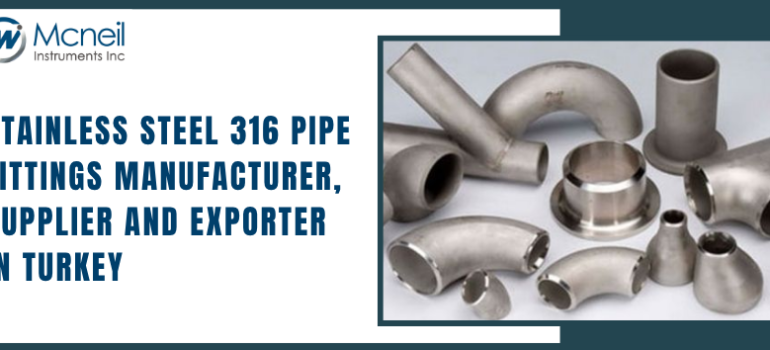
Mcneil Instruments is a manufacturer, supplier, stockist, and exporter of Stainless Steel 316 Pipe Fittings serving industrial requirements in Turkey and international markets. The company provides precision-engineered fittings in different configurations for applications requiring dependable connections and long service life.
What Are Stainless Steel 316 Pipe Fittings?
Stainless Steel 316 Pipe Fittings are engineered components used to connect, redirect, branch, reduce, or terminate piping systems. They are manufactured from Grade 316 stainless steel, an austenitic stainless steel containing molybdenum.
The addition of molybdenum improves the material’s resistance to pitting and crevice corrosion, particularly in chloride-containing and chemically aggressive environments. This makes SS 316 an appropriate material for applications where standard stainless steel grades may not provide sufficient corrosion resistance.
Mcneil Instruments supplies Stainless Steel 316 Pipe Fittings in configurations including elbows, tees, reducers, caps, crosses, couplings, unions, and stub ends.
Why Choose Stainless Steel 316 Pipe Fittings for Industrial Applications in Turkey?
Industrial facilities in Turkey operate across diverse environments, from coastal and marine locations to chemical processing plants and manufacturing facilities. Selecting the appropriate piping material is therefore essential for system reliability.
1. Excellent Corrosion Resistance
The molybdenum content of Stainless Steel 316 provides enhanced resistance to pitting and crevice corrosion. This is particularly valuable in marine, coastal, chemical, and water-treatment applications.
2. Resistance to Chloride Environments
Facilities exposed to saltwater or chloride-containing fluids can experience accelerated corrosion. SS 316 provides improved resistance in these environments, making it suitable for marine infrastructure, desalination facilities, and coastal industrial projects.
3. High Strength and Durability
SS 316 pipe fittings offer good mechanical strength and durability, allowing them to withstand demanding operating conditions involving pressure, temperature variations, and continuous industrial use.
4. Good Weldability
Stainless Steel 316 can be fabricated and welded for a variety of piping applications. Proper material selection and fabrication practices help maintain system integrity during installation.
5. Hygienic Surface
The clean and non-reactive characteristics of stainless steel make SS 316 suitable for applications where hygiene and material cleanliness are important, including food processing and pharmaceutical manufacturing.
Stainless Steel 316 Pipe Fittings Specifications
Mcneil Instruments manufactures and supplies SS 316 Pipe Fittings according to recognized international specifications.
Specification
Details
Material Grade
Stainless Steel 316
Manufacturing Standard
ASTM A403 / ASME SA403
Size Range
1/2″ NB to 48″ NB
Types
Seamless, Welded, Fabricated
Forms
Elbow, Tee, Reducer, Cap, Stub End, Cross
Schedule
SCH 10 to SCH XXS
Ends
Bevelled, Plain, Threaded
Applicable Standards
ASME B16.9, ASME B16.11, ASME B16.28, MSS-SP-43
These specifications are based on the product information provided by Mcneil Instruments.
Types of Stainless Steel 316 Pipe Fittings Available
Different piping layouts require different fitting configurations. SS 316 fittings can be selected according to the required connection, direction, diameter, and piping design.
Stainless Steel 316 Elbows
Elbows are used to change the direction of fluid flow. They are commonly available in configurations such as 45-degree and 90-degree elbows for industrial piping systems.
Stainless Steel 316 Tees
Tees allow a piping system to branch into another line. They are useful for process piping, utility systems, and fluid distribution networks.
Stainless Steel 316 Reducers
Reducers connect pipes with different diameters. They help transition between pipe sizes while maintaining the required piping configuration.
Stainless Steel 316 Crosses
Cross fittings provide multiple branches from a central connection point and can be used in specialized piping arrangements.
Stainless Steel 316 Caps and Plugs
Caps and plugs are used to close or isolate pipe ends during operation, maintenance, testing, or system modification.
Stainless Steel 316 Stub Ends
Stub ends are commonly used with lap-joint flange arrangements where frequent dismantling of piping connections may be required.
Stainless Steel 316 Couplings and Unions
These fittings are used to join pipe sections and facilitate convenient installation or maintenance depending on the piping configuration.
Mcneil Instruments lists these configurations among its Stainless Steel 316 Pipe Fittings product offerings.
Applications of Stainless Steel 316 Pipe Fittings in Turkey
Turkey’s diversified industrial base creates demand for corrosion-resistant piping components across numerous sectors.
Chemical and Petrochemical Industry
Chemical and petrochemical facilities frequently handle aggressive chemicals, solvents, and corrosive process fluids. Stainless Steel 316 fittings can provide improved resistance in these demanding environments.
Applications include:
Process piping
Chemical transfer systems
Storage facilities
Production units
Utility piping
Petrochemical processing systems
Marine and Shipbuilding Industry
Turkey has an established marine and shipbuilding industry, where piping systems may be exposed to seawater, humidity, and chloride-rich environments.
SS 316 fittings are suitable for applications requiring enhanced resistance to marine corrosion.
Oil and Gas Industry
Oil and gas facilities require dependable piping components for process and auxiliary systems. Stainless Steel 316 fittings can be used in selected applications where corrosion resistance and mechanical durability are important.
Food and Beverage Processing
Hygienic piping is essential in food and beverage manufacturing. Stainless Steel 316 offers a clean, durable material option for process systems where corrosion resistance and hygiene are important considerations.
Pharmaceutical Manufacturing
Pharmaceutical facilities require piping systems that maintain cleanliness and process integrity. SS 316 fittings can be used in suitable process and utility applications.
Water Treatment and Desalination
Water treatment and desalination facilities can expose piping components to moisture, dissolved salts, and corrosive conditions. The enhanced chloride resistance of SS 316 makes it useful for selected water-treatment applications.
Power Generation
Power plants and energy facilities contain numerous piping networks for process fluids, cooling systems, utilities, and other services. Stainless Steel 316 fittings can be selected for applications requiring corrosion resistance and reliable mechanical performance.
Why Mcneil Instruments for Stainless Steel 316 Pipe Fittings in Turkey?
Choosing the right manufacturer and exporter is important for maintaining consistent product quality and dependable project supply.
Mcneil Instruments offers Stainless Steel 316 Pipe Fittings for industrial customers requiring precision-engineered components and international supply capabilities.
Key advantages include:
Stainless Steel 316 material availability
Multiple fitting configurations
Wide dimensional range
Manufacturing according to recognized international standards
Applications across multiple industrial sectors
Export and international supply capabilities
Technical assistance for product selection
Solutions for demanding and corrosive environments
The company also supplies other stainless steel grades and industrial piping products for different application requirements.
How to Select the Right SS 316 Pipe Fittings
Before purchasing Stainless Steel 316 Pipe Fittings for a project in Turkey, buyers should evaluate several technical parameters.
Material Grade
Confirm whether SS 316 is appropriate for the fluid, temperature, pressure, and environmental conditions.
Fitting Type
Select the required configuration, such as elbow, tee, reducer, cap, cross, coupling, union, or stub end.
Pipe Size
The fitting dimensions should correspond correctly with the connected piping system.
Wall Thickness and Schedule
Select the appropriate schedule based on the design pressure, temperature, and applicable engineering requirements.
Manufacturing Standard
Project specifications may require compliance with standards such as ASTM A403 / ASME SA403 and dimensional standards such as ASME B16.9 or other applicable specifications.
End Connection
Depending on the piping design, fittings may require bevelled, plain, threaded, or other specified ends.
Stainless Steel 316 vs Other Stainless Steel Grades
SS 316 is not automatically the best choice for every piping application. Material selection should be based on the actual operating environment.
SS 304 is commonly used for general corrosion-resistant applications, while SS 316 is preferred when greater resistance to chlorides and certain aggressive environments is required.
SS 316L, with its lower carbon content, may be selected for applications where enhanced welding characteristics and reduced risk of sensitization are important.
The correct grade should therefore be selected according to the project’s fluid chemistry, temperature, pressure, fabrication requirements, and applicable standards.
Quality Considerations When Buying Pipe Fittings in Turkey
For industrial projects, purchasing decisions should go beyond price. Buyers should evaluate:
Material traceability
Applicable manufacturing standards
Dimensional accuracy
Surface quality
Required inspection and testing
Documentation and certificates
Manufacturing consistency
Export packaging
Delivery requirements
For critical applications, buyers should clearly communicate project specifications and documentation requirements to the manufacturer before placing an order.
Stainless Steel 316 Pipe Fittings for Turkey’s Growing Industrial Sector
Turkey’s strategic location and diverse industrial economy continue to support demand for reliable piping infrastructure. Industries including chemical processing, petrochemicals, marine engineering, food processing, pharmaceuticals, energy, and water treatment require piping systems that can withstand challenging operating environments.
Stainless Steel 316 Pipe Fittings offer a combination of corrosion resistance, durability, mechanical strength, and hygienic characteristics that makes them suitable for many of these applications.
With a broad range of fitting configurations, sizes, and manufacturing options, Mcneil Instruments supports industrial customers looking for Stainless Steel 316 Pipe Fittings for projects in Turkey and international markets.
Conclusion
Selecting the correct pipe fittings is essential for the safety, reliability, and long-term performance of industrial piping systems. Stainless Steel 316 Pipe Fittings are particularly valuable in applications where resistance to corrosion, chlorides, chemicals, moisture, and demanding operating conditions is required.
From chemical and petrochemical facilities to marine, food processing, pharmaceutical, oil and gas, water treatment, and energy applications, SS 316 fittings can provide a durable connection solution when properly specified for the service environment.
Mcneil Instruments manufactures, supplies, stocks, and exports Stainless Steel 316 Pipe Fittings in various configurations and sizes, supporting industrial requirements in Turkey and other international markets.
For businesses looking for a reliable Stainless Steel 316 Pipe Fittings Manufacturer, Supplier and Exporter in Turkey, Mcneil Instruments provides industrial piping solutions designed around internationally recognized specifications and demanding application requirements.
Frequently Asked Questions
1. Who is a Stainless Steel 316 Pipe Fittings supplier in Turkey?
Mcneil Instruments is a manufacturer, supplier, stockist, and exporter of Stainless Steel 316 Pipe Fittings serving industrial customers in Turkey and international markets.
2. What industries use Stainless Steel 316 Pipe Fittings in Turkey?
SS 316 fittings are used in chemical, petrochemical, marine, shipbuilding, food and beverage, pharmaceutical, oil and gas, water treatment, desalination, power generation, and other industrial applications.
3. What standards are applicable to SS 316 Pipe Fittings?
Mcneil Instruments lists ASTM A403 / ASME SA403 as the manufacturing specification and ASME B16.9, ASME B16.11, ASME B16.28, and MSS-SP-43 among applicable standards.
4. What sizes of SS 316 Pipe Fittings are available?
The listed product range covers sizes from 1/2″ NB to 48″ NB, subject to the specific fitting type and manufacturing requirements.
5. Why is Stainless Steel 316 suitable for marine applications?
The molybdenum content in SS 316 improves resistance to pitting and crevice corrosion, particularly in chloride-containing environments, making it useful for appropriately specified marine and coastal applications.
6. What types of SS 316 fittings can be supplied?
Common configurations include elbows, tees, reducers, caps, crosses, stub ends, couplings, and unions, depending on the required piping arrangement.
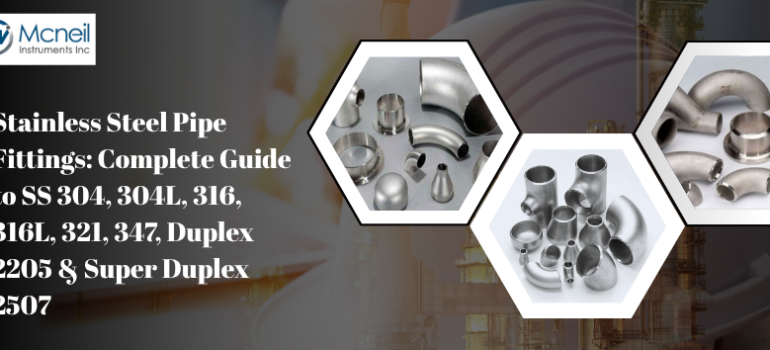
In industrial piping systems, the pipe itself is only one part of the equation. The joints, connections, directional changes, branches, and terminations also need to withstand pressure, temperature, corrosion, and continuous operation. This is whereStainless Steel Pipe Fittings play an essential role.
Stainless steel pipe fittings are precision-engineered components used to connect, redirect, branch, reduce, or terminate piping systems. Their combination of corrosion resistance, mechanical strength, temperature stability, weldability, and long service life makes them suitable for demanding industries ranging from oil and gas to pharmaceuticals and food processing.
Mcneil Instruments is a manufacturer, supplier, stockist, and exporter of Stainless Steel Pipe Fittings in India, offering fittings in grades including SS 304, 304L, 316, 316L, 321, 347, Duplex 2205, Super Duplex 2507, 17-4PH, and 15-5PH.
What Are Stainless Steel Pipe Fittings?
Stainless Steel Pipe Fittings are components installed between sections of pipe or at the end of a piping system to control its configuration and maintain a secure flow path.
Depending on the piping design, fittings can be used to:
Change the direction of flow
Create branches
Connect different pipe diameters
Join straight sections of pipe
Close pipeline ends
Connect piping to other components
Facilitate maintenance and dismantling
In critical piping systems, fitting selection is just as important as pipe selection because joints must maintain structural integrity and prevent leakage during operation.
Why Are Stainless Steel Pipe Fittings Preferred?
Stainless steel provides a useful combination of mechanical strength, corrosion resistance, temperature stability, and fabrication characteristics.
The key advantages of Stainless Steel Pipe Fittings include:
Excellent Corrosion Resistance
Stainless steel fittings can perform reliably in environments exposed to moisture, chemicals, chlorides, and other corrosive media, depending on the selected grade.
High Temperature Resistance
Suitable grades can be used in elevated-temperature piping systems, including steam, boiler, heat exchanger, and process applications.
High Mechanical Strength
Stainless steel fittings provide the structural strength required for demanding pressure systems.
Excellent Weldability
Many stainless steel grades can be welded and fabricated for permanent piping assemblies.
Hygienic Surface
Smooth stainless steel surfaces are suitable for industries where cleanliness and contamination control are important.
Long Service Life
Their corrosion resistance and durability can reduce maintenance requirements and replacement frequency.
Types of Stainless Steel Pipe Fittings
Different fittings perform different functions within an industrial piping network.
Stainless Steel Elbows
Elbow fittings are used to change the direction of fluid flow. Common configurations include 45° and 90° elbows.
They are widely used where piping layouts require directional changes while maintaining a controlled flow path.
Stainless Steel Tees
Tees are used to create a branch connection within a pipeline.
They allow process flow to be distributed into two directions and are commonly used in process plants and utility systems.
Stainless Steel Reducers
Reducers connect pipes with different diameters.
They are commonly available as:
Concentric reducers
Eccentric reducers
The appropriate configuration depends on the piping layout and flow requirements.
Stainless Steel Couplings
Couplings join two sections of pipe in a straight line.
They can be useful for pipeline extensions, repairs, and maintenance applications.
Stainless Steel Caps & Plugs
Caps and plugs are used to close the end of a pipeline.
They can be used for:
Pipeline isolation
Pressure testing
Temporary closure
System termination
Stainless Steel Stub Ends
Stub ends are commonly used with lap joint flanges, particularly in piping systems where regular dismantling or maintenance is required.
Manufacturing Standards for Stainless Steel Pipe Fittings
International standards help ensure dimensional consistency, material integrity, and compatibility with industrial piping systems.
Mcneil Instruments lists the following standards for its stainless steel pipe fittings:
ASTM A403
ASME B16.9
ASME B16.11
ASME B16.28
MSS-SP-43
EN standards
DIN standards
ISO standards
ASTM A403 is specified for stainless steel wrought fittings, while ASME B16.9 covers factory-made butt weld fittings. ASME B16.11 covers forged socket weld and threaded fittings, and ASME B16.28 covers short-radius elbows.
Stainless Steel Pipe Fitting Grades
Choosing the correct stainless steel grade is critical because different operating environments require different combinations of corrosion resistance, temperature capability, strength, and weldability.
Mcneil Instruments offers a broad range of stainless steel and high-performance stainless grades.
Stainless Steel 304 Pipe Fittings
Versatile Grade for General Industrial Applications
SS 304 Pipe Fittings are widely used because of their corrosion resistance, durability, weldability, and versatility.
The source specifies an approximate composition of 18% chromium and 8% nickel, making SS 304 suitable for general industrial and commercial applications.
Applications
Oil & gas
Chemical processing
Food processing
Water treatment
General pressure piping
Key Features
Excellent corrosion resistance
Good oxidation resistance
Good weldability
Good formability
Hygienic and easy to clean
Cost-effective austenitic stainless steel option
Mcneil Instruments lists SS 304 fittings in sizes from 1/2″ NB to 48″ NB, with seamless, welded, and fabricated options.
Stainless Steel 304L Pipe Fittings
Low-Carbon Grade for Welded Systems
SS 304L Pipe Fittings are the low-carbon version of SS 304. The lower carbon content improves weldability and helps reduce the risk of intergranular corrosion after welding.
The source specifies a maximum carbon content of 0.03%.
Applications
Chemical processing
Petrochemical plants
Pharmaceutical facilities
Food & beverage systems
Sanitary piping
Key Features
Excellent weldability
Improved resistance to intergranular corrosion
High strength
Good formability
Suitable for clean and sanitary environments
Stainless Steel 316 Pipe Fittings
Enhanced Corrosion Resistance for Aggressive Environments
SS 316 Pipe Fittings contain molybdenum, which enhances their resistance to chlorides and aggressive chemical environments.
They are particularly suitable for applications where pitting and crevice corrosion are concerns.
Applications
Marine systems
Chemical processing
Pharmaceutical plants
Food & beverage facilities
High-temperature process systems
Key Features
Superior corrosion resistance
Excellent chemical resistance
Strong performance in chloride environments
Good weldability
High mechanical strength
Stainless Steel 316L Pipe Fittings
Low-Carbon Solution for Corrosive and Hygienic Applications
SS 316L Pipe Fittings combine the corrosion resistance of 316 with the improved weldability associated with a low-carbon grade.
They are particularly useful where welding, cleanliness, corrosion resistance, and long-term durability are all important.
Applications
Pharmaceutical manufacturing
Food & beverage processing
Petrochemical plants
Marine applications
Process piping
Key Features
Excellent corrosion resistance
Improved weldability
Reduced risk of carbide precipitation during welding
Strong chloride resistance
Suitable for high-pressure and temperature applications
Stainless Steel 321 Pipe Fittings
Titanium-Stabilized Grade for High-Temperature Applications
SS 321 Pipe Fittings are titanium-stabilized austenitic stainless steel fittings designed for applications involving elevated temperatures.
The source identifies SS 321 as suitable for environments involving exposure to the chromium carbide precipitation range of approximately 427–816°C.
Applications
Aerospace
Heat exchangers
Chemical processing plants
Refineries
Pressure vessels
Exhaust manifolds
Expansion joints
Key Features
Excellent high-temperature performance
Resistance to intergranular corrosion
Good structural stability after welding
Strong mechanical properties
Suitable for high-temperature and high-stress applications
Stainless Steel 347 Pipe Fittings
High-Temperature Stability with Niobium Stabilization
SS 347 Pipe Fittings are niobium-stabilized austenitic stainless steel fittings designed for high-temperature service.
The stabilization helps reduce carbide precipitation during welding and supports structural integrity during prolonged thermal exposure.
Applications
Aerospace
Chemical manufacturing
Petroleum refining
Power generation
Boiler systems
Heat exchangers
Key Features
Excellent high-temperature resistance
Good oxidation resistance
High creep strength
Strong thermal stability
Excellent resistance to intergranular corrosion
Duplex 2205 Pipe Fittings
High Strength and Corrosion Resistance
Duplex 2205 Pipe Fittings combine austenitic and ferritic stainless steel characteristics to provide high mechanical strength along with strong corrosion resistance.
Mcneil Instruments identifies Duplex 2205 as a nitrogen-enhanced duplex stainless steel with resistance to pitting, crevice corrosion, and stress corrosion cracking.
Applications
Chemical processing
Marine systems
Oil & gas
Desalination plants
High-performance process piping
Key Features
High mechanical strength
Excellent corrosion resistance
Strong resistance to stress corrosion cracking
Suitable for demanding marine environments
Suitable for high-pressure applications
Mcneil Instruments lists Duplex 2205 fittings in sizes from 1/2″ NB to 24″ NB under ASTM A815 / ASME SA815.
Super Duplex 2507 Pipe Fittings
For Highly Corrosive and High-Pressure Environments
Super Duplex 2507 Pipe Fittings are designed for extremely demanding applications where high strength and corrosion resistance are required simultaneously.
The source highlights their performance against chloride-induced corrosion and identifies applications including offshore platforms, petrochemical plants, and heat exchangers.
Applications
Offshore platforms
Petrochemical plants
Heat exchangers
Marine systems
High-pressure process systems
Key Features
Exceptional strength
Excellent chloride corrosion resistance
High corrosion resistance
Suitable for aggressive environments
Long-term durability
Mcneil Instruments lists Super Duplex 2507 under ASTM A815 / ASME SA815, with sizes from 1/2″ NB to 24″ NB.
17-4PH Stainless Steel Pipe Fittings are precipitation-hardening stainless steel components designed for applications where high strength, toughness, and corrosion resistance are required.
The source identifies applications in aerospace, marine, chemical, pressure, and structural systems.
Key Features
High strength
Good corrosion resistance
Excellent toughness
Heat-treatable
Suitable for demanding mechanical applications
Mcneil Instruments lists UNS S17400 under ASTM A182 / ASME SA182, with solution-treated and aged conditions from H900 to H1150.
Stainless Steel 15-5PH Pipe Fittings
High Strength with Improved Toughness
15-5PH Stainless Steel Pipe Fittings are martensitic precipitation-hardening stainless steel fittings designed for high-strength and demanding mechanical applications.
The source notes improved toughness and transverse properties compared with 17-4PH.
Applications
Aerospace
Nuclear industries
Petrochemical plants
High-pressure systems
Structural applications
Key Features
High mechanical strength
Good corrosion resistance
Excellent mechanical performance
Low-temperature heat treatment capability
Mcneil Instruments lists UNS S15500 under ASTM A564 / ASME SA564, with conditions from H900 to H1150.
Stainless Steel Pipe Fittings: Grade Comparison
Grade
Primary Advantage
Typical Applications
SS 304
Versatility and corrosion resistance
General industrial, food, water treatment
SS 304L
Improved weldability
Chemical, pharmaceutical, sanitary systems
SS 316
Chloride and chemical resistance
Marine, chemical, pharmaceutical
SS 316L
Corrosion resistance with improved weldability
Marine, pharmaceutical, petrochemical
SS 321
High-temperature stability
Refineries, heat exchangers, aerospace
SS 347
High-temperature and intergranular corrosion resistance
Power, refining, chemical processing
Duplex 2205
High strength and corrosion resistance
Oil & gas, marine, desalination
Super Duplex 2507
Extreme corrosion resistance and strength
Offshore, petrochemical, heat exchangers
17-4PH
High strength and toughness
Aerospace, marine, chemical
15-5PH
High strength and improved toughness
Aerospace, nuclear, petrochemical
The appropriate grade should always be selected according to actual fluid chemistry, pressure, temperature, environmental exposure, connection method, and applicable project standards.
How Stainless Steel Pipe Fittings Are Installed
Proper installation begins with understanding the requirements of the piping system.
Step 1: Determine the Piping Requirements
Identify:
Pipe diameter
Wall thickness
Fluid or gas
Operating pressure
Operating temperature
Environmental exposure
Step 2: Select the Appropriate Fitting
Choose the fitting type and stainless steel grade according to the system requirements.
Step 3: Select the Connection Method
Common options include:
Butt weld
Socket weld
Threaded connections
Butt weld fittings are suitable for permanent high-pressure systems, while threaded fittings can offer easier dismantling and maintenance. Socket weld fittings are commonly used in compact, high-strength assemblies.
Step 4: Inspect and Test the Joint
After installation, the system should be checked for leakage, pressure resistance, dimensional accuracy, and overall connection integrity.
Applications of Stainless Steel Pipe Fittings
Stainless steel pipe fittings are used across a broad range of industries.
Oil & Gas
They are used in upstream, midstream, and downstream systems where pressure and corrosion resistance are critical.
Chemical & Petrochemical
Stainless steel fittings provide reliable connections in systems exposed to aggressive chemicals and elevated temperatures.
Power Generation
Applications include boilers, heat exchangers, steam lines, and other process systems.
Food & Beverage
Stainless steel fittings are preferred for hygienic fluid handling and systems requiring cleanable surfaces.
Pharmaceutical Manufacturing
They support contamination-controlled process and fluid transfer systems.
Water Treatment & Desalination
Duplex and Super Duplex grades are particularly useful where salinity, moisture, and corrosion create demanding service conditions.
Marine & Offshore
Stainless steel and high-performance duplex grades can provide resistance to harsh marine environments and saltwater exposure.
Mcneil Instruments offers a broad range of stainless steel pipe fitting grades and configurations for industrial applications.
The company’s product range covers SS 304, 304L, 316, 316L, 321, 347, Duplex 2205, Super Duplex 2507, 17-4PH, and 15-5PH. The fittings are available in different forms, sizes, schedules, connection configurations, and manufacturing conditions according to the grade and application.
Mcneil Instruments also highlights capabilities including:
Manufacturing and supply
Stock availability
Global export
Material testing
Dimensional inspection
International standards compliance
Custom requirements
For critical industrial projects, selecting the right material, fitting configuration, and applicable standard is essential for achieving reliable long-term piping performance.
Conclusion
Stainless Steel Pipe Fittings are essential components in modern industrial piping systems, providing secure connections while helping systems withstand pressure, temperature, corrosion, and demanding operating conditions.
The right grade depends on the application. SS 304 and 304L are versatile options for general industrial and hygienic applications. SS 316 and 316L provide enhanced resistance to chlorides and aggressive environments. SS 321 and 347 are suitable for elevated-temperature service, while Duplex 2205 and Super Duplex 2507 offer higher strength and corrosion resistance for demanding applications. 17-4PH and 15-5PH provide high-strength precipitation-hardening options for specialized applications.
Whether the requirement is for Stainless Steel Elbows, Tees, Reducers, Couplings, Caps, Plugs, Stub Ends, Buttweld Pipe Fittings, Socket Weld Fittings, or Threaded Fittings, choosing the correct material grade and manufacturing standard is essential for safe and reliable operation.
Mcneil Instruments provides a comprehensive range of stainless steel pipe fittings for oil & gas, chemical, petrochemical, pharmaceutical, food processing, marine, water treatment, desalination, and power generation applications.
Industrial piping systems demand components that offer exceptional durability, corrosion resistance, and long-term reliability. Selecting the right pipe fittings is essential to ensure leak-free connections, improved operational efficiency, and lower maintenance costs across industries.
Mcneil Instruments is a trusted manufacturer and supplier of premium-quality Stainless Steel 304 Pipe Fittings, Stainless Steel 304L Pipe Fittings, and Stainless Steel 347 Pipe Fittings, manufactured according to international quality standards for industrial, commercial, and process piping applications.
Why Stainless Steel Pipe Fittings Are Preferred in Industrial Piping
Modern industries require piping systems capable of handling pressure, temperature fluctuations, corrosive media, and continuous operation.
Key Benefits
✔ Excellent corrosion resistance
✔ High mechanical strength
✔ Outstanding durability
✔ Excellent weldability
✔ Leak-proof connections
✔ High-pressure capability
✔ Long service life
✔ Low maintenance requirements
✔ Cost-effective industrial solution
Understanding Stainless Steel Pipe Fitting Grades
Stainless Steel 304 Pipe Fittings
Stainless Steel 304 Pipe Fittings are the most commonly used austenitic stainless steel fittings, offering excellent corrosion resistance, good mechanical strength, and outstanding fabrication properties.
Key Features
Excellent corrosion resistance
Superior weldability
High strength
Excellent formability
Hygienic surface finish
Long operational life
Common Applications
Food Processing Plants
Chemical Processing
Water Treatment
Pharmaceutical Industry
General Industrial Piping
HVAC Systems
Stainless Steel 304L Pipe Fittings
Stainless Steel 304L Pipe Fittingscontain lower carbon content than 304, making them ideal for welded applications where carbide precipitation must be minimized.
Advantages
Improved weldability
Better corrosion resistance after welding
Reduced carbide precipitation
Excellent fabrication properties
Long service life
Widely Used In
Process Piping
Chemical Plants
Pressure Vessels
Pharmaceutical Equipment
Food Processing
Fabricated Piping Systems
Stainless Steel 347 Pipe Fittings
Stainless Steel 347 Pipe Fittings are stabilized with niobium, providing exceptional resistance to intergranular corrosion and high-temperature oxidation.
Benefits
Superior high-temperature performance
Excellent oxidation resistance
High creep strength
Excellent thermal stability
Outstanding corrosion resistance
Applications
Heat Exchangers
Power Generation Plants
Refineries
Petrochemical Plants
Boiler Systems
Aerospace Components
Types of Stainless Steel Pipe Fittings
Mcneil Instruments manufactures a complete range of stainless steel pipe fittings for industrial piping systems.
Our product range includes:
Elbows
Tees
Reducers
Stub Ends
Pipe Caps
Crosses
Couplings
Unions
Nipples
Bushings
Socket Weld Fittings
Threaded Pipe Fittings
Butt Weld Pipe Fittings
Equal Tees
Reducing Tees
Long Radius Elbows
Short Radius Elbows
Custom Pipe Fittings
Stainless Steel 304 vs 304L vs 347 Pipe Fittings
Grade
Major Advantage
Best Applications
Stainless Steel 304 Pipe Fittings
General corrosion resistance
Food processing, water treatment, industrial piping
Stainless Steel 304L Pipe Fittings
Excellent weldability
Fabricated piping, pressure vessels, chemical plants
Stainless Steel 347 Pipe Fittings
High-temperature strength
Refineries, power plants, petrochemical industries
Applications of Stainless Steel Pipe Fittings
Our Stainless Steel 304 Pipe Fittings, Stainless Steel 304L Pipe Fittings, and Stainless Steel 347 Pipe Fittings are widely used in:
Oil & Gas Industry
Petrochemical Plants
Chemical Processing
Power Generation
Water Treatment Plants
Marine Engineering
Pharmaceutical Industry
Food & Beverage Processing
Pulp & Paper Industry
Heat Exchanger Manufacturing
LNG Plants
Fertilizer Industry
Industrial Automation
Process Equipment
Pressure Piping Systems
Benefits of Stainless Steel Pipe Fittings
Compared with conventional piping materials, stainless steel pipe fittings provide several operational advantages.
Industrial customers continue to choose stainless steel pipe fittings because they deliver:
Long operational life
Superior corrosion resistance
Reliable leak-proof performance
Excellent mechanical strength
Reduced maintenance costs
Easy installation
Better lifecycle value
Consistent industrial performance
Conclusion
Selecting the right pipe fittings is essential for building efficient and reliable industrial piping systems. Whether your project requires Stainless Steel 304 Pipe Fittings for general-purpose applications, Stainless Steel 304L Pipe Fittingsfor superior weldability, or Stainless Steel 347 Pipe Fittings for high-temperature service, choosing the correct grade ensures long-term performance and operational efficiency.
Mcneil Instruments manufactures premium-quality stainless steel pipe fittings engineered to meet international standards and deliver dependable performance across diverse industrial applications.
Frequently Asked Questions (FAQs)
1. What is the difference between Stainless Steel 304, 304L, and 347 Pipe Fittings?
Stainless Steel 304 is ideal for general industrial use, 304L offers better weldability due to its lower carbon content, while 347 provides superior high-temperature strength and resistance to intergranular corrosion.
2. Which industries commonly use Stainless Steel Pipe Fittings?
Oil & gas, chemical processing, petrochemical, food processing, pharmaceutical, marine, power generation, water treatment, and industrial manufacturing.
3. Which stainless steel grade is best for welded piping systems?
Stainless Steel 304L Pipe Fittings are recommended because their low carbon content minimizes carbide precipitation during welding.
4. Why are Stainless Steel 347 Pipe Fittings used in high-temperature applications?
They are stabilized with niobium, providing excellent oxidation resistance, thermal stability, and high-temperature strength.
5. Does Mcneil Instruments manufacture customized stainless steel pipe fittings?
Yes. We manufacture customized stainless steel pipe fittings in various sizes, schedules, pressure ratings, and specifications based on customer requirements.
Turkey has emerged as one of the most important industrial and manufacturing hubs connecting Europe, Asia, and the Middle East. With continued investments in energy infrastructure, petrochemical facilities, shipbuilding, construction, water treatment, food processing, pharmaceuticals, and manufacturing, the demand for reliable industrial piping components continues to grow rapidly.
Modern industrial facilities depend on systems that can withstand pressure, temperature fluctuations, corrosive environments, and continuous operation. Among the most important components within these systems are Stainless Steel Pipe Fittings, which ensure safe, efficient, and leak-free flow throughout industrial networks.
As Turkey expands its industrial capabilities and infrastructure projects, the need for high-quality pipe fittings has become more important than ever.
This is where Mcneil Instruments plays a vital role.
As a global manufacturer, supplier, exporter, stockist, and wholesaler, Mcneil Instruments supplies premium-quality Stainless Steel Pipe Fittings in Turkey for critical industrial applications across multiple sectors.
Why Stainless Steel Pipe Fittings Are Essential for Turkey’s Industries
Industrial piping systems require reliable connections that can maintain operational integrity under demanding conditions.
Stainless Steel Pipe Fittings provide:
• Excellent corrosion resistance • High-pressure handling capabilities • Long operational life • Superior mechanical strength • Leak-free performance • Easy installation and maintenance • Resistance to chemical exposure • High-temperature performance
These advantages make stainless steel fittings the preferred choice across Turkey’s industrial sectors.
Turkey’s Key Industries Using Stainless Steel Pipe Fittings
Energy and Power Generation
Turkey continues investing heavily in power generation projects, renewable energy facilities, thermal plants, and transmission infrastructure.
Stainless steel fittings are widely used for:
• Steam systems • Cooling water lines • High-pressure pipelines • Process piping networks • Instrumentation systems
Oil and Gas Industry
Turkey’s strategic geographic position makes it an important energy transit and processing hub.
• Superior corrosion resistance • Excellent durability
SS 316L Pipe Fittings
Ideal for critical industrial applications requiring enhanced corrosion protection and superior welding characteristics.
SS 321 Pipe Fittings
Suitable for elevated temperature environments and heat-intensive operations.
SS 347 Pipe Fittings
Designed for high-temperature and high-pressure industrial applications.
Advantages of Choosing Mcneil Instruments for Stainless Steel Pipe Fittings in Turkey
Extensive Inventory Availability
Mcneil Instruments maintains ready stock of standard and specialty stainless steel fittings for immediate dispatch.
International Quality Standards
Products are manufactured according to globally recognized specifications and industry requirements.
Wide Product Range
Customers can source multiple industrial requirements from a single trusted supplier.
Global Export Expertise
Mcneil Instruments serves customers across Europe, the Middle East, Africa, and Asia with reliable export solutions.
Competitive Pricing
Efficient manufacturing and inventory management allow cost-effective procurement without compromising quality.
Technical Support
The experienced team assists customers in selecting the most suitable products for their applications.
Applications of Stainless Steel Pipe Fittings in Turkey
Mcneil Instruments supplies fittings for:
• Oil & Gas Facilities • Petrochemical Plants • Refineries • Marine Industry • Shipbuilding Yards • Water Treatment Plants • Desalination Facilities • Food Processing Units • Pharmaceutical Manufacturing • HVAC Systems • Power Plants • Infrastructure Projects • Industrial Manufacturing Facilities • Renewable Energy Projects
Why Turkey Continues to Invest in Industrial Infrastructure
Turkey’s long-term development strategy includes major investments in:
• Energy security projects • Industrial manufacturing expansion • Transportation infrastructure • Petrochemical developments • Water treatment facilities • Renewable energy installations • Marine and port infrastructure • Smart industrial zones
Each of these sectors relies heavily on durable piping systems and high-quality stainless steel components.
As industrial projects continue to expand, demand for dependable pipe fittings is expected to remain strong for years to come.
Conclusion
Turkey’s growing industrial economy requires infrastructure that is reliable, efficient, and built to last. From power generation and petrochemicals to marine operations and manufacturing facilities, Stainless Steel Pipe Fittings remain essential for ensuring safe and uninterrupted industrial performance.
With an extensive inventory of SS 304 Pipe Fittings, SS 304L Pipe Fittings, SS 316 Pipe Fittings, SS 316L Pipe Fittings, SS 321 Pipe Fittings, and SS 347 Pipe Fittings, Mcneil Instruments continues to support Turkey’s industrial growth with premium-quality products, global supply capabilities, and dependable service.
For industries seeking durable, corrosion-resistant, and internationally compliant piping solutions, Mcneil Instruments remains a trusted partner for Stainless Steel Pipe Fittings in Turkey.
Introduction: The Backbone of Nigeria’s Expanding Industrial Sector
Nigeria is one of Africa’s largest industrial and energy economies. From Lagos and Abuja to Port Harcourt, Kano, and Warri, major investments in oil & gas, petrochemicals, power generation, marine infrastructure, and manufacturing continue to reshape the country’s industrial landscape.
As these industries expand, the demand for reliable piping systems has increased dramatically.
Modern facilities require piping components capable of handling:
• High pressure operations • Corrosive environments • Chemical processing • Offshore applications • Temperature fluctuations • Continuous industrial operations
This is exactly why Stainless Steel Pipe Fittings have become an essential component of Nigeria’s industrial infrastructure.
High-quality stainless steel fittings provide the strength, corrosion resistance, and durability required for long-term industrial performance in challenging operating environments.
What Are Stainless Steel Pipe Fittings?
Stainless Steel Pipe Fittings are components used to connect, redirect, control, or terminate piping systems.
They play a critical role in maintaining safe and efficient industrial operations.
Why Stainless Steel Pipe Fittings Are Important in Nigeria
Nigeria’s industries frequently operate in environments exposed to:
• Humidity • Offshore saltwater conditions • Chemical exposure • High temperatures • Heavy industrial workloads
Ordinary materials often deteriorate under such conditions.
Stainless steel pipe fittings provide exceptional resistance against corrosion, oxidation, and mechanical wear, making them ideal for Nigerian industrial applications.
Key Benefits of Stainless Steel Pipe Fittings
Outstanding Corrosion Resistance
One of the biggest advantages of stainless steel fittings is their ability to resist:
These procedures ensure compliance with international quality standards and long-term reliability.
The Future of Stainless Steel Pipe Fittings in Nigeria
As Nigeria continues investing in:
• Energy infrastructure • Refinery expansion • Manufacturing growth • Marine development • Industrial modernization
the demand for corrosion-resistant and high-performance piping systems will continue to rise.
Stainless steel pipe fittings will remain essential for ensuring safe, efficient, and long-lasting industrial operations.
Conclusion
Nigeria’s industrial growth depends on reliable infrastructure capable of handling challenging operating conditions.
From offshore oil platforms and petrochemical plants to power generation facilities and manufacturing units, stainless steel pipe fittings provide the strength, corrosion resistance, and durability required for long-term success.
Their ability to withstand pressure, heat, moisture, and chemical exposure makes them one of the most important components in modern industrial piping systems.
Mcneil Instruments supplies high-performance stainless steel pipe fittings designed for durability, corrosion resistance, pressure stability, and long-term industrial reliability.
What Are Stainless Steel Pipe Fittings?
Stainless steel pipe fittings are mechanical components used to connect, redirect, regulate, or terminate industrial piping systems.
These fittings help industries:
• Control flow direction • Connect different pipe sizes • Maintain pressure integrity • Prevent leakage • Improve system flexibility
Stainless steel fittings are widely preferred because they offer superior corrosion resistance, excellent mechanical strength, and long operational life.
Why Kentucky Industries Use Stainless Steel Pipe Fittings
Kentucky has strong industrial sectors including:
• Manufacturing • Chemical processing • Food processing • Automotive production • Energy and utilities • Water treatment systems
These industries require piping systems capable of handling harsh industrial environments without failure.
That’s why stainless steel pipe fittings supplied by Mcneil Instruments are widely used across critical industrial applications.
Why Mcneil Instruments Stainless Steel Pipe Fittings Stand Out
Excellent Corrosion Resistance
One of the biggest advantages of stainless steel pipe fittings is their ability to resist:
Kentucky is home to a diverse range of industries, including manufacturing, automotive production, food processing, chemical manufacturing, energy generation, and water treatment facilities. These sectors require piping systems capable of handling pressure fluctuations, temperature changes, chemicals, and continuous operation. Any failure within a piping network can result in production delays, maintenance expenses, and operational risks. As a result, industries prioritize high-quality stainless steel pipe fittings that can deliver consistent performance over extended periods.
What Are Stainless Steel Pipe Fittings?
Stainless steel pipe fittings are components used to connect, redirect, regulate, or terminate pipelines within industrial systems. These fittings play a critical role in maintaining efficient fluid flow and ensuring system integrity. Common types include elbows, tees, reducers, couplings, unions, caps, and threaded fittings, each serving a specific purpose within a piping network. Properly engineered fittings help prevent leakage, improve system flexibility, and support long-term operational reliability.
Superior Corrosion Resistance for Long-Term Performance
One of the primary reasons Kentucky industries choose stainless steel pipe fittings is their exceptional resistance to corrosion. Industrial environments often expose piping systems to moisture, chemicals, oxidation, and varying temperatures. Stainless steel forms a protective oxide layer that shields the material from rust and deterioration, helping maintain structural integrity even in challenging environments. This corrosion resistance significantly extends service life while reducing maintenance requirements and replacement costs.
Excellent Strength Under High-Pressure Conditions
Many industrial operations involve high-pressure fluid transfer systems where reliability is critical. Stainless steel pipe fittings provide excellent tensile strength and mechanical stability, allowing them to withstand demanding pressure conditions without compromising performance. Their ability to maintain leak-proof connections helps ensure operational safety and efficiency across a wide range of industrial applications.
Reduced Maintenance and Operational Costs
Frequent repairs and system downtime can have a significant impact on productivity and profitability. Stainless steel pipe fittings offer a longer service life compared to many alternative materials, reducing maintenance frequency and minimizing unexpected failures. Their durability helps industrial facilities maintain continuous operations while lowering long-term operating expenses.
Common Stainless Steel Grades Used in Industrial Applications
Different operating conditions require different stainless steel grades. Some of the most widely used grades include:
Stainless Steel 304 Pipe Fittings
SS 304 Pipe Fittings offer excellent corrosion resistance, strength, and affordability. They are widely used in water treatment facilities, food processing plants, and general industrial applications.
Stainless Steel 304L Pipe Fittings
The low-carbon version of SS 304 provides enhanced weldability and reduced risk of intergranular corrosion, making it suitable for welded piping systems.
Stainless Steel 316 Pipe Fittings
Containing molybdenum, SS 316 Pipe Fittings provide superior resistance to chlorides and aggressive chemicals. They are commonly used in chemical processing and marine environments.
Stainless Steel 316L Pipe Fittings
This grade combines excellent corrosion resistance with improved weldability, making it ideal for pharmaceutical and process industries.
Stainless Steel 321 and 347 Pipe Fittings
These grades are designed for elevated temperature applications where resistance to thermal stress and oxidation is essential. They are widely used in power plants, refineries, and high-temperature processing facilities.
Types of Stainless Steel Pipe Fittings Used Across Kentucky Industries
Elbows
Elbows are used to change the direction of fluid flow within piping systems and are available in various angles and configurations.
Tees
Tees allow fluid to be divided or combined, making them essential for complex piping layouts.
Reducers
Reducers connect pipes of different diameters while maintaining smooth flow characteristics.
Couplings and Unions
These fittings simplify maintenance and system modifications by providing secure yet removable connections.
Caps and Plugs
Caps and plugs are used to safely close the ends of pipelines and equipment connections.
Applications Across Major Kentucky Industries
Manufacturing Facilities
Industrial manufacturing plants rely on stainless steel pipe fittings for hydraulic systems, machinery, compressed air systems, and process piping.
Food and Beverage Processing
The hygienic properties of stainless steel make it a preferred material for food production and beverage processing facilities.
Chemical Processing Plants
Chemical facilities depend on corrosion-resistant fittings capable of handling aggressive substances safely.
Water Treatment Systems
Municipal and industrial water treatment operations use stainless steel fittings to ensure reliable flow control and long-term durability.
Energy and Utility Infrastructure
Power plants and utility systems require fittings capable of performing under high pressure and temperature conditions.
Why Quality Matters in Industrial Pipe Fittings
The performance of a piping system is only as strong as its individual components. Poor-quality fittings can lead to leakage, pressure loss, corrosion damage, system failures, and costly downtime. High-quality stainless steel pipe fittings manufactured according to international standards help ensure safety, efficiency, and compliance with industry requirements. Comprehensive quality testing, including hydrostatic testing, PMI testing, dimensional inspection, and mechanical analysis, further guarantees product reliability.
The Future of Industrial Infrastructure in Kentucky
As Kentucky continues to expand its industrial capabilities, the demand for durable and efficient piping solutions will continue to grow. Stainless steel pipe fittings remain a preferred choice because they combine strength, corrosion resistance, reliability, and cost-effectiveness. Their ability to perform in demanding environments makes them an essential component of modern industrial infrastructure.
From manufacturing plants and chemical facilities to water treatment and energy systems, Kentucky industries require fittings capable of handling pressure, corrosion, and demanding operational environments.
Introduction: Where Environment Meets Engineering, Materials Must Perform
Let’s get straight to it—Louisiana’s industries operate in some of the toughest conditions. Coastal humidity, salt exposure, aggressive chemicals, and high-pressure systems all hit at once.
That mix creates constant stress on piping and instrumentation systems. Standard fittings don’t last long here. That’s exactly why industries rely on Duplex 2205, Super Duplex 2507, 17-4PH, and 15-5PH tube fittings—materials engineered for durability, corrosion resistance, and precision performance.
What Are Duplex & PH Stainless Steel Tube Fittings?
These are high-performance instrumentation tube fittings designed to connect and control fluid flow in critical industrial systems.
They offer:
Leak-proof sealing under pressure
Strong resistance to corrosion and chemicals
High mechanical strength for long-term use
Unlike conventional fittings, these are built for systems where failure isn’t acceptable.
Why These Tube Fittings Stand Out
• Designed for high-pressure and high-temperature systems • Resistant to chloride-induced corrosion and cracking • Reliable in marine and chemical environments • Long service life with minimal maintenance
In Louisiana, this directly translates to reduced downtime and better operational efficiency.
Technical Specifications
Parameter
Specification
Material Grades
Duplex 2205, Super Duplex 2507, 17-4PH, 15-5PH
Standard
ASTM / ASME
Type
Instrumentation Tube Fittings
Size Range
1/16” to 2”
Pressure Capability
High-pressure applications
Temperature Suitability
Extreme environments
Applications
Oil & Gas, Marine, Chemical, Power
These specifications ensure compatibility with demanding industrial systems and global standards.
Understanding the Core Materials
Duplex 2205 – Balanced Performance
Duplex 2205 combines strength and corrosion resistance.
Nearly twice the strength of standard stainless steel
Resistant to pitting and stress corrosion cracking
Cost-effective for large-scale applications
Best for: Refineries, pipelines, chemical plants
Super Duplex 2507 – Extreme Corrosion Resistance
This grade is built for the harshest environments.
Superior resistance to seawater and chlorides
Higher strength than Duplex 2205
Reliable in offshore conditions
Best for: Offshore rigs, marine systems, coastal plants
17-4PH – High Strength & Precision
A precipitation-hardened stainless steel known for mechanical performance.
High strength and hardness
Excellent fatigue resistance
Stable under pressure
Best for: Precision instrumentation, high-stress systems
15-5PH – Improved Toughness
An advanced version of 17-4PH with better structural integrity.
Enhanced toughness and reliability
Uniform strength in thicker sections
Reduced cracking risk
Best for: Power plants, chemical industries
Material Composition: Why It Matters
Performance comes down to what goes into the material:
In Louisiana, where environmental stress and operational pressure go hand in hand, choosing the right material directly impacts efficiency, safety, and cost.
Working with a reliable manufacturer ensures consistent quality and long-term performance across all industrial applications.
Introduction: The Importance of Stainless Steel Pipe Fittings in Industrial Systems
In modern industrial piping networks, pipe fittings play a crucial role in ensuring the efficient and safe transportation of fluids, gases, and chemicals. These components are responsible for connecting pipelines, redirecting flow, reducing pipe diameters, or sealing the end of pipelines. From oil refineries and petrochemical plants to food processing units, power plants, pharmaceutical facilities, and water treatment systems, reliable pipe fittings are essential for maintaining system integrity.
Among various stainless steel grades available in the market, Stainless Steel 304 pipe fittings are one of the most widely used due to their excellent balance of corrosion resistance, mechanical strength, weldability, and cost efficiency. Stainless Steel 304 belongs to the austenitic stainless steel family, which is known for its durability and resistance to oxidation and corrosion in many environments.
While SS 304 is widely used in industrial applications, other stainless steel grades such as 304L, 316, 316L, 321, and 347 are also important alternatives, especially when higher corrosion resistance or better performance in high-temperature environments is required. Understanding the properties and differences between these grades helps engineers and procurement specialists select the most suitable material for their specific piping applications.
This article explores Stainless Steel 304 pipe fittings in detail, including their composition, mechanical properties, industrial applications, and comparison with related stainless steel grades.
What Are Stainless Steel 304 Pipe Fittings?
Stainless Steel 304 pipe fittings are components used to join pipes and tubing in piping systems while maintaining structural strength and corrosion resistance. These fittings are typically manufactured according to standards such as ASTM A403 / ASME SA403, which define specifications for austenitic stainless steel pipe fittings.
Pipe fittings are available in a wide variety of shapes and configurations to accommodate different piping system designs. The most commonly used types include:
● Elbows – used to change the direction of fluid flow
● Tees – used to split or combine flow within a pipeline
● Reducers – used to connect pipes of different diameters
● Stub ends – used with lap joint flanges for easier assembly
● Caps – used to seal the end of a pipeline
● Cross fittings – used where four pipes intersect
These fittings are produced using forging, machining, or welding processes to ensure durability and dimensional accuracy.
Chemical Composition of Stainless Steel 304
The performance of Stainless Steel 304 pipe fittings largely depends on their chemical composition. The alloy contains chromium and nickel as its primary elements, which provide corrosion resistance and structural stability.
Element
Typical Composition (%)
Chromium (Cr)
18 – 20
Nickel (Ni)
8 – 11
Carbon (C)
≤ 0.08
Manganese (Mn)
≤ 2
Silicon (Si)
≤ 1
Phosphorus (P)
≤ 0.045
Sulfur (S)
≤ 0.03
Chromium forms a passive oxide layer on the metal surface that protects it from corrosion, while nickel enhances toughness and ductility.
Mechanical Properties of Stainless Steel 304 Pipe Fittings
The mechanical strength and structural reliability of SS 304 pipe fittings make them suitable for a wide range of industrial conditions.
Property
Typical Value
Tensile Strength
≥ 515 MPa
Yield Strength
≥ 205 MPa
Elongation
≥ 40%
Hardness
≤ 201 HB
Density
8 g/cm³
Stainless Steel 304 exhibits excellent ductility and toughness, even at low temperatures, making it suitable for demanding industrial environments.
Key Advantages of Stainless Steel 304 Pipe Fittings
Strong Corrosion Resistance
The chromium content in SS 304 forms a protective oxide layer that shields the material from corrosion caused by moisture, chemicals, and atmospheric exposure.
Excellent Weldability
SS 304 fittings can be easily welded using common welding techniques such as TIG, MIG, and arc welding without significantly affecting the metal’s mechanical properties.
High Strength and Durability
The austenitic microstructure of SS 304 provides excellent toughness and resistance to cracking or mechanical stress.
Hygienic Surface Finish
The smooth surface of stainless steel makes it ideal for industries that require sanitary conditions, including food processing and pharmaceutical manufacturing.
Versatile Industrial Use
Because of its balanced properties, SS 304 pipe fittings are used in numerous industries worldwide.
Technical Specifications of Stainless Steel 304 Pipe Fittings
Specification
Details
Standard
ASTM A403 / ASME SA403
Grade
WP304
Size Range
½″ to 48″ NB
Wall Thickness
SCH 10 to SCH XXS
Manufacturing Type
Seamless / Welded
Connection Type
Butt Weld, Threaded, Socket Weld
Pressure Standard
ASME B16.9 / B16.11
These specifications ensure compatibility with standard piping systems used across global industries.
Industrial Applications of Stainless Steel 304 Pipe Fittings
Stainless Steel 304 pipe fittings are widely used across multiple sectors because they offer durability, corrosion resistance, and reliability.
Oil and Gas Industry
Used in pipelines, refineries, and offshore platforms for transporting hydrocarbons and process fluids.
Food and Beverage Processing
SS 304 is suitable for hygienic piping systems used in food manufacturing and beverage processing plants.
Chemical Processing Plants
Resistant to many chemicals and solvents, making it suitable for process piping systems.
Pharmaceutical Industry
Maintains sanitary conditions required for pharmaceutical production facilities.
Water Treatment Systems
Used in pipelines for potable water and wastewater treatment plants.
Other Important Stainless Steel Pipe Fitting Grades
Although SS 304 is one of the most commonly used stainless steels, other grades are often selected for specific environments or operating conditions.
Stainless Steel 304L Pipe Fittings
304L is the low-carbon version of SS 304, designed to minimize carbide precipitation during welding.
Key Characteristics
● Improved weldability
● Reduced risk of intergranular corrosion
● Similar corrosion resistance to SS 304
Applications
● Chemical tanks
● Welded pipelines
● Process piping systems
Stainless Steel 316 Pipe Fittings
SS 316 contains molybdenum, which significantly enhances resistance to corrosion, particularly in chloride environments.
Key Characteristics
● Superior corrosion resistance
● Better performance in marine environments
Applications
● Marine piping systems
● Offshore platforms
● Chemical processing plants
Stainless Steel 316L Pipe Fittings
316L is the low-carbon version of SS 316, offering improved weldability and corrosion resistance.
Applications
● Pharmaceutical processing systems
● Pressure vessels
● Chemical transport pipelines
Stainless Steel 321 Pipe Fittings
SS 321 contains titanium stabilizers that improve its resistance to high-temperature oxidation and carbide precipitation.
Applications
● Heat exchangers
● High-temperature piping systems
● Aerospace applications
Stainless Steel 347 Pipe Fittings
SS 347 is stabilized with niobium, which enhances resistance to intergranular corrosion at elevated temperatures.
Applications
● Thermal power plants
● Petrochemical reactors
● High-temperature steam pipelines
Comparison of Stainless Steel Grades
Grade
Alloy Element
Key Advantage
Typical Applications
304
Chromium + Nickel
General corrosion resistance
Food, water, piping
304L
Low carbon
Improved weldability
Chemical pipelines
316
Molybdenum
Superior corrosion resistance
Marine systems
316L
Low carbon + Mo
Better corrosion resistance
Pharmaceutical
321
Titanium
High-temperature stability
Aerospace
347
Niobium
Resistance to intergranular corrosion
Power plants
Quality Testing of Stainless Steel Pipe Fittings
To ensure reliability and compliance with international standards, stainless steel pipe fittings undergo several quality checks.
Typical testing procedures include:
● Chemical composition testing
● Mechanical strength testing
● Hydrostatic pressure testing
● Ultrasonic and radiographic inspection
● Positive Material Identification (PMI)
● Dimensional inspection
These testing methods ensure the fittings meet required industrial specifications and safety standards.
Conclusion
Stainless Steel 304 pipe fittings continue to be one of the most widely used components in industrial piping systems due to their excellent corrosion resistance, strength, weldability, and versatility. Their ability to perform effectively across a wide range of industries makes them a reliable choice for many piping applications.
However, in environments where higher corrosion resistance, improved weldability, or better high-temperature performance is required, alternative stainless steel grades such as 304L, 316, 316L, 321, and 347 may be preferred.
Understanding the differences between these grades allows engineers and procurement professionals to select the most suitable material, ensuring long-lasting performance, operational safety, and efficiency in industrial piping systems.
Advanced Flow Control & Piping Solutions by Mcneil Instruments Powering the Netherlands’ Industrial & Energy Sector with Precision Engineering
The Netherlands is one of Europe’s strongest industrial and logistics hubs. From Rotterdam’s oil terminals and offshore energy platforms to chemical processing plants, shipbuilding yards, water management systems, and advanced manufacturing facilities — the country depends on reliable, corrosion-resistant, and high-performance piping systems.
Behind every safe and efficient industrial operation are four essential components:
Mcneil Instruments is a trusted manufacturer, supplier, and exporter of these industrial components in the Netherlands, delivering durable, high-pressure, and corrosion-resistant solutions built for demanding European standards.
This detailed guide combines complete information from all Netherlands product categories into one comprehensive industrial overview.
1. Pipe Fittings in the Netherlands – Strengthening Industrial Pipeline Networks
What Are Pipe Fittings?
Pipe fittings are mechanical connectors used to join pipes, change flow direction, reduce or expand diameter, and create branch connections within a piping system. They are critical in large-scale industrial infrastructure.
In a country like the Netherlands — where offshore oil, gas, and marine industries are prominent — pipe fittings must withstand pressure fluctuations, saltwater exposure, and harsh environmental conditions.
Types of Pipe Fittings Supplied
1.1 Elbows
90° and 45° options
Long and short radius designs
Used for directional flow changes
1.2 Tees
Equal tees
Reducing tees
Designed for flow division and merging
1.3 Reducers
Concentric reducers
Eccentric reducers
Connect pipes of varying diameters
1.4 Couplings
Full coupling
Half coupling
Used for pipe extension or repair
1.5 Caps & Plugs
Secure pipe ends
Provide system maintenance access
Materials Available
Stainless Steel (304, 316, 316L)
Carbon Steel
Alloy Steel
Duplex & Super Duplex Steel
These materials are selected based on environmental exposure, temperature, pressure ratings, and industry-specific compliance.
Applications Across Dutch Industries
Offshore oil & gas platforms
Petrochemical plants
Shipbuilding & marine systems
Municipal water infrastructure
Food processing facilities
Energy & power generation units
Performance Advantages
High-pressure resistance
Superior corrosion protection
Dimensional precision
Long operational lifespan
Compliance with ASTM & ASME standards
2. Industrial Tubes in the Netherlands – Precision for Fluid Transport
Understanding Industrial Tubes
Industrial tubes are hollow cylindrical components engineered for accurate fluid and gas transport. Compared to pipes, tubes often feature tighter tolerances and smoother finishes for precision systems.
In the Netherlands’ advanced industrial environment, tube quality directly impacts efficiency, safety, and compliance.
Types of Tubes Offered
2.1 Stainless Steel Tubes
Excellent corrosion resistance
Suitable for marine and chemical industries
High-temperature durability
2.2 Duplex & Super Duplex Tubes
High strength-to-weight ratio
Resistance to chloride-induced corrosion
Ideal for offshore installations
2.3 Seamless Tubes
No welded joints
Superior pressure performance
Preferred for critical applications
2.4 Welded Tubes
Cost-effective solution
Smooth internal finish
Suitable for moderate pressure systems
2.5 Instrumentation Tubing
Tight dimensional accuracy
Designed for control and measurement systems
High-purity internal surfaces
Key Features
High tensile strength
Excellent surface finish
Precise OD & ID control
Oxidation resistance
Leak-proof performance
Industrial Applications
Heat exchangers
Hydraulic systems
Offshore oil rigs
Chemical processing units
Gas distribution networks
Industrial automation systems
3. Tube Fittings in the Netherlands – Leak-Free Precision Connections
What Are Tube Fittings?
Tube fittings connect tubing systems in high-pressure, vibration-sensitive, and instrumentation-based environments. They are essential for leak prevention and operational safety.
Dutch industries require extremely precise fittings, particularly in offshore, chemical, and high-tech sectors.
Types of Tube Fittings
3.1 Compression Fittings
No welding required
Easy installation
Secure sealing
3.2 Double Ferrule Fittings
Enhanced sealing technology
High-pressure compatibility
Strong vibration resistance
3.3 Bulkhead Fittings
Used for panel-mounted installations
Secure pass-through connections
3.4 Union Fittings
Straight unions
Union elbows
Union tees
Benefits of Mcneil Tube Fittings
Leak-proof assembly
Reusability
Strong grip on tubing
Resistance to mechanical stress
Long service life
Common Applications
Oil & gas instrumentation
Analytical laboratories
Pneumatic systems
Chemical dosing units
Marine hydraulic systems
4. Valve Fittings in the Netherlands – Precision Flow Regulation
The Role of Valve Fittings
Valve fittings regulate and control the movement of fluids within industrial systems. They ensure efficiency, prevent backflow, and protect equipment.
In energy-driven Dutch industries, precision valve control is essential.
Types of Valve Fittings
4.1 Ball Valve Fittings
Quick shut-off
Low torque operation
Reliable sealing
4.2 Needle Valve Fittings
Fine flow control
Ideal for instrumentation systems
4.3 Check Valve Fittings
Prevent reverse flow
Protect pump systems
4.4 Instrumentation Valves
High accuracy
Suitable for sensitive measurement applications
Key Features
Corrosion-resistant construction
High-pressure tolerance
Smooth operational mechanism
Minimal maintenance
Extended operational lifespan
Applications in the Netherlands
Offshore drilling systems
Refinery plants
Chemical processing facilities
Marine engineering
Gas distribution networks
5. Engineering Excellence & Quality Compliance
Mcneil Instruments operates with advanced manufacturing technology including:
CNC precision machining
Automated welding systems
Surface finishing treatments
Precision forging
Strict quality control laboratories
Certifications & Standards
Products comply with:
ASTM Standards
ASME Specifications
ISO Quality Management Systems
European industrial compliance requirements
Each product undergoes rigorous inspection before dispatch.
6. Export & Logistics Support for the Netherlands
We ensure:
Safe packaging
Timely shipment
Bulk order support
Custom documentation
International export compliance
Our supply chain system guarantees consistent availability and reliable delivery across the Netherlands.
7. Why Source All Components from One Supplier?
By sourcing:
Pipe Fittings
Industrial Tubes
Tube Fittings
Valve Fittings
From a single manufacturer, industries benefit from:
Uniform material quality
Faster project timelines
Simplified procurement
Cost efficiency
Reduced compatibility risks
8. Long-Term Industrial Partnership Commitment
Mcneil Instruments focuses on:
Technical consultation
Custom engineering solutions
After-sales support
Sustainable production
Reliable long-term collaboration
We support Dutch industries with durable and compliant industrial solutions built for demanding European environments.
Conclusion: Trusted Industrial Flow Solutions Partner in the Netherlands
From high-pressure pipe fittings to corrosion-resistant tubes and advanced valve fittings, Mcneil Instruments delivers precision-engineered industrial components tailored for the Netherlands’ industrial sector.
Our solutions are designed for offshore durability, chemical resistance, high performance, and operational safety.
For industries seeking reliability, quality, and long-term value — Mcneil Instruments is your trusted partner in the Netherlands.
Request a Quote for Industrial Tubes & Fittings in the Netherlands
Introduction: Delivering Trusted Pipe Fittings Solutions Across Indiana
In industrial and infrastructure systems, pipe fittings are more than simple connectors — they are critical components that ensure leak-proof joins, controlled flow direction, and durability under extreme service conditions. Whether in oil refineries, power plants, chemical facilities, or water treatment systems, the quality of pipe fittings directly impacts safety, efficiency, and longevity.
Indiana’s thriving industrial hub demands high-quality piping components capable of withstanding pressure variations, temperature extremes, and corrosive media. Mcneil Instruments, a globally recognized pipe fittings manufacturer, supplier, and exporter in Indiana, delivers precision-engineered solutions trusted by industries throughout the region and around the world.
What Are Pipe Fittings?
Pipe fittings are mechanical accessories used to connect straight pipe sections, alter flow direction, adapt pipe size, or seal off fluid pathways. While basic in concept, they must meet high standards of strength and precision to function reliably in critical systems.
Well-engineered pipe fittings:
✔ Ensure secure, leak-free connections ✔ Maintain structural integrity under pressure ✔ Adapt pipe networks to complex layouts ✔ Support dimensional accuracy in installations ✔ Boost system reliability and safety
Mcneil Instruments manufactures pipe fittings using advanced production processes to deliver superior performance for industrial applications.
Key Industries in Indiana That Use Pipe Fittings
Indiana’s industrial ecosystem spans multiple sectors that rely on quality pipe fittings from Mcneil Instruments:
✔ Oil & Gas processing and distribution ✔ Petrochemical and chemical manufacturing ✔ Power generation and utilities ✔ Water & wastewater treatment ✔ Steel and heavy manufacturing ✔ Construction and infrastructure ✔ HVAC and mechanical installations ✔ Marine and industrial fabrication
These industries require fittings capable of handling high pressures, fluid velocities, and corrosive environments while maintaining operational reliability.
Types of Pipe Fittings Offered by Mcneil Instruments
Mcneil Instruments supplies an extensive range of industrial pipe fittings designed to meet international standards and project specifications:
● Buttweld Pipe Fittings – Elbows, tees, reducers, caps ● Forged Fittings – Socket weld & threaded ● Flanges – Weld neck, slip-on, blind, lap joint ● Couplings & Unions – Secure transitional connections ● Adapters & Reducers – Size and type adaptation ● Tees, Crosses & Elbows – Flow direction control ● Custom-Engineered Fittings tailored to project needs
Every fitting is manufactured for dimensional precision, pressure handling capacity, and long service performance.
Material Grades & Performance Benefits
To meet varied industrial requirements, Mcneil Instruments pipe fittings are available in a range of premium materials:
Stainless Steel Fittings
✔ Superior corrosion resistance ✔ Outstanding strength and thermal stability ✔ Ideal for chemical, marine, and outdoor applications
Carbon Steel Fittings
✔ Cost-effective and reliable ✔ Excellent mechanical performance ✔ Suitable for moderate and high-pressure systems
Alloy Steel Fittings
✔ Enhanced strength at high temperatures ✔ Excellent resistance to stress and cyclic loading
Duplex & Nickel Alloys
✔ Exceptional corrosion resistance ✔ Ideal for aggressive environments and high-risk applications
Choosing the right material ensures a longer service life, reduced maintenance, and improved system safety.
Technical Advantages of Mcneil Instruments Pipe Fittings
Mcneil Instruments pipe fittings are engineered for reliability and performance:
✔ High dimensional precision for proper fit ✔ Smooth interior surfaces to reduce flow turbulence ✔ Superior corrosion and oxidation resistance ✔ High tensile strength and impact resistance ✔ Compatibility with welding and installation methods ✔ Pressure-rated designs for safe operations
These technical attributes make our pipe fittings suitable for demanding industrial environments.
Manufacturing Excellence & Quality Assurance
Quality is at the heart of Mcneil Instruments’ manufacturing process. Each pipe fitting undergoes multiple stages of inspection and testing:
🌟 Raw material verification and certification 🌟 Advanced forging, forming, and machining 🌟 Dimensional and tolerance checks 🌟 Hydrostatic and pressure testing 🌟 Non-Destructive Testing (NDT) – radiographic & ultrasonic 🌟 Surface finishing and protective treatment 🌟 Final inspection before dispatch
All fittings supplied in Indiana meet global standards and performance benchmarks.
Why Quality Pipe Fittings Matter in Indiana
Indiana’s industrial and infrastructure projects operate under complex conditions — from high temperatures and pressures to corrosive and abrasive environments. Inferior pipe fittings can cause:
⚠ Leakage and fluid loss ⚠ Pressure instability ⚠ Increased maintenance costs ⚠ Production downtime ⚠ Safety hazards
Investing in precision-engineered pipe fittings from Mcneil Instruments ensures reliable, efficient, and safe system performance.
Benefits of Choosing Mcneil Instruments Pipe Fittings
For Industrial Operators
✔ Improved system reliability ✔ Reduced downtime and maintenance ✔ Enhanced safety and compliance ✔ Longer service life ✔ Consistent operational performance
For Engineers & Project Leaders
✔ Compliance with international standards ✔ Custom solutions for complex systems ✔ Accurate dimensional performance ✔ Timely delivery and support ✔ Cost-effective solutions
Mcneil Instruments focuses on delivering value-driven solutions optimized for your project requirements.
Why Mcneil Instruments Stands Out in Indiana
Mcneil Instruments is a recognized global supplier trusted for both standard and specialized piping components. Our strengths include:
✅ International quality manufacturing ✅ Advanced production and inspection technology ✅ Broad product range and customization options ✅ Robust export and logistics support ✅ Dedicated technical consultation ✅ Competitive pricing and delivery reliability
We ensure every fitting supports your system’s performance and safety goals.
Conclusion: Superior Pipe Fittings for Industrial Success in Indiana
Pipe fittings are essential components that influence system safety, efficiency, and long-term performance. Choosing the right manufacturer ensures both operational reliability and cost savings.
Mcneil Instruments supplies premium pipe fittings in Indiana — engineered for resilience, precision, and industrial performance. From project planning to system execution, our fittings deliver dependable results you can trust.
👉 Partner with Mcneil Instruments for pipe fittings built for excellence, engineered for the future.
Introduction: Building Stronger Industrial Systems with Quality Pipe Fittings
In today’s fast-growing industrial environment, the reliability of piping systems directly affects safety, efficiency, and operational performance. From oil & gas installations to chemical processing plants, the quality of instrumentation pipe fittings plays a critical role in ensuring leak-proof, high-pressure connections.
Nigeria, being one of Africa’s largest industrial and energy hubs, demands durable and corrosion-resistant piping components. This is where Mcneil Instruments, a trusted manufacturer and supplier of stainless steel instrumentation pipe fittings, delivers world-class solutions engineered for performance.
This blog explains stainless steel instrumentation pipe fittings, their applications, material grades, benefits, and why Mcneil Instruments is the preferred supplier for industries in Nigeria.
What Are Stainless Steel Instrumentation Pipe Fittings?
Instrumentation pipe fittings are precision-engineered components used to connect, control, and direct fluid flow in industrial piping systems. These fittings are designed for high-pressure, high-temperature, and corrosive environments.
Mcneil Instruments manufactures premium-quality:
Stainless Steel 304 Pipe Fittings
Stainless Steel 304L Pipe Fittings
Stainless Steel 316 Pipe Fittings
Stainless Steel 316L Pipe Fittings
Stainless Steel 321 Pipe Fittings
Stainless Steel 347 Pipe Fittings
These fittings ensure long service life, superior strength, and reliable sealing performance.
Industries in Nigeria That Use Instrumentation Pipe Fittings
Stainless steel instrumentation fittings are widely used across Nigerian industries, including:
● Oil & Gas refineries and offshore platforms ● Petrochemical plants ● Power generation facilities ● Chemical processing units ● Marine and shipbuilding industries ● Water treatment plants
Mcneil Instruments supplies fittings that meet international standards required for these demanding sectors.
Types of Stainless Steel Pipe Fittings Offered
Mcneil Instruments provides a wide range of instrumentation fittings such as:
● Tube fittings ● Elbows (90°, 45°) ● Tees and crosses ● Couplings and unions ● Ferrule fittings ● Adaptors and connectors ● Bulkhead fittings
Each fitting is manufactured with high dimensional accuracy to ensure safe and efficient installations.
Material Grades and Their Advantages
Stainless Steel 304 Pipe Fittings
Ideal for general industrial use with excellent corrosion resistance and affordability.
Stainless Steel 304L Pipe Fittings
Low carbon content prevents carbide precipitation, making them suitable for welding applications.
Stainless Steel 316 Pipe Fittings
Enhanced resistance to chlorides and chemicals — perfect for marine and chemical industries.
Stainless Steel 316L Pipe Fittings
Offers superior corrosion resistance with better weldability in harsh environments.
Stainless Steel 321 Pipe Fittings
Stabilized with titanium for high-temperature performance.
Stainless Steel 347 Pipe Fittings
Niobium-stabilized alloy designed for heavy-duty, high-heat applications.
Benefits of Stainless Steel Instrumentation Pipe Fittings
For Industrial Operations
● Leak-proof and high-pressure performance ● Excellent resistance to corrosion and chemicals ● Long operational life ● Reduced maintenance costs ● High temperature tolerance
For Project Owners & Contractors
● Compliance with international standards ● Reliable supply and consistent quality ● Safe installation and operation ● Cost-effective lifecycle performance
Why Quality Pipe Fittings Matter in Nigeria
Nigeria’s climate, offshore operations, and industrial exposure to moisture, chemicals, and extreme temperatures demand robust materials. Inferior fittings can lead to:
Mcneil Instruments is a globally recognized name in instrumentation pipe fittings manufacturing, serving clients in Nigeria and worldwide.
Why Choose Mcneil Instruments?
● International quality standards ● Precision manufacturing technology ● Wide range of stainless steel grades ● Timely global export supply ● Competitive pricing ● Technical support for industrial projects
From small-scale installations to large industrial projects, Mcneil Instruments provides dependable piping solutions.
Future of Industrial Piping in Nigeria
With Nigeria expanding its energy, infrastructure, and manufacturing sectors, the demand for reliable stainless steel instrumentation fittings will continue to grow. Companies that invest in high-grade materials ensure safety, compliance, and operational efficiency.
Conclusion: Strengthen Your Systems with Mcneil Instruments
Stainless steel instrumentation pipe fittings are the backbone of safe and efficient industrial piping systems. Selecting the right grade and manufacturer makes a significant difference in performance and longevity.
Introduction: The Backbone of Safe & Efficient Fluid Control
In modern industries, precision, durability, and leak-proof performance are non-negotiable. From oil & gas plants to semiconductor facilities, the reliability of small components like instrumentation pipe fittings determines the safety and efficiency of entire systems.
Mcneil Instruments is a trusted manufacturer and supplier of instrumentation pipe fittings, delivering precision-engineered solutions for industries that require accuracy under pressure.
This guide explains instrumentation pipe fittings, their applications, key stainless steel grades, benefits, and why Mcneil Instruments is a reliable supplier for Singapore industries.
What Are Instrumentation Pipe Fittings?
Instrumentation pipe fittings are specialized components used to connect tubes and pipes in systems that measure, control, and regulate pressure, flow, and temperature.
They are designed for:
● Leak-proof connections ● High-pressure systems ● Corrosive environments ● Precision flow control
Unlike regular fittings, instrumentation fittings must maintain tight tolerances and vibration resistance, making material quality critical.
Mcneil Instruments manufactures high-performance fittings that meet international quality standards for industrial use.
Common Types of Instrumentation Pipe Fittings
Industries in Singapore use a variety of fittings depending on system requirements:
● Tube fittings ● Compression fittings ● Elbows and tees ● Couplings and unions ● Reducers and adapters ● Ferrule fittings
These fittings are essential in sectors like oil & gas, petrochemicals, power generation, pharmaceuticals, and marine engineering.
Stainless Steel Grades Used in Instrumentation Pipe Fittings
Material selection determines durability, corrosion resistance, and performance. Mcneil Instruments supplies fittings in the following premium grades:
Stainless Steel 304 Pipe Fittings
● Excellent corrosion resistance ● Strong and cost-effective ● Ideal for general industrial applications
Stainless Steel 304L Pipe Fittings
● Low carbon version of 304 ● Better weldability ● Reduced risk of carbide precipitation
Stainless Steel 316 Pipe Fittings
● Superior resistance to chemicals and marine environments ● Molybdenum content improves corrosion resistance ● Widely used in oil, gas, and offshore systems
Stainless Steel 316L Pipe Fittings
● Low carbon 316 grade ● Excellent for high-temperature and corrosive conditions ● Preferred for pharmaceutical and chemical industries
Stainless Steel 321 Pipe Fittings
● Titanium-stabilized grade ● Excellent performance at high temperatures ● Suitable for heat exchangers and thermal systems
Stainless Steel 347 Pipe Fittings
● Niobium-stabilized stainless steel ● Resists intergranular corrosion ● Ideal for heavy-duty and high-pressure applications
Why Instrumentation Pipe Fittings Are Crucial for Singapore Industries
Singapore’s industries operate under strict safety and quality standards. Poor-quality fittings can lead to leaks, downtime, and safety hazards. High-grade stainless steel fittings ensure:
● Operational safety ● Leak-free performance ● Long service life ● Reduced maintenance costs ● Compliance with international standards
Mcneil Instruments supplies precision fittings that perform reliably even in harsh marine and chemical environments common in Singapore.
Benefits of Choosing Stainless Steel Instrumentation Fittings
For Engineers & Plant Operators
● High strength under pressure ● Resistance to corrosion and oxidation ● Stable performance in extreme temperatures ● Easy installation and maintenance
For Businesses
● Lower long-term operational costs ● Improved system efficiency ● Compliance with safety regulations ● Reduced risk of system failure
Mcneil Instruments is a recognized name in precision-engineered industrial components.
Why Choose Mcneil Instruments?
● Wide range of Stainless Steel 304, 304L, 316, 316L, 321, and 347 Pipe Fittings ● High manufacturing accuracy ● International quality standards ● Reliable supply for Singapore industries ● Technical expertise and customer support
From oil refineries to cleanroom facilities, Mcneil Instruments delivers fittings that industries can depend on.
Applications of Instrumentation Pipe Fittings
These fittings are used in:
● Oil & gas processing plants ● Petrochemical industries ● Marine and offshore installations ● Power plants ● Semiconductor and electronics manufacturing ● Pharmaceutical production ● Water treatment systems
Future of Instrumentation Fittings in Singapore
With increasing automation, smart plants, and stricter environmental norms, demand for high-quality stainless steel instrumentation pipe fittings continues to grow.
Industries are shifting toward corrosion-resistant and high-performance materials like Stainless Steel 316L and 347 to ensure long-term reliability.
Conclusion: Precision That Powers Performance
Instrumentation pipe fittings may be small components, but they play a massive role in industrial safety and efficiency. Choosing the right material and manufacturer is critical.
Mcneil Instruments, a trusted manufacturer and supplier of instrumentation pipe fittings, provides durable, precision-engineered solutions tailored for Singapore’s advanced industrial landscape.
Invest in quality fittings today to ensure safer, stronger, and more reliable operations tomorrow.
Supporting South Africa’s Industrial & Infrastructure Growth
South Africa stands as one of Africa’s most industrially advanced economies. From deep-level mining and oil & gas operations to power generation, water infrastructure, chemical processing, and heavy manufacturing—every sector depends on piping systems that can perform reliably under extreme conditions.
High pressure, abrasive slurry, corrosive chemicals, temperature fluctuations, and continuous operation are part of everyday industrial life in South Africa. In such environments, pipe fittings are not just connectors—they are pressure-retaining, load-bearing components that directly impact plant safety, operational efficiency, and uptime. Even a single fitting failure can result in costly shutdowns, production losses, and serious safety risks.
That’s why industries across the country rely on Mcneil Instruments, a globally trusted manufacturer, supplier, and exporter of ASTM, ASME, and ISO-compliant pipe fittings engineered to meet South Africa’s demanding industrial requirements.
This guide explains pipe fittings, their types, materials, standards, applications, and why Mcneil Instruments is a preferred partner for South African projects.
What Are Pipe Fittings?
Pipe fittings are engineered components used to connect, redirect, control, or terminate flow within piping systems. They allow changes in direction, pipe diameter, pressure flow, and system branching—while maintaining mechanical strength and leak-free performance.
In South Africa, pipe fittings are critical across:
Mining slurry and mineral processing lines
Oil & gas refineries and fuel terminals
Power plants and boiler systems
Water treatment and desalination facilities
Chemical and petrochemical plants
Mcneil Instruments designs pipe fittings with dimensional accuracy, pressure integrity, and long service life, even in harsh African operating environments.
Types of Pipe Fittings for South African Applications
Elbows (45°, 90°, 180°)
Used to change flow direction while minimizing turbulence and pressure loss. Common applications:
Mining process pipelines
Petrochemical and refinery units
Power plant auxiliary piping
Tees & Crosses
Enable flow splitting or combining in multi-line systems. Common applications:
Process distribution networks
Water and wastewater treatment plants
Chemical dosing systems
Reducers (Concentric & Eccentric)
Ensure smooth flow transition between different pipe diameters. Common applications:
Pump suction and discharge lines
Slurry handling systems
Industrial utility pipelines
Caps & Plugs
Safely close pipe ends during operation, testing, or future expansion. Common applications:
Pipeline termination points
Maintenance shutdowns
Pressure testing systems
Stub Ends & Flanged Fittings
Allow easy dismantling and maintenance of high-pressure piping. Common applications:
Refineries and power stations
Large-diameter industrial pipelines
Offshore and coastal installations
Materials & Grades for Pipe Fittings in South Africa
South African industries face abrasion, corrosion, high pressure, and temperature extremes, making material selection a critical decision.
Mcneil Instruments supplies pipe fittings in:
Carbon Steel (ASTM A234 WPB) – cost-effective strength for oil, gas, water, and mining
Stainless Steel (ASTM A403 WP304, WP316, WP316L) – corrosion resistance for chemical, coastal, and hygienic applications
Alloy Steel (ASTM A234 WP5, WP9, WP11, WP22, WP91) – ideal for high-temperature and high-pressure service
Special Alloys – for aggressive chemical and extreme operating conditions
These materials ensure reliable performance across onshore, offshore, coastal, and inland installations in South Africa.
Standards & Compliance You Can Trust
All pipe fittings supplied by Mcneil Instruments are manufactured and tested according to internationally accepted standards.
Oil & Gas: refineries, terminals, fuel distribution systems
Power Generation: boilers, steam lines, auxiliary piping
Water & Wastewater: treatment plants, pumping stations
Chemical & Petrochemical: corrosive and high-pressure process lines
Quality Assurance: Testing & Certification
Each pipe fitting is thoroughly inspected before dispatch.
Testing Procedures
Dimensional and visual inspection
Hydrostatic or pressure testing
PMI (Positive Material Identification)
Weld and surface finish inspection
Certifications Provided
EN 10204 3.1 / 3.2
ASTM & ASME compliance certificates
ISO 9001:2015 Quality Management
Mcneil Instruments: A Reliable Pipe Fittings Supplier to South Africa
With extensive export experience across Africa, Mcneil Instruments supports South African projects with:
Custom sizes and project-specific fittings
Secure export packaging for long-distance transport
Timely delivery to South African ports and sites
Technical assistance for material and grade selection
Future Outlook: Growing Demand for Pipe Fittings in South Africa
As South Africa continues to invest in mining expansion, energy transition projects, water infrastructure upgrades, and industrial modernization, demand for durable, standards-compliant pipe fittings will keep rising.
High-strength, corrosion-resistant fittings will remain essential for ensuring plant safety, efficiency, and long-term operational reliability.
Conclusion: Pipe Fittings Built for South African Industry
From deep underground mines to refineries, power plants, and water treatment facilities, industrial pipe fittings play a vital role in keeping South Africa’s industries running safely and efficiently.
By combining global standards, strict quality control, and proven export expertise, Mcneil Instruments delivers precision-engineered pipe fittingsthat meet the real-world challenges of South African industrial environments—today and into the future.
Introduction: The Role of Stainless Steel ASTM Pipe Fittings in Modern Industry
In industrial piping systems that handle critical fluids and gases, the quality and performance of pipe fittings can make the difference between safe, reliable operation and costly downtime or failure. Whether in chemical plants, oil and gas facilities, pharmaceuticals, power generation, water treatment, or food and beverage processing, piping components must meet stringent standards for strength, corrosion resistance, and dimensional accuracy.
Stainless steel ASTM pipe fittingsare engineered to meet these challenges. They are precision-manufactured components designed to connect, redirect, branch, or terminate stainless pipes in systems that demand durability and safety. As a leading manufacturer, supplier, and exporter, Mcneil Instruments delivers comprehensive stainless steel ASTM pipe fittings that conform to international standards and perform reliably in the most demanding environments.
This blog explores what stainless steel ASTM pipe fittings are, their key material grades and applications, technical specifications, benefits, and why industries around the world — including those in the USA, Europe, Africa, and Asia — choose Mcneil Instruments as their trusted provider.
Understanding Stainless Steel ASTM Pipe Fittings
Stainless steel ASTM pipe fittings are components designed to join sections of pipe, change flow direction, adapt pipe sizes, or cap pipe ends, while providing a secure and leak-proof connection. These fittings are manufactured according to ASTM (American Society for Testing and Materials) standards, ensuring conformity with internationally recognized material and performance criteria.
These fittings are usually supplied in seamless or welded form, depending on the grade and application, and are commonly used in high-purity and high-pressure systems where corrosion resistance and mechanical strength are priorities.
Key Stainless Steel Grades for ASTM Pipe Fittings
Mcneil Instruments supplies pipe fittings in a wide range of stainless steel grades to meet diverse industrial requirements. Some of the most popular grades include:
1. Stainless Steel ASTM A403 WP304 Pipe Fittings
304 stainless steel is the most widely used general-purpose austenitic grade. It provides excellent corrosion resistance, formability, and weldability.
Applications:
Water treatment lines
Food and beverage systems
General industrial piping
Key Characteristics:
Excellent resistance to rust and corrosion
Good weldability and ductility
Suitable for a wide range of temperatures
2. Stainless Steel ASTM A403 WP316 Pipe Fittings
316 stainless steel enhances corrosion resistance with the addition of molybdenum, making it suitable for chloride-rich or aggressive environments.
Applications:
Petrochemical piping
Marine environments
Chemical processing
Key Characteristics:
Better pitting and crevice corrosion resistance, especially in chloride environments
High strength at elevated temperatures
3. Stainless Steel ASTM A403 WP316L Pipe Fittings
316L is a low-carbon variant of 316, optimized for enhanced weldability and reduced carbide precipitation during welding.
Applications:
Pharmaceutical and sanitary systems
High-temperature welding applications
Key Characteristics:
Improved weldability
Reduced risk of sensitization in welded components
4. Stainless Steel ASTM A403 WP321 Pipe Fittings
WP321 is stabilized with titanium to resist intergranular corrosion, especially in high-temperature environments.
Applications:
Heat exchangers
Exhaust systems
Chemical processing
Key Characteristics:
Enhanced high-temperature performance
Excellent resistance to intergranular corrosion
5. Stainless Steel ASTM A403 WP347 Pipe Fittings
WP347 is stabilized with niobium and offers similar benefits to WP321, with improved mechanical stability.
Applications:
High-temperature steam systems
Refineries and petrochemical units
Key Characteristics:
Superior stabilization at high temperatures
Reliable corrosion resistance under thermal cycling
Types of Stainless Steel ASTM Pipe Fittings Offered
Mcneil Instruments manufactures the following types of stainless steel ASTM pipe fittings:
Elbows (45°, 90°, 180°) — change direction in piping systems
Tees & Crosses — enable branching and distribution
Reducers (Concentric & Eccentric) — adapt between different pipe sizes
Caps & Plugs — terminate pipe ends securely
Stub Ends & Lap Joint Fittings — for easy flange connections
Custom Machined Fittings — engineered to project-specific dimensions
Each fitting is precision manufactured, inspected, and tested for dimensional accuracy and mechanical performance.
Technical Specifications and Standards
Below is an overview of typical technical specifications for Mcneil Instruments’ stainless steel ASTM pipe fittings.
Material & Standards Compliance
Standard
Description
ASTM A403
Standard Specification for Wrought Austenitic Stainless Steel Pipe Fittings
ASME B16.9
Factory-Made Wrought Buttwelding Fittings
ASME B16.11
Forged Fittings, Socket-Welding and Threaded
ISO & DIN
Additional standards supported upon request
Dimensions & Size Range
Parameter
Details
Size Range
1/2″ NB to 48″ NB (custom sizes available)
Wall Thickness
SCH 10S to SCH XXS (depending on grade and application)
Connection Type
Buttweld, Socket Weld, Threaded (as required)
Ends
Beveled, Plain, Threaded
Mcneil Instruments supports tailored sizing for specific engineer designs or unique industrial applications.
Mechanical Properties (Typical by Grade)
Grade
Tensile Strength
Yield Strength
Elongation
Corrosion Resistance
WP304
515 MPa
205 MPa
≥ 40%
Excellent
WP316
515 MPa
205 MPa
≥ 40%
Very High
WP316L
485 MPa
170 MPa
≥ 40%
Very High
WP321
515 MPa
205 MPa
≥ 35%
High (High Temp)
WP347
515 MPa
205 MPa
≥ 35%
High (Thermal Cycling)
Note: Actual property values may vary slightly depending on manufacturing processes and certifications; full testing reports are supplied with each batch.
Mcneil Instruments adheres to ASTM, ASME, ISO, and international specifications — ensuring products meet rigorous compliance.
Diverse Product Range
From standard stainless steel grades (304, 316) to stabilized and specialty grades (321, 347), the range addresses diverse industrial environments.
Custom Engineering Support
Mcneil Instruments offers tailored solutions based on project specifications, including non-standard sizes and complex configurations.
Reliable Supply Chain
As a trusted supplier and exporter, Mcneil Instruments manages logistics, documentation, export compliance, and on-time delivery to global destinations.
Technical Assistance
Engineering support, material selection guidance, and compliance documentation help buyers make informed decisions and streamline procurement.
Conclusion: Stainless Steel ASTM Pipe Fittings for Reliable Flow Systems
Stainless steel ASTM pipe fittings are foundational components for industrial piping systems that demand durability, corrosion resistance, and compliance with global standards. Whether for oil and gas infrastructure in Houston, chemical plants in Europe, water treatment systems in Africa, or pharmaceutical facilities in Asia, these fittings ensure reliable, long-term performance.