Quality You Can Trust: ASTM B366 Hastelloy B2 Pipe Fittings for Demanding Industrial Applications
In industries where corrosion resistance, material reliability and long-term performance are essential, selecting the right piping components makes a significant difference. Chemical processing, petrochemical, pharmaceutical and other process industries often operate under aggressive conditions where conventional stainless steel fittings may not provide the required level of protection. This is where ASTM B366 Hastelloy B2 Pipe Fittings offer a dependable solution.
At Mcneil Instruments, we understand the importance of supplying quality-engineered piping components that meet demanding industrial requirements. Our focus is on providing reliable Hastelloy B2 pipe fittings designed for applications involving highly corrosive chemicals and challenging operating environments.
What Are ASTM B366 Hastelloy B2 Pipe Fittings?
ASTM B366 is a material specification covering factory-made wrought nickel and nickel-alloy fittings used in pressure piping applications. Hastelloy B2, also known as UNS N10665, is a nickel-molybdenum alloy developed for excellent resistance to hydrochloric acid and other reducing chemical environments.
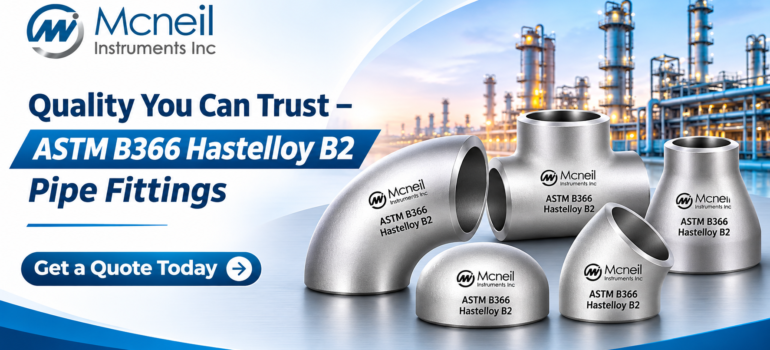
These fittings are manufactured to provide dependable connections between piping systems while maintaining corrosion resistance and mechanical integrity. Depending on project requirements, they can be supplied in different configurations, including elbows, tees, reducers, caps and other butt-weld fittings.
Key Properties of Hastelloy B2 Pipe Fittings
- Excellent Corrosion Resistance
Hastelloy B2 offers excellent resistance to hydrochloric acid at various concentrations and temperatures. It is particularly suitable for reducing environments where many conventional alloys may experience rapid corrosion. - Resistance to Pitting and Crevice Corrosion
Its nickel-molybdenum composition provides good resistance to localized corrosion in suitable chemical environments, helping improve piping system reliability. - Low Carbon and Silicon Content
Hastelloy B2 is designed with controlled carbon and silicon content to help minimize harmful carbide and silicide precipitation during thermal exposure and welding-related operations. - Reliable Performance in Chemical Processing
These fittings are used in industrial systems where chemical compatibility and material integrity are critical for safe and consistent operations. - Suitable for Fabricated Piping Systems
ASTM B366 Hastelloy B2 fittings are available in different dimensions and configurations to support customized piping layouts and industrial installation requirements.
Common Types of ASTM B366 Hastelloy B2 Pipe Fittings
Depending on the piping design and application, Hastelloy B2 fittings are available in several configurations:
Hastelloy B2 Elbows: Used to change the direction of fluid flow in piping systems.
Hastelloy B2 Equal and Reducing Tees: Used for creating branch connections.
Hastelloy B2 Reducers: Used to connect pipes of different diameters.
Hastelloy B2 End Caps: Used to close piping ends.
Hastelloy B2 Cross Fittings: Used for connecting four piping sections.
Custom Butt Weld Fittings: Manufactured according to project drawings and dimensional requirements.
Industrial Applications of Hastelloy B2 Pipe Fittings
ASTM B366 Hastelloy B2 pipe fittings are commonly considered for applications involving reducing chemical environments.
Chemical Processing Plants: Used in piping systems handling hydrochloric acid and other compatible aggressive chemicals.
Petrochemical Industry: Suitable for selected process lines where corrosion resistance and material reliability are essential.
Pharmaceutical Manufacturing: Used in compatible chemical processing and handling systems requiring reliable material performance.
Specialty Chemical Production: Supports piping systems exposed to demanding chemical conditions.
Industrial Processing Facilities: Used in specialized equipment and piping installations where material selection is based on chemical compatibility.
The suitability of Hastelloy B2 depends on chemical concentration, temperature, contaminants and operating conditions. Proper material selection should always be based on application-specific engineering requirements.
ASTM B366 Standards and Quality Requirements
ASTM B366 establishes requirements for factory-made wrought nickel and nickel-alloy fittings used in pressure piping systems. Compliance with the applicable specification helps ensure that fittings meet the required material and manufacturing criteria.
When sourcing Hastelloy B2 fittings, buyers should consider the following quality and inspection requirements:
Chemical composition verification
Mechanical property testing
Dimensional inspection
Material Test Certificates (MTC)
Positive Material Identification (PMI), where specified
Surface and visual inspection
Heat number identification and material traceability
Non-destructive testing (NDT), where required by the project
The applicable inspection and testing requirements should be clearly defined in the purchase order and project specification.
Why Choose Mcneil Instruments for Hastelloy B2 Pipe Fittings?
Choosing an experienced supplier is important when sourcing nickel-alloy piping components for critical industrial applications. At Mcneil Instruments, we focus on delivering piping products that meet customer specifications and industrial quality expectations.
Our advantages include:
Supply of Hastelloy B2 pipe fittings in different configurations.
Products manufactured to applicable ASTM specifications.
Custom dimensions and project-specific requirements.
Material documentation and traceability as specified.
Support for domestic and international industrial requirements.
Reliable supply solutions for chemical, petrochemical and process industries.
We aim to support customers with quality-focused products, technical specifications and dependable service.
Conclusion
ASTM B366 Hastelloy B2 Pipe Fittings are an important choice for industrial piping systems that require resistance to reducing acids and demanding chemical environments. Their nickel-molybdenum composition, corrosion resistance and suitability for selected chemical-processing applications make them valuable components in specialized industrial installations.
At Mcneil Instruments, we are committed to supplying quality-engineered Hastelloy B2 pipe fittings that support the requirements of modern process industries. Whether you need elbows, tees, reducers, caps or customized fittings, our team can assist with your project requirements.
Looking for Reliable ASTM B366 Hastelloy B2 Pipe Fittings?
Choose Mcneil Instruments for quality-focused nickel-alloy piping solutions. We offer Hastelloy B2 elbows, tees, reducers, caps and customized pipe fittings for demanding industrial applications.
Contact our team today to discuss your requirements and request a competitive quotation.
Website: https://www.mcneilinstruments.com/
Frequently Asked Questions (FAQs)
- What is ASTM B366 Hastelloy B2?
ASTM B366 Hastelloy B2 refers to factory-made wrought nickel-alloy fittings manufactured according to ASTM B366 requirements. Hastelloy B2 is a nickel-molybdenum alloy identified by UNS N10665, known for its resistance to reducing chemical environments. - What is the UNS number of Hastelloy B2?
The UNS designation of Hastelloy B2 is N10665. It is a nickel-molybdenum alloy containing approximately 26–30% molybdenum. - What types of Hastelloy B2 pipe fittings are available?
Common configurations include 45-degree and 90-degree elbows, tees, reducers, caps, bends, stub ends and other customized butt-weld fittings. - Is Hastelloy B2 suitable for hydrochloric acid applications?
Yes. Hastelloy B2 offers excellent resistance to hydrochloric acid under suitable operating conditions. However, concentration, temperature, impurities and oxidizing contaminants must be evaluated before selecting the material.
Rolled Alloys+1 - What is the difference between Hastelloy B2 and stainless steel?
Hastelloy B2 is a nickel-molybdenum alloy specifically designed for demanding reducing-acid environments. Stainless steel grades such as 304 and 316 offer good corrosion resistance in many general industrial applications but may not provide equivalent performance in certain aggressive acid environments. - Which industries use ASTM B366 Hastelloy B2 fittings?
These fittings are used in chemical processing, petrochemical manufacturing, pharmaceutical production, specialty chemical plants and other industrial facilities handling compatible corrosive chemicals. - Can Hastelloy B2 fittings be customized?
Yes. Hastelloy B2 fittings can be sourced in different sizes, schedules, dimensions and configurations according to project drawings and applicable manufacturing specifications. - What documents should be checked when purchasing Hastelloy B2 fittings?
Buyers should check the Material Test Certificate, chemical composition, mechanical test results, dimensional inspection reports and heat number traceability. Additional inspection documents can be requested according to project requirements. - Is Hastelloy B2 suitable for all corrosive environments?
No. Hastelloy B2 is particularly suited to reducing environments. Its low chromium content makes it unsuitable for certain strongly oxidizing environments, oxidizing salts, wet chlorine gas and hypochlorite bleach.
Rolled Alloys+1 - Where can I buy ASTM B366 Hastelloy B2 Pipe Fittings?
You can contact Mcneil Instruments for Hastelloy B2 pipe fittings in different configurations and sizes. Share your technical specifications and project requirements to discuss suitable supply options.