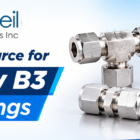
In industries where corrosive chemicals and demanding operating conditions are common, selecting the right material for piping components is essential. Hastelloy B3 tube fittings are designed to provide excellent resistance to corrosion, particularly in environments containing hydrochloric acid and other aggressive chemicals.
Mcneil Instruments offers reliable Hastelloy B3 tube fittings designed to meet the requirements of chemical processing, petrochemical, pharmaceutical, and other industrial applications.
What Are Hastelloy B3 Tube Fittings?
Hastelloy B3 is a nickel-molybdenum alloy known for its excellent resistance to hydrochloric acid and other reducing chemicals. It offers improved thermal stability and resistance to corrosion compared with several conventional nickel-based alloys.
Hastelloy B3 tube fittings are used to connect, control, and maintain the integrity of tubing systems in corrosive environments. These fittings help create secure connections while supporting reliable fluid transportation in critical industrial processes.
Key Properties of Hastelloy B3 Tube Fittings
Excellent Corrosion Resistance: Hastelloy B3 provides outstanding resistance to hydrochloric acid across a wide range of concentrations and temperatures. Improved Thermal Stability: Its chemical composition helps maintain structural stability during thermal exposure and demanding operating conditions. Resistance to Pitting and Stress Corrosion: The alloy offers resistance to localized corrosion and stress corrosion cracking in suitable chemical environments. High Mechanical Strength: Hastelloy B3 tube fittings provide dependable mechanical performance for demanding industrial applications. Reliable Connections: Properly selected and installed fittings help maintain secure tubing connections and reduce the risk of leakage.
Applications of Hastelloy B3 Tube Fittings
Hastelloy B3 tube fittings are widely used in industries that handle aggressive chemicals and corrosive fluids.
Common applications include: Chemical processing plants Pharmaceutical manufacturing facilities Petrochemical industries Acid handling and processing systems Industrial instrumentation systems Chemical storage and transfer applications Their corrosion resistance makes them particularly suitable for tubing systems exposed to hydrochloric acid and other reducing chemical environments.
Selecting Hastelloy B3 tube fittings can help improve the reliability and service life of tubing systems operating in corrosive environments.
Their resistance to aggressive chemicals helps reduce corrosion-related maintenance, minimize the risk of premature component failure, and support dependable industrial operations.
However, the suitability of Hastelloy B3 depends on the chemical composition, concentration, temperature, and operating conditions of the application. Proper material selection is essential to achieve the desired performance.
Mcneil Instruments provides industrial instrumentation and piping solutions designed to meet demanding application requirements.
With a focus on quality, reliability, and customer satisfaction, Mcneil Instruments supports industries that require dependable tube fittings for critical operations.
Whether you need Hastelloy B3 tube fittings for chemical processing, instrumentation, or other industrial applications, choosing a reliable supplier is essential for maintaining system performance and operational efficiency.
Looking for reliable Hastelloy B3 tube fittings for your industrial applications? Contact Mcneil Instruments today for quality instrumentation solutions designed to meet your project requirements.
Frequently Asked Questions (FAQs)
What are Hastelloy B3 tube fittings? Hastelloy B3 tube fittings are tubing connection components manufactured from a nickel-molybdenum alloy known for its excellent resistance to hydrochloric acid and other corrosive chemicals.
What are the main benefits of Hastelloy B3 tube fittings? They offer excellent corrosion resistance, improved thermal stability, good mechanical strength, and reliable performance in demanding chemical environments.
Which industries use Hastelloy B3 tube fittings? These fittings are commonly used in chemical processing, petrochemical, pharmaceutical, and industrial instrumentation applications.
Are Hastelloy B3 tube fittings suitable for hydrochloric acid applications? Yes, Hastelloy B3 offers excellent resistance to hydrochloric acid under suitable operating conditions. The specific concentration and temperature should be evaluated before selecting the material.
How do I select the right Hastelloy B3 tube fittings? Consider the operating pressure, temperature, chemical composition, tubing dimensions, connection type, and material compatibility before selecting the fittings.
Pharmaceutical manufacturing and chemical-processing facilities require piping systems that can maintain integrity when exposed to aggressive acids, corrosive process chemicals, elevated temperatures and repeated thermal or fabrication cycles. Material selection is therefore an important part of designing process piping, transfer lines, reactor connections and associated equipment.
Hastelloy B2 and B3 Pipe Fittings are nickel-molybdenum alloy components developed for demanding reducing-acid environments. They are particularly associated with hydrochloric acid and other non-oxidizing chemical services. Mcneil Instruments manufactures and supplies Hastelloy B2 and B3 Pipe Fittings in configurations including elbows, tees, reducers, couplings and flanges for chemical, pharmaceutical and other industrial applications.
The two grades are closely related, but their metallurgical characteristics are not identical. Hastelloy B3 was developed with greater thermal stability than B2, which can be important when fabrication, welding or thermal cycling is part of the application. Haynes International describes B3 as having improved structural stability compared with earlier B-type alloys.
What Are Hastelloy B2 and B3 Pipe Fittings?
Hastelloy B2 and B3 Pipe Fittings are corrosion-resistant nickel-based alloy fittings used to connect, redirect, branch, reduce or terminate piping systems.
They can be manufactured in configurations such as:
45° elbows
90° elbows
Long-radius elbows
Equal tees
Reducing tees
Concentric reducers
Eccentric reducers
Pipe caps
Stub ends
Crosses
Couplings
Unions
Nipples
Flanges
Custom configurations
Mcneil Instruments specifically lists elbows, tees, reducers, couplings and flanges for its B2 and B3 pipe-fitting ranges.
These fittings are particularly relevant when conventional carbon steel or stainless steel materials do not provide the required resistance to the process environment.
Why Are Hastelloy B2 and B3 Important in Pharmaceutical Chemical Processing?
Pharmaceutical and chemical plants can use aggressive chemicals during:
Chemical synthesis
Intermediate production
API manufacturing
Acid handling
Solvent processing
Reactor operations
Chemical transfer
Cleaning processes
Waste treatment
Scrubbing
Process neutralization
Depending on the process, piping components may encounter hydrochloric acid, sulfuric acid, phosphoric acid, hydrobromic acid and other chemical media.
Hastelloy B2 and B3 are primarily associated with reducing and non-oxidizing acid environments. Haynes International identifies B3 as having very high resistance to pure hydrochloric, hydrobromic and sulfuric acids.
However, neither grade should be selected solely because a process is described as “chemical.” The actual chemical composition, concentration, temperature, impurities and oxidizing conditions need to be evaluated.
Hastelloy B2 Pipe Fittings
Hastelloy B2, also known as UNS N10665, is a nickel-molybdenum alloy designed for reducing chemical environments.
Mcneil Instruments publishes the following indicative composition and properties for its B2 pipe fittings:
Parameter
Published Specification
Nickel
Approximately 65%
Molybdenum
26–30%
Chromium
Approximately 1%
Iron
Maximum 2.5%
Temperature Range
–196°C to +315°C
Tensile Strength
≥485 MPa
Yield Strength
≥170 MPa
Hardness
≤95 HRB
Standards
ASTM B366, ASME SB366, B574
These are Mcneil Instruments’ published product values; the exact requirements for a project should be confirmed against the applicable material certificate and purchasing specification.
Corrosion Characteristics of B2
Hastelloy B2 is particularly suited to reducing acids. Independent alloy data also cautions that its low chromium content makes it unsuitable for certain strongly oxidizing media and oxidizing salts.
This distinction is important in pharmaceutical chemical processing because a process stream may contain several chemicals rather than a single pure acid.
Hastelloy B3 Pipe Fittings
Hastelloy B3, designated UNS N10675, is another nickel-molybdenum alloy developed for severe reducing-acid service.
Mcneil Instruments publishes:
Parameter
Published Specification
Nickel
Approximately 64%
Molybdenum
29–34%
Chromium
Approximately 1%
Iron
Maximum 2.5%
Temperature Range
–196°C to +315°C
Tensile Strength
≥485 MPa
Yield Strength
≥170 MPa
Hardness
≤95 HRB
Standards
ASTM B366, ASME SB366, B574
Haynes International describes B3 as having enhanced structural stability compared with earlier B-type alloys and improved resistance characteristics in several non-oxidizing acidic environments.
Hastelloy B2 vs B3 Pipe Fittings
B2 and B3 should not be treated as interchangeable simply because both belong to the nickel-molybdenum B-family.
Factor
Hastelloy B2
Hastelloy B3
Alloy family
Nickel-molybdenum
Nickel-molybdenum
Primary service
Reducing acids
Reducing acids
Hydrochloric acid
Suitable for selected conditions
Strong resistance in selected conditions
Sulfuric acid
Suitable for selected reducing conditions
Strong resistance in selected conditions
Thermal stability
Lower than B3
Improved
Welding/fabrication considerations
Requires appropriate controls
Improved thermal stability
Chromium content
Low
Low
Oxidizing environments
Requires careful evaluation
Requires careful evaluation
Pharmaceutical applications
Process-dependent
Process-dependent
Chemical processing
Widely applicable
Widely applicable
Haynes International specifically reports improved thermal stability for B3 compared with B2, including reduced susceptibility to undesirable phase precipitation during thermal exposure.
Why Thermal Stability Matters in Pharmaceutical Piping
Pharmaceutical processing systems may contain welded piping assemblies, reactor connections and process lines that experience repeated heating and cooling.
Thermal cycling can influence:
Metallurgical stability
Weld-area performance
Corrosion resistance
Dimensional stability
Long-term service performance
B3 was developed partly to address thermal-stability limitations associated with earlier B-series alloys. Haynes reports that its chemistry reduces the tendency to form deleterious intermetallic phases and improves structural stability during fabrication and service.
Therefore, where fabrication involves significant welding or thermal exposure, engineers may need to compare B2 and B3 based on the complete process and fabrication specification.
Hastelloy B2 and B3 for Pharmaceutical Manufacturing
Pharmaceutical plants can contain specialized process equipment and piping for chemical synthesis and active pharmaceutical ingredient production.
Potential applications include:
Reactor connections
Acid-transfer lines
Chemical dosing lines
Process piping
Sampling lines
Drain systems
Process-control systems
Chemical storage connections
Scrubber systems
Waste-treatment lines
Mcneil Instruments identifies pharmaceutical processing among the industries for which B2 and B3 fittings can be used.
The actual suitability depends on the process chemistry and the cleanliness, surface-finish and validation requirements of the pharmaceutical installation.
Hastelloy B2 and B3 for Chemical Processing
Chemical-processing systems are one of the principal application areas for B2 and B3.
They can be considered for systems involving:
Hydrochloric acid
Sulfuric acid
Phosphoric acid
Hydrobromic acid
Other reducing acids
Chemical intermediates
Acid transfer
Chemical reaction systems
B3 is documented as having strong resistance to hydrochloric and sulfuric acids and is used in chemical-process-industry applications involving reducing acid service.
Hastelloy B2 and B3 for Hydrochloric Acid Systems
Hydrochloric acid can be highly aggressive toward many conventional engineering materials.
B2 is specifically associated with reducing-acid service, including hydrochloric acid. B3 is also designed for highly corrosive hydrochloric-acid environments.
Potential applications include:
HCl transfer lines
Acid dosing systems
Reactor piping
Chemical injection
Scrubber systems
Process sampling
Acid storage connections
The concentration and temperature of the hydrochloric acid must be considered when selecting the alloy.
Hastelloy B2 and B3 for Sulfuric Acid Processing
Sulfuric acid systems can operate across a wide range of concentrations and temperatures, with corrosion behavior changing significantly according to process conditions.
Hastelloy B2 and B3 can be considered for selected reducing sulfuric-acid services.
B3’s manufacturer documentation identifies sulfuric acid among its important chemical-processing applications.
Engineers should evaluate:
Acid concentration
Operating temperature
Contaminants
Flow conditions
Aeration
Oxidizing species
Welded areas
Pressure
before selecting the fitting material.
Important Limitation: B2 and B3 Are Not Universal Acid Alloys
A common material-selection mistake is assuming that an alloy designed for strong acids is automatically suitable for every chemical environment.
B2 has very low chromium content, and independent technical documentation warns against its use in strongly oxidizing media and oxidizing salts.
B3 likewise has low chromium content. Published technical information notes restrictions involving strongly oxidizing environments and salts. (Corrosion Resistant Alloys)
Therefore, B2 and B3 should be evaluated carefully where the pharmaceutical process contains:
Ferric salts
Cupric salts
Hypochlorite
Wet chlorine
Strong oxidizers
Oxidizing acids
Where oxidizing and reducing conditions coexist, other Hastelloy grades such as C22 or C276 may need to be evaluated depending on the process chemistry.
Types of Hastelloy B2 and B3 Pipe Fittings
90° Elbows
Used to change piping direction by approximately 90°.
45° Elbows
Used where a smaller directional change is required.
Equal Tees
Provide a branch connection with the same nominal size as the main line.
Reducing Tees
Provide a branch connection with a different nominal diameter.
Reducers
Connect piping sections with different diameters.
Couplings
Connect two compatible piping sections.
Flanges
Provide bolted connections between piping components, valves, equipment or other flanged components.
Custom Fittings
Custom configurations may be manufactured according to project drawings, dimensions and technical requirements. Mcneil Instruments states that customized B2 and B3 configurations are available.
Hastelloy B2 and B3 Pipe Fitting Standards
Mcneil Instruments identifies the following standards for its B2 and B3 pipe fittings:
ASTM B366
ASME SB366
B574
The exact standard should be specified according to the fitting type and project requirements. Material designation alone does not establish all dimensional, pressure, inspection and testing requirements.
For pharmaceutical and chemical projects, procurement specifications may additionally require:
Material Test Certificates
Chemical composition verification
Mechanical testing
Dimensional inspection
PMI
Surface inspection
Hardness testing
NDT where applicable
Traceability documentation
Certificate of conformity
Hastelloy B2 and B3 Pipe Fitting Specifications
Specification
Hastelloy B2 / B3
Material
Nickel-Molybdenum alloy
B2 UNS
N10665
B3 UNS
N10675
Fitting Types
Elbows, tees, reducers, couplings, flanges and custom fittings
Standards
ASTM B366, ASME SB366, B574
B2 Published Temperature Range
–196°C to +315°C
B3 Published Temperature Range
–196°C to +315°C
B2 Published Tensile Strength
≥485 MPa
B3 Published Tensile Strength
≥485 MPa
B2 Published Yield Strength
≥170 MPa
B3 Published Yield Strength
≥170 MPa
Hardness
≤95 HRB
Published values are product-specific and should be confirmed against the actual purchase specification, material certificate and design requirements.
How to Select Hastelloy B2 or B3 Pipe Fittings
1. Identify the Process Chemical
Determine exactly what chemical will contact the fitting.
Do not select the alloy based only on a broad description such as “acid service.”
2. Determine Chemical Concentration
Corrosion rates can change substantially with concentration.
Record:
Chemical concentration
Impurities
Water content
Dissolved gases
Oxidizing contaminants
3. Determine Operating Temperature
Temperature can significantly affect corrosion behavior and metallurgical stability.
Consider both:
Normal operating temperature
Maximum/design temperature
4. Identify Oxidizing Conditions
This is particularly important for B2 and B3 because their low chromium content makes them specialized alloys for reducing environments rather than universal oxidizing-service materials.
5. Select B2 or B3
Compare the two grades according to:
Process chemistry
Temperature
Welded construction
Thermal cycling
Corrosion mechanism
Fabrication requirements
Project standards
6. Select the Fitting Configuration
Determine whether the system requires:
Elbow
Tee
Reducer
Coupling
Flange
Custom fitting
7. Confirm Dimensions
Verify:
Nominal pipe size
Outside diameter
Wall thickness
Schedule
End connection
Face-to-face dimensions
8. Confirm Manufacturing and Inspection Requirements
For critical pharmaceutical and chemical projects, confirm:
Applicable ASTM/ASME specification
Material certificates
PMI
Dimensional inspection
NDT requirements
Surface requirements
Traceability
Third-party inspection where required
Hastelloy B2 vs Stainless Steel in Pharmaceutical Chemical Processing
Stainless steel is widely used in pharmaceutical facilities, but it is not automatically suitable for every aggressive chemical service.
Factor
Stainless Steel
Hastelloy B2/B3
General pharmaceutical service
Widely used
Specialized
Reducing-acid resistance
Grade dependent
Strong for selected environments
Hydrochloric acid
Often challenging depending on grade and conditions
Designed for selected reducing-acid service
Sulfuric acid
Highly grade/concentration dependent
Suitable for selected reducing conditions
Oxidizing environments
Some grades offer strong performance
Requires careful evaluation
Material cost
Generally lower
Generally higher
Typical role
General sanitary/process service
Severe chemical service where compatible
The appropriate material should be selected from the actual process conditions rather than assuming that a higher-alloy material is always necessary.
In pharmaceutical facilities, corrosion resistance is only one part of material selection.
Depending on the application, engineers may also need to evaluate:
Surface Finish
Internal surfaces may need to meet project-specific roughness requirements to support cleaning and process control.
Cleanability
The fitting design should avoid unnecessary crevices or geometries that could complicate cleaning.
Weld Quality
Where fittings are welded into process systems, welding procedures and post-weld requirements should be established.
Traceability
Critical pharmaceutical installations may require complete material traceability from raw material through fabrication and inspection.
Contamination Control
The selected material and surface condition should be compatible with the process and cleaning chemicals.
Validation Requirements
The fitting specification should align with the equipment and process-validation requirements applicable to the facility.
Why Choose Mcneil Instruments for Hastelloy B2 and B3 Pipe Fittings?
Mcneil Instruments manufactures and supplies Hastelloy pipe fittings in grades including B2 and B3, alongside C22, C276 and X. Its published B2 and B3 product information identifies chemical processing and pharmaceutical applications among the intended industrial uses.
Mcneil Instruments offers:
Hastelloy B2 Pipe Fittings
Hastelloy B3 Pipe Fittings
Elbows
Tees
Reducers
Couplings
Flanges
Custom configurations
ASTM B366 options
ASME SB366 options
B574-related material options
International export support
The company states that its B2 and B3 fittings are available for international projects and can be supplied in custom configurations.
Frequently Asked Questions
What are Hastelloy B2 and B3 Pipe Fittings?
They are nickel-molybdenum alloy fittings designed primarily for demanding reducing-acid and other corrosive chemical environments.
What is Hastelloy B2 used for?
B2 is particularly associated with reducing acids and chemical-processing environments. Mcneil Instruments identifies chemical processing, petrochemical, pharmaceutical, offshore, marine and industrial piping among its applications.
What is Hastelloy B3 used for?
B3 is used for demanding chemical-processing applications involving reducing acids, including selected hydrochloric- and sulfuric-acid services. Haynes International identifies chemical-process-industry applications and emphasizes its enhanced structural stability.
What is the difference between Hastelloy B2 and B3?
B3 was developed with greater thermal stability than B2. Haynes International reports reduced susceptibility to undesirable phase precipitation and improved fabrication/service characteristics compared with B2.
Are B2 and B3 suitable for hydrochloric acid?
They are specifically associated with hydrochloric-acid service under suitable conditions. The actual concentration, temperature and presence of contaminants must be evaluated before material selection.
Are B2 and B3 suitable for all acids?
No. They are specialized primarily for reducing/non-oxidizing acid environments. Strongly oxidizing media and oxidizing salts require particular caution because of their low chromium content.
What standards are available for Hastelloy B2 and B3 Pipe Fittings?
Mcneil Instruments lists ASTM B366, ASME SB366 and B574 for its B2 and B3 pipe-fitting products.
Are Hastelloy B2 and B3 used in pharmaceutical processing?
Yes. Mcneil Instruments identifies pharmaceutical processing among the applications for both B2 and B3 pipe fittings.
Are B3 fittings better than B2 fittings?
The appropriate grade depends on the process conditions. B3 has enhanced thermal stability compared with B2, but that does not mean it is universally suitable for every application. Process chemistry, temperature, fabrication conditions and project requirements should determine the selection.
Conclusion
Hastelloy B2 and B3 Pipe Fittings for Pharmaceutical Chemical Processing provide specialized corrosion-resistant solutions for piping systems exposed to demanding reducing-acid environments.
Hastelloy B2 is a nickel-molybdenum alloy associated with strong reducing-acid service, while B3 was developed with improved thermal stability and fabrication characteristics compared with earlier B-series alloys. Both grades can be considered for selected hydrochloric-, sulfuric- and other non-oxidizing chemical services.
Mcneil Instruments supplies Hastelloy B2 and B3 Pipe Fittings in configurations including elbows, tees, reducers, couplings and flanges, with published standards including ASTM B366, ASME SB366 and B574.
For pharmaceutical and chemical-processing projects, the correct fitting should be selected by evaluating the chemical composition, concentration, temperature, oxidizing/reducing conditions, pressure, piping dimensions, fabrication method, surface requirements, inspection requirements and applicable standards.
B2 and B3 are not universal corrosion-resistant materials. Their low chromium content means that strongly oxidizing environments require particular attention, and alternative alloys may be more appropriate depending on the process chemistry.