Introduction: The Importance of Stainless Steel Pipe Fittings in Industrial Systems
In modern industrial piping networks, pipe fittings play a crucial role in ensuring the efficient and safe transportation of fluids, gases, and chemicals. These components are responsible for connecting pipelines, redirecting flow, reducing pipe diameters, or sealing the end of pipelines. From oil refineries and petrochemical plants to food processing units, power plants, pharmaceutical facilities, and water treatment systems, reliable pipe fittings are essential for maintaining system integrity.
Among various stainless steel grades available in the market, Stainless Steel 304 pipe fittings are one of the most widely used due to their excellent balance of corrosion resistance, mechanical strength, weldability, and cost efficiency. Stainless Steel 304 belongs to the austenitic stainless steel family, which is known for its durability and resistance to oxidation and corrosion in many environments.
While SS 304 is widely used in industrial applications, other stainless steel grades such as 304L, 316, 316L, 321, and 347 are also important alternatives, especially when higher corrosion resistance or better performance in high-temperature environments is required. Understanding the properties and differences between these grades helps engineers and procurement specialists select the most suitable material for their specific piping applications.
This article explores Stainless Steel 304 pipe fittings in detail, including their composition, mechanical properties, industrial applications, and comparison with related stainless steel grades.
What Are Stainless Steel 304 Pipe Fittings?
Stainless Steel 304 pipe fittings are components used to join pipes and tubing in piping systems while maintaining structural strength and corrosion resistance. These fittings are typically manufactured according to standards such as ASTM A403 / ASME SA403, which define specifications for austenitic stainless steel pipe fittings.
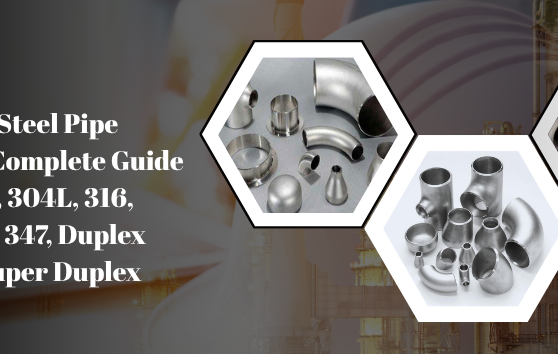
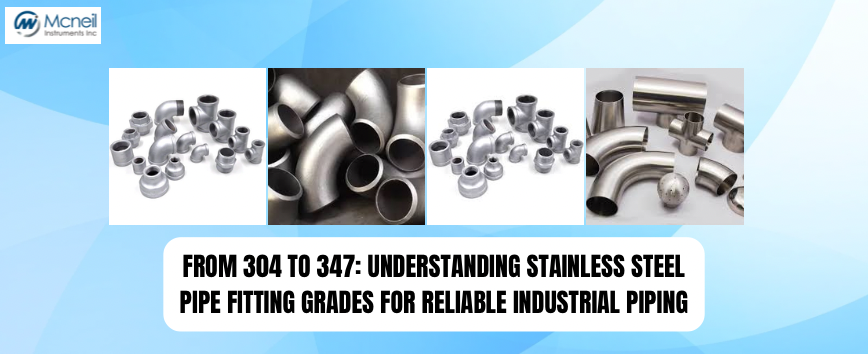
Pipe fittings are available in a wide variety of shapes and configurations to accommodate different piping system designs. The most commonly used types include:
● Elbows – used to change the direction of fluid flow
● Tees – used to split or combine flow within a pipeline
● Reducers – used to connect pipes of different diameters
● Stub ends – used with lap joint flanges for easier assembly
● Caps – used to seal the end of a pipeline
● Cross fittings – used where four pipes intersect
These fittings are produced using forging, machining, or welding processes to ensure durability and dimensional accuracy.
Chemical Composition of Stainless Steel 304
The performance of Stainless Steel 304 pipe fittings largely depends on their chemical composition. The alloy contains chromium and nickel as its primary elements, which provide corrosion resistance and structural stability.
| Element | Typical Composition (%) |
| Chromium (Cr) | 18 – 20 |
| Nickel (Ni) | 8 – 11 |
| Carbon (C) | ≤ 0.08 |
| Manganese (Mn) | ≤ 2 |
| Silicon (Si) | ≤ 1 |
| Phosphorus (P) | ≤ 0.045 |
| Sulfur (S) | ≤ 0.03 |
Chromium forms a passive oxide layer on the metal surface that protects it from corrosion, while nickel enhances toughness and ductility.
Mechanical Properties of Stainless Steel 304 Pipe Fittings
The mechanical strength and structural reliability of SS 304 pipe fittings make them suitable for a wide range of industrial conditions.
| Property | Typical Value |
| Tensile Strength | ≥ 515 MPa |
| Yield Strength | ≥ 205 MPa |
| Elongation | ≥ 40% |
| Hardness | ≤ 201 HB |
| Density | 8 g/cm³ |
Stainless Steel 304 exhibits excellent ductility and toughness, even at low temperatures, making it suitable for demanding industrial environments.
Key Advantages of Stainless Steel 304 Pipe Fittings
The chromium content in SS 304 forms a protective oxide layer that shields the material from corrosion caused by moisture, chemicals, and atmospheric exposure.
SS 304 fittings can be easily welded using common welding techniques such as TIG, MIG, and arc welding without significantly affecting the metal’s mechanical properties.
The austenitic microstructure of SS 304 provides excellent toughness and resistance to cracking or mechanical stress.
The smooth surface of stainless steel makes it ideal for industries that require sanitary conditions, including food processing and pharmaceutical manufacturing.
Because of its balanced properties, SS 304 pipe fittings are used in numerous industries worldwide.
Technical Specifications of Stainless Steel 304 Pipe Fittings
| Specification | Details |
| Standard | ASTM A403 / ASME SA403 |
| Grade | WP304 |
| Size Range | ½″ to 48″ NB |
| Wall Thickness | SCH 10 to SCH XXS |
| Manufacturing Type | Seamless / Welded |
| Connection Type | Butt Weld, Threaded, Socket Weld |
| Pressure Standard | ASME B16.9 / B16.11 |
These specifications ensure compatibility with standard piping systems used across global industries.
Industrial Applications of Stainless Steel 304 Pipe Fittings
Stainless Steel 304 pipe fittings are widely used across multiple sectors because they offer durability, corrosion resistance, and reliability.
Used in pipelines, refineries, and offshore platforms for transporting hydrocarbons and process fluids.
SS 304 is suitable for hygienic piping systems used in food manufacturing and beverage processing plants.
Resistant to many chemicals and solvents, making it suitable for process piping systems.
Maintains sanitary conditions required for pharmaceutical production facilities.
Used in pipelines for potable water and wastewater treatment plants.
Other Important Stainless Steel Pipe Fitting Grades
Although SS 304 is one of the most commonly used stainless steels, other grades are often selected for specific environments or operating conditions.
Stainless Steel 304L Pipe Fittings
304L is the low-carbon version of SS 304, designed to minimize carbide precipitation during welding.
● Improved weldability
● Reduced risk of intergranular corrosion
● Similar corrosion resistance to SS 304
● Chemical tanks
● Welded pipelines
● Process piping systems
Stainless Steel 316 Pipe Fittings
SS 316 contains molybdenum, which significantly enhances resistance to corrosion, particularly in chloride environments.
● Superior corrosion resistance
● Better performance in marine environments
● Marine piping systems
● Offshore platforms
● Chemical processing plants
Stainless Steel 316L Pipe Fittings
316L is the low-carbon version of SS 316, offering improved weldability and corrosion resistance.
● Pharmaceutical processing systems
● Pressure vessels
● Chemical transport pipelines
Stainless Steel 321 Pipe Fittings
SS 321 contains titanium stabilizers that improve its resistance to high-temperature oxidation and carbide precipitation.
● Heat exchangers
● High-temperature piping systems
● Aerospace applications
Stainless Steel 347 Pipe Fittings
SS 347 is stabilized with niobium, which enhances resistance to intergranular corrosion at elevated temperatures.
● Thermal power plants
● Petrochemical reactors
● High-temperature steam pipelines
Comparison of Stainless Steel Grades
| Grade | Alloy Element | Key Advantage | Typical Applications |
| 304 | Chromium + Nickel | General corrosion resistance | Food, water, piping |
| 304L | Low carbon | Improved weldability | Chemical pipelines |
| 316 | Molybdenum | Superior corrosion resistance | Marine systems |
| 316L | Low carbon + Mo | Better corrosion resistance | Pharmaceutical |
| 321 | Titanium | High-temperature stability | Aerospace |
| 347 | Niobium | Resistance to intergranular corrosion | Power plants |
Quality Testing of Stainless Steel Pipe Fittings
To ensure reliability and compliance with international standards, stainless steel pipe fittings undergo several quality checks.
Typical testing procedures include:
● Chemical composition testing
● Mechanical strength testing
● Hydrostatic pressure testing
● Ultrasonic and radiographic inspection
● Positive Material Identification (PMI)
● Dimensional inspection
These testing methods ensure the fittings meet required industrial specifications and safety standards.
Stainless Steel 304 pipe fittings continue to be one of the most widely used components in industrial piping systems due to their excellent corrosion resistance, strength, weldability, and versatility. Their ability to perform effectively across a wide range of industries makes them a reliable choice for many piping applications.
However, in environments where higher corrosion resistance, improved weldability, or better high-temperature performance is required, alternative stainless steel grades such as 304L, 316, 316L, 321, and 347 may be preferred.
Understanding the differences between these grades allows engineers and procurement professionals to select the most suitable material, ensuring long-lasting performance, operational safety, and efficiency in industrial piping systems.