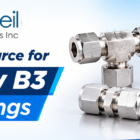
Hastelloy B2 and B3 Pipe Fittings for Pharmaceutical Chemical Processing
Pharmaceutical manufacturing and chemical-processing facilities require piping systems that can maintain integrity when exposed to aggressive acids, corrosive process chemicals, elevated temperatures and repeated thermal or fabrication cycles. Material selection is therefore an important part of designing process piping, transfer lines, reactor connections and associated equipment.
Hastelloy B2 and B3 Pipe Fittings are nickel-molybdenum alloy components developed for demanding reducing-acid environments. They are particularly associated with hydrochloric acid and other non-oxidizing chemical services. Mcneil Instruments manufactures and supplies Hastelloy B2 and B3 Pipe Fittings in configurations including elbows, tees, reducers, couplings and flanges for chemical, pharmaceutical and other industrial applications.
The two grades are closely related, but their metallurgical characteristics are not identical. Hastelloy B3 was developed with greater thermal stability than B2, which can be important when fabrication, welding or thermal cycling is part of the application. Haynes International describes B3 as having improved structural stability compared with earlier B-type alloys.
What Are Hastelloy B2 and B3 Pipe Fittings?
Hastelloy B2 and B3 Pipe Fittings are corrosion-resistant nickel-based alloy fittings used to connect, redirect, branch, reduce or terminate piping systems.
They can be manufactured in configurations such as:
- 45° elbows
- 90° elbows
- Long-radius elbows
- Equal tees
- Reducing tees
- Concentric reducers
- Eccentric reducers
- Pipe caps
- Stub ends
- Crosses
- Couplings
- Unions
- Nipples
- Flanges
- Custom configurations
Mcneil Instruments specifically lists elbows, tees, reducers, couplings and flanges for its B2 and B3 pipe-fitting ranges.
These fittings are particularly relevant when conventional carbon steel or stainless steel materials do not provide the required resistance to the process environment.
Why Are Hastelloy B2 and B3 Important in Pharmaceutical Chemical Processing?
Pharmaceutical and chemical plants can use aggressive chemicals during:
- Chemical synthesis
- Intermediate production
- API manufacturing
- Acid handling
- Solvent processing
- Reactor operations
- Chemical transfer
- Cleaning processes
- Waste treatment
- Scrubbing
- Process neutralization
Depending on the process, piping components may encounter hydrochloric acid, sulfuric acid, phosphoric acid, hydrobromic acid and other chemical media.
Hastelloy B2 and B3 are primarily associated with reducing and non-oxidizing acid environments. Haynes International identifies B3 as having very high resistance to pure hydrochloric, hydrobromic and sulfuric acids.
However, neither grade should be selected solely because a process is described as “chemical.” The actual chemical composition, concentration, temperature, impurities and oxidizing conditions need to be evaluated.
Hastelloy B2 Pipe Fittings
Hastelloy B2, also known as UNS N10665, is a nickel-molybdenum alloy designed for reducing chemical environments.
Mcneil Instruments publishes the following indicative composition and properties for its B2 pipe fittings:
| Parameter | Published Specification |
| Nickel | Approximately 65% |
| Molybdenum | 26–30% |
| Chromium | Approximately 1% |
| Iron | Maximum 2.5% |
| Temperature Range | –196°C to +315°C |
| Tensile Strength | ≥485 MPa |
| Yield Strength | ≥170 MPa |
| Hardness | ≤95 HRB |
| Standards | ASTM B366, ASME SB366, B574 |
These are Mcneil Instruments’ published product values; the exact requirements for a project should be confirmed against the applicable material certificate and purchasing specification.
Corrosion Characteristics of B2
Hastelloy B2 is particularly suited to reducing acids. Independent alloy data also cautions that its low chromium content makes it unsuitable for certain strongly oxidizing media and oxidizing salts.
This distinction is important in pharmaceutical chemical processing because a process stream may contain several chemicals rather than a single pure acid.
Hastelloy B3 Pipe Fittings
Hastelloy B3, designated UNS N10675, is another nickel-molybdenum alloy developed for severe reducing-acid service.
Mcneil Instruments publishes:
| Parameter | Published Specification |
| Nickel | Approximately 64% |
| Molybdenum | 29–34% |
| Chromium | Approximately 1% |
| Iron | Maximum 2.5% |
| Temperature Range | –196°C to +315°C |
| Tensile Strength | ≥485 MPa |
| Yield Strength | ≥170 MPa |
| Hardness | ≤95 HRB |
| Standards | ASTM B366, ASME SB366, B574 |
Haynes International describes B3 as having enhanced structural stability compared with earlier B-type alloys and improved resistance characteristics in several non-oxidizing acidic environments.
Hastelloy B2 vs B3 Pipe Fittings
B2 and B3 should not be treated as interchangeable simply because both belong to the nickel-molybdenum B-family.
| Factor | Hastelloy B2 | Hastelloy B3 |
| Alloy family | Nickel-molybdenum | Nickel-molybdenum |
| Primary service | Reducing acids | Reducing acids |
| Hydrochloric acid | Suitable for selected conditions | Strong resistance in selected conditions |
| Sulfuric acid | Suitable for selected reducing conditions | Strong resistance in selected conditions |
| Thermal stability | Lower than B3 | Improved |
| Welding/fabrication considerations | Requires appropriate controls | Improved thermal stability |
| Chromium content | Low | Low |
| Oxidizing environments | Requires careful evaluation | Requires careful evaluation |
| Pharmaceutical applications | Process-dependent | Process-dependent |
| Chemical processing | Widely applicable | Widely applicable |
Haynes International specifically reports improved thermal stability for B3 compared with B2, including reduced susceptibility to undesirable phase precipitation during thermal exposure.
Why Thermal Stability Matters in Pharmaceutical Piping
Pharmaceutical processing systems may contain welded piping assemblies, reactor connections and process lines that experience repeated heating and cooling.
Thermal cycling can influence:
- Metallurgical stability
- Weld-area performance
- Corrosion resistance
- Dimensional stability
- Long-term service performance
B3 was developed partly to address thermal-stability limitations associated with earlier B-series alloys. Haynes reports that its chemistry reduces the tendency to form deleterious intermetallic phases and improves structural stability during fabrication and service.
Therefore, where fabrication involves significant welding or thermal exposure, engineers may need to compare B2 and B3 based on the complete process and fabrication specification.
Hastelloy B2 and B3 for Pharmaceutical Manufacturing
Pharmaceutical plants can contain specialized process equipment and piping for chemical synthesis and active pharmaceutical ingredient production.
Potential applications include:
- Reactor connections
- Acid-transfer lines
- Chemical dosing lines
- Process piping
- Sampling lines
- Drain systems
- Process-control systems
- Chemical storage connections
- Scrubber systems
- Waste-treatment lines
Mcneil Instruments identifies pharmaceutical processing among the industries for which B2 and B3 fittings can be used.
The actual suitability depends on the process chemistry and the cleanliness, surface-finish and validation requirements of the pharmaceutical installation.
Hastelloy B2 and B3 for Chemical Processing
Chemical-processing systems are one of the principal application areas for B2 and B3.
They can be considered for systems involving:
- Hydrochloric acid
- Sulfuric acid
- Phosphoric acid
- Hydrobromic acid
- Other reducing acids
- Chemical intermediates
- Acid transfer
- Chemical reaction systems
B3 is documented as having strong resistance to hydrochloric and sulfuric acids and is used in chemical-process-industry applications involving reducing acid service.
Hastelloy B2 and B3 for Hydrochloric Acid Systems
Hydrochloric acid can be highly aggressive toward many conventional engineering materials.
B2 is specifically associated with reducing-acid service, including hydrochloric acid. B3 is also designed for highly corrosive hydrochloric-acid environments.
Potential applications include:
- HCl transfer lines
- Acid dosing systems
- Reactor piping
- Chemical injection
- Scrubber systems
- Process sampling
- Acid storage connections
The concentration and temperature of the hydrochloric acid must be considered when selecting the alloy.
Hastelloy B2 and B3 for Sulfuric Acid Processing
Sulfuric acid systems can operate across a wide range of concentrations and temperatures, with corrosion behavior changing significantly according to process conditions.
Hastelloy B2 and B3 can be considered for selected reducing sulfuric-acid services.
B3’s manufacturer documentation identifies sulfuric acid among its important chemical-processing applications.
Engineers should evaluate:
- Acid concentration
- Operating temperature
- Contaminants
- Flow conditions
- Aeration
- Oxidizing species
- Welded areas
- Pressure
before selecting the fitting material.
Important Limitation: B2 and B3 Are Not Universal Acid Alloys
A common material-selection mistake is assuming that an alloy designed for strong acids is automatically suitable for every chemical environment.
B2 has very low chromium content, and independent technical documentation warns against its use in strongly oxidizing media and oxidizing salts.
B3 likewise has low chromium content. Published technical information notes restrictions involving strongly oxidizing environments and salts. (Corrosion Resistant Alloys)
Therefore, B2 and B3 should be evaluated carefully where the pharmaceutical process contains:
- Ferric salts
- Cupric salts
- Hypochlorite
- Wet chlorine
- Strong oxidizers
- Oxidizing acids
Where oxidizing and reducing conditions coexist, other Hastelloy grades such as C22 or C276 may need to be evaluated depending on the process chemistry.
Types of Hastelloy B2 and B3 Pipe Fittings
90° Elbows
Used to change piping direction by approximately 90°.
45° Elbows
Used where a smaller directional change is required.
Equal Tees
Provide a branch connection with the same nominal size as the main line.
Reducing Tees
Provide a branch connection with a different nominal diameter.
Reducers
Connect piping sections with different diameters.
Couplings
Connect two compatible piping sections.
Flanges
Provide bolted connections between piping components, valves, equipment or other flanged components.
Custom Fittings
Custom configurations may be manufactured according to project drawings, dimensions and technical requirements. Mcneil Instruments states that customized B2 and B3 configurations are available.
Hastelloy B2 and B3 Pipe Fitting Standards
Mcneil Instruments identifies the following standards for its B2 and B3 pipe fittings:
- ASTM B366
- ASME SB366
- B574
The exact standard should be specified according to the fitting type and project requirements. Material designation alone does not establish all dimensional, pressure, inspection and testing requirements.
For pharmaceutical and chemical projects, procurement specifications may additionally require:
- Material Test Certificates
- Chemical composition verification
- Mechanical testing
- Dimensional inspection
- PMI
- Surface inspection
- Hardness testing
- NDT where applicable
- Traceability documentation
- Certificate of conformity
Hastelloy B2 and B3 Pipe Fitting Specifications
| Specification | Hastelloy B2 / B3 |
| Material | Nickel-Molybdenum alloy |
| B2 UNS | N10665 |
| B3 UNS | N10675 |
| Fitting Types | Elbows, tees, reducers, couplings, flanges and custom fittings |
| Standards | ASTM B366, ASME SB366, B574 |
| B2 Published Temperature Range | –196°C to +315°C |
| B3 Published Temperature Range | –196°C to +315°C |
| B2 Published Tensile Strength | ≥485 MPa |
| B3 Published Tensile Strength | ≥485 MPa |
| B2 Published Yield Strength | ≥170 MPa |
| B3 Published Yield Strength | ≥170 MPa |
| Hardness | ≤95 HRB |
Published values are product-specific and should be confirmed against the actual purchase specification, material certificate and design requirements.
How to Select Hastelloy B2 or B3 Pipe Fittings
1. Identify the Process Chemical
Determine exactly what chemical will contact the fitting.
Do not select the alloy based only on a broad description such as “acid service.”
2. Determine Chemical Concentration
Corrosion rates can change substantially with concentration.
Record:
- Chemical concentration
- Impurities
- Water content
- Dissolved gases
- Oxidizing contaminants
3. Determine Operating Temperature
Temperature can significantly affect corrosion behavior and metallurgical stability.
Consider both:
- Normal operating temperature
- Maximum/design temperature
4. Identify Oxidizing Conditions
This is particularly important for B2 and B3 because their low chromium content makes them specialized alloys for reducing environments rather than universal oxidizing-service materials.
5. Select B2 or B3
Compare the two grades according to:
- Process chemistry
- Temperature
- Welded construction
- Thermal cycling
- Corrosion mechanism
- Fabrication requirements
- Project standards
6. Select the Fitting Configuration
Determine whether the system requires:
- Elbow
- Tee
- Reducer
- Coupling
- Flange
- Custom fitting
7. Confirm Dimensions
Verify:
- Nominal pipe size
- Outside diameter
- Wall thickness
- Schedule
- End connection
- Face-to-face dimensions
8. Confirm Manufacturing and Inspection Requirements
For critical pharmaceutical and chemical projects, confirm:
- Applicable ASTM/ASME specification
- Material certificates
- PMI
- Dimensional inspection
- NDT requirements
- Surface requirements
- Traceability
- Third-party inspection where required
Hastelloy B2 vs Stainless Steel in Pharmaceutical Chemical Processing
Stainless steel is widely used in pharmaceutical facilities, but it is not automatically suitable for every aggressive chemical service.
| Factor | Stainless Steel | Hastelloy B2/B3 |
| General pharmaceutical service | Widely used | Specialized |
| Reducing-acid resistance | Grade dependent | Strong for selected environments |
| Hydrochloric acid | Often challenging depending on grade and conditions | Designed for selected reducing-acid service |
| Sulfuric acid | Highly grade/concentration dependent | Suitable for selected reducing conditions |
| Oxidizing environments | Some grades offer strong performance | Requires careful evaluation |
| Material cost | Generally lower | Generally higher |
| Typical role | General sanitary/process service | Severe chemical service where compatible |
The appropriate material should be selected from the actual process conditions rather than assuming that a higher-alloy material is always necessary.
Pharmaceutical Considerations Beyond Corrosion Resistance
In pharmaceutical facilities, corrosion resistance is only one part of material selection.
Depending on the application, engineers may also need to evaluate:
Surface Finish
Internal surfaces may need to meet project-specific roughness requirements to support cleaning and process control.
Cleanability
The fitting design should avoid unnecessary crevices or geometries that could complicate cleaning.
Weld Quality
Where fittings are welded into process systems, welding procedures and post-weld requirements should be established.
Traceability
Critical pharmaceutical installations may require complete material traceability from raw material through fabrication and inspection.
Contamination Control
The selected material and surface condition should be compatible with the process and cleaning chemicals.
Validation Requirements
The fitting specification should align with the equipment and process-validation requirements applicable to the facility.
Why Choose Mcneil Instruments for Hastelloy B2 and B3 Pipe Fittings?
Mcneil Instruments manufactures and supplies Hastelloy pipe fittings in grades including B2 and B3, alongside C22, C276 and X. Its published B2 and B3 product information identifies chemical processing and pharmaceutical applications among the intended industrial uses.
Mcneil Instruments offers:
- Hastelloy B2 Pipe Fittings
- Hastelloy B3 Pipe Fittings
- Elbows
- Tees
- Reducers
- Couplings
- Flanges
- Custom configurations
- ASTM B366 options
- ASME SB366 options
- B574-related material options
- International export support
The company states that its B2 and B3 fittings are available for international projects and can be supplied in custom configurations.
Frequently Asked Questions
What are Hastelloy B2 and B3 Pipe Fittings?
They are nickel-molybdenum alloy fittings designed primarily for demanding reducing-acid and other corrosive chemical environments.
What is Hastelloy B2 used for?
B2 is particularly associated with reducing acids and chemical-processing environments. Mcneil Instruments identifies chemical processing, petrochemical, pharmaceutical, offshore, marine and industrial piping among its applications.
What is Hastelloy B3 used for?
B3 is used for demanding chemical-processing applications involving reducing acids, including selected hydrochloric- and sulfuric-acid services. Haynes International identifies chemical-process-industry applications and emphasizes its enhanced structural stability.
What is the difference between Hastelloy B2 and B3?
B3 was developed with greater thermal stability than B2. Haynes International reports reduced susceptibility to undesirable phase precipitation and improved fabrication/service characteristics compared with B2.
Are B2 and B3 suitable for hydrochloric acid?
They are specifically associated with hydrochloric-acid service under suitable conditions. The actual concentration, temperature and presence of contaminants must be evaluated before material selection.
Are B2 and B3 suitable for all acids?
No. They are specialized primarily for reducing/non-oxidizing acid environments. Strongly oxidizing media and oxidizing salts require particular caution because of their low chromium content.
What standards are available for Hastelloy B2 and B3 Pipe Fittings?
Mcneil Instruments lists ASTM B366, ASME SB366 and B574 for its B2 and B3 pipe-fitting products.
Are Hastelloy B2 and B3 used in pharmaceutical processing?
Yes. Mcneil Instruments identifies pharmaceutical processing among the applications for both B2 and B3 pipe fittings.
Are B3 fittings better than B2 fittings?
The appropriate grade depends on the process conditions. B3 has enhanced thermal stability compared with B2, but that does not mean it is universally suitable for every application. Process chemistry, temperature, fabrication conditions and project requirements should determine the selection.
Conclusion
Hastelloy B2 and B3 Pipe Fittings for Pharmaceutical Chemical Processing provide specialized corrosion-resistant solutions for piping systems exposed to demanding reducing-acid environments.
Hastelloy B2 is a nickel-molybdenum alloy associated with strong reducing-acid service, while B3 was developed with improved thermal stability and fabrication characteristics compared with earlier B-series alloys. Both grades can be considered for selected hydrochloric-, sulfuric- and other non-oxidizing chemical services.
Mcneil Instruments supplies Hastelloy B2 and B3 Pipe Fittings in configurations including elbows, tees, reducers, couplings and flanges, with published standards including ASTM B366, ASME SB366 and B574.
For pharmaceutical and chemical-processing projects, the correct fitting should be selected by evaluating the chemical composition, concentration, temperature, oxidizing/reducing conditions, pressure, piping dimensions, fabrication method, surface requirements, inspection requirements and applicable standards.
B2 and B3 are not universal corrosion-resistant materials. Their low chromium content means that strongly oxidizing environments require particular attention, and alternative alloys may be more appropriate depending on the process chemistry.