Introduction
Seawater and desalination industries operate in some of the most demanding environments for industrial materials. Continuous exposure to high chloride concentrations, moisture, elevated temperatures and corrosive conditions can cause serious damage to conventional stainless steel components. Selecting the right material is therefore essential for maintaining equipment reliability, operational efficiency and long-term performance.
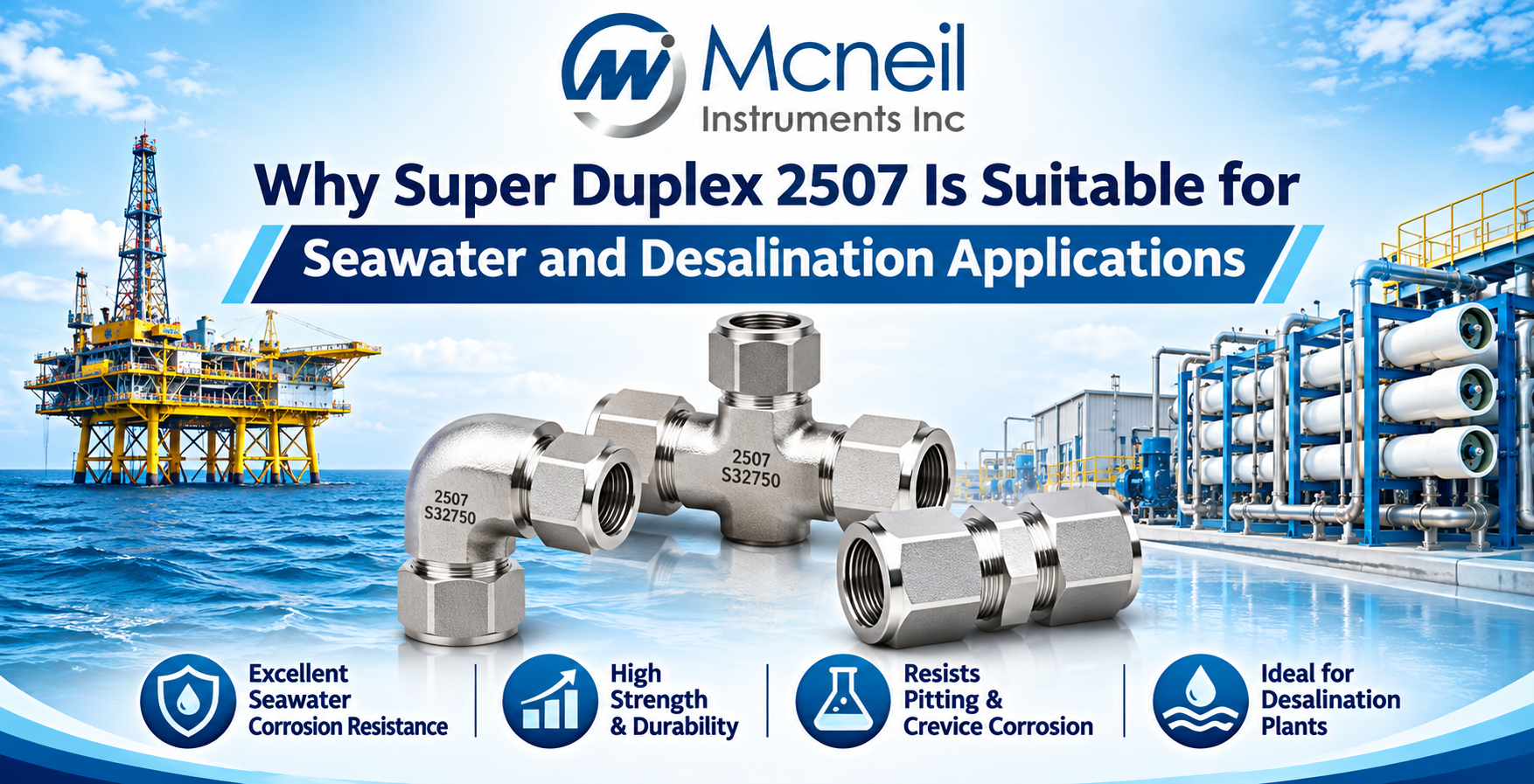
Super Duplex Stainless Steel 2507 (UNS S32750) is widely used in demanding marine, offshore and desalination applications because of its excellent corrosion resistance, high mechanical strength and resistance to chloride-induced stress corrosion cracking.
At Mcneil Instruments, we understand the importance of selecting high-performance materials for critical industrial applications. Super Duplex 2507 offers a dependable material solution for seawater handling systems, desalination plants, offshore installations and other chloride-rich environments.
What Is Super Duplex Stainless Steel 2507?
Super Duplex 2507 is a high-alloy stainless steel that combines approximately equal proportions of austenitic and ferritic microstructures. Its chemical composition typically includes around 25% chromium, 7% nickel, 4% molybdenum and nitrogen, which contribute to its excellent corrosion resistance and mechanical properties.
One of its key characteristics is its high Pitting Resistance Equivalent Number (PREN), typically above 40. This makes it particularly suitable for environments containing high chloride concentrations, where conventional stainless steel grades may experience pitting and crevice corrosion.
Super Duplex 2507 is commonly supplied in different product forms, including pipes, tubes, fittings, flanges and other engineered components for demanding industrial applications.
Why Is Super Duplex 2507 Suitable for Seawater Applications?
- Excellent Resistance to Chloride Corrosion
Seawater contains high concentrations of chlorides, which can cause localized corrosion in many stainless steel grades. Super Duplex 2507 contains high levels of chromium, molybdenum and nitrogen, providing enhanced resistance to pitting and crevice corrosion.
This makes it a suitable material for seawater pipelines, cooling water systems, offshore equipment and marine processing facilities. - High Resistance to Stress Corrosion Cracking
Chloride-induced stress corrosion cracking is a major concern in marine and desalination environments, particularly when equipment operates under high temperatures and mechanical stress.
Super Duplex 2507 offers significantly better resistance to chloride stress corrosion cracking than conventional austenitic stainless steel grades such as 304 and 316. This helps improve component reliability in demanding operating conditions. - High Mechanical Strength
Super Duplex 2507 provides approximately twice the yield strength of conventional austenitic stainless steel grades such as 304L and 316L, depending on the product form and applicable specification.
Its higher strength allows engineers to consider reduced wall thicknesses in certain designs, potentially lowering material weight and overall equipment costs while maintaining the required mechanical performance. - Resistance to Pitting and Crevice Corrosion
Pitting and crevice corrosion are common challenges in seawater applications, especially around joints, gaskets, flanges and stagnant areas.
The high chromium, molybdenum and nitrogen content of Super Duplex 2507 provides excellent resistance to these localized corrosion mechanisms, making it suitable for critical seawater-handling components. - Long Service Life and Reduced Maintenance
Material failure in seawater and desalination systems can result in expensive repairs, production interruptions and equipment replacement.
By offering excellent corrosion resistance and high mechanical strength, Super Duplex 2507 can help extend equipment service life and reduce maintenance requirements when correctly selected, fabricated and installed.
Applications of Super Duplex 2507 in Desalination Plants
Desalination plants convert seawater into freshwater through processes such as reverse osmosis and thermal desalination. These systems require materials capable of handling highly corrosive water and demanding operating conditions.
Super Duplex 2507 is used in several critical applications, including:
Seawater Intake Systems: Suitable for pipelines, pumps and fittings that transport untreated seawater.
Reverse Osmosis Systems: Used in selected high-pressure piping, manifolds and associated equipment.
High-Pressure Pumps: Its high mechanical strength and corrosion resistance make it suitable for demanding pump components.
Heat Exchangers: Used in suitable heat exchanger components exposed to corrosive seawater.
Brine Handling Systems: Offers resistance to chloride-rich concentrated brine environments, subject to operating conditions.
Seawater Cooling Systems: Suitable for cooling water pipelines, valves and associated equipment.
Marine and Offshore Installations: Used in piping systems, structural components and equipment exposed to aggressive marine conditions.
Super Duplex 2507 vs Stainless Steel 316L
Although Stainless Steel 316L is widely used in industrial piping and marine applications, it may not provide sufficient resistance in highly aggressive seawater environments.
Super Duplex 2507 offers higher resistance to pitting, crevice corrosion and chloride-induced stress corrosion cracking, along with substantially higher mechanical strength.
For this reason, engineers often consider Super Duplex 2507 for critical seawater applications where conventional stainless steel may face greater corrosion risks.
However, the final material selection should always consider chloride concentration, temperature, flow conditions, fabrication quality and the specific requirements of the application.
Why Choose Mcneil Instruments for Super Duplex 2507 Products?
Selecting the right material supplier is important for maintaining quality and reliability in critical industrial projects.
At Mcneil Instruments, we focus on supplying industrial piping and instrumentation products designed to meet demanding application requirements. Our product range includes stainless steel, duplex and super duplex materials for industrial, marine, offshore and process applications.
We understand the importance of material specifications, dimensional accuracy and quality documentation when sourcing products for seawater and desalination projects.
Whether you require Super Duplex 2507 pipes, tubes, flanges, fittings or other piping components, our team can assist with your material requirements.
Conclusion
Super Duplex Stainless Steel 2507 is an excellent material choice for many demanding seawater and desalination applications. Its combination of high corrosion resistance, superior mechanical strength and resistance to chloride-induced stress corrosion cracking makes it suitable for critical industrial environments.
From seawater intake pipelines to reverse osmosis systems and offshore installations, Super Duplex 2507 helps engineers address some of the toughest material challenges.
For reliable industrial piping and instrumentation product requirements, connect with Mcneil Instruments to discuss your project specifications.
Looking for Reliable Super Duplex 2507 Products for Your Seawater or Desalination Project?
Choose Mcneil Instruments for industrial piping and instrumentation product requirements. We support demanding industrial applications with quality-focused material solutions, including Super Duplex 2507 pipes, tubes, flanges and fittings.
Contact our team today to discuss your requirements, technical specifications and product enquiries.
Website: https://mcneilinstruments.com/
Frequently Asked Questions (FAQs)
- What is Super Duplex 2507 stainless steel?
Super Duplex 2507 is a high-performance duplex stainless steel identified by UNS S32750 and EN 1.4410. It contains approximately 25% chromium, 7% nickel and 4% molybdenum, along with nitrogen, providing excellent corrosion resistance and high mechanical strength. - Why is Super Duplex 2507 preferred for seawater applications?
Super Duplex 2507 offers excellent resistance to chloride-induced pitting, crevice corrosion and stress corrosion cracking. These properties make it suitable for seawater pipelines, marine equipment, offshore installations and cooling water systems. - Is Super Duplex 2507 suitable for desalination plants?
Yes. Super Duplex 2507 is used in desalination equipment, including reverse osmosis pressure vessels, seawater transportation pipelines and heat exchanger tubing. Its corrosion resistance makes it suitable for many chloride-rich operating environments. - What is the difference between Super Duplex 2507 and Stainless Steel 316L?
Super Duplex 2507 provides significantly higher mechanical strength and better resistance to chloride-induced pitting, crevice corrosion and stress corrosion cracking compared with Stainless Steel 316L. It is generally preferred for more aggressive seawater environments. - What is the PREN value of Super Duplex 2507?
Super Duplex 2507 typically has a PREN value of 40 or higher, with a minimum value of approximately 41 for SAF 2507. A higher PREN generally indicates better resistance to pitting corrosion in chloride-containing environments. - Which industries commonly use Super Duplex 2507?
Super Duplex 2507 is commonly used in desalination, oil and gas, marine engineering, offshore platforms, petrochemical processing, chemical industries, seawater cooling systems and power generation. - Is Super Duplex 2507 available in pipes, tubes and flanges?
Yes. Super Duplex 2507 is available in different product forms, including pipes, tubes, flanges, fittings, plates and bars. Availability depends on product specifications, dimensions and project requirements. - Can Super Duplex 2507 completely prevent seawater corrosion?
No material is completely immune to corrosion under every operating condition. Although Super Duplex 2507 offers excellent corrosion resistance, its performance depends on temperature, chloride concentration, flow conditions, fabrication, welding and maintenance practices.