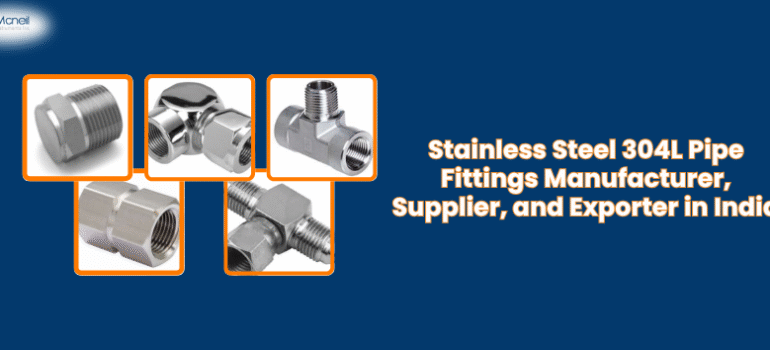
Stainless Steel 304L Pipe Fittings Manufacturer, Supplier, and Exporter in India

Introduction

Pipe fittings are crucial components that ensure leak-proof connections, maintain pipeline integrity, and support system reliability. They enable fluid transfer, pressure control, and system adaptability in industries like food processing, pharmaceuticals, oil and gas, and water treatment.

Introduction to Stainless Steel 304L Pipe Fittings

Stainless Steel 304L pipe fittings including elbows, tees, reducers, caps, couplings, and unions are recognized for their low-carbon formulation, excellent corrosion resistance, and superior weldability. These characteristics make them ideal for welding-intensive installations and systems exposed to corrosive environments.

Mcneil Instruments is a leading manufacturer, supplier, and exporter of stainless steel 304L pipe fittings in India. With modern facilities and adherence to international standards, Mcneil delivers high-quality products to both domestic and global markets.

Understanding Stainless Steel 304L Pipe Fittings

Definition and Composition of Stainless Steel 304L

Stainless Steel 304L is an austenitic grade that mirrors the properties of 304 but contains lower carbon content (≤ 0.03%). This low-carbon design significantly reduces the risk of intergranular corrosion, especially in welded assemblies.

Key Characteristics:
  1. Low Carbon Content – Ensures superior weldability without needing post-weld annealing.
  2. Chemical Composition – 18–20% Chromium, 8–10.5% Nickel, ≤ 0.03% Carbon.
  3. Corrosion Resistance – Effective against acids, chlorides, and oxidative environments; excellent intergranular resistance after welding.
  4. Enhanced Weldability – Ideal for welded pipe systems; reduced risk of sensitization.
  5. Mechanical Properties – Yields ≥ 170 MPa, tensile ≥ 485 MPa, elongation ≥ 40%.
  6. Hygienic Properties – Smooth, non-porous surface, easy to clean and sterilize.
Comparison with Stainless Steel 304

While both grades share chromium and nickel content, 304L’s reduced carbon content enhances weld integrity and corrosion resistance in welded environments, giving it a clear advantage over SS 304 pipe fittings.

Manufacturing Process of SS 304L Pipe Fittings

A. Raw Material Sourcing

Mcneil Instruments sources premium-grade SS 304L billets, bars, and plates in compliance with ASTM A403 standards for fittings.

B. Forming Methods
  • Buttweld Fittings: Formed by hot forging or pressing; available in seamless or welded variants.
  • Forged Fittings: Precision forging is used for socket weld and threaded fittings, ensuring dimensional accuracy and strength.
C. Finishing Operations

Machining ensures precise dimensions; fittings undergo beveling, threading, and polishing to meet specifications.

D. Heat Treatment

Solution Annealing performed at approximately 1030–1140°C followed by rapid cooling restores corrosion resistance and ductility.

E. Rigorous Quality Control & Testing

Mcneil Instruments adheres to strict testing protocols, including:

TestPurpose
Dimensional InspectionEnsures compliance with ASME/ANSI B16.9 and B16.28
Chemical AnalysisConfirms 304L composition
Mechanical TestingValidates tensile, yield, elongation, and hardness
Non-Destructive Testing (NDT)Detects internal/external defects via UT or RT
Positive Material IdentificationConfirms material grade using PMI tools
Hydrostatic TestingEnsures leak-free performance under pressure
CertificationsProvides MTCs, EN 10204 3.1/3.2, IBR, and NACE as needed

Technical Specifications of SS 304L Pipe Fittings

PropertyValue / Standard
MaterialStainless Steel 304L
StandardASTM A403 WP304L
Pressure RatingASME Class 150–600, PN16–PN100
Wall ThicknessAs per schedule (5–12.7 mm typical)
DimensionsAs per ASME/ANSI B16.9 & B16.11
Mechanical StrengthTensile ≥ 485 MPa; Yield ≥ 170 MPa
Corrosion ResistanceExcellent against chlorides and acids

Certifications Table for SS 304L Pipe Fittings

CertificationDescription
ASTM / ASME StandardsASTM A403 WP304L, ASME B16.9, B16.11
ISO 9001:2015Quality Management System
EN 10204 3.1 / 3.2Third-party material test certification
IBR ApprovalCompliance with Indian Boiler Regulations
NACE MR0175/ISO 15156Sour service suitability

Available Sizes & Specifications

Fitting TypeSize RangeDimensions
Buttweld Fittings½″ to 24″ (15–600 mm)ASME B16.9
Socket Weld / Threaded½″ to 4″ (15–100 mm)ASME B16.11
SchedulesSch 10–160, custom variants—
Material FormsSeamless, Welded, Forged—

Conclusion

Stainless Steel 304L pipe fittings are essential for welded, corrosive environments that require structural integrity, hygiene, and ease of fabrication. Choosing a reputable supplier ensures product reliability and compliance.

Mcneil Instruments, a recognized manufacturer, supplier, and exporter of 304L pipe fittings in India, delivers precision-engineered products backed by rigorous testing and certifications. Their technical expertise and global logistics capabilities make them an ideal partner for industrial projects.

Contact Mcneil Instruments today for a comprehensive range of ASTM A403 WP304L fittings tailored to your specific requirements.

Read More

Stainless Steel 304 Pipe Fittings Manufacturer, Supplier, and Exporter in India

Introduction

Stainless Steel 304 pipe fittings are essential components used in piping systems across diverse industries such as food processing, pharmaceuticals, water treatment, and construction. With its excellent corrosion resistance and mechanical properties, Grade 304 has become a staple for reliable and hygienic connections.

Mcneil Instruments is a leading manufacturer, supplier, and exporter of stainless steel 304 pipe fittings in India. With a commitment to quality, precision, and performance, Mcneil offers a complete range of SS 304 fittings designed to meet both domestic and international demand.

Understanding Stainless Steel 304: The “18/8” Advantage

Stainless Steel 304 gets its “18/8” nickname from its chemistry: approximately 18% chromium and 8% nickel. This balanced composition offers a combination of corrosion resistance, strength, durability, and hygiene, ideal for demanding environments.

  • Excellent Corrosion Resistance: The chromium content forms a protective oxide film on the surface, shielding the material against humidity, acids, and chlorides.
  • Good Formability and Weldability: SS 304 can be readily shaped into elbows, tees, reducers, and other connection types, and it welds cleanly with minimal post-processing.
  • High Strength and Durability: Capable of withstanding moderate pressures and temperatures, SS 304 fittings are reliable for long-term use.
  • Hygienic Properties: The non-porous surface makes it easy to clean and sterilize, making it a preferred choice for sanitary applications.

What Is a 304 Pipe Grade?

The term 304 pipe grade refers to pipes and fittings made of stainless steel conforming to international standards (e.g., ASTM A403 WP304) and designed to precise dimensions, mechanical properties, and performance criteria. Below are key specifications and charts related to SS 304 fittings.

Stainless Steel 304 Pipe Fittings Sizes & Dimensions

Fitting TypeRangeSchedule
Elbows, Tees½″ to 12″ (15 to 300 mm)Sch 10–160
Reducers, CapsSame rangeSch 10–160
Couplings, Unions½″ to 4″ (15 to 100 mm)Sch 10–160

Stainless Steel 304 Chemical Composition

ElementMinMax
Chromium18.0%20.0%
Nickel8.0%10.5%
Carbon—0.08%
Manganese—2.0%
Phosphorus—0.045%
Sulfur—0.03%

ASTM A403 WP304 Mechanical Properties

PropertyMin. Value
Tensile Strength515 MPa
Yield Strength205 MPa
Elongation (in 50 mm)40%
Hardness (Rockwell B)92

Pressure Rating for SS 304 Fittings

Fitting SizeSchedule 40 RatingSchedule 80 Rating
½″1,480 psi (10.2 MPa)2,540 psi (17.5 MPa)
1″1,220 psi (8.4 MPa)2,020 psi (13.9 MPa)
2″1,130 psi (7.8 MPa)2,000 psi (13.8 MPa)

SS 304 vs SS 304L Fittings

FeatureSS 304SS 304L
Carbon ContentUp to 0.08%Up to 0.03% (lower)
WeldabilityGoodExcellent
Intergranular CorrosionModerateVery Low (better)

Manufacturing Process

Stainless steel 304 pipe fittings undergo a multi-stage manufacturing process:

  1. Raw Material Sourcing: Precision-grade SS 304 is sourced from reputable mills with full traceability.
  2. Forging / Casting: Fittings are hammered or cast into blanks based on the required shape—elbows, tees, caps, etc.
  3. Machining & Forming: CNC machining and forming processes refine the fittings to precise dimensions and wall thickness.
  4. Heat Treatment: Annealing is performed to restore ductility and corrosion resistance after forming.
  5. Quality Assurance: Every batch is tested for chemical composition, dimensional accuracy, surface finish, and pressure integrity.
  6. Final Inspection & Packaging: Fittings are checked, individually marked, cleaned, and packed for export-ready condition.

Mcneil Instruments: Your Trusted SS 304 Pipe Fittings Solution

When you choose Mcneil Instruments, you gain access to:

  • ASTM A403 WP304 certified fittings
  • A comprehensive product range of elbows, tees, reducers, caps, couplings, and unions
  • Strict quality control protocols, including hydrostatic testing and dimensional accuracy
  • Robust supply chain management for timely delivery in India and abroad
  • Technical support to assist with material selection and application requirements
  • Competitive pricing with consistent quality and after-sales service

Our commitment is to excellence from sourcing raw materials to shipping the final product.

Ensuring Quality and Compliance

Before selecting a supplier, verify that they offer:

  • Certifications: ASTM, ASME, ISO
  • Material Traceability through Mill Test Certificates (MTCs)
  • Pressure Ratings and mechanical test results
  • Packaging Standards for safe transit and storage
  • Reputation & References from previous clients

Conclusion

Stainless steel 304 pipe fittings are trusted for their corrosion resistance, strength, and hygiene. However, not all fittings are manufactured to the same standards. Choosing a supplier like Mcneil Instruments ensures that you receive authentic, certified, and high-performance SS 304 fittings backed by technical expertise.

Contact Mcneil Instruments today to explore a wide selection of ASTM A403 WP304 fittings tailored to your project needs.

Read More

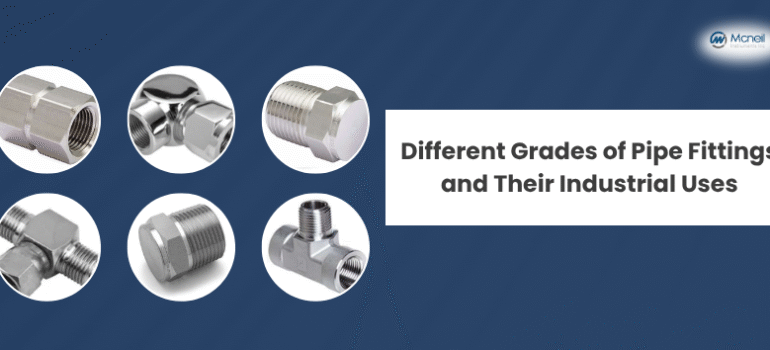
Different Grades of Pipe Fittings and Their Industrial Uses

Introduction

When it comes to industrial piping systems, not all pipe fittings are created equal. Each fitting is defined by its material grade, which determines its strength, corrosion resistance, temperature tolerance, and overall durability. These material differences are not just technicalities—they directly impact the performance, safety, and longevity of the systems they’re part of.

As a leading manufacturer, supplier, and exporter of pipe fittings in India, Mcneil Instruments specializes in delivering high-quality fittings across a wide spectrum of grades and alloys. From stainless steel and carbon steel to exotic metals like Inconel, Hastelloy, and Titanium, Mcneil Instruments offers tailored solutions for industries ranging from petrochemicals and power plants to pharmaceuticals and marine applications.

Selecting the right grade of pipe fittings is crucial—not only for ensuring compliance with international standards, but also for optimizing efficiency, minimizing maintenance, and avoiding costly failures.

This blog is designed to guide engineers, project managers, and procurement specialists through the most common grades of pipe fittings and their industrial uses, helping you make informed choices based on application-specific requirements.

Understanding Pipe Fitting Grades by Material Type

Carbon Steel Pipe Fittings

Carbon steel fittings are cost-effective and widely used in industrial pipelines. Common grades include ASTM A105, ideal for moderate pressure and non-corrosive environments, while ASTM A234 WPB/WP11/WP22/WP91 are designed for varying pressure and temperature service in high-pressure systems.

Key grades:

  • ASTM A105 – Forged fittings, suitable for general industrial use
  • ASTM A234 WPB/WP11/WP22/WP91 – Welded fittings qualified for steam, oil, and power industries

Stainless Steel Fittings
  • SS 304 & 304L: SS 304 is the most common stainless steel, offering good corrosion resistance and formability. The 304L variant has lower carbon content, enhancing its weldability and reducing intergranular corrosion in welded systems.
  • SS 316 & 316L: With added molybdenum, SS 316 provides better resistance to chlorides and acids—making it ideal for marine and chemical processing. 316L further improves on this by offering enhanced post-weld corrosion resistance due to its lower carbon.
  • SS 321 & 347: SS 321 includes titanium for stability in high-temperature welding, preventing carbide precipitation. SS 347 uses niobium (columbium) for similar stabilization, offering excellent performance in annealing, heat exchangers, and boiler systems.
  • Duplex & Super Duplex: Duplex 2205 and Super Duplex 2507 offer a balance of strength and corrosion resistance, outperforming 316L in harsh environments like seawater or chemical processing. These alloys are favored in offshore oil, gas, and desalination systems.
  • PH Stainless Steels: 17-4PH and 15-5PH are precipitation-hardening grades combining high strength and moderate corrosion resistance, common in aerospace, petrochemical, and high-pressure instrumentation.
Nickel alloys & Superalloys
  • Inconel Series: Inconel 600, 625, 718, 725, 800, 800H are nickel-chromium alloys known for exceptional high-temperature strength and corrosion resistance. Widely used in gas turbines, nuclear power, and chemical processing.
  • Monel: Monel 400 and K500 are nickel-copper alloys, resistant to seawater and acids—common in marine, desalination, and chemical plant applications.
  • Hastelloy: C276, C22, B2, B3, X are nickel-molybdenum-chromium alloys that stand up to difficult chemical exposures, including chlorides and strong acids, used in specialty chemical, pollution control, and nuclear industries.
  • Incoloy: 800, 800H, 825, 925 combine nickel, iron, and chromium to resist oxidation and corrosion. These grades are preferred for heat exchangers, chemical reactors, and petroleum refinery coils.
Specialty Alloy & Non-Ferrous Fittings
  • Titanium (Grades 1–4): These provide the best strength-to-weight ratio and excellent corrosion resistance to seawater, chlorides, and oxidizing acids—frequently applied in aerospace, desalination, and medical equipment.
  • Tantalum (Ta-1, Ta-2, Ta-10W, Ta-2.5W): Tantalum excels in resisting sulfuric and phosphoric acids and is used in harsh chemical processing, semiconductor manufacturing, and nuclear waste handling.
  • Bronzes & Phosphor Bronzes: Alloys like C22000, C23000, C51000, C54400 offer corrosion resistance and good machinability for use in valves, pumps, marine hardware, and low-pressure systems.
  • Brass (C26000, C23000): Brass fittings are ductile and corrosion-resistant, perfect for water plumbing, HVAC, and low-pressure hydraulic systems.
  • Stainless Fittings (ASTM A403 WP Grades): ASTM A403 WP304, WP316, WP317 are seamless and welded stainless steel fittings designed to meet ASME piping requirements in sanitary, chemical, and pharmaceutical industries.

Choosing the Right Grade

Selecting pipe fitting material is a function of:

  • Pressure and temperature conditions
  • Chemical compatibility with the transferred media
  • Weldability, fabrication requirements
  • Industry and regulatory standards (ASTM, ASME, NACE)

Consulting experienced suppliers like Mcneil Instruments, with material experts across grades from Duplex 2205 fittings to Incoloy 800H valves, helps ensure optimal and compliant material selection.

Mcneil Instruments: Your Partner for Precision Pipe Fittings

At Mcneil Instruments, we offer a broad portfolio of pipe fitting grades including ASTM A234 WP5/9/11/22/91, Duplex/Super Duplex, Inconel, Hastelloy, Titanium, Tantalum, Bronze, and Brass. With certifications to ASTM, ASME, ISO, and NACE, and robust material testing, we help engineers in India and globally select the right grade for critical projects—supporting everything from oil & gas to desalination and pharmaceutical applications.

Conclusion

Not all pipe fittings are created equal—materials and grades matter. Understanding material properties and industry needs helps ensure safety, integrity, and compliance. Explore Mcneil Instruments’ comprehensive range of grades—partner with us to select pipe fittings tailored for your specific industry applications.

Contact us for grade recommendations, datasheets, and expert assistance in material selection for your next critical infrastructure project!

Read More

Pipe Fittings Manufacturer, Supplier and Exporter in Canada

Mcneil Instrument is a leading Pipe Fittings Manufacturer, Supplier and Exporter in Canada. Pipe fittings are an essential part of piping systems and other machines that involve various types of pipes. Hence, we bring to you an extensive range of quality pipe fittings that will ensure the utmost durability and secure connection for your piping systems. Our Product line of Pipe Fittings include: Coupling Pipe Fitting, Plug Union, Cap Pipe Fitting, Female Branch Tee, Female Elbow, Male Run Tee, Female Run Tee, Buttweld Pipe Fittings

What Are Pipe Fittings?

Pipe fittings are used to connect, redirect, and control the flow of fluids and gases within piping systems. They come in various shapes and sizes, including elbows, tees, reducers, and couplings. Each type of fitting serves a specific purpose, and the material used can impact its performance and suitability for particular applications.

Comprehensive Product Portfolio

Mcneil Instruments Inc. offers an expansive catalog of precision-engineered products designed to meet various pipe fitting standards and dimensions:

No.Product NameSizeMaterialAdditional Info
1Coupling Pipe Fitting1/8″ to 4″Stainless Steel (304, 316, 316L, 321, 347, etc.), Carbon Steel, Alloy Steel, Copper-NickelEnd Connections: Threaded, Welded, etc.
2Plug Union1/8″ to 4″Stainless Steel, Alloy Steel, Carbon Steel, Copper-NickelPressure Ratings: Class 2000, 3000, 6000, 9000
3Cap Pipe Fitting1/8″ to 4″Stainless Steel, Carbon Steel, Alloy SteelStandard: ASTM A182, ASTM A403, ASME B16.9, etc.
4Female Branch Tee1/8″ to 4″Stainless Steel, Carbon Steel, Alloy SteelEnd Connections: Threaded (NPT/BSP), Welding
5Female Elbow1/8″ to 4″Stainless Steel, Alloy Steel, Copper-Nickel, Carbon SteelSurface Finish: Plain, Pickled, Sand Blasted
6Male Run Tee1/8″ to 4″Stainless Steel (304, 316, 316L, 321, 347, etc.), Duplex Steel, Super Duplex Steel, Carbon Steel, Alloy SteelPressure Rating: Class 2000, 3000, 6000, 9000
7Female Run Tee1/8″ to 4″Stainless Steel, Duplex Steel, Super Duplex Steel, Carbon Steel, Copper-NickelEnd Connection Type: Threaded (NPT/BSP), Welding
8Buttweld Pipe Fittings1/8″ to 4″Stainless Steel, Carbon Steel, Alloy Steel, Copper-NickelStandard: ASME B16.9, ASME B16.11, MSS SP-79, etc.

 Pipe Fitting Material Options

When choosing pipe fitting materials, it’s essential to consider the specific requirements of your application. Here’s a breakdown of various options:

  • Stainless Steel: Best for environments requiring high corrosion resistance and strength.
  • Carbon Steel: Suitable for high-pressure and high-temperature applications at a lower cost.
  • Brass: Ideal for residential plumbing with good machinability and aesthetic appeal.
  • PVC: Affordable and versatile, perfect for water supply and drainage.
  • CPVC: Handles higher temperatures, making it suitable for hot water systems.
  • PEX: Flexible and durable, great for residential plumbing and heating systems.

Quality Assurance & Certifications

Mcneil Instruments Inc. continues to lead as one of the best ppie fittings suppliers in Canada, with a strong emphasis on quality assurance. The company meets international pipe fitting certifications such as:

●     Indian Plumbing Association (IPA) Certified Plumbing Professional: This certification, provided by IPA, ensures proficiency in modern plumbing systems, installation, and maintenance according to Indian standards and regulations.

●     CIPET (Central Institute of Petrochemicals Engineering and Technology) Piping Design and Engineering Certification: CIPET offers specialized certification courses on piping design and engineering, focused on industries like petrochemicals, refineries, and process plants.

●     Bureau of Indian Standards (BIS) Certified Pipe Fitter: BIS offers certification programs that train individuals in pipe fitting skills, emphasizing quality standards and safety regulations specific to the Indian industry.

●     Industrial Training Institutes (ITI) Plumber Trade Certification: This government-recognized certification equips individuals with practical skills in plumbing and pipefitting through a formal training program, focusing on hands-on experience and compliance with Indian codes.

Mcneil Instruments: Global Exporter of Approved Pipe Fittings – Region-Wise Coverage

I. Middle East: Comprehensive Supply of Approved Fittings
  • Region: UAE, Oman, Kuwait, Qatar, Bahrain, Saudi Arabia
  • Industries Served: Oil & Gas, Petrochemicals, Construction, Marine
  • Commitment: McNeil Instruments is a leading supplier of pipe fittings in the Middle East. Our products adhere to stringent regional and international standards, crucial for high-demand sectors.
  • Partnerships: We are a trusted partner for government projects, refineries, and industrial infrastructure.
  • Specific Country Focus:
    • UAE: Supplying pipe fittings for oil refineries, offshore drilling operations, and diverse energy projects.
    • Oman: Catering to Petroleum Development Oman (PDO), oil exploration initiatives, and infrastructure development.
    • Kuwait: Meeting the specific requirements of Kuwait National Petroleum Company (KNPC), Kuwait Oil Company (KOC), and other heavy industrial applications.
    • Qatar: Supporting major players like Qatar Gas, LNG processing facilities, and petrochemical plants with reliable pipe fitting solutions.
    • Bahrain: Delivering high-quality pipe fittings for marine, energy, and manufacturing sectors.
    • Saudi Arabia: Ensuring compliance with Saudi Aramco standards for pipeline projects, refineries, and petrochemical industries.
II. North America: High-Grade Fittings for Canadian Industries
  • Region: Canada
  • Industries Served: Mining, Energy, Construction, Water Treatment
  • Product Standards: McNeil Instruments provides high-grade, industry-certified pipe fittings tailored for Canadian industries. Our pressure-resistant and corrosion-proof fittings comply with Canadian regulations.
  • Application Focus: Ensuring safe and efficient operations in oil sands, natural gas extraction, and various industrial projects across Canada.

Conclusion

In summary, Mcneil Instruments stands as a premier manufacturer, supplier, and exporter of high-quality pipe fittings in Canada, with a robust global presence. Our extensive product portfolio, encompassing a wide range of materials, sizes, and specifications, ensures that we can meet the diverse needs of various industries. From stainless steel fittings designed for high corrosion resistance to carbon steel fittings suitable for high-pressure applications, we provide solutions that prioritize durability and reliability.

Our commitment to quality is underscored by our adherence to international standards and certifications, including those from the Indian Plumbing Association (IPA), CIPET, Bureau of Indian Standards (BIS), and Industrial Training Institutes (ITI). This dedication to excellence extends to our global operations, where we serve critical sectors in the Middle East and North America, ensuring that our products meet the stringent requirements of these demanding markets.

Whether it’s supporting the oil and gas industry in the UAE or providing high-grade fittings for mining operations in Canada, Mcneil Instruments consistently delivers exceptional products and services. We are a trusted partner for projects of all scales, committed to providing reliable, durable, and certified pipe fitting solutions that drive efficiency and safety.

For all your pipe fitting needs, choose Mcneil Instruments, your dependable partner for quality and reliability.

Read More

Pipe Fittings Manufacturer, Supplier and Exporter in USA

Mcneil Instrument is a leading Pipe Fittings Manufacturer, Supplier and Exporter in the USA. Pipe fittings are an essential part of piping systems and other machines that involve various types of pipes. Hence, we bring to you an extensive range of quality pipe fittings that will ensure the utmost durability and secure connection for your piping systems. Our Product line of Pipe Fittings include: Coupling Pipe Fitting, Plug Union, Cap Pipe Fitting, Female Branch Tee, Female Elbow, Male Run Tee, Female Run Tee, Buttweld Pipe Fittings

What Are Pipe Fittings?

Pipe fittings are used to connect, redirect, and control the flow of fluids and gases within piping systems. They come in various shapes and sizes, including elbows, tees, reducers, and couplings. Each type of fitting serves a specific purpose, and the material used can impact its performance and suitability for particular applications.

Comprehensive Product Portfolio

Mcneil Instruments Inc. offers an expansive catalog of precision-engineered products designed to meet various pipe fitting standards and dimensions:

No.Product NameSizeMaterialAdditional Info
1Coupling Pipe Fitting1/8″ to 4″Stainless Steel (304, 316, 316L, 321, 347, etc.), Carbon Steel, Alloy Steel, Copper-NickelEnd Connections: Threaded, Welded, etc.
2Plug Union1/8″ to 4″Stainless Steel, Alloy Steel, Carbon Steel, Copper-NickelPressure Ratings: Class 2000, 3000, 6000, 9000
3Cap Pipe Fitting1/8″ to 4″Stainless Steel, Carbon Steel, Alloy SteelStandard: ASTM A182, ASTM A403, ASME B16.9, etc.
4Female Branch Tee1/8″ to 4″Stainless Steel, Carbon Steel, Alloy SteelEnd Connections: Threaded (NPT/BSP), Welding
5Female Elbow1/8″ to 4″Stainless Steel, Alloy Steel, Copper-Nickel, Carbon SteelSurface Finish: Plain, Pickled, Sand Blasted
6Male Run Tee1/8″ to 4″Stainless Steel (304, 316, 316L, 321, 347, etc.), Duplex Steel, Super Duplex Steel, Carbon Steel, Alloy SteelPressure Rating: Class 2000, 3000, 6000, 9000
7Female Run Tee1/8″ to 4″Stainless Steel, Duplex Steel, Super Duplex Steel, Carbon Steel, Copper-NickelEnd Connection Type: Threaded (NPT/BSP), Welding
8Buttweld Pipe Fittings1/8″ to 4″Stainless Steel, Carbon Steel, Alloy Steel, Copper-NickelStandard: ASME B16.9, ASME B16.11, MSS SP-79, etc.

 Pipe Fitting Material Options

When choosing pipe fitting materials, it’s essential to consider the specific requirements of your application. Here’s a breakdown of various options:

  • Stainless Steel: Best for environments requiring high corrosion resistance and strength.
  • Carbon Steel: Suitable for high-pressure and high-temperature applications at a lower cost.
  • Brass: Ideal for residential plumbing with good machinability and aesthetic appeal.
  • PVC: Affordable and versatile, perfect for water supply and drainage.
  • CPVC: Handles higher temperatures, making it suitable for hot water systems.
  • PEX: Flexible and durable, great for residential plumbing and heating systems.

Quality Assurance & Certifications

Mcneil Instruments Inc. continues to lead as one of the best ppie fittings suppliers in USA, with a strong emphasis on quality assurance. The company meets international pipe fitting certifications such as:

●     Indian Plumbing Association (IPA) Certified Plumbing Professional: This certification, provided by IPA, ensures proficiency in modern plumbing systems, installation, and maintenance according to Indian standards and regulations.

●     CIPET (Central Institute of Petrochemicals Engineering and Technology) Piping Design and Engineering Certification: CIPET offers specialized certification courses on piping design and engineering, focused on industries like petrochemicals, refineries, and process plants.

●     Bureau of Indian Standards (BIS) Certified Pipe Fitter: BIS offers certification programs that train individuals in pipe fitting skills, emphasizing quality standards and safety regulations specific to the Indian industry.

●     Industrial Training Institutes (ITI) Plumber Trade Certification: This government-recognized certification equips individuals with practical skills in plumbing and pipefitting through a formal training program, focusing on hands-on experience and compliance with Indian codes.

Mcneil Instruments: Global Exporter of Approved Pipe Fittings – Region-Wise Coverage

I. Middle East: Comprehensive Supply of Approved Fittings
  • Region: UAE, Oman, Kuwait, Qatar, Bahrain, Saudi Arabia
  • Industries Served: Oil & Gas, Petrochemicals, Construction, Marine
  • Commitment: Mcneil Instruments is a leading supplier of pipe fittings in the Middle East. Our products adhere to stringent regional and international standards, crucial for high-demand sectors.
  • Partnerships: We are a trusted partner for government projects, refineries, and industrial infrastructure.
  • Specific Country Focus:
    • UAE: Supplying pipe fittings for oil refineries, offshore drilling operations, and diverse energy projects.
    • Oman: Catering to Petroleum Development Oman (PDO), oil exploration initiatives, and infrastructure development.
    • Kuwait: Meeting the specific requirements of Kuwait National Petroleum Company (KNPC), Kuwait Oil Company (KOC), and other heavy industrial applications.
    • Qatar: Supporting major players like Qatar Gas, LNG processing facilities, and petrochemical plants with reliable pipe fitting solutions.
    • Bahrain: Delivering high-quality pipe fittings for marine, energy, and manufacturing sectors.
    • Saudi Arabia: Ensuring compliance with Saudi Aramco standards for pipeline projects, refineries, and petrochemical industries.
II. North America: High-Grade Fittings for Canadian Industries
  • Region: Canada
  • Industries Served: Mining, Energy, Construction, Water Treatment
  • Product Standards: Mcneil Instruments provides high-grade, industry-certified pipe fittings tailored for Canadian industries. Our pressure-resistant and corrosion-proof fittings comply with Canadian regulations.
  • Application Focus: Ensuring safe and efficient operations in oil sands, natural gas extraction, and various industrial projects across Canada.

Conclusion

In summary, Mcneil Instruments stands as a premier manufacturer, supplier, and exporter of high-quality pipe fittings in the USA, with a robust global presence. Our extensive product portfolio, encompassing a wide range of materials, sizes, and specifications, ensures that we can meet the diverse needs of various industries. From stainless steel fittings designed for high corrosion resistance to carbon steel fittings suitable for high-pressure applications, we provide solutions that prioritize durability and reliability.

Our commitment to quality is underscored by our adherence to international standards and certifications, including those from the Indian Plumbing Association (IPA), CIPET, Bureau of Indian Standards (BIS), and Industrial Training Institutes (ITI). This dedication to excellence extends to our global operations, where we serve critical sectors in the Middle East and North America, ensuring that our products meet the stringent requirements of these demanding markets.

Whether it’s supporting the oil and gas industry in the UAE or providing high-grade fittings for mining operations in Canada, Mcneil Instruments consistently delivers exceptional products and services. We are a trusted partner for projects of all scales, committed to providing reliable, durable, and certified pipe fitting solutions that drive efficiency and safety.

For all your pipe fitting needs, choose Mcneil Instruments, your dependable partner for quality and reliability.

Read More

Pipe Fittings Manufacturer, Supplier and Exporter in Oman

Mcneil Instrument is a leading Pipe Fittings Manufacturer, Supplier and Exporter in Oman. Pipe fittings are an essential part of piping systems and other machines that involve various types of pipes. Hence, we bring to you an extensive range of quality pipe fittings that will ensure the utmost durability and secure connection for your piping systems. Our Product line of Pipe Fittings include: Coupling Pipe Fitting, Plug Union, Cap Pipe Fitting, Female Branch Tee, Female Elbow, Male Run Tee, Female Run Tee, Buttweld Pipe Fittings

What Are Pipe Fittings?

Pipe fittings are used to connect, redirect, and control the flow of fluids and gases within piping systems. They come in various shapes and sizes, including elbows, tees, reducers, and couplings. Each type of fitting serves a specific purpose, and the material used can impact its performance and suitability for particular applications.

Comprehensive Product Portfolio

Mcneil Instruments Inc. offers an expansive catalog of precision-engineered products designed to meet various pipe fitting standards and dimensions:

No.Product NameSizeMaterialAdditional Info
1Coupling Pipe Fitting1/8″ to 4″Stainless Steel (304, 316, 316L, 321, 347, etc.), Carbon Steel, Alloy Steel, Copper-NickelEnd Connections: Threaded, Welded, etc.
2Plug Union1/8″ to 4″Stainless Steel, Alloy Steel, Carbon Steel, Copper-NickelPressure Ratings: Class 2000, 3000, 6000, 9000
3Cap Pipe Fitting1/8″ to 4″Stainless Steel, Carbon Steel, Alloy SteelStandard: ASTM A182, ASTM A403, ASME B16.9, etc.
4Female Branch Tee1/8″ to 4″Stainless Steel, Carbon Steel, Alloy SteelEnd Connections: Threaded (NPT/BSP), Welding
5Female Elbow1/8″ to 4″Stainless Steel, Alloy Steel, Copper-Nickel, Carbon SteelSurface Finish: Plain, Pickled, Sand Blasted
6Male Run Tee1/8″ to 4″Stainless Steel (304, 316, 316L, 321, 347, etc.), Duplex Steel, Super Duplex Steel, Carbon Steel, Alloy SteelPressure Rating: Class 2000, 3000, 6000, 9000
7Female Run Tee1/8″ to 4″Stainless Steel, Duplex Steel, Super Duplex Steel, Carbon Steel, Copper-NickelEnd Connection Type: Threaded (NPT/BSP), Welding
8Buttweld Pipe Fittings1/8″ to 4″Stainless Steel, Carbon Steel, Alloy Steel, Copper-NickelStandard: ASME B16.9, ASME B16.11, MSS SP-79, etc.

 Pipe Fitting Material Options

When choosing pipe fitting materials, it’s essential to consider the specific requirements of your application. Here’s a breakdown of various options:

  • Stainless Steel: Best for environments requiring high corrosion resistance and strength.
  • Carbon Steel: Suitable for high-pressure and high-temperature applications at a lower cost.
  • Brass: Ideal for residential plumbing with good machinability and aesthetic appeal.
  • PVC: Affordable and versatile, perfect for water supply and drainage.
  • CPVC: Handles higher temperatures, making it suitable for hot water systems.
  • PEX: Flexible and durable, great for residential plumbing and heating systems.

Quality Assurance & Certifications

Mcneil Instruments Inc. continues to lead as one of the best ppie fittings suppliers in Oman, with a strong emphasis on quality assurance. The company meets international pipe fitting certifications such as:

●     Indian Plumbing Association (IPA) Certified Plumbing Professional: This certification, provided by IPA, ensures proficiency in modern plumbing systems, installation, and maintenance according to Indian standards and regulations.

●     CIPET (Central Institute of Petrochemicals Engineering and Technology) Piping Design and Engineering Certification: CIPET offers specialized certification courses on piping design and engineering, focused on industries like petrochemicals, refineries, and process plants.

●     Bureau of Indian Standards (BIS) Certified Pipe Fitter: BIS offers certification programs that train individuals in pipe fitting skills, emphasizing quality standards and safety regulations specific to the Indian industry.

●     Industrial Training Institutes (ITI) Plumber Trade Certification: This government-recognized certification equips individuals with practical skills in plumbing and pipefitting through a formal training program, focusing on hands-on experience and compliance with Indian codes.

Mcneil Instruments: Global Exporter of Approved Pipe Fittings – Region-Wise Coverage

I. Middle East: Comprehensive Supply of Approved Fittings
  • Region: UAE, Oman, Kuwait, Qatar, Bahrain, Saudi Arabia
  • Industries Served: Oil & Gas, Petrochemicals, Construction, Marine
  • Commitment: Mcneil Instruments is a leading supplier of pipe fittings in the Middle East. Our products adhere to stringent regional and international standards, crucial for high-demand sectors.
  • Partnerships: We are a trusted partner for government projects, refineries, and industrial infrastructure.
  • Specific Country Focus:
    • UAE: Supplying pipe fittings for oil refineries, offshore drilling operations, and diverse energy projects.
    • Oman: Catering to Petroleum Development Oman (PDO), oil exploration initiatives, and infrastructure development.
    • Kuwait: Meeting the specific requirements of Kuwait National Petroleum Company (KNPC), Kuwait Oil Company (KOC), and other heavy industrial applications.
    • Qatar: Supporting major players like Qatar Gas, LNG processing facilities, and petrochemical plants with reliable pipe fitting solutions.
    • Bahrain: Delivering high-quality pipe fittings for marine, energy, and manufacturing sectors.
    • Saudi Arabia: Ensuring compliance with Saudi Aramco standards for pipeline projects, refineries, and petrochemical industries.
II. North America: High-Grade Fittings for Canadian Industries
  • Region: Canada
  • Industries Served: Mining, Energy, Construction, Water Treatment
  • Product Standards: Mcneil Instruments provides high-grade, industry-certified pipe fittings tailored for Canadian industries. Our pressure-resistant and corrosion-proof fittings comply with Canadian regulations.
  • Application Focus: Ensuring safe and efficient operations in oil sands, natural gas extraction, and various industrial projects across Canada.

Conclusion

In summary, Mcneil Instruments stands as a premier manufacturer, supplier, and exporter of high-quality pipe fittings in Oman, with a robust global presence. Our extensive product portfolio, encompassing a wide range of materials, sizes, and specifications, ensures that we can meet the diverse needs of various industries. From stainless steel fittings designed for high corrosion resistance to carbon steel fittings suitable for high-pressure applications, we provide solutions that prioritize durability and reliability.

Our commitment to quality is underscored by our adherence to international standards and certifications, including those from the Indian Plumbing Association (IPA), CIPET, Bureau of Indian Standards (BIS), and Industrial Training Institutes (ITI). This dedication to excellence extends to our global operations, where we serve critical sectors in the Middle East and North America, ensuring that our products meet the stringent requirements of these demanding markets.

Whether it’s supporting the oil and gas industry in the UAE or providing high-grade fittings for mining operations in Canada, Mcneil Instruments consistently delivers exceptional products and services. We are a trusted partner for projects of all scales, committed to providing reliable, durable, and certified pipe fitting solutions that drive efficiency and safety.

For all your pipe fitting needs, choose Mcneil Instruments, your dependable partner for quality and reliability.

Read More

Pipe Fittings Manufacturer, Supplier and Exporter in Kuwait

Mcneil Instrument is a leading Pipe Fittings Manufacturer, Supplier and Exporter in Kuwait. Pipe fittings are an essential part of piping systems and other machines that involve various types of pipes. Hence, we bring to you an extensive range of quality pipe fittings that will ensure the utmost durability and secure connection for your piping systems. Our Product line of Pipe Fittings include: Coupling Pipe Fitting, Plug Union, Cap Pipe Fitting, Female Branch Tee, Female Elbow, Male Run Tee, Female Run Tee, Buttweld Pipe Fittings

What Are Pipe Fittings?

Pipe fittings are used to connect, redirect, and control the flow of fluids and gases within piping systems. They come in various shapes and sizes, including elbows, tees, reducers, and couplings. Each type of fitting serves a specific purpose, and the material used can impact its performance and suitability for particular applications.

Comprehensive Product Portfolio

Mcneil Instruments Inc. offers an expansive catalog of precision-engineered products designed to meet various pipe fitting standards and dimensions:

No.Product NameSizeMaterialAdditional Info
1Coupling Pipe Fitting1/8″ to 4″Stainless Steel (304, 316, 316L, 321, 347, etc.), Carbon Steel, Alloy Steel, Copper-NickelEnd Connections: Threaded, Welded, etc.
2Plug Union1/8″ to 4″Stainless Steel, Alloy Steel, Carbon Steel, Copper-NickelPressure Ratings: Class 2000, 3000, 6000, 9000
3Cap Pipe Fitting1/8″ to 4″Stainless Steel, Carbon Steel, Alloy SteelStandard: ASTM A182, ASTM A403, ASME B16.9, etc.
4Female Branch Tee1/8″ to 4″Stainless Steel, Carbon Steel, Alloy SteelEnd Connections: Threaded (NPT/BSP), Welding
5Female Elbow1/8″ to 4″Stainless Steel, Alloy Steel, Copper-Nickel, Carbon SteelSurface Finish: Plain, Pickled, Sand Blasted
6Male Run Tee1/8″ to 4″Stainless Steel (304, 316, 316L, 321, 347, etc.), Duplex Steel, Super Duplex Steel, Carbon Steel, Alloy SteelPressure Rating: Class 2000, 3000, 6000, 9000
7Female Run Tee1/8″ to 4″Stainless Steel, Duplex Steel, Super Duplex Steel, Carbon Steel, Copper-NickelEnd Connection Type: Threaded (NPT/BSP), Welding
8Buttweld Pipe Fittings1/8″ to 4″Stainless Steel, Carbon Steel, Alloy Steel, Copper-NickelStandard: ASME B16.9, ASME B16.11, MSS SP-79, etc.

 Pipe Fitting Material Options

When choosing pipe fitting materials, it’s essential to consider the specific requirements of your application. Here’s a breakdown of various options:

  • Stainless Steel: Best for environments requiring high corrosion resistance and strength.
  • Carbon Steel: Suitable for high-pressure and high-temperature applications at a lower cost.
  • Brass: Ideal for residential plumbing with good machinability and aesthetic appeal.
  • PVC: Affordable and versatile, perfect for water supply and drainage.
  • CPVC: Handles higher temperatures, making it suitable for hot water systems.
  • PEX: Flexible and durable, great for residential plumbing and heating systems.

Quality Assurance & Certifications

Mcneil Instruments Inc. continues to lead as one of the best ppie fittings suppliers in Kuwait, with a strong emphasis on quality assurance. The company meets international pipe fitting certifications such as:

●     Indian Plumbing Association (IPA) Certified Plumbing Professional: This certification, provided by IPA, ensures proficiency in modern plumbing systems, installation, and maintenance according to Indian standards and regulations.

●     CIPET (Central Institute of Petrochemicals Engineering and Technology) Piping Design and Engineering Certification: CIPET offers specialized certification courses on piping design and engineering, focused on industries like petrochemicals, refineries, and process plants.

●     Bureau of Indian Standards (BIS) Certified Pipe Fitter: BIS offers certification programs that train individuals in pipe fitting skills, emphasizing quality standards and safety regulations specific to the Indian industry.

●     Industrial Training Institutes (ITI) Plumber Trade Certification: This government-recognized certification equips individuals with practical skills in plumbing and pipefitting through a formal training program, focusing on hands-on experience and compliance with Indian codes.

Mcneil Instruments: Global Exporter of Approved Pipe Fittings – Region-Wise Coverage

I. Middle East: Comprehensive Supply of Approved Fittings
  • Region: UAE, Oman, Kuwait, Qatar, Bahrain, Saudi Arabia
  • Industries Served: Oil & Gas, Petrochemicals, Construction, Marine
  • Commitment: McNeil Instruments is a leading supplier of pipe fittings in the Middle East. Our products adhere to stringent regional and international standards, crucial for high-demand sectors.
  • Partnerships: We are a trusted partner for government projects, refineries, and industrial infrastructure.
  • Specific Country Focus:
    • UAE: Supplying pipe fittings for oil refineries, offshore drilling operations, and diverse energy projects.
    • Oman: Catering to Petroleum Development Oman (PDO), oil exploration initiatives, and infrastructure development.
    • Kuwait: Meeting the specific requirements of Kuwait National Petroleum Company (KNPC), Kuwait Oil Company (KOC), and other heavy industrial applications.
    • Qatar: Supporting major players like Qatar Gas, LNG processing facilities, and petrochemical plants with reliable pipe fitting solutions.
    • Bahrain: Delivering high-quality pipe fittings for marine, energy, and manufacturing sectors.
    • Saudi Arabia: Ensuring compliance with Saudi Aramco standards for pipeline projects, refineries, and petrochemical industries.
II. North America: High-Grade Fittings for Canadian Industries
  • Region: Canada
  • Industries Served: Mining, Energy, Construction, Water Treatment
  • Product Standards: McNeil Instruments provides high-grade, industry-certified pipe fittings tailored for Canadian industries. Our pressure-resistant and corrosion-proof fittings comply with Canadian regulations.
  • Application Focus: Ensuring safe and efficient operations in oil sands, natural gas extraction, and various industrial projects across Canada.

Conclusion

In summary, Mcneil Instruments stands as a premier manufacturer, supplier, and exporter of high-quality pipe fittings in Kuwait, with a robust global presence. Our extensive product portfolio, encompassing a wide range of materials, sizes, and specifications, ensures that we can meet the diverse needs of various industries. From stainless steel fittings designed for high corrosion resistance to carbon steel fittings suitable for high-pressure applications, we provide solutions that prioritize durability and reliability.

Our commitment to quality is underscored by our adherence to international standards and certifications, including those from the Indian Plumbing Association (IPA), CIPET, Bureau of Indian Standards (BIS), and Industrial Training Institutes (ITI). This dedication to excellence extends to our global operations, where we serve critical sectors in the Middle East and North America, ensuring that our products meet the stringent requirements of these demanding markets.

Whether it’s supporting the oil and gas industry in the UAE or providing high-grade fittings for mining operations in Canada, Mcneil Instruments consistently delivers exceptional products and services. We are a trusted partner for projects of all scales, committed to providing reliable, durable, and certified pipe fitting solutions that drive efficiency and safety.

For all your pipe fitting needs, choose Mcneil Instruments, your dependable partner for quality and reliability.

Read More

Pipe Fittings Manufacturer, Supplier and Exporter in Bahrain

Mcneil Instrument is a leading Pipe Fittings Manufacturer, Supplier and Exporter in Bahrain. Pipe fittings are an essential part of piping systems and other machines that involve various types of pipes. Hence, we bring to you an extensive range of quality pipe fittings that will ensure the utmost durability and secure connection for your piping systems. Our Product line of Pipe Fittings include: Coupling Pipe Fitting, Plug Union, Cap Pipe Fitting, Female Branch Tee, Female Elbow, Male Run Tee, Female Run Tee, Buttweld Pipe Fittings

What Are Pipe Fittings?

Pipe fittings are used to connect, redirect, and control the flow of fluids and gases within piping systems. They come in various shapes and sizes, including elbows, tees, reducers, and couplings. Each type of fitting serves a specific purpose, and the material used can impact its performance and suitability for particular applications.

Comprehensive Product Portfolio

Mcneil Instruments Inc. offers an expansive catalog of precision-engineered products designed to meet various pipe fitting standards and dimensions:

No.Product NameSizeMaterialAdditional Info
1Coupling Pipe Fitting1/8″ to 4″Stainless Steel (304, 316, 316L, 321, 347, etc.), Carbon Steel, Alloy Steel, Copper-NickelEnd Connections: Threaded, Welded, etc.
2Plug Union1/8″ to 4″Stainless Steel, Alloy Steel, Carbon Steel, Copper-NickelPressure Ratings: Class 2000, 3000, 6000, 9000
3Cap Pipe Fitting1/8″ to 4″Stainless Steel, Carbon Steel, Alloy SteelStandard: ASTM A182, ASTM A403, ASME B16.9, etc.
4Female Branch Tee1/8″ to 4″Stainless Steel, Carbon Steel, Alloy SteelEnd Connections: Threaded (NPT/BSP), Welding
5Female Elbow1/8″ to 4″Stainless Steel, Alloy Steel, Copper-Nickel, Carbon SteelSurface Finish: Plain, Pickled, Sand Blasted
6Male Run Tee1/8″ to 4″Stainless Steel (304, 316, 316L, 321, 347, etc.), Duplex Steel, Super Duplex Steel, Carbon Steel, Alloy SteelPressure Rating: Class 2000, 3000, 6000, 9000
7Female Run Tee1/8″ to 4″Stainless Steel, Duplex Steel, Super Duplex Steel, Carbon Steel, Copper-NickelEnd Connection Type: Threaded (NPT/BSP), Welding
8Buttweld Pipe Fittings1/8″ to 4″Stainless Steel, Carbon Steel, Alloy Steel, Copper-NickelStandard: ASME B16.9, ASME B16.11, MSS SP-79, etc.

 Pipe Fitting Material Options

When choosing pipe fitting materials, it’s essential to consider the specific requirements of your application. Here’s a breakdown of various options:

  • Stainless Steel: Best for environments requiring high corrosion resistance and strength.
  • Carbon Steel: Suitable for high-pressure and high-temperature applications at a lower cost.
  • Brass: Ideal for residential plumbing with good machinability and aesthetic appeal.
  • PVC: Affordable and versatile, perfect for water supply and drainage.
  • CPVC: Handles higher temperatures, making it suitable for hot water systems.
  • PEX: Flexible and durable, great for residential plumbing and heating systems.

Quality Assurance & Certifications

Mcneil Instruments Inc. continues to lead as one of the best ppie fittings suppliers in Bahrain, with a strong emphasis on quality assurance. The company meets international pipe fitting certifications such as:

●     Indian Plumbing Association (IPA) Certified Plumbing Professional: This certification, provided by IPA, ensures proficiency in modern plumbing systems, installation, and maintenance according to Indian standards and regulations.

●     CIPET (Central Institute of Petrochemicals Engineering and Technology) Piping Design and Engineering Certification: CIPET offers specialized certification courses on piping design and engineering, focused on industries like petrochemicals, refineries, and process plants.

●     Bureau of Indian Standards (BIS) Certified Pipe Fitter: BIS offers certification programs that train individuals in pipe fitting skills, emphasizing quality standards and safety regulations specific to the Indian industry.

●     Industrial Training Institutes (ITI) Plumber Trade Certification: This government-recognized certification equips individuals with practical skills in plumbing and pipefitting through a formal training program, focusing on hands-on experience and compliance with Indian codes.

Mcneil Instruments: Global Exporter of Approved Pipe Fittings – Region-Wise Coverage

I. Middle East: Comprehensive Supply of Approved Fittings
  • Region: UAE, Oman, Kuwait, Qatar, Bahrain, Saudi Arabia
  • Industries Served: Oil & Gas, Petrochemicals, Construction, Marine
  • Commitment: Mcneil Instruments is a leading supplier of pipe fittings in the Middle East. Our products adhere to stringent regional and international standards, crucial for high-demand sectors.
  • Partnerships: We are a trusted partner for government projects, refineries, and industrial infrastructure.
  • Specific Country Focus:
    • UAE: Supplying pipe fittings for oil refineries, offshore drilling operations, and diverse energy projects.
    • Oman: Catering to Petroleum Development Oman (PDO), oil exploration initiatives, and infrastructure development.
    • Kuwait: Meeting the specific requirements of Kuwait National Petroleum Company (KNPC), Kuwait Oil Company (KOC), and other heavy industrial applications.
    • Qatar: Supporting major players like Qatar Gas, LNG processing facilities, and petrochemical plants with reliable pipe fitting solutions.
    • Bahrain: Delivering high-quality pipe fittings for marine, energy, and manufacturing sectors.
    • Saudi Arabia: Ensuring compliance with Saudi Aramco standards for pipeline projects, refineries, and petrochemical industries.
II. North America: High-Grade Fittings for Canadian Industries
  • Region: Canada
  • Industries Served: Mining, Energy, Construction, Water Treatment
  • Product Standards: Mcneil Instruments provides high-grade, industry-certified pipe fittings tailored for Canadian industries. Our pressure-resistant and corrosion-proof fittings comply with Canadian regulations.
  • Application Focus: Ensuring safe and efficient operations in oil sands, natural gas extraction, and various industrial projects across Canada.

Conclusion

In summary, Mcneil Instruments stands as a premier manufacturer, supplier, and exporter of high-quality pipe fittings in Bahrain, with a robust global presence. Our extensive product portfolio, encompassing a wide range of materials, sizes, and specifications, ensures that we can meet the diverse needs of various industries. From stainless steel fittings designed for high corrosion resistance to carbon steel fittings suitable for high-pressure applications, we provide solutions that prioritize durability and reliability.

Our commitment to quality is underscored by our adherence to international standards and certifications, including those from the Indian Plumbing Association (IPA), CIPET, Bureau of Indian Standards (BIS), and Industrial Training Institutes (ITI). This dedication to excellence extends to our global operations, where we serve critical sectors in the Middle East and North America, ensuring that our products meet the stringent requirements of these demanding markets.

Whether it’s supporting the oil and gas industry in the UAE or providing high-grade fittings for mining operations in Canada, Mcneil Instruments consistently delivers exceptional products and services. We are a trusted partner for projects of all scales, committed to providing reliable, durable, and certified pipe fitting solutions that drive efficiency and safety.

For all your pipe fitting needs, choose Mcneil Instruments, your dependable partner for quality and reliability.

Read More

Pipe Fittings Manufacturer, Supplier and Exporter in UAE

Mcneil Instrument is a leading Pipe Fittings Manufacturer, Supplier and Exporter in UAE. Pipe fittings are an essential part of piping systems and other machines that involve various types of pipes. Hence, we bring to you an extensive range of quality pipe fittings that will ensure the utmost durability and secure connection for your piping systems. Our Product line of Pipe Fittings include: Coupling Pipe Fitting, Plug Union, Cap Pipe Fitting, Female Branch Tee, Female Elbow, Male Run Tee, Female Run Tee, Buttweld Pipe Fittings

What Are Pipe Fittings?

Pipe fittings are used to connect, redirect, and control the flow of fluids and gases within piping systems. They come in various shapes and sizes, including elbows, tees, reducers, and couplings. Each type of fitting serves a specific purpose, and the material used can impact its performance and suitability for particular applications.

Comprehensive Product Portfolio

Mcneil Instruments Inc. offers an expansive catalog of precision-engineered products designed to meet various pipe fitting standards and dimensions:

No.Product NameSizeMaterialAdditional Info
1Coupling Pipe Fitting1/8″ to 4″Stainless Steel (304, 316, 316L, 321, 347, etc.), Carbon Steel, Alloy Steel, Copper-NickelEnd Connections: Threaded, Welded, etc.
2Plug Union1/8″ to 4″Stainless Steel, Alloy Steel, Carbon Steel, Copper-NickelPressure Ratings: Class 2000, 3000, 6000, 9000
3Cap Pipe Fitting1/8″ to 4″Stainless Steel, Carbon Steel, Alloy SteelStandard: ASTM A182, ASTM A403, ASME B16.9, etc.
4Female Branch Tee1/8″ to 4″Stainless Steel, Carbon Steel, Alloy SteelEnd Connections: Threaded (NPT/BSP), Welding
5Female Elbow1/8″ to 4″Stainless Steel, Alloy Steel, Copper-Nickel, Carbon SteelSurface Finish: Plain, Pickled, Sand Blasted
6Male Run Tee1/8″ to 4″Stainless Steel (304, 316, 316L, 321, 347, etc.), Duplex Steel, Super Duplex Steel, Carbon Steel, Alloy SteelPressure Rating: Class 2000, 3000, 6000, 9000
7Female Run Tee1/8″ to 4″Stainless Steel, Duplex Steel, Super Duplex Steel, Carbon Steel, Copper-NickelEnd Connection Type: Threaded (NPT/BSP), Welding
8Buttweld Pipe Fittings1/8″ to 4″Stainless Steel, Carbon Steel, Alloy Steel, Copper-NickelStandard: ASME B16.9, ASME B16.11, MSS SP-79, etc.

 Pipe Fitting Material Options

When choosing pipe fitting materials, it’s essential to consider the specific requirements of your application. Here’s a breakdown of various options:

  • Stainless Steel: Best for environments requiring high corrosion resistance and strength.
  • Carbon Steel: Suitable for high-pressure and high-temperature applications at a lower cost.
  • Brass: Ideal for residential plumbing with good machinability and aesthetic appeal.
  • PVC: Affordable and versatile, perfect for water supply and drainage.
  • CPVC: Handles higher temperatures, making it suitable for hot water systems.
  • PEX: Flexible and durable, great for residential plumbing and heating systems.

Quality Assurance & Certifications

Mcneil Instruments Inc. continues to lead as one of the best ppie fittings suppliers in UAE, with a strong emphasis on quality assurance. The company meets international pipe fitting certifications such as:

●     Indian Plumbing Association (IPA) Certified Plumbing Professional: This certification, provided by IPA, ensures proficiency in modern plumbing systems, installation, and maintenance according to Indian standards and regulations.

●     CIPET (Central Institute of Petrochemicals Engineering and Technology) Piping Design and Engineering Certification: CIPET offers specialized certification courses on piping design and engineering, focused on industries like petrochemicals, refineries, and process plants.

●     Bureau of Indian Standards (BIS) Certified Pipe Fitter: BIS offers certification programs that train individuals in pipe fitting skills, emphasizing quality standards and safety regulations specific to the Indian industry.

●     Industrial Training Institutes (ITI) Plumber Trade Certification: This government-recognized certification equips individuals with practical skills in plumbing and pipefitting through a formal training program, focusing on hands-on experience and compliance with Indian codes.

Mcneil Instruments: Global Exporter of Approved Pipe Fittings – Region-Wise Coverage

I. Middle East: Comprehensive Supply of Approved Fittings
  • Region: UAE, Oman, Kuwait, Qatar, Bahrain, Saudi Arabia
  • Industries Served: Oil & Gas, Petrochemicals, Construction, Marine
  • Commitment: Mcneil Instruments is a leading supplier of pipe fittings in the Middle East. Our products adhere to stringent regional and international standards, crucial for high-demand sectors.
  • Partnerships: We are a trusted partner for government projects, refineries, and industrial infrastructure.
  • Specific Country Focus:
    • UAE: Supplying pipe fittings for oil refineries, offshore drilling operations, and diverse energy projects.
    • Oman: Catering to Petroleum Development Oman (PDO), oil exploration initiatives, and infrastructure development.
    • Kuwait: Meeting the specific requirements of Kuwait National Petroleum Company (KNPC), Kuwait Oil Company (KOC), and other heavy industrial applications.
    • Qatar: Supporting major players like Qatar Gas, LNG processing facilities, and petrochemical plants with reliable pipe fitting solutions.
    • Bahrain: Delivering high-quality pipe fittings for marine, energy, and manufacturing sectors.
    • Saudi Arabia: Ensuring compliance with Saudi Aramco standards for pipeline projects, refineries, and petrochemical industries.
II. North America: High-Grade Fittings for Canadian Industries
  • Region: Canada
  • Industries Served: Mining, Energy, Construction, Water Treatment
  • Product Standards: McNeil Instruments provides high-grade, industry-certified pipe fittings tailored for Canadian industries. Our pressure-resistant and corrosion-proof fittings comply with Canadian regulations.
  • Application Focus: Ensuring safe and efficient operations in oil sands, natural gas extraction, and various industrial projects across Canada.

Conclusion

In summary, Mcneil Instruments stands as a premier manufacturer, supplier, and exporter of high-quality pipe fittings in UAE, with a robust global presence. Our extensive product portfolio, encompassing a wide range of materials, sizes, and specifications, ensures that we can meet the diverse needs of various industries. From stainless steel fittings designed for high corrosion resistance to carbon steel fittings suitable for high-pressure applications, we provide solutions that prioritize durability and reliability.

Our commitment to quality is underscored by our adherence to international standards and certifications, including those from the Indian Plumbing Association (IPA), CIPET, Bureau of Indian Standards (BIS), and Industrial Training Institutes (ITI). This dedication to excellence extends to our global operations, where we serve critical sectors in the Middle East and North America, ensuring that our products meet the stringent requirements of these demanding markets.

Whether it’s supporting the oil and gas industry in the UAE or providing high-grade fittings for mining operations in Canada, Mcneil Instruments consistently delivers exceptional products and services. We are a trusted partner for projects of all scales, committed to providing reliable, durable, and certified pipe fitting solutions that drive efficiency and safety.

For all your pipe fitting needs, choose Mcneil Instruments, your dependable partner for quality and reliability.

Read More

Pipe Fittings Manufacturer, Supplier and Exporter in Qatar

Mcneil Instrument is a leading Pipe Fittings Manufacturer, Supplier and Exporter in Qatar. Pipe fittings are an essential part of piping systems and other machines that involve various types of pipes. Hence, we bring to you an extensive range of quality pipe fittings that will ensure the utmost durability and secure connection for your piping systems. Our Product line of Pipe Fittings include: Coupling Pipe Fitting, Plug Union, Cap Pipe Fitting, Female Branch Tee, Female Elbow, Male Run Tee, Female Run Tee, Buttweld Pipe Fittings

What Are Pipe Fittings?

Pipe fittings are used to connect, redirect, and control the flow of fluids and gases within piping systems. They come in various shapes and sizes, including elbows, tees, reducers, and couplings. Each type of fitting serves a specific purpose, and the material used can impact its performance and suitability for particular applications.

Comprehensive Product Portfolio

Mcneil Instruments Inc. offers an expansive catalog of precision-engineered products designed to meet various pipe fitting standards and dimensions:

No.Product NameSizeMaterialAdditional Info
1Coupling Pipe Fitting1/8″ to 4″Stainless Steel (304, 316, 316L, 321, 347, etc.), Carbon Steel, Alloy Steel, Copper-NickelEnd Connections: Threaded, Welded, etc.
2Plug Union1/8″ to 4″Stainless Steel, Alloy Steel, Carbon Steel, Copper-NickelPressure Ratings: Class 2000, 3000, 6000, 9000
3Cap Pipe Fitting1/8″ to 4″Stainless Steel, Carbon Steel, Alloy SteelStandard: ASTM A182, ASTM A403, ASME B16.9, etc.
4Female Branch Tee1/8″ to 4″Stainless Steel, Carbon Steel, Alloy SteelEnd Connections: Threaded (NPT/BSP), Welding
5Female Elbow1/8″ to 4″Stainless Steel, Alloy Steel, Copper-Nickel, Carbon SteelSurface Finish: Plain, Pickled, Sand Blasted
6Male Run Tee1/8″ to 4″Stainless Steel (304, 316, 316L, 321, 347, etc.), Duplex Steel, Super Duplex Steel, Carbon Steel, Alloy SteelPressure Rating: Class 2000, 3000, 6000, 9000
7Female Run Tee1/8″ to 4″Stainless Steel, Duplex Steel, Super Duplex Steel, Carbon Steel, Copper-NickelEnd Connection Type: Threaded (NPT/BSP), Welding
8Buttweld Pipe Fittings1/8″ to 4″Stainless Steel, Carbon Steel, Alloy Steel, Copper-NickelStandard: ASME B16.9, ASME B16.11, MSS SP-79, etc.

 Pipe Fitting Material Options

When choosing pipe fitting materials, it’s essential to consider the specific requirements of your application. Here’s a breakdown of various options:

  • Stainless Steel: Best for environments requiring high corrosion resistance and strength.
  • Carbon Steel: Suitable for high-pressure and high-temperature applications at a lower cost.
  • Brass: Ideal for residential plumbing with good machinability and aesthetic appeal.
  • PVC: Affordable and versatile, perfect for water supply and drainage.
  • CPVC: Handles higher temperatures, making it suitable for hot water systems.
  • PEX: Flexible and durable, great for residential plumbing and heating systems.

Quality Assurance & Certifications

Mcneil Instruments Inc. continues to lead as one of the best pipe fittings suppliers in Qatar, with a strong emphasis on quality assurance. The company meets international pipe fitting certifications such as:

●     India Plumbing Association (IPA) Certified Plumbing Professional: This certification, provided by IPA, ensures proficiency in modern plumbing systems, installation, and maintenance according to India standards and regulations.

●     CIPET (Central Institute of Petrochemicals Engineering and Technology) Piping Design and Engineering Certification: CIPET offers specialized certification courses on piping design and engineering, focused on industries like petrochemicals, refineries, and process plants.

●     Bureau of India Standards (BIS) Certified Pipe Fitter: BIS offers certification programs that train individuals in pipe fitting skills, emphasizing quality standards and safety regulations specific to the Qatarn industry.

●     Industrial Training Institutes (ITI) Plumber Trade Certification: This government-recognized certification equips individuals with practical skills in plumbing and pipefitting through a formal training program, focusing on hands-on experience and compliance with Qatarn codes.

Mcneil Instruments: Global Exporter of Approved Pipe Fittings – Region-Wise Coverage

I. Middle East: Comprehensive Supply of Approved Fittings
  • Region: UAE, Oman, Kuwait, Qatar, Bahrain, Saudi Arabia
  • Industries Served: Oil & Gas, Petrochemicals, Construction, Marine
  • Commitment: Mcneil Instruments is a leading supplier of pipe fittings in the Middle East. Our products adhere to stringent regional and international standards, crucial for high-demand sectors.
  • Partnerships: We are a trusted partner for government projects, refineries, and industrial infrastructure.
  • Specific Country Focus:
    • UAE: Supplying pipe fittings for oil refineries, offshore drilling operations, and diverse energy projects.
    • Oman: Catering to Petroleum Development Oman (PDO), oil exploration initiatives, and infrastructure development.
    • Kuwait: Meeting the specific requirements of Kuwait National Petroleum Company (KNPC), Kuwait Oil Company (KOC), and other heavy industrial applications.
    • Qatar: Supporting major players like Qatar Gas, LNG processing facilities, and petrochemical plants with reliable pipe fitting solutions.
    • Bahrain: Delivering high-quality pipe fittings for marine, energy, and manufacturing sectors.
    • Saudi Arabia: Ensuring compliance with Saudi Aramco standards for pipeline projects, refineries, and petrochemical industries.
II. North America: High-Grade Fittings for Canadian Industries
  • Region: Canada
  • Industries Served: Mining, Energy, Construction, Water Treatment
  • Product Standards: Mcneil Instruments provides high-grade, industry-certified pipe fittings tailored for Canadian industries. Our pressure-resistant and corrosion-proof fittings comply with Canadian regulations.
  • Application Focus: Ensuring safe and efficient operations in oil sands, natural gas extraction, and various industrial projects across Canada.

Conclusion

In summary, Mcneil Instruments stands as a premier manufacturer, supplier, and exporter of high-quality pipe fittings in Qatar, with a robust global presence. Our extensive product portfolio, encompassing a wide range of materials, sizes, and specifications, ensures that we can meet the diverse needs of various industries. From stainless steel fittings designed for high corrosion resistance to carbon steel fittings suitable for high-pressure applications, we provide solutions that prioritize durability and reliability.

Our commitment to quality is underscored by our adherence to international standards and certifications, including those from the Qatarn Plumbing Association (IPA), CIPET, Bureau of India Standards (BIS), and Industrial Training Institutes (ITI). This dedication to excellence extends to our global operations, where we serve critical sectors in the Middle East and North America, ensuring that our products meet the stringent requirements of these demanding markets.

Whether it’s supporting the oil and gas industry in the UAE or providing high-grade fittings for mining operations in Canada, Mcneil Instruments consistently delivers exceptional products and services. We are a trusted partner for projects of all scales, committed to providing reliable, durable, and certified pipe fitting solutions that drive efficiency and safety.

For all your pipe fitting needs, choose Mcneil Instruments, your dependable partner for quality and reliability.

Read More

Pipe Fittings Manufacturer, Supplier and Exporter in Saudi Arabia

Mcneil Instrument is a leading Pipe Fittings Manufacturer, Supplier and Exporter in Saudi Arabia. Pipe fittings are an essential part of piping systems and other machines that involve various types of pipes. Hence, we bring to you an extensive range of quality pipe fittings that will ensure the utmost durability and secure connection for your piping systems. Our Product line of Pipe Fittings include: Coupling Pipe Fitting, Plug Union, Cap Pipe Fitting, Female Branch Tee, Female Elbow, Male Run Tee, Female Run Tee, Buttweld Pipe Fittings

What Are Pipe Fittings?

Pipe fittings are used to connect, redirect, and control the flow of fluids and gases within piping systems. They come in various shapes and sizes, including elbows, tees, reducers, and couplings. Each type of fitting serves a specific purpose, and the material used can impact its performance and suitability for particular applications.

Comprehensive Product Portfolio

Mcneil Instruments Inc. offers an expansive catalog of precision-engineered products designed to meet various pipe fitting standards and dimensions:

No.Product NameSizeMaterialAdditional Info
1Coupling Pipe Fitting1/8″ to 4″Stainless Steel (304, 316, 316L, 321, 347, etc.), Carbon Steel, Alloy Steel, Copper-NickelEnd Connections: Threaded, Welded, etc.
2Plug Union1/8″ to 4″Stainless Steel, Alloy Steel, Carbon Steel, Copper-NickelPressure Ratings: Class 2000, 3000, 6000, 9000
3Cap Pipe Fitting1/8″ to 4″Stainless Steel, Carbon Steel, Alloy SteelStandard: ASTM A182, ASTM A403, ASME B16.9, etc.
4Female Branch Tee1/8″ to 4″Stainless Steel, Carbon Steel, Alloy SteelEnd Connections: Threaded (NPT/BSP), Welding
5Female Elbow1/8″ to 4″Stainless Steel, Alloy Steel, Copper-Nickel, Carbon SteelSurface Finish: Plain, Pickled, Sand Blasted
6Male Run Tee1/8″ to 4″Stainless Steel (304, 316, 316L, 321, 347, etc.), Duplex Steel, Super Duplex Steel, Carbon Steel, Alloy SteelPressure Rating: Class 2000, 3000, 6000, 9000
7Female Run Tee1/8″ to 4″Stainless Steel, Duplex Steel, Super Duplex Steel, Carbon Steel, Copper-NickelEnd Connection Type: Threaded (NPT/BSP), Welding
8Buttweld Pipe Fittings1/8″ to 4″Stainless Steel, Carbon Steel, Alloy Steel, Copper-NickelStandard: ASME B16.9, ASME B16.11, MSS SP-79, etc.

 Pipe Fitting Material Options

When choosing pipe fitting materials, it’s essential to consider the specific requirements of your application. Here’s a breakdown of various options:

  • Stainless Steel: Best for environments requiring high corrosion resistance and strength.
  • Carbon Steel: Suitable for high-pressure and high-temperature applications at a lower cost.
  • Brass: Ideal for residential plumbing with good machinability and aesthetic appeal.
  • PVC: Affordable and versatile, perfect for water supply and drainage.
  • CPVC: Handles higher temperatures, making it suitable for hot water systems.
  • PEX: Flexible and durable, great for residential plumbing and heating systems.

Quality Assurance & Certifications

Mcneil Instruments Inc. continues to lead as one of the best ppie fittings suppliers in Saudi Arabia, with a strong emphasis on quality assurance. The company meets international pipe fitting certifications such as:

●     Saudi Arabian Plumbing Association (IPA) Certified Plumbing Professional: This certification, provided by IPA, ensures proficiency in modern plumbing systems, installation, and maintenance according to Saudi Arabian standards and regulations.

●     CIPET (Central Institute of Petrochemicals Engineering and Technology) Piping Design and Engineering Certification: CIPET offers specialized certification courses on piping design and engineering, focused on industries like petrochemicals, refineries, and process plants.

●     Bureau of Saudi Arabian Standards (BIS) Certified Pipe Fitter: BIS offers certification programs that train individuals in pipe fitting skills, emphasizing quality standards and safety regulations specific to the Saudi Arabian industry.

●     Industrial Training Institutes (ITI) Plumber Trade Certification: This government-recognized certification equips individuals with practical skills in plumbing and pipefitting through a formal training program, focusing on hands-on experience and compliance with Saudi Arabian codes.

Mcneil Instruments: Global Exporter of Approved Pipe Fittings – Region-Wise Coverage

I. Middle East: Comprehensive Supply of Approved Fittings
  • Region: UAE, Oman, Kuwait, Qatar, Bahrain, Saudi Arabia
  • Industries Served: Oil & Gas, Petrochemicals, Construction, Marine
  • Commitment: Mcneil Instruments is a leading supplier of pipe fittings in the Middle East. Our products adhere to stringent regional and international standards, crucial for high-demand sectors.
  • Partnerships: We are a trusted partner for government projects, refineries, and industrial infrastructure.
  • Specific Country Focus:
    • UAE: Supplying pipe fittings for oil refineries, offshore drilling operations, and diverse energy projects.
    • Oman: Catering to Petroleum Development Oman (PDO), oil exploration initiatives, and infrastructure development.
    • Kuwait: Meeting the specific requirements of Kuwait National Petroleum Company (KNPC), Kuwait Oil Company (KOC), and other heavy industrial applications.
    • Qatar: Supporting major players like Qatar Gas, LNG processing facilities, and petrochemical plants with reliable pipe fitting solutions.
    • Bahrain: Delivering high-quality pipe fittings for marine, energy, and manufacturing sectors.
    • Saudi Arabia: Ensuring compliance with Saudi Aramco standards for pipeline projects, refineries, and petrochemical industries.
II. North America: High-Grade Fittings for Canadian Industries
  • Region: Canada
  • Industries Served: Mining, Energy, Construction, Water Treatment
  • Product Standards: Mcneil Instruments provides high-grade, industry-certified pipe fittings tailored for Canadian industries. Our pressure-resistant and corrosion-proof fittings comply with Canadian regulations.
  • Application Focus: Ensuring safe and efficient operations in oil sands, natural gas extraction, and various industrial projects across Canada.

Conclusion

In summary, Mcneil Instruments stands as a premier manufacturer, supplier, and exporter of high-quality pipe fittings in Saudi Arabia, with a robust global presence. Our extensive product portfolio, encompassing a wide range of materials, sizes, and specifications, ensures that we can meet the diverse needs of various industries. From stainless steel fittings designed for high corrosion resistance to carbon steel fittings suitable for high-pressure applications, we provide solutions that prioritize durability and reliability.

Our commitment to quality is underscored by our adherence to international standards and certifications, including those from the Saudi Arabian Plumbing Association (IPA), CIPET, Bureau of Saudi Arabian Standards (BIS), and Industrial Training Institutes (ITI). This dedication to excellence extends to our global operations, where we serve critical sectors in the Middle East and North America, ensuring that our products meet the stringent requirements of these demanding markets.

Whether it’s supporting the oil and gas industry in the UAE or providing high-grade fittings for mining operations in Canada, Mcneil Instruments consistently delivers exceptional products and services. We are a trusted partner for projects of all scales, committed to providing reliable, durable, and certified pipe fitting solutions that drive efficiency and safety.

For all your pipe fitting needs, choose Mcneil Instruments, your dependable partner for quality and reliability.

Read More

Pipe Fittings Manufacturer, Supplier and Exporter in India

Mcneil Instrument is a leading Pipe Fittings Manufacturer, Supplier and Exporter in India. Pipe fittings are an essential part of piping systems and other machines that involve various types of pipes. Hence, we bring to you an extensive range of quality pipe fittings that will ensure the utmost durability and secure connection for your piping systems. Our Product line of Pipe Fittings include: Coupling Pipe Fitting, Plug Union, Cap Pipe Fitting, Female Branch Tee, Female Elbow, Male Run Tee, Female Run Tee, Buttweld Pipe Fittings

What Are Pipe Fittings?

Pipe fittings are used to connect, redirect, and control the flow of fluids and gases within piping systems. They come in various shapes and sizes, including elbows, tees, reducers, and couplings. Each type of fitting serves a specific purpose, and the material used can impact its performance and suitability for particular applications.

Comprehensive Product Portfolio

Mcneil Instruments Inc. offers an expansive catalog of precision-engineered products designed to meet various pipe fitting standards and dimensions:

No.Product NameSizeMaterialAdditional Info
1Coupling Pipe Fitting1/8″ to 4″Stainless Steel (304, 316, 316L, 321, 347, etc.), Carbon Steel, Alloy Steel, Copper-NickelEnd Connections: Threaded, Welded, etc.
2Plug Union1/8″ to 4″Stainless Steel, Alloy Steel, Carbon Steel, Copper-NickelPressure Ratings: Class 2000, 3000, 6000, 9000
3Cap Pipe Fitting1/8″ to 4″Stainless Steel, Carbon Steel, Alloy SteelStandard: ASTM A182, ASTM A403, ASME B16.9, etc.
4Female Branch Tee1/8″ to 4″Stainless Steel, Carbon Steel, Alloy SteelEnd Connections: Threaded (NPT/BSP), Welding
5Female Elbow1/8″ to 4″Stainless Steel, Alloy Steel, Copper-Nickel, Carbon SteelSurface Finish: Plain, Pickled, Sand Blasted
6Male Run Tee1/8″ to 4″Stainless Steel (304, 316, 316L, 321, 347, etc.), Duplex Steel, Super Duplex Steel, Carbon Steel, Alloy SteelPressure Rating: Class 2000, 3000, 6000, 9000
7Female Run Tee1/8″ to 4″Stainless Steel, Duplex Steel, Super Duplex Steel, Carbon Steel, Copper-NickelEnd Connection Type: Threaded (NPT/BSP), Welding
8Buttweld Pipe Fittings1/8″ to 4″Stainless Steel, Carbon Steel, Alloy Steel, Copper-NickelStandard: ASME B16.9, ASME B16.11, MSS SP-79, etc.

 Pipe Fitting Material Options

When choosing pipe fitting materials, it’s essential to consider the specific requirements of your application. Here’s a breakdown of various options:

  • Stainless Steel: Best for environments requiring high corrosion resistance and strength.
  • Carbon Steel: Suitable for high-pressure and high-temperature applications at a lower cost.
  • Brass: Ideal for residential plumbing with good machinability and aesthetic appeal.
  • PVC: Affordable and versatile, perfect for water supply and drainage.
  • CPVC: Handles higher temperatures, making it suitable for hot water systems.
  • PEX: Flexible and durable, great for residential plumbing and heating systems.

Quality Assurance & Certifications

Mcneil Instruments Inc. continues to lead as one of the best ppie fittings suppliers in India, with a strong emphasis on quality assurance. The company meets international pipe fitting certifications such as:

●     Indian Plumbing Association (IPA) Certified Plumbing Professional: This certification, provided by IPA, ensures proficiency in modern plumbing systems, installation, and maintenance according to Indian standards and regulations.

●     CIPET (Central Institute of Petrochemicals Engineering and Technology) Piping Design and Engineering Certification: CIPET offers specialized certification courses on piping design and engineering, focused on industries like petrochemicals, refineries, and process plants.

●     Bureau of Indian Standards (BIS) Certified Pipe Fitter: BIS offers certification programs that train individuals in pipe fitting skills, emphasizing quality standards and safety regulations specific to the Indian industry.

●     Industrial Training Institutes (ITI) Plumber Trade Certification: This government-recognized certification equips individuals with practical skills in plumbing and pipefitting through a formal training program, focusing on hands-on experience and compliance with Indian codes.

Mcneil Instruments: Global Exporter of Approved Pipe Fittings – Region-Wise Coverage

I. Middle East: Comprehensive Supply of Approved Fittings
  • Region: UAE, Oman, Kuwait, Qatar, Bahrain, Saudi Arabia
  • Industries Served: Oil & Gas, Petrochemicals, Construction, Marine
  • Commitment: McNeil Instruments is a leading supplier of pipe fittings in the Middle East. Our products adhere to stringent regional and international standards, crucial for high-demand sectors.
  • Partnerships: We are a trusted partner for government projects, refineries, and industrial infrastructure.
  • Specific Country Focus:
    • UAE: Supplying pipe fittings for oil refineries, offshore drilling operations, and diverse energy projects.
    • Oman: Catering to Petroleum Development Oman (PDO), oil exploration initiatives, and infrastructure development.
    • Kuwait: Meeting the specific requirements of Kuwait National Petroleum Company (KNPC), Kuwait Oil Company (KOC), and other heavy industrial applications.
    • Qatar: Supporting major players like Qatar Gas, LNG processing facilities, and petrochemical plants with reliable pipe fitting solutions.
    • Bahrain: Delivering high-quality pipe fittings for marine, energy, and manufacturing sectors.
    • Saudi Arabia: Ensuring compliance with Saudi Aramco standards for pipeline projects, refineries, and petrochemical industries.
II. North America: High-Grade Fittings for Canadian Industries
  • Region: Canada
  • Industries Served: Mining, Energy, Construction, Water Treatment
  • Product Standards: McNeil Instruments provides high-grade, industry-certified pipe fittings tailored for Canadian industries. Our pressure-resistant and corrosion-proof fittings comply with Canadian regulations.
  • Application Focus: Ensuring safe and efficient operations in oil sands, natural gas extraction, and various industrial projects across Canada.

Conclusion

In summary, Mcneil Instruments stands as a premier manufacturer, supplier, and exporter of high-quality pipe fittings in India, with a robust global presence. Our extensive product portfolio, encompassing a wide range of materials, sizes, and specifications, ensures that we can meet the diverse needs of various industries. From stainless steel fittings designed for high corrosion resistance to carbon steel fittings suitable for high-pressure applications, we provide solutions that prioritize durability and reliability.

Our commitment to quality is underscored by our adherence to international standards and certifications, including those from the Indian Plumbing Association (IPA), CIPET, Bureau of Indian Standards (BIS), and Industrial Training Institutes (ITI). This dedication to excellence extends to our global operations, where we serve critical sectors in the Middle East and North America, ensuring that our products meet the stringent requirements of these demanding markets.

Whether it’s supporting the oil and gas industry in the UAE or providing high-grade fittings for mining operations in Canada, Mcneil Instruments consistently delivers exceptional products and services. We are a trusted partner for projects of all scales, committed to providing reliable, durable, and certified pipe fitting solutions that drive efficiency and safety.

For all your pipe fitting needs, choose Mcneil Instruments, your dependable partner for quality and reliability.

Read More

Why Global Industries Trust Indian Pipe Fittings Manufacturers: Setting New Quality Standards in 2024

Mcneil Instruments Inc.: Pioneering Excellence in Industrial Fitting Solutions

INTRODUCTION & INDUSTRY OVERVIEW

The Global Impact of Indian Manufacturing Excellence

India has become a powerhouse in the global pipe fitting manufacturing industry, with Indian pipe fitting manufacturers making significant strides in delivering high-quality products that meet international standards. Mcneil Instruments Inc., recognized as one of the best pipe fittings manufacturers in India, leads the way by providing advanced, precision-engineered solutions for various industrial sectors. The country’s strong reputation as a hub for industrial pipe fitting types and custom pipe fitting solutions has attracted global industries, making India the go-to destination for quality pipe fittings.

 Market Leadership and Innovation

Within the industrial pipe fittings market, Mcneil Instruments has earned its place as a top innovator and leader, consistently delivering superior products as one of the quality pipe fittings suppliers in the country. Known for offering a broad range of instrumentation tube fittings in India, the company combines cutting-edge technology with rigorous quality standards. As a key player in global markets, Mcneil Instruments ensures its products align with global pipe fitting standards and customer-specific requirements, cementing its reputation as a trusted exporter.

Comprehensive Product Portfolio

Mcneil Instruments Inc. offers an expansive catalog of precision-engineered products designed to meet various pipe fitting standards and dimensions:

 1. Coupling Pipe Fittings: Coupling Pipe Fittings comply with ASTM and ASME standards, made from grades like 304, 316, and more. They come in full, half, and reducing types with sizes from 1/8″ to 4″ and pressure ratings up to Class 9000. Available in threaded or socket weld connections, they undergo rigorous testing and come with Mill Test Certificates and custom markings.

2. Plug & Unions: Plug & Union fittings are available in various material grades like Monel (400, K500), Nickel (200, 201), Inconel (600, 625), Incoloy (800, 800HT), Hastelloy (B2, C276), and Titanium (Gr2, Gr5). Stainless steel includes 304, 316, while carbon and duplex steel cover ASTM grades, and alloy steel offers AISI and EN variants for enhanced connectivity.

3. Cap Pipe Fittings: Cap Pipe Fittings are available in various material grades, including stainless steel (ASTM A182 F304/316, A312/A403 TP304/316L), duplex steel (ASTM A182 F51, F55), and carbon steel (ASTM A105, A350 LF2). Alloy steel options include ASTM A182 F1, F9, F22, and more, ensuring precision-engineered performance. 

4. Female Branch Tee: The Female Branch Tee is manufactured per standards like ASTM A182, ASME B16.9, and available in grades 304, 316, and more. Sizes range from 1/8″ to 4″, with pressure ratings up to Class 9000. Threaded end connections follow ASME B16.11, with finishes like pickled or sandblasted, and Mill Test Certificates (MTC) provided with custom markings and special requirements upon request.

5. Female Elbow: The Female Elbow is manufactured to ASTM and ASME standards, available in material grades like 304, 316, and more. Types include 90° and 45° elbows, with sizes from 1/8″ to 4″ and pressure ratings up to Class 9000. Threaded end connections follow ASME B16.11, with finishes like pickled or sandblasted, and Mill Test Certificates provided with custom markings and specifications upon request.

6. Male Run Tee: The Male Run Tee is designed for creating a branch in pipelines, available in sizes from 1/8″ to 4″ with pressure ratings up to Class 9000. It is made from stainless steel materials like 304 and 316, meeting ASTM and ASME standards. This tee undergoes rigorous testing and comes with Mill Test Certificates and custom markings for quality assurance.

7. Female Run Tee: The Female Run Tee is engineered for creating pipeline branches, also available in sizes from 1/8″ to 4″ and pressure ratings up to Class 9000. Constructed from high-quality stainless steel such as 304 and 316, it complies with ASTM and ASME standards. This fitting is rigorously tested and includes Mill Test Certificates and custom markings to ensure quality and reliability.

INDUSTRY APPLICATIONS & SOLUTIONS

Serving Global Industries

 Mcneil Instruments Inc. delivers specialized pipe fittings to a wide array of industries, ensuring they meet the stringent demands of global markets. As one of the top instrumentation tube fittings India suppliers, our solutions are tailored for high-precision industries:

1. Oil & Gas Industry: In the oil and gas industry, fittings are designed for high-pressure applications using corrosion-resistant materials to withstand extreme conditions. They align with international certifications to ensure safety in critical systems.

2. Chemical Processing: In chemical processing, fittings are resistant to harsh chemicals and precision-engineered for effective flow control. Their durability meets the demanding requirements of the chemical industry.

3. Pharmaceutical Manufacturing: In pharmaceutical manufacturing, fittings are designed for hygienic, contamination-free use and made from high-purity materials. They comply with stringent quality requirements to ensure safety and cleanliness. 

4. Power Generation: In power generation, fittings are built to endure high temperatures and pressures, ensuring reliable performance in energy-critical applications. They are certified to meet strict safety and quality standards.

5. Aerospace & Defense: In aerospace and defense, fittings are precision-engineered for complex systems with specialized flare end specifications. They strictly adhere to international pipe fitting certifications for safety and performance.

QUALITY ASSURANCE & CERTIFICATIONS

Setting Quality Benchmarks

 Mcneil Instruments Inc. continues to lead as one of the best flare fittings suppliers in India, with a strong emphasis on quality assurance. The company meets international pipe fitting certifications such as:

●     Indian Plumbing Association (IPA) Certified Plumbing Professional: This certification, provided by IPA, ensures proficiency in modern plumbing systems, installation, and maintenance according to Indian standards and regulations.

●     CIPET (Central Institute of Petrochemicals Engineering and Technology) Piping Design and Engineering Certification: CIPET offers specialized certification courses on piping design and engineering, focused on industries like petrochemicals, refineries, and process plants.

●     Bureau of Indian Standards (BIS) Certified Pipe Fitter: BIS offers certification programs that train individuals in pipe fitting skills, emphasizing quality standards and safety regulations specific to the Indian industry.

●     Industrial Training Institutes (ITI) Plumber Trade Certification: This government-recognized certification equips individuals with practical skills in plumbing and pipefitting through a formal training program, focusing on hands-on experience and compliance with Indian codes.

MANUFACTURING EXCELLENCE

As one of India’s leading pipe fittings exporters, Mcneil Instruments ensures its products are manufactured using cutting-edge technology. The company leverages state-of-the-art production facilities equipped with CNC machines to produce products with precise specifications that meet global pipe fitting standards. Quality is further enhanced by automated testing equipment, which guarantees adherence to the highest pipe fitting manufacturing process standards.

GLOBAL PRESENCE & CUSTOMER SUPPORT

  • International Market Reach: Mcneil Instruments Inc. has a strong global presence, exporting products to key markets worldwide. Supported by a vast distribution network, we ensure timely delivery and localized technical support in all regions we serve.
  • Comprehensive Customer Service: We offer exceptional customer support, including technical consultations, custom pipe fitting solutions, installation guidance, and after-sales services, ensuring optimal results for every client.

 CONCLUSION

When you choose Mcneil Instruments Inc., you are partnering with one of the best pipe fittings manufacturers in India. Our competitive pricing, superior product quality, reliable delivery, and expert technical support make us the preferred choice for industries worldwide.

At Mcneil Instruments, we take great care in packing our pipe fittings to ensure they reach our customers in perfect condition. Depending on the mode of transport, our fittings are packed in specially branded carton boxes or wooden crate boxes. Each fitting is wrapped in a thin protective plastic, and beveled ends are covered with plastic caps.

If you are looking for reliable and trusted Pipe Fittings Manufacturers in India, look no further than Mcneil Instruments. We ensure top quality raw materials to deliver optimum quality products at a price that fits your budget.

Buying your pipe fitting instruments from the Best Pipe Fittings Exporters means that you need not worry about anything else. We will ensure that all your specifications are followed and that our products meet all your requirements. Contact us now to place your order for best-in-class pipe fitting solutions and let us take care of the rest!

Read More
Types of Pipe Fittings Materials, Application, and Maintenance

Types of Pipe Fittings Materials, Application, and Maintenance 

Pipe fittings are crucial components in various systems, connecting pipes and enabling the smooth flow of fluids and gases. The choice of material for pipe fittings can greatly affect the durability, performance, and cost of the entire system. In this guide, we’ll explore different types of pipe fitting materials, their applications, and key considerations to help you make informed decisions.

What Are Pipe Fittings?

Pipe fittings are used to connect, redirect, and control the flow of fluids and gases within piping systems. They come in various shapes and sizes, including elbows, tees, reducers, and couplings. Each type of fitting serves a specific purpose, and the material used can impact its performance and suitability for particular applications.

Types of Pipe Fitting Materials

1. Metallic Materials

1.1. Stainless Steel

Stainless steel is a popular choice for pipe fittings due to its excellent corrosion resistance, strength, and aesthetic appeal. It is often used in industries where hygiene and corrosion resistance are critical, such as food processing, pharmaceuticals, and chemical processing.

  • Advantages:
    • Corrosion Resistance: Stainless steel resists rust and corrosion, making it ideal for harsh environments.
    • Strength: It offers high tensile strength and can handle high pressure and temperature.
    • Durability: Stainless steel fittings have a long lifespan and require minimal maintenance.
  • Applications:
    • Food and beverage processing
    • Pharmaceutical manufacturing
    • Chemical industries
    • Marine applications

1.2. Carbon Steel

Carbon steel is another common metallic material used for pipe fittings. It is known for its strength and affordability, making it suitable for many industrial applications. Carbon steel fittings are often used in construction, oil and gas, and water supply systems.

  • Advantages:
    • Strength: Carbon steel is known for its strength and ability to withstand high pressures.
    • Cost-Effective: It is generally less expensive than stainless steel.
    • Versatility: Suitable for various applications, including high-temperature and high-pressure environments.
  • Applications:
    • Construction and infrastructure
    • Oil and gas pipelines
    • Water and sewage systems
    • Power generation

1.3. Brass

Brass is an alloy of copper and zinc, offering good corrosion resistance and machinability. It is commonly used for fittings in residential and commercial plumbing systems.

  • Advantages:
    • Corrosion Resistance: Brass fittings resist corrosion and are suitable for use in water systems.
    • Machinability: Easy to machine and shape, making it suitable for complex designs.
    • Aesthetic Appeal: Brass fittings have a polished, attractive appearance.
  • Applications:
    • Residential and commercial plumbing
    • HVAC systems
    • Decorative applications

2. Non-Metallic Materials

2.1. PVC (Polyvinyl Chloride)

PVC is a type of plastic commonly used for pipe fittings in water and drainage systems. It is lightweight, durable, and resistant to corrosion and chemicals. Pipe fitting material for PVC is ideal for a range of applications due to its affordability and performance.

  • Advantages:
    • Lightweight: Easy to handle and install due to its low weight.
    • Corrosion Resistance: Resistant to corrosion and chemical damage.
    • Cost-Effective: Generally less expensive than metal fittings.
  • Applications:
    • Water supply and drainage systems
    • Irrigation systems
    • Chemical processing

2.2. CPVC (Chlorinated Polyvinyl Chloride)

CPVC is a modified form of PVC that can handle higher temperatures. It is often used in hot water systems and applications requiring greater temperature resistance.

  • Advantages:
    • Temperature Resistance: Can withstand higher temperatures compared to standard PVC.
    • Corrosion Resistance: Resists corrosion and chemical damage.
    • Ease of Installation: Lightweight and easy to cut and join.
  • Applications:
    • Hot water supply systems
    • Industrial and chemical processing
    • Residential plumbing

2.3. PEX (Cross-Linked Polyethylene)

PEX is a flexible plastic material used for pipe fittings in water supply systems. It is known for its flexibility, ease of installation, and resistance to freezing.

  • Advantages:
    • Flexibility: Can be bent and shaped easily, reducing the need for fittings.
    • Resistance to Freezing: Less likely to burst in freezing conditions compared to rigid pipes.
    • Durability: Resistant to scale and chlorine, which extends its lifespan.
  • Applications:
    • Residential water supply systems
    • Radiant heating systems
    • Plumbing repairs and renovations

Pipe Fitting Material Options

When choosing pipe fitting materials, it’s essential to consider the specific requirements of your application. Here’s a breakdown of various options:

  • Stainless Steel: Best for environments requiring high corrosion resistance and strength.
  • Carbon Steel: Suitable for high-pressure and high-temperature applications at a lower cost.
  • Brass: Ideal for residential plumbing with good machinability and aesthetic appeal.
  • PVC: Affordable and versatile, perfect for water supply and drainage.
  • CPVC: Handles higher temperatures, making it suitable for hot water systems.
  • PEX: Flexible and durable, great for residential plumbing and heating systems.

Pipe Fitting Materials List

Here is a list of common pipe fitting materials:

  • Stainless Steel
  • Carbon Steel
  • Brass
  • PVC (Polyvinyl Chloride)
  • CPVC (Chlorinated Polyvinyl Chloride)
  • PEX (Cross-Linked Polyethylene)

Best Pipe Fitting Materials

The best pipe fitting materials depend on your application’s specific needs. For instance:

  • For high-pressure applications: Stainless steel and carbon steel are preferred due to their strength and durability.
  • For corrosive environments: Stainless steel and PVC offer excellent corrosion resistance.
  • For residential plumbing: Brass, PVC, and PEX are commonly used due to their ease of installation and cost-effectiveness.

Pipe Fitting Materials for High Pressure

In high-pressure applications, the choice of pipe fitting material is critical to ensure safety and performance. Stainless steel and carbon steel are often chosen for their ability to withstand high pressure and extreme conditions. Pipe fitting material specifications for high-pressure systems include factors like tensile strength, yield strength, and pressure rating.

Pipe Fitting Material Specifications

When selecting pipe fitting materials, consider the following specifications:

  • Pressure Rating: The maximum pressure the fitting can handle.
  • Temperature Rating: The temperature range the material can withstand.
  • Corrosion Resistance: The material’s ability to resist chemical and environmental damage.
  • Durability: The material’s longevity and maintenance requirements.

Durable Pipe Fitting Materials

Durable pipe fitting materials are essential for long-lasting performance and reliability. Metals like stainless steel and carbon steel offer high durability, while PVC and CPVC provide durability in specific conditions. Choosing a material with a proven track record of durability can help minimize maintenance and replacement costs.

Pipe Fitting Material Comparison

Here’s a brief comparison of various pipe fitting materials:

  • Stainless Steel: Excellent corrosion resistance, high strength, and durability.
  • Carbon Steel: Strong and cost-effective but prone to corrosion.
  • Brass: Good corrosion resistance and machinability; ideal for plumbing.
  • PVC: Lightweight, affordable, and resistant to corrosion.
  • CPVC: Handles higher temperatures than PVC; suitable for hot water.
  • PEX: Flexible, durable, and resistant to freezing.

How to Maintain Pipe Fittings in a Piping Network

To keep pipe fittings in good shape and ensure they work properly, follow these simple maintenance tips:

  1. Inspect Regularly: Check your fittings often. Look for any signs of damage or leaks, especially where fittings connect to other parts. Catching small issues early can prevent bigger problems later.
  2. Tighten and Seal: Occasionally, tighten bolts, apply sealants, and replace gaskets to prevent leaks and keep connections secure.
  3. Protect from Corrosion: Use materials or coatings that resist rust and corrosion to protect your fittings.
  4. Keep Clean: Regularly clean fittings to remove dirt and debris.
  5. Flush the System: Periodically flush the piping system to prevent clogs and ensure smooth flow. This helps reduce stress and pressure on the fittings.
  6. Lubricate When Needed: Some fittings require lubrication. Follow expert advice or the manufacturer’s instructions to know how often to lubricate.
  7. Don’t Delay Repairs: Address any repairs or replacements as soon as possible to avoid bigger issues.
  8. Document Everything: For large networks, keep records of installation dates, maintenance, cleaning, repairs, and replacements. This helps track and resolve recurring problems.

Regular monitoring and maintenance of your fittings and piping system will extend their lifespan and keep the system safe and reliable.

Pipe Fitting Material Properties

Understanding pipe fitting material properties helps in selecting the right material for your needs. Key properties to consider include:

  • Strength: The material’s ability to withstand internal and external forces.
  • Corrosion Resistance: The material’s resistance to chemical and environmental damage.
  • Flexibility: How easily the material can be shaped or bent.
  • Temperature Tolerance: The range of temperatures the material can handle.

Pipe Fitting Materials in Construction

In construction, pipe fitting materials are chosen for their strength, durability, and ability to withstand environmental conditions. Carbon steel and stainless steel are commonly used for structural applications, while PVC and CPVC are used in plumbing and drainage systems.

Pipe Fitting Materials Guide

This pipe fitting materials guide covers the essential aspects of selecting materials for various applications. Whether you need fittings for high-pressure systems, plumbing, or industrial use, understanding the characteristics and advantages of each material will help you make the best choice.

Instrumental Pipe Fitting Material

When dealing with specialized applications, such as instrumentation and control systems, the choice of instrumental pipe fitting material becomes critical. Materials like stainless steel and brass are often used due to their precision, durability, and ability to handle high-pressure and temperature conditions.

Pipe Fitting Material for PVC

Pipe fitting material for PVC is widely used in water supply, drainage, and chemical processing due to its affordability and resistance to corrosion. PVC fittings are lightweight, easy to install, and offer good performance for a variety of applications.

Choosing the right pipe fitting material is essential for the performance, durability, and cost-effectiveness of your piping system. By understanding the various materials available, their advantages, and their applications, you can make informed decisions that meet your specific needs. Whether you’re working on a residential plumbing project, industrial system, or specialized application, selecting the appropriate materials will help ensure a reliable and efficient system.

For more information on pipe fittings and materials, or to get expert advice tailored to your specific needs, feel free to reach out to industry professionals who can guide you through the selection process.

Read More
Best Blu-Lock Pipe Fittings Manufacturer, Supplier, and Exporter in India

Best Blu-Lock Pipe Fittings Manufacturer, Supplier, and Exporter in India

In modern plumbing and irrigation systems, ensuring reliable and efficient connections is crucial. Blu-Lock fittings have emerged as a popular choice due to their innovative design and ease of use. This blog delves into what Blu-Lock fittings are, their benefits, specifications, sizes, and applications, including their compatibility with different types of pipes.

What Are Blu Lock Fittings?

Blu Lock fittings are a type of push-fit fitting designed for use with Blu Lock piping systems. These fittings are commonly used in residential and commercial plumbing, as well as irrigation systems. They feature a unique design that allows for quick and easy connections without the need for tools, adhesives, or clamping mechanisms.

The key feature of Blu-Lock fittings is their push-fit design, which provides a secure, leak-proof connection. This design simplifies the installation process, making it faster and more efficient compared to traditional methods.

Benefits of Blu-Lock Fittings

  1. Ease of Installation: Blu-Lock fittings are designed for simplicity. The push-fit mechanism eliminates the need for specialized tools or adhesives. Installers can achieve a secure connection by simply pushing the fitting onto the pipe.
  2. Leak-Proof Connections: The push-fit design creates a tight seal that prevents leaks. This feature is essential for maintaining the integrity of the plumbing system and ensuring efficient operation.
  3. Versatility: Blu-Lock fittings are suitable for a wide range of applications, including residential plumbing, commercial plumbing, and irrigation systems. They can be used with various types of piping materials.
  4. Durability: Made from high-quality materials, Blu-Lock fittings are designed to withstand the pressures and stresses typical in plumbing and irrigation systems. They offer long-term performance and reliability.
  5. Cost-Effective: The ease of installation and maintenance reduces labour costs, making Blu-Lock fittings a cost-effective choice for both DIY enthusiasts and professional installers.

Specifications of Blu-Lock Fittings

Blu-Lock fittings are engineered to meet specific standards to ensure their performance and reliability. Here are some common specifications:

SpecificationDetails
MaterialHigh-density polyethylene (HDPE) or other durable plastic materials
Pressure RatingTypically ranges from 160 PSI to 200 PSI, depending on the application
Temperature RangeOperates effectively within 33°F to 140°F (1°C to 60°C)
Connection TypePush-fit design for quick and secure connections

Sizes of Blu-Lock Fittings

Blu-Lock fittings come in various sizes to accommodate different pipe diameters and applications. The most common sizes include:

  1. 1/2” Blu-Lock Fittings: Suitable for smaller piping systems, commonly used in residential plumbing or low-flow applications.
  2. 3/4” Blu-Lock Fittings: Ideal for medium-sized pipes, often used in general plumbing and irrigation systems.
  3. 1” Blu-Lock Fittings: Designed for larger pipes, these fittings are used in higher flow applications or for larger residential or commercial systems.
  4. 1-1/4” Blu-Lock Fittings: Used for substantial piping systems that require robust connections, often seen in larger irrigation or industrial setups.
  5. 1-1/2” Blu-Lock Fittings: For even larger pipes, suitable for high-volume applications in commercial or agricultural systems.
  6. 2” Blu-Lock Fittings: Designed for large diameter pipes, often used in extensive irrigation systems or large-scale plumbing applications.
  7. 2-1/2” and 3” Blu-Lock Fittings: These sizes cater to very large systems, such as major irrigation projects or industrial installations.

The exact size of Blu-Lock fittings you need will depend on the diameter of your pipes and the specific requirements of your plumbing or irrigation system. Always refer to the manufacturer’s specifications to ensure proper fit and function.

How to Use Blu-Lock Fittings

Using Blu-Lock fittings is straightforward. Here’s a step-by-step guide:

  1. Preparation: Ensure that the pipe ends are clean and free of debris. The pipe should be cut straight and square to ensure a proper seal.
  2. Insertion: Simply push the Blu-Lock fitting onto the pipe until it is fully seated. The fitting will automatically create a secure, leak-proof connection.
  3. Check Connection: Verify that the fitting is properly installed by checking for any movement or leaks. Ensure that the pipe is fully inserted into the fitting.
  4. Testing: Turn on the water supply and check for any leaks. Make any necessary adjustments or repairs if leaks are detected.

Types of Blu Lock Fittings

Blu-Lock fittings are designed for various applications and come in several types to accommodate different needs. Here are the common types of Blu-Lock fittings:

  1. Blu-Lock Couplings: Used to connect two pieces of pipe of the same diameter. They are ideal for extending or repairing a pipeline.
  2. Blu-Lock Elbows: These fittings are used to change the direction of the pipe by 45° or 90°. They are essential for navigating around obstacles or altering the direction of the pipeline.
  3. Blu-Lock Tees: A tee fitting has three openings and is used to create a branch in the pipeline. It allows you to split the flow into two directions from a single pipe.
  4. Blu-Lock Reducers: These fittings connect pipes of different diameters. They are used to transition between different pipe sizes within the same system.
  5. Blu-Lock Caps: Caps are used to close off the end of a pipe. They are useful for terminating pipelines or for future expansion points.
  6. Blu-Lock Plugs: Similar to caps, plugs are used to seal off the end of a pipe. They are often used temporarily during system maintenance or testing.
  7. Blu-Lock Adaptors: Adaptors are used to connect Blu Lock fittings to other types of fittings or pipe systems that may have different connection standards.
  8. Blu-Lock Unions: Unions are designed to allow for easy disconnection and reconnection of pipes without needing to remove the fittings. They are useful in applications where frequent maintenance is required.

Each type of Blu-Lock fitting serves a specific function and helps to create a flexible, efficient piping system. Choosing the right type and size of fitting is crucial for ensuring a secure and leak-proof connection in your plumbing or irrigation system.

Can You Use Blu-Lock Fittings with Poly Pipe

Blu-Lock fittings are specifically designed for use with Blu-Lock piping systems, which are typically used for cold water applications. They utilize a unique push-fit design that ensures a secure connection without the need for tools or adhesives.

Polyethylene (poly) pipes, on the other hand, are usually connected using different types of fittings such as compression fittings or barbed fittings. While Blu-Lock fittings are not generally intended for use with poly pipes, there are other compatible fitting systems specifically designed for polyethylene piping.

If you’re considering using Blu-Lock fittings with poly pipes, it’s important to consult with the fitting manufacturer’s guidelines and recommendations to ensure compatibility and maintain system integrity.

Blu-Lock Fittings and Poly Pipe

Blu-Lock fittings are not typically designed for use with poly pipes. Polyethylene pipes typically require different types of fittings, such as compression fittings or barbed fittings, for secure connections. Using Blu-Lock fittings on poly pipes may lead to compatibility issues and potential leaks. Always consult the manufacturer’s guidelines to ensure compatibility with your piping system.

Blu-Lock Pipe Fittings Manufacturer, Supplier, and Exporter

McNeil Instruments is a prominent Blu-Lock pipe fittings manufacturer, supplier, and exporter known for its commitment to quality and customer satisfaction. Here’s why McNeil Instruments stands out:

  • High-Quality Products: McNeil Instruments offers Blu-Lock fittings that meet stringent quality standards, ensuring reliable performance and durability.
  • Extensive Product Range: From 1/2” Blu Lock fittings to various couplings and adaptors, McNeil Instruments provides a wide range of options to suit different applications.
  • Exceptional Service: With a focus on customer needs, McNeil Instruments provides excellent support and service, helping you select the right fittings for your project.
  • Global Presence: As a leading exporter, McNeil Instruments serves customers worldwide, making it a reliable choice for international buyers.

Blu-Lock fittings offer a modern, efficient solution for connecting pipes in plumbing and irrigation systems. Their push-fit design simplifies installation, ensures leak-proof connections, and provides long-term reliability. While Blu Lock fittings are not typically used with poly pipes, they are well-suited for a range of other piping materials and applications.

For those looking to install new piping, extend an existing system, or perform repairs, Blu-Lock fittings can make the process easier and more efficient. Partnering with a reputable manufacturer or supplier, such as Mcneil Instruments, ensures that you receive high-quality products and excellent support.

Read More
What is Buttweld Pipe Fittings and Advantages of Butt Weld Pipe Fittings using in Chemical and Petrochemical Industries

What is Buttweld Pipe Fittings and Advantages of Butt Weld Pipe Fittings using in Chemical and Petrochemical Industries

In the demanding environments of the chemical and petrochemical industries, the integrity and reliability of piping systems are paramount. Among the various components used to construct these systems, buttweld pipe fittings stand out for their exceptional strength and durability. These fittings, designed to connect sections of pipe seamlessly through welding, play a crucial role in ensuring efficient and safe operations. Understanding what butt weld pipe fittings are and their advantages can help in making informed decisions for building robust and long-lasting piping networks in these critical industries.

What are Buttweld Pipe Fittings?

Buttweld pipe fittings are a type of piping component used to join two sections of pipe or change the direction of flow. These fittings are welded directly onto the pipe, ensuring a strong and permanent connection. Buttweld fittings include elbows, tees, reducers, caps, and stub ends, all designed to be welded on-site. The term “buttweld” comes from the method of connecting the fittings: the pipes and fittings are butted together and then welded around the circumference, creating a seamless and robust joint.

Types of Buttweld Pipe Fittings:

Buttweld pipe fittings come in various types and sizes to meet the diverse needs of piping systems. Each type of fitting serves a specific purpose, ensuring that the system operates efficiently and safely. Here are the most common types of buttweld pipe fittings:

1. Elbows

  • Function: Elbows change the direction of the flow in the piping system.
  • Angles: Typically available in 45° and 90° angles. There are also 180° elbows for reversing flow direction.
  • Applications: Used in situations where the piping layout requires changes in direction, such as around corners or obstacles.

2. Tees

  • Function: Tees split or combine the flow of a fluid.
  • Types:
    • Equal Tees: The branch has the same diameter as the main pipe.
    • Reducing Tees: The branch has a smaller diameter than the main pipe.
  • Applications: Commonly used in branch connections for distributing or collecting fluids.

3. Reducers

  • Function: Reducers connect pipes of different diameters.
  • Types:
    • Concentric Reducers: The centreline of the smaller end is in line with the centreline of the larger end. Used for vertical piping.
    • Eccentric Reducers: The centreline of the smaller end is offset. Used for horizontal piping to maintain the same top or bottom level.
  • Applications: Used to transition between different pipe sizes, often seen in pump inlet and outlet connections.

4. Caps

  • Function: Caps close the end of a pipe.
  • Applications: Used to seal off the end of a piping system, often in temporary or permanent applications.

5. Stub Ends

  • Function: Stub ends are used with lap joint flanges to provide a flat face for bolting.
  • Applications: Used in systems where the piping needs to be frequently dismantled for inspection, cleaning, or replacement.

6. Crosses

  • Function: Crosses are like tees but with four connections.
  • Applications: Used in systems requiring four-way connections, but less common due to the stress and complexity they introduce to the piping system.

7. Bends

  • Function: Bends are similar to elbows, but are typically custom-fabricated and have a larger radius.
  • Applications: Used where standard elbows are not suitable, providing smoother flow transitions.

8. Return Bends

  • Function: Return bends reverse the direction of the flow, similar to 180° elbows.
  • Applications: Often used in heat exchangers and coil-type piping systems.

Each of these fittings plays a critical role in the design and functionality of piping systems, ensuring that fluid flow is managed effectively and safely across various industrial applications, particularly in chemical and petrochemical industries.

Advantages of Butt Weld Pipe Fittings in Chemical and Petrochemical Industries

1. Strong and Reliable Joints

One of the main advantages of butt weld fittings is the strength and reliability of the joints they create. The welding process forms a continuous metal structure between the pipe and the fitting, which is less likely to leak compared to mechanical joints. This strength is crucial in the chemical and petrochemical industries, where pipes often carry hazardous and high-pressure fluids.

2. Smooth Interior Surface

Buttweld fittings provide a smooth interior surface with no internal threading or protruding parts. This smoothness minimizes turbulence and pressure drops within the piping system, which is essential for maintaining efficient flow rates and preventing erosion or corrosion over time.

3. Durability and Longevity

Made from high-quality materials like stainless steel, alloy steel, and other corrosion-resistant alloys, butt weld fittings are designed to withstand harsh conditions. In chemical and petrochemical plants, where pipes are exposed to various corrosive substances and extreme temperatures, the durability of buttweld fittings ensures long-term performance and reduces maintenance needs.

4. Versatility and Flexibility

Buttweld fittings come in a wide range of sizes, shapes, and materials, making them suitable for various applications within the chemical and petrochemical industries. Whether it’s a high-temperature process or a system carrying highly corrosive chemicals, there are butt weld fittings designed to meet specific needs. Their versatility allows engineers to design complex piping systems with numerous changes in direction and elevation.

5. Enhanced Safety

Safety is paramount in the chemical and petrochemical industries. Buttweld fittings, with their strong and leak-proof connections, contribute to safer working environments by reducing the risk of leaks and potential exposure to hazardous substances. The welded joints also eliminate the need for potentially weak mechanical connections, further enhancing system integrity.

6. Cost-Effective Over Time

While the initial installation of buttweld fittings might be more labor-intensive compared to other types of fittings, their long-term benefits make them cost-effective. The reduced risk of leaks, lower maintenance requirements, and longevity of the fittings mean that over time, the overall cost of maintaining the piping system is lower.

7. Compliance with Standards

Buttweld fittings are manufactured to meet various international standards, ensuring compatibility and reliability. These standards include ASTM, ASME, and ANSI specifications, which provide guidelines on material properties, dimensions, and testing methods. Compliance with these standards ensures that the fittings are suitable for use in critical applications within the chemical and petrochemical industries.

Applications of Buttweld Pipe Fittings in Chemical and Petrochemical Industries

1. Chemical Processing Plants

In chemical processing plants, various chemicals are produced, refined, and transported. Buttweld pipe fittings are used to construct the intricate piping systems required for these processes, providing reliable connections that can withstand high pressures and temperatures, as well as corrosive substances.

2. Petrochemical Plants

Petrochemical plants convert natural gas and crude oil into valuable products such as plastics, fertilizers, and fuels. The robust nature of buttweld fittings ensures that these plants can operate efficiently without frequent maintenance or downtime, even under extreme conditions.

3. Refineries

Refineries process crude oil into various useful products, including gasoline, diesel, and jet fuel. The high temperature and pressure environments in refineries demand the use of durable and leak-proof fittings like buttweld fittings, which can handle the rigorous conditions.

4. Pharmaceutical Industry

In the pharmaceutical industry, the purity of products is critical. Buttweld fittings, with their smooth internal surfaces and reliable joints, help maintain the sanitary conditions necessary for producing pharmaceuticals, minimizing the risk of contamination.

5. Fertilizer Production

Fertilizer production involves handling various aggressive chemicals. Buttweld fittings made from corrosion-resistant materials ensure that the piping systems remain intact and leak-free, safeguarding the integrity of the production process.

6. Food and Beverage Industry

Although primarily used in chemical and petrochemical industries, buttweld fittings are also valuable in the food and beverage industry, where sanitary conditions are paramount. The smooth interior surfaces of buttweld fittings prevent contamination and ensure the cleanliness of the production processes.

7. Power Generation

In power plants, particularly those using fossil fuels, buttweld pipe fittings are essential for constructing pipelines that transport steam, water, and other fluids. Their ability to withstand high pressures and temperatures makes them ideal for these demanding applications.

8. Water Treatment Plants

Water treatment plants use various chemicals to purify water. Buttweld fittings provide reliable and corrosion-resistant connections in the piping systems that transport these chemicals, ensuring the efficiency and safety of the treatment processes.

9. Oil and Gas Industry

In the oil and gas industry, buttweld fittings are used in the construction of pipelines that transport crude oil and natural gas from extraction sites to processing facilities. Their strength and durability are crucial for preventing leaks and ensuring the safe transportation of these valuable resources.

Buttweld pipe fittings play a critical role across a wide range of applications within the chemical and petrochemical industries, as well as other sectors that demand high-performance piping systems. Their reliable, durable, and efficient nature makes them indispensable for maintaining the integrity and efficiency of these complex industrial processes.

Buttweld pipe fittings are a vital component in the infrastructure of chemical and petrochemical industries. Their robust, durable, and reliable nature makes them an excellent choice for handling the demanding conditions of these industries. With advantages like strong joints, smooth interiors, and enhanced safety, buttweld fittings help ensure efficient and safe operations. Investing in high-quality buttweld fittings is a strategic decision that pays off in the long run through reduced maintenance costs and increased system reliability.

Read More
Types of Pipe Fittings in the Oil and Gas Industry

Types of Pipe Fittings in the Oil and Gas Industry

The oil and gas industry is a cornerstone of modern energy production, requiring a vast network of pipelines to transport crude oil, natural gas, and other refined products. These pipelines depend heavily on the quality and types of pipe fittings used to ensure efficient and safe operations. Understanding the different types of pipe fittings and the materials used in their construction is crucial for anyone involved in the oil and gas sector. In this blog, we will delve into the various types of pipe fittings, the types of pipes commonly used, and highlight reputable manufacturers like Mcneil Instruments who provide these essential components.

Types of Pipe Fittings in Oil and Gas Industry

Pipe fittings are essential components that connect straight sections of pipe, adapt to different sizes or shapes, and regulate fluid flow. In the oil and gas industry, the following types of pipe fittings are commonly used:

  1. Elbows: Used to change the direction of the pipeline, typically at 90° or 45° angles.
  2. Tees: Allow for the division or combining of flow. They come in T-shaped fittings with one inlet and two outlets or vice versa.
  3. Reducers: Connect pipes of different diameters. They come in concentric and eccentric forms.
  4. Couplings: Used to connect two pipes together. They come in full and half couplings.
  5. Unions: Similar to couplings but provide a means for easy disassembly of pipes.
  6. Caps and Plugs: Used to close the end of a pipe.
  7. Valves: Control the flow and pressure within the pipeline.

Pipe fittings play a crucial role in the oil and gas industry, ensuring that pipelines are connected securely and operate efficiently. Quality fittings help prevent leaks and maintain the integrity of the pipeline system. Manufacturers like Mcneil Instruments provide a wide range of high-quality pipe fittings tailored to the specific needs of the oil and gas industry.

Types of Pipes Used in Oil and Gas

Selecting the appropriate type of pipe is vital for the operational efficiency and safety of oil and gas pipelines. The primary types of pipes used in this industry include:

  1. Steel Pipes: Known for their strength and durability, steel pipes are widely used in the transportation of oil and gas. They can withstand high pressure and extreme temperatures.
  2. Stainless Steel Pipes: Resistant to corrosion and high temperatures, making them suitable for harsh environments.
  3. PVC Pipes: Used for low-pressure applications, PVC pipes are lightweight and resistant to chemical corrosion.
  4. Polyethylene (PE) Pipes: Flexible and resistant to corrosion, PE pipes are used in low-pressure applications.
  5. Ductile Iron Pipes: Strong and durable, suitable for high-pressure applications.

Types of Gas Pipe Fittings

Gas pipe fittings must be designed to handle the specific requirements of gas transportation, Industrial Pipe Types including high pressure and the potential for corrosive substances. Common types of gas pipe fittings include:

  1. Compression Fittings: These fittings use compression to create a secure seal between pipes. They are commonly used in gas pipelines due to their reliability and ease of installation.
  2. Flare Fittings: Flare fittings are designed to withstand high-pressure gas systems. They feature a cone-shaped end that fits into a flared tube, providing a tight and leak-proof connection.
  3. Threaded Fittings: Threaded fittings have screw threads on their ends, allowing them to be easily screwed onto pipes. They are commonly used in gas systems for their simplicity and versatility.
  4. Welded Fittings: Welded fittings provide a permanent and robust connection between pipes. They are welded together using heat and pressure, making them ideal for high-pressure gas applications where leaks must be avoided at all costs.

These gas pipe fittings play a crucial role in maintaining the integrity and safety of gas pipelines in the oil and gas sector, ensuring that gases are transported efficiently and without leaks.

Industrial Pipe Types

In industrial settings, especially in the oil and gas sector, the types of pipes used must meet stringent safety and performance standards. The main types of industrial pipes include:

  1. Seamless Pipes:
    1. Description: Made from a solid block of steel without any seams.
    2. Uses: Ideal for high-pressure and high-temperature applications due to their superior strength and resistance to pressure.
  2. ERW (Electric Resistance Welded) Pipes:
    1. Description: Created by welding steel plates together, forming a pipe with a longitudinal seam.
    2. Uses: Suitable for medium to high-pressure applications and often used in the transportation of oil and gas.
  3. LSAW (Longitudinal Submerged Arc Welding) Pipes:
    1. Description: Manufactured by welding steel plates longitudinally, resulting in a strong pipe with a straight seam.
    2. Uses: Commonly used for high-pressure environments and long-distance oil and gas transportation.
  4. SSAW (Spiral Submerged Arc Welding) Pipes:
    1. Description: Made by spirally welding strips of steel, creating a spiral seam.
    2. Uses: Used in low to medium pressure applications and for long-distance pipelines due to their flexibility in size and length.
  5. Ductile Iron Pipes:
    1. Description: Made from ductile cast iron, known for its strength and durability.
    2. Uses: Suitable for high-pressure and harsh environmental conditions, often used for transporting water and gas.
  6. PVC (Polyvinyl Chloride) Pipes:
    1. Description: Lightweight and resistant to chemical corrosion.
    2. Uses: Used for low-pressure applications and for carrying non-corrosive fluids.
  7. Polyethylene (PE) Pipes:
    1. Description: Flexible, lightweight, and resistant to corrosion.
    2. Uses: Ideal for low-pressure applications and often used in gas distribution networks.

Each type of pipe has unique characteristics that make it suitable for specific applications within the oil and gas industry. Selecting the right type of pipe is essential for ensuring the efficiency, safety, and longevity of the pipeline systems.

Types of Pipe Materials Used in Oil and Gas

In the oil and gas industry, selecting the right pipe materials is essential for ensuring durability, safety, and efficiency in transporting various fluids and gases. Here are some commonly used pipe materials:

MaterialCharacteristicsCommon Uses
Carbon SteelStrong, durable, high-pressure toleranceOil and gas transportation pipelines
Stainless SteelCorrosion-resistant, high temperature toleranceOffshore drilling, corrosive environments
Alloy SteelEnhanced strength and toughness, resistant to extreme conditionsHigh-pressure and high-temperature applications
Ductile IronStrong, durable, impact-resistantWater and gas pipelines in harsh environments
PVC (Polyvinyl Chloride)Lightweight, chemical-resistant, easy to installLow-pressure applications, non-corrosive fluids
Polyethylene (PE)Flexible, corrosion-resistant, lightweightLow-pressure gas distribution, water supply lines
CopperGood thermal conductivity, corrosion-resistantSpecialized applications, HVAC systems
Nickel AlloysHigh resistance to corrosion and oxidationHigh-temperature and corrosive environments
Composite MaterialsCombination of materials, tailored propertiesSpecific applications requiring custom properties

Types of Pipes Used in Oil and Gas Industry

Understanding the different types of pipes and their applications is essential for the efficient transportation of oil and gas. Steel, stainless steel, PVC, and polyethylene pipes are among the most commonly used types in this industry, each serving specific functions based on their material properties and the operational requirements.

the oil and gas industry relies on a diverse array of pipe fittings and materials to maintain the integrity and efficiency of its pipeline systems. From the strength and durability of steel pipes to the flexibility and corrosion resistance of polyethylene pipes, each type plays a vital role in the safe transport of energy resources. Companies like Mcneil Instruments are at the forefront, supplying high-quality pipe fittings that meet the stringent demands of the industry. By understanding and selecting the appropriate fittings and materials, businesses can ensure the long-term reliability and safety of their operations.

People also search

TYPES OF PIPE FITTINGS IN OIL AND GAS INDUSTRY, OIL AND GAS PIPE FITTINGS, TYPES OF PIPES USED IN OIL AND GAS, OIL AND GAS FITTINGS, GAS PIPE FITTINGS TYPES, OIL PIPE FITTINGS, PIPE FITTINGS FOR OIL AND GAS INDUSTRY, OIL AND GAS FITTINGS MARKET, PIPES USED IN OIL AND GAS INDUSTRY, OIL PIPELINE FITTINGS, OIL & GAS PIPE FITTINGS, DIFFERENT TYPES OF PIPES USED IN OIL AND GAS, TYPES OF PIPES USED IN OIL AND GAS PDF, TYPES OF PIPE MATERIALS USED IN OIL AND GAS, PIPE FITTINGS IN OIL AND GAS INDUSTRY, PIPE FITTINGS OIL AND GAS, INDUSTRIAL GAS PIPE FITTINGS, PIPING IN OIL AND GAS INDUSTRY, OIL AND GAS PIPES

Read More
Guide of Installing and Using Male Run Tees

Guide of Installing and Using Male Run Tees

Male run tees are essential components in plumbing and piping systems. They play a crucial role in directing fluid flow and connecting pipes of different sizes. Installing male run tees might seem tricky, but with the right steps, you can do it yourself! These tees are super important in plumbing because they help pipes connect and let water or other fluids flow in different directions. Don’t worry, we’ll guide you through the process step by step, so you’ll be a pro in no time.

What is a Male Run Tee?

A male run tee is a type of pipe fitting that has three openings: one for connecting to a female thread, one for connecting to a pipe, and one for connecting to another fitting or pipe. It is called a “male” run tee because one end has external threads that fit into a female fitting.

How Does a Male Run Tee Work?

The male run tee acts as a connector between pipes or fittings in a plumbing system. The end with the male threads screws into a female fitting, creating a secure connection. The branch of the tee allows fluid to flow in a different direction, while the main run continues straight through the fitting.

Types of Male Run Tees

There are different types of male run tees designed for specific applications and materials:

Material: Male run tees can be made from various materials such as brass, stainless steel, PVC, and copper. The choice of material depends on factors like the type of fluid being transported, temperature, and pressure.

Size: Male run tees come in various sizes to accommodate different pipe diameters. Common sizes range from 1/8 inch to several inches in diameter.

Thread Type: The threads on male run tees can be tapered (NPT) or parallel (NPS). NPT threads are used for sealing and are commonly found in plumbing applications.

Installation Process of Male Run Tee

Male run tees are indispensable components in plumbing and piping systems, offering versatility in directing fluid flow and connecting pipes of varying sizes. Here’s a straightforward guide on how to install and effectively use male run tees:

1. Gather Your Tools and Materials: Before starting the installation process, ensure you have the necessary tools and materials:

  • Male run tee fitting
  • Pipe cutter or hacksaw
  • Thread sealant (Teflon tape or pipe dope)
  • Adjustable wrench

2. Prepare the Pipes:

  • Measure and mark the pipes where you intend to install the male run tee.
  • Use a pipe cutter or hacksaw to cut the pipes to the desired length. Ensure the cuts are clean and free from burrs.

3. Apply Thread Sealant:

  • To prevent leaks, apply thread sealant to the male threads of the male run tee fitting. You can use Teflon tape or pipe dope for this purpose. Wrap the tape around the threads in a clockwise direction, ensuring a tight seal.

4. Connect the Male Run Tee:

  • Screw the male run tee into the female fitting or connection point. Use an adjustable wrench to tighten the fitting securely. Avoid over-tightening, as this can damage the threads.

5. Connect the Pipes:

  • Once the male run tee is in place, connect the pipes to the remaining openings of the tee fitting. Ensure the pipes are aligned correctly and securely attached. If necessary, use appropriate fittings or couplings to make the connections.

6. Test for Leaks:

  • Turn on the water or fluid flow to test the installation. Check for any leaks around the connections of the male run tee and pipes. If leaks are detected, tighten the fittings further or reapply thread sealant as needed.

Using Male Run Tees:

  • Male run tees facilitate fluid flow and direction changes in plumbing and piping systems. They can be used in various applications, including water distribution systems, HVAC systems, hydraulic systems, pneumatic systems, and gas pipelines.
  • Ensure the male run tee is installed in the correct orientation to achieve the desired flow direction.
  • Regularly inspect the male run tee and surrounding connections for any signs of leaks or damage. Address any issues promptly to prevent further complications.

By following these steps, you can successfully install and utilize male run tees in your plumbing and piping systems, ensuring efficient fluid flow and system functionality.

Technical Specification of Male Run Tee

END CONNECTIONSTOD x MPT x TOD
TUBE OD SIZE (TOD)From 1/8” OD to 1.5” OD (Fractional) From 3mm OD to 38mm OD (Metric)
MALE PIPE THREAD SIZE (MPT)1/8” to 1.5” NPT (Taper) Threads (BSPP/ BSPT/ ISO/ Metric or any other types upon request)
TYPEDouble ferrule design with nut (Single ferrule optional)
MOCSS316, 304/ Brass/ Alloy 400, 600, C276/ CS/ PTFE etc
MODEL NO DESIGNATOR (*)MOC*-MRT- TOD1*-MPT*-TOD2*

Common Applications of Male Run Tee

Male run tees are used in various plumbing and piping systems, including:

  1. Water distribution systems
  2. HVAC systems
  3. Hydraulic systems
  4. Pneumatic systems
  5. Gas pipelines

Using male run tees is pretty simple once they’re installed. Just make sure they’re connected the right way to guide the water or fluids where you need them. Keep an eye out for any leaks or problems, and fix them quickly if you spot any. With your male run tees properly installed and maintained, your plumbing system will work smoothly for a long time!

Read More
A Simple Guide to Understand Cap Pipe Fittings

A Simple Guide to Understand the Work of Cap Pipe Fittings

Cap pipe fittings are important components used in plumbing systems. They serve the purpose of sealing off the end of a pipe, preventing leakage and maintaining the integrity of the pipeline. In this guide, we will explore what cap pipe fittings are, how they work, and where they are commonly used.

What are Cap Pipe Fittings?

Cap pipe fittings, also known as pipe caps or end caps, are small devices that are used to seal the end of a pipe. They are typically made of materials such as metal, plastic, or rubber, depending on the application and the type of pipe being used.

How do Cap Pipe Fittings Work?

Cap pipe fittings work by covering the open end of a pipe securely, preventing the flow of fluids or gases out of the pipe. They are designed to create a tight seal, which helps to prevent leaks and maintain the pressure within the pipe system. Cap fittings are usually threaded or welded onto the end of the pipe, ensuring a secure connection.

Where are Cap Pipe Fittings Used?

Cap pipe fittings are used in various industries and applications where the ends of pipes need to be sealed. Some common uses include:

Plumbing: In residential and commercial plumbing systems, cap fittings are used to seal off unused pipes or to temporarily close off pipes during maintenance or repairs.

HVAC (Heating, Ventilation, and Air Conditioning): Cap fittings are used in HVAC systems to seal the ends of pipes that are not currently in use or to cap off vents and outlets.

Industrial Applications: In industrial settings, cap fittings are used in pipelines to seal off sections of piping that are not in use or to isolate specific sections of the system.

Agriculture: Cap fittings are used in agricultural irrigation systems to seal the ends of pipes and prevent water leakage.

Dimensions Of End Cap pipe fittings

Size(mm)Size(Inch)Pressure Rating (Kg/cm2)I.D.SDLPlainThreaded
Material  CodeStandard Pkg.Material  CodeStandard Pkg.
20½”1020.3016.0023.102083500––
25¾”1025.3019.0027.002084400––
321″1032.4022.0031.102085300––
401¼”1040.3526.0034.0020861002098150
501½”1050.3531.0040.00208775209975
632″1063.5038.0046.5020881002100150
752½”675.5045.0055.002076100209575
752½”1075.5046.0053.60208975––
903″690.5051.0061.00207750209650
903″1090.5051.0063.30209050––
1104″6110.5061.0075.00207830209730
1104″10110.5059.5074.10209125––
1405″6140.5076.0086.00207915––
1405″10140.5076.5092.60209215––
1606″6160.5086.00112.00208012––
1606″10160.5086.50104.60209312––
1807″6180.6096.00109.00208110––
2008″6200.60106.00120.0020826––
2008″10200.60107.00129.30209415––
* All dimensions in “MM”

Cap Pipe Fitting Grades

Stainless Steel Cap Pipe Fitting
ASTM A182 F304/304L, F306/316L, F309, F31, F317, F321, F347,F454L, ASTM A312/A403 TP304, TP304L, TP316, TP316L

Duplex & Super Duplex Steel Cap Pipe Fitting
ASTM A 182 – F 51, F53, F55 S 31803, S 32205, S 32550, S 32750, S 32760, S 32950.

Carbon Steel Cap Pipe Fitting
ASTM/ ASME A 105, ASTM/ ASME A 350 LF 2, ASTM / ASME A 53 GR. A & B, ASTM / ASME A 691, ASTM A 106 GR. A, B & C. API 5L GR. B, X 42, X 46, X 52, X 60, X 65

Alloy Steel Cap Pipe Fitting
ASTM / ASME A 182, ASTM / ASME A 335 F1, F5, F9, F11, F12, F22, F23, F91, ASTM / ASME A 691 GR 1 CR, 1 1/4 CR, 2 1/4 CR, 5 CR, 9CR, 91

Cap pipe fittings play a crucial role in plumbing and piping systems by providing a reliable means of sealing off the ends of pipes. They are essential for preventing leaks, maintaining pressure, and ensuring the integrity of the pipeline. With their simple yet effective design, cap fittings are widely used across various industries and applications.

Read More
A complete guide to pipe fittings along with their types, applications, materials, and functions.

A Complete Guide To Pipe Fittings Along With Their Types, Applications, Materials, And Functions

What are Pipe Fittings?

Pipe fittings, sometimes referred to as pipe connectors, connect two pipes in a plumbing system to extend the run or reverse the direction of flow. They come in a range of diameters to fit the pipe they will join, and they are used to combine, divert, or reduce the flow of the water supply.

The dimensions of pipe fittings are important, and size guidelines must be maintained too. Some fittings are made with various-sized openings and act as a transition between different pipe sizes, while the majority have openings that are the same size on both ends.

Here Are A Few Things You Need To Know About Pipe Fittings

Every types of fittings has a specific function, and an effective installation depends on locating any weak points or improper fittings. The success of a pipe fitting ultimately depends on whatever fitting is selected for a certain application. All pipe fittings need to be compact, flexible, and dependable, but selecting the right one for the job is essential.

To assist you in selecting a pipe fittings for industrial applications, we will discuss typical types of fittings and how to use them for various needs.

A threaded fitting called a pipe fitting is used to construct various plumbing structures. Many types of pipe fittings are available in a variety of shapes and sizes. Examples include Plugs and Unions, Cap Pipe Fitting, Female Branch Tee, Female Elbow, Male Run Tee, and Female Run Tee. Regardless of its form, a pipe fitting is connected to tubes and pipes to divide equipment and close or seal a pipe.

A Leading Pipe Fittings Manufacturer in India, Mcneil Instruments specializes in the manufacture of high quality pipe fittings and other metal products. We provide a wide choice of pipe fittings that are specifically designed to satisfy the high standards of different industries, with an emphasis on excellent craftsmanship and precision engineering. Our reputation as a reliable partner in the manufacturing industry has been maintained by our commitment to innovation and client satisfaction.

 Common Types of Pipe Fittings and Their Applications

In any plumbing fittings system, pipe fittings for industrial applications and tube fittings are frequently employed to create a straight connection between various components or sections. They are frequently called adapters since they may fit into different forms and sizes.

Fittings have several uses, including branching, rerouting, regulating, controlling, throttling, and more. They therefore exist in a variety of forms. Below is a discussion of some of the more popular ones along with their functions.

  1. Plugs and Unions: Plugs and Unions are used for closing pipe ends or connecting two pipe sections. Plugs seal an opening, while unions allow for easy disconnection for maintenance or repairs.
  2. Cap Pipe Fitting: This is essentially a plug specifically designed for capping the end of a pipe, offering a secure and leak-proof closure.
  3. Female Branch Tee: This fitting has a female threaded inlet on the main run and female threaded outlets on each branch, allowing you to connect a pipe to the main run and two additional pipes branching out at a 90-degree angle.
  4. Female Elbow: This fitting features a female threaded connection on each end, allowing you to change the direction of a pipe run by 90 degrees.
  5. Male Run Tee: This has a male threaded end that connects directly to a pipe and two female threaded outlets on each branch. It’s ideal for connecting pipes to a main run with female threaded connections.
  6. Female Run Tee: Similar to the male run tee, but with a female threaded end for connecting to a male threaded pipe. It offers two female threaded outlets on each branch for connecting additional pipes

Types of Pipe Fittings for Industrial Applications and Secure Connections

Various methods can be implemented to secure pipe joints, depending on the type of pipe, its characteristics, and the fittings for industrial applications utilized. Methods of connection include: Click-to-connect or push-to-fit fittings sometimes known as push-to-connect fittings. Installing these plumbing fittings for DIY plumbing projects is quick and simple. To grab and establish a watertight connection in low-pressure conditions, they are equipped with a unique O-ring and metal teeth. With PEX, PVC, and copper pipe, they can be utilized according to particular conditions.

  1. Threaded Fittings: For a snug fit, threaded pipe fittings can be twisted together. Female threaded pipes and fittings fit around male connectors, which have thread on the exterior, and have threading on the interior of the fitting. When we look at a bottle that has a twist-off lid, the threads on the bottle are male, but the lid is female.
  2. Sweat Fittings: When solder is melted, or “sweated,” around the joint of copper or brass fittings and pipes, a permanent, leak-free pipe junction is created.
  3. Slip Fittings: Liquid cement that dries quickly and primer is used to attach smooth-walled plastic pipes and fittings that slide together with ease.
  4. Compression Fittings: These fittings use pressure to force pipe segments together for a tight intersection. They also contain a threaded body, nut, and sleeve known as a “ferrule.”
  5. Flare Fittings: Once the pipe has been ‘flared’ using a specific tool, a flare nut and the cone-shaped fitting connect with the pipe and fitting. They are used for high water pressure and gas applications.
  6. Clamp Fittings: The fitting is inserted, and then a clamp is tightened around the pipe
  7. Crimp Fittings: After the fitting gets installed, a metal ring is securely pushed or crimped, around the pipe using a special tool.

Different Types of Pipe Fittings material Used for Making Pipe Fittings?

Fittings are built of a variety of materials to ensure that they are appropriate for every application.

  1. Steel: Steel fittings are durable and strong, and can resist high temperatures and pressures well. Carbon steel, stainless steel, and alloy steel are common types of steel used to make fittings.
  2. Copper: Copper fittings are malleable, so they can be shaped easily. In addition, they are corrosion-resistant and have good thermal conductivity. These features have made them popular in plumbing fittings.
  3. PVC: PVC fittings can be cheaper and lighter. Besides, they show good resistance to chemicals and corrosion.
  4. CPVC: CPVC fittings share the advantages of PVC fittings, but they are also suitable for higher temperatures.
  5. Brass: Brass fittings are not only visually appealing but also resist corrosion really well. They are mostly suitable for lower pressures.
  6. Ductile Iron: Ductile iron fittings are exceptionally strong and durable. That is why they are popular in industrial settings.
  7. ABS: ABS fittings are light and durable. Also, they can resist chemicals and low temperatures.
  8. HDPE: The main distinguishing feature of HDPE fittings is their excellent chemical resistance.

Different Types of Pipe Fittings Material with Characteristics and Industrial

the different types of pipe fittings materials and their typical uses:

MaterialCharacteristicsTypical Uses
Carbon SteelStrong, durableIndustrial applications
Stainless SteelCorrosion-resistantFood processing, chemical industries
CopperCorrosion-resistant, easy to installWater supply lines, plumbing
BrassCorrosion-resistantPlumbing, gas applications
PVCLightweight, chemical-resistantCold water plumbing, irrigation systems
CPVCHigher temperature toleranceHot water lines, industrial applications
PEXFlexible, scale-resistantResidential plumbing (hot and cold water)
ABSDurable, impact-resistantDrain, waste, and vent pipes
Cast IronStrong, durableDrainage systems, underground water mains
Ductile IronFlexible, shock-resistantWater and sewer lines
Galvanized SteelRust-resistant due to zinc coatingOutdoor, industrial applications
AluminumLightweight, corrosion-resistantSpecific industrial applications, lightweight needs
BronzeDurable, corrosion-resistantMarine applications, plumbing

This table provides a quick reference to help choose the appropriate material for different piping needs based on their characteristics and typical applications.

Different industries where pipe fittings are used:

Given their diverse uses, pipe fittings are used in several sectors, including:

  1. Chemical/Petrochemical: Pipe fittings in this sector are crucial for transporting various chemicals and fluids safely and efficiently within processing plants and refineries.
  2. Municipal: Pipe fittings facilitate the distribution of water, sewage, and other utilities in municipal infrastructure projects, ensuring reliable and sustainable public services.
  3. Food, Beverage, and Dairy: In this industry, hygienic pipe fittings are essential for maintaining sanitary conditions during the processing and distribution of food and beverage products.
  4. Oil and Gas: Pipe fittings play a vital role in oil and gas operations by connecting pipelines, controlling flow, and ensuring the integrity of the infrastructure in exploration, production, and distribution processes.
  5. Power: Pipe fittings are used in power generation facilities to transport water, steam, and other fluids essential for operating turbines and other machinery.
  6. Semiconductor: In semiconductor manufacturing, specialized pipe fittings maintain the purity of process gases and chemicals critical for producing electronic components.
  7. Marine & Dredging: Pipe fittings are utilized in marine and dredging applications for constructing pipelines, drainage systems, and underwater infrastructure.
  8. Sanitation: Pipe fittings are integral to sanitation systems, facilitating the collection and disposal of sewage and wastewater to safeguard public health and the environment.
  9. Irrigation: Pipe fittings support irrigation systems by connecting pipes, controlling water flow, and distributing water to agricultural fields, gardens, and landscaping projects.
  10. Residential: Pipe fittings are essential components of residential plumbing systems, ensuring the efficient supply of water and the safe disposal of wastewater within homes and buildings.
  11. Road & Highway Construction: Pipe fittings are used in infrastructure projects for drainage systems, culverts, and utilities, supporting the construction and maintenance of roads and highways.
  12. Ventilation: Pipe fittings aid in ventilation systems by connecting ducts, controlling airflow, and removing stale air or fumes from enclosed spaces for better indoor air quality.

In all the above-mentioned industries pipes are used to transfer liquid, gas, slurries, and other solids and fluids from one area to another and accordingly different categories of pipe fittings are used.

People who are experts in the installation of pipe fittings in various industries:

The pipes are installed, repaired, and maintained by pipefitters. They study the design specifications required to construct suitable industrial piping assemblies, steam production, heating, and cooling systems. Additionally, they might work in a variety of contexts, such as homes, businesses, and industrial settings where pipe systems need to be installed.

  1. Plumber: The most common term for a pipefitting professional specializing in residential and commercial water and drainage systems.
  2. Pipefitter: The general term for skilled workers who install, repair, and maintain piping systems across various construction projects.
  3. Welder/Pipe Welder: Specializes in joining pipes using welding techniques, crucial for high-pressure applications.
  4. Steamfitter: Installs and maintains piping systems for steam distribution in buildings and industrial settings
  5. Process Pipefitter: Works in industries like oil & gas, chemical processing, and power generation, installing and maintaining piping systems for transporting various fluids and materials.
  6. Marine Pipefitter: Specializes in installing and maintaining piping systems on ships and offshore rigs, requiring expertise in corrosion-resistant materials and working in challenging marine environments.
  7. Fire Protection Pipefitter: Installs and maintains sprinkler systems and fire hydrant networks in buildings.

Selection Criteria for Pipe Fittings at Mcneil Instruments

Choosing the right pipe fittings involves considering several important factors to ensure compatibility and performance. Here’s a guide to help you select the appropriate fittings:

  • Connection Types: Pipe fittings can feature various connection types. For instance, a fitting may have one end as female threaded and the other as male threaded, or one end as male slip and the other as threaded, particularly in plastic fittings. Ensure the fitting’s connection types match your specific requirements for a secure and leak-free connection.
  • Materials of Construction: Typically, the material of the pipe fitting should match the material of the pipe it is being used with. However, fittings made from materials conforming to specific codes or standards may sometimes be used with different pipe materials. For example, stainless steel fittings may be used with carbon steel pipes depending on the application.
  • Flow Considerations: To maintain consistent flow, the ends of pipe fittings should be slightly larger than the pipe to avoid narrowing the inner diameter (ID) of the pipe. This helps in smooth, uninterrupted flow and reduces the risk of blockages.
  • Type of Fitting: Pipe fittings are available in various types, such as threaded or slip, and male or female configurations. Choose the type that best suits your piping system and application needs.
  • Size: For accurate fitting, measure the size of the pipe fittings correctly. Male threaded fittings are measured to the outside diameter (OD), while female fittings are measured to the inside diameter (ID) of the inlet.
  • Thickness: Pipe fittings come in different thicknesses or “schedules,” similar to pipes. Ensure that the thickness of the fitting matches the schedule of the pipe for a proper fit and performance.
  • Design: Fittings are designed to handle specific types of fluids, gases, chemicals, or conditions. Select a fitting design that aligns with the requirements of the fluid or environment it will be used in.
  • Standards and Codes: Adhere to industry standards and codes when selecting pipe fittings. Organizations like ASTM, ASME, and BSP set these standards, which dictate the quality and usage of fittings. Ensure the fittings comply with relevant standards to guarantee reliability and safety.

At Mcneil Instruments, we offer a wide range of pipe fittings designed to meet these criteria, ensuring optimal performance and compatibility for your industrial applications.

Conclusion

The world’s infrastructure depends on a massive network of pipes to carry essential liquids, and the lesser-known heroes of this network are pipe fittings. Pipefitters, who range from the friendly plumber servicing your kitchen sink to the experts in industrial environments, make sure these connections are safe, effective, and appropriate for the intended use. Making informed judgments for your own plumbing needs is made possible by having a thorough understanding of the many types of pipe fittings, the materials they’re constructed of, and their numerous functions. Proper pipe fitting selection and installation are essential for a safe, functioning, and long-lasting system, whether one is navigating the complexity of industrial pipes or simply wants to ensure a leak-proof connection at home.

Read More