Introduction: The Backbone of Nigeria’s Expanding Industrial Sector
Nigeria is one of Africa’s largest industrial and energy economies. From Lagos and Abuja to Port Harcourt, Kano, and Warri, major investments in oil & gas, petrochemicals, power generation, marine infrastructure, and manufacturing continue to reshape the country’s industrial landscape.
As these industries expand, the demand for reliable piping systems has increased dramatically.
Modern facilities require piping components capable of handling:
• High pressure operations
• Corrosive environments
• Chemical processing
• Offshore applications
• Temperature fluctuations
• Continuous industrial operations
This is exactly why Stainless Steel Pipe Fittings have become an essential component of Nigeria’s industrial infrastructure.
High-quality stainless steel fittings provide the strength, corrosion resistance, and durability required for long-term industrial performance in challenging operating environments.
What Are Stainless Steel Pipe Fittings?
Stainless Steel Pipe Fittings are components used to connect, redirect, control, or terminate piping systems.
These fittings ensure:
• Leak-free connections
• Smooth fluid flow
• Pressure management
• Corrosion protection
• System reliability
Common fitting types include:
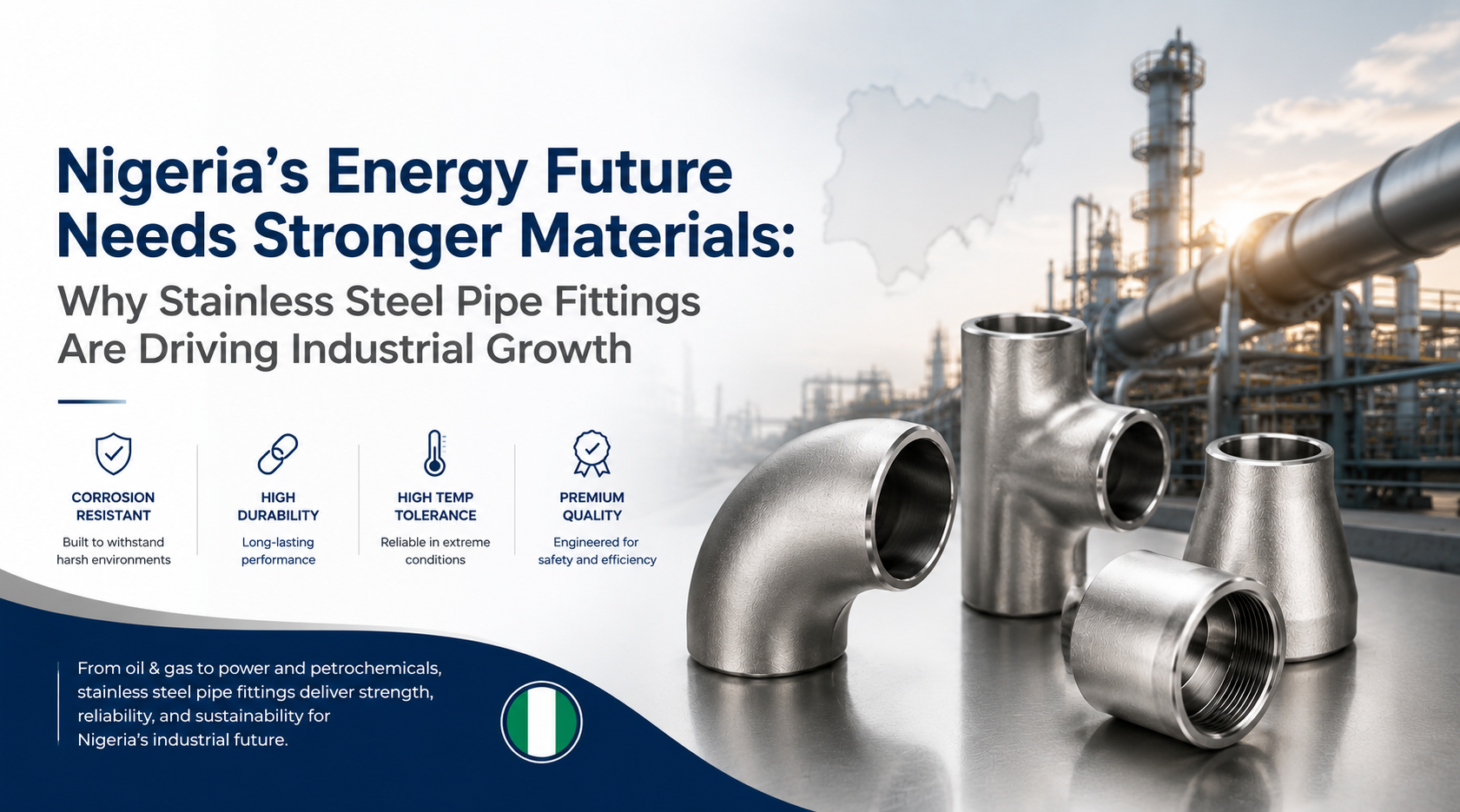
• Elbows
• Tees
• Reducers
• Couplings
• Caps
• Stub Ends
• Unions
They play a critical role in maintaining safe and efficient industrial operations.
Why Stainless Steel Pipe Fittings Are Important in Nigeria
Nigeria’s industries frequently operate in environments exposed to:
• Humidity
• Offshore saltwater conditions
• Chemical exposure
• High temperatures
• Heavy industrial workloads
Ordinary materials often deteriorate under such conditions.
Stainless steel pipe fittings provide exceptional resistance against corrosion, oxidation, and mechanical wear, making them ideal for Nigerian industrial applications.
Key Benefits of Stainless Steel Pipe Fittings
Outstanding Corrosion Resistance
One of the biggest advantages of stainless steel fittings is their ability to resist:
• Rust formation
• Chemical attack
• Chloride exposure
• Oxidation
• Moisture damage
This makes them particularly valuable for offshore and coastal installations.
High Mechanical Strength
Stainless steel pipe fittings maintain structural integrity even under demanding operating conditions.
Industries benefit from:
• Improved safety
• Better pressure handling
• Reduced failures
• Longer service life
Excellent Temperature Resistance
These fittings perform effectively under both elevated and low-temperature conditions.
Applications include:
• Steam systems
• Refinery operations
• Process plants
• Thermal systems
Reduced Maintenance Costs
Because of their durability and corrosion resistance, stainless steel fittings help reduce:
• Downtime
• Repair costs
• Replacement frequency
• Operational disruptions
Technical Specifications
| Parameter | Specification |
| Product | Stainless Steel Pipe Fittings |
| Standards | ASTM / ASME |
| Types | Butt Weld, Threaded, Forged |
| Material Grades | 304, 304L, 316, 316L, 321, 347 |
| Size Range | ½” to 48″ |
| Pressure Rating | Industrial & High Pressure Applications |
| Applications | Oil & Gas, Marine, Chemical, Power |
Popular Stainless Steel Grades Used in Nigeria
Stainless Steel 304 Pipe Fittings
SS 304 is one of the most widely used stainless steel grades.
Features
• Good corrosion resistance
• Excellent strength
• Easy fabrication
• Cost-effective performance
Applications
• Water systems
• Food processing
• General industrial piping
Stainless Steel 304L Pipe Fittings
304L contains lower carbon content, improving weldability and corrosion resistance.
Benefits
• Reduced carbide precipitation
• Better welding performance
• Improved durability
Used extensively in welded process systems.
Stainless Steel 316 Pipe Fittings
SS 316 contains molybdenum, which improves resistance to chloride attack and harsh chemicals.
Advantages
• Superior corrosion resistance
• Marine-grade performance
• Excellent chemical resistance
Ideal for offshore and marine applications.
Stainless Steel 316L Pipe Fittings
316L combines corrosion resistance with enhanced weldability.
Common Uses
• Oil & gas facilities
• Petrochemical plants
• Pharmaceutical industries
• Offshore projects
Stainless Steel 321 Pipe Fittings
321 stainless steel contains titanium stabilization for improved heat resistance.
Applications
• Heat exchangers
• Thermal processing systems
• High-temperature piping
Stainless Steel 347 Pipe Fittings
347 stainless steel offers superior performance in elevated-temperature applications.
Used In
• Refineries
• Power plants
• High-pressure steam systems
• Petrochemical facilities
Why Stainless Steel Pipe Fittings Are Essential for Nigeria’s Oil & Gas Industry
Nigeria is one of Africa’s largest oil-producing nations.
Oil and gas facilities require piping systems capable of handling:
• Offshore environments
• Corrosive fluids
• High pressure operations
• Continuous production cycles
Stainless steel pipe fittings provide the reliability required to support these critical operations.
Applications Across Nigerian Industries
Oil & Gas Industry
Used in:
• Refineries
• Offshore platforms
• Pipelines
• Processing facilities
Petrochemical Plants
Provide corrosion-resistant solutions for aggressive chemical processing.
Power Generation Facilities
Support steam systems and high-temperature operations.
Marine Industry
Resist seawater corrosion and harsh offshore conditions.
Water Treatment Plants
Maintain clean and corrosion-resistant water distribution systems.
Manufacturing Industry
Support industrial fluid transfer and utility networks.
Common Types of Stainless Steel Pipe Fittings
Elbows
Used to change flow direction within piping systems.
Tees
Allow fluid distribution in multiple directions.
Reducers
Connect different pipe sizes efficiently.
Cap
Seal pipe ends securely.
Stub Ends
Used with lap joint flanges for easier maintenance.
Couplings
Provide strong and leak-resistant pipe connections.
Stainless Steel vs Carbon Steel Pipe Fittings
| Property | Stainless Steel | Carbon Steel |
| Corrosion Resistance | Excellent | Moderate |
| Service Life | Long | Medium |
| Maintenance | Low | Higher |
| Chemical Resistance | Excellent | Limited |
| Offshore Performance | Superior | Moderate |
This is why stainless steel continues to be the preferred choice for demanding industrial applications.
Quality Testing and Inspection
Industrial-grade stainless steel pipe fittings undergo:
• Hydrostatic testing
• PMI testing
• Mechanical testing
• Dimensional inspection
• Corrosion resistance testing
These procedures ensure compliance with international quality standards and long-term reliability.
The Future of Stainless Steel Pipe Fittings in Nigeria
As Nigeria continues investing in:
• Energy infrastructure
• Refinery expansion
• Manufacturing growth
• Marine development
• Industrial modernization
the demand for corrosion-resistant and high-performance piping systems will continue to rise.
Stainless steel pipe fittings will remain essential for ensuring safe, efficient, and long-lasting industrial operations.
Conclusion
Nigeria’s industrial growth depends on reliable infrastructure capable of handling challenging operating conditions.
From offshore oil platforms and petrochemical plants to power generation facilities and manufacturing units, stainless steel pipe fittings provide the strength, corrosion resistance, and durability required for long-term success.
Their ability to withstand pressure, heat, moisture, and chemical exposure makes them one of the most important components in modern industrial piping systems.