Introduction: Precision Piping for America’s Industrial Sector
In demanding industrial environments across the United States, such as petrochemical refineries, power plants, pharmaceutical facilities, aerospace systems, and water treatment plants, corrosion resistance and material purity are essential. When conventional materials fail due to aggressive media, high temperatures, or severe corrosion, titanium pipe fittings provide a robust and long-lasting solution.
Titanium fittings combine lightweight strength, superior corrosion resistance, and high temperature performance, making them indispensable for critical piping systems. These attributes have made titanium the material of choice in many high-value applications where reliability and longevity are paramount.
As a trusted manufacturer, supplier, and exporter, Mcneil Instruments delivers top-quality titanium pipe fittings that comply with global standards and meet the exacting needs of industrial customers in the United States.
This blog covers:
- What titanium pipe fittings are and how they are used
- Key titanium grades and material properties
- Technical specifications
- Applications across industries in the USA
- Quality assurance and why Mcneil Instruments is a preferred partner
Understanding Titanium Pipe Fittings
Titanium pipe fittings are connectors used to join, redirect, transition, or terminate titanium piping in industrial systems. They are typically used within critical process lines where corrosion resistance and structural performance directly impact operational safety and lifecycle costs.
Unlike conventional stainless steels, titanium alloys form a passive oxide layer that shields the metal from corrosion, even in highly aggressive environments like seawater, acids, and chlorides. This makes them ideal for industries where contamination, corrosion, or reactive compounds can compromise the integrity of process lines.
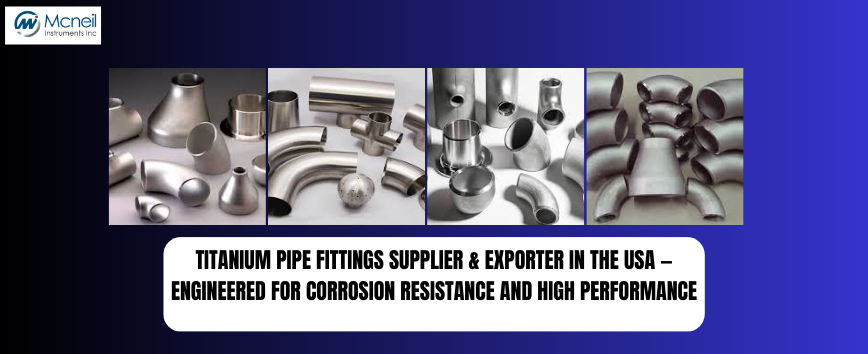
Common types of titanium pipe fittings include:
- Elbows (45°, 90°, 180°)
- Tees and crosses
- Reducers (concentric and eccentric)
- Caps and plugs
- Flanges and adapters
- Stub ends and couplings
Each fitting type is designed to ensure secure, leak-proof connections with titanium pipes, preserving system integrity under pressure and temperature fluctuations.
Key Titanium Grades and Their Benefits
Mcneil Instrument supplies titanium pipe fittings in multiple grades to address a variety of industrial applications.
Titanium Grade 1 Pipe Fittings
- Characteristics: Highest corrosion resistance, lowest strength among the titanium grades.
- Applications: Ideal for highly corrosive environments such as seawater service, chemical handling, and acid processing.
Titanium Grade 2 Pipe Fittings
- Characteristics: Most widely used titanium grade, combining excellent corrosion resistance with good strength.
- Applications: Suitable for general industrial piping, seawater systems, and heat exchanger tubes.
Titanium Grade 3 Pipe Fittings
- Characteristics: Slightly higher strength than Grades 1 and 2 with good corrosion resistance.
- Applications: Used where marginally higher mechanical strength is required without sacrificing corrosion resistance.
Titanium Grade 4 Pipe Fittings
- Characteristics: Highest strength among commercially pure titanium grades, with excellent corrosion resistance.
- Applications: Pressure vessels, high-stress pipework, and critical offshore or marine systems.
Each titanium grade is selected based on application conditions such as fluid chemistry, temperature, pressure, and long-term durability requirements.
Why Titanium Is an Excellent Material Choice
Titanium and its alloys are used across high-performance industries due to the following material strengths:
Superior Corrosion Resistance
Titanium withstands aggressive chemical attack, including chlorides, seawater, and many industrial acids, outperforming most stainless steels and nickel alloys.
High Strength-to-Weight Ratio
Titanium offers excellent mechanical performance while remaining significantly lighter than stainless steel, reducing support weight and installation costs.
Biocompatible
The material is non-toxic and suitable for medical and pharmaceutical applications where purity is critical.
High Temperature Capability
Titanium maintains mechanical properties at elevated temperatures, supporting heat exchanger and thermal systems.
These properties make titanium pipe fittings ideal for challenging applications where material failure can lead to downtime, safety risks, or costly maintenance.
Technical Specifications & Standards Compliance
Titanium pipe fittings from Mcneil Instruments are manufactured to meet rigorous international specifications — ensuring compatibility with industrial systems used in the United States.
| Specification | Details |
| Material Standard | ASTM B363, ASME SB363 Titanium Pipe Fittings |
| Titanium Grades | Grade 1, Grade 2, Grade 3, Grade 4 |
| End Connections | Butt Weld, Socket Weld, Threaded |
| Size Range | 1/4″ NB to 24″ NB |
| Pressure Ratings | Up to 6000 psi (depending on grade and application) |
| Temperature Range | -196°C to +600°C (depending on service) |
| Surface Finish | Mill finish, Pickled, Passivated |
| Manufacturing | Forged, Machined, Seamless |
Each batch undergoes strict dimensional and metallurgical controls, aligned with ASTM and ASME standards to ensure performance under industrial conditions.
Mechanical Properties of Titanium Grades
| Titanium Grade | Tensile Strength | Yield Strength | Elongation | Corrosion Resistance |
| Grade 1 | ~240 MPa | ~170 MPa | ~24% | Exceptional |
| Grade 2 | ~340 MPa | ~275 MPa | ~20% | Excellent |
| Grade 3 | ~380 MPa | ~310 MPa | ~16% | Excellent |
| Grade 4 | ~480 MPa | ~415 MPa | ~14% | Excellent |
Values may vary slightly based on heat treatment and specific specifications.
These mechanical properties demonstrate titanium’s ability to support moderate to high-strength piping applications while resisting corrosion in aggressive media.
Applications of Titanium Pipe Fittings in the USA
Titanium pipe fittings find extensive use across a wide range of industries in the United States:
Oil & Gas and Petrochemical Processing
Used in offshore platforms, subsea pipelines, and processing plants where chloride environments and corrosive fluids are present.
Chemical and Process Industries
Used in pipelines handling acids, solvents, and highly corrosive process streams.
Desalination and Water Treatment
Titanium’s resistance to seawater corrosion makes it ideal for desalination plants and coastal facilities.
Power Generation
Heat exchangers, boiler feed lines, and cooling water systems benefit from titanium’s thermal stability and corrosion resistance.
Pharmaceutical & Biotechnology
Sanitary process lines and high-purity piping systems require materials that do not contaminate fluids.
Marine and Shipbuilding
Titanium performs reliably in hull piping, seawater intakes, and corrosion-prone environments.
Quality Assurance, Testing & Certification
To ensure every titanium pipe fitting meets performance expectations, Mcneil Instruments employs a rigorous quality and testing protocol:
- Material Verification and Chemical Analysis
- Mechanical Testing (Tensile, Yield, and Elongation)
- Positive Material Identification (PMI)
- Hydrostatic and Pneumatic Pressure Testing
- Non-Destructive Examination (Ultrasonic / Radiographic)
- Dimensional Inspection
- Mill Test Certificates (EN 10204 3.1 / 3.2)
These tests and certifications provide traceability and confidence that the product meets ASTM and ASME standards — critical for industrial use in the USA.
Industrial Benefits Specific to the USA Market
In the USA, industries face stringent safety, environmental, and compliance requirements. Titanium pipe fittings offer:
Longevity in Harsh Conditions
Corrosion resistance reduces replacement frequency and long-term maintenance costs.
Reduced Lifecycle Cost
Materials that withstand aggressive fluids and temperature reduce total cost of ownership.
Compliance With Safety Codes
Products produced to ASTM/ASME standards align with U.S. regulatory expectations for pressure systems, refinery piping, and processing facilities.
Enhanced Product Purity
Ideal for pharmaceutical, food, and semiconductor production where contamination control is critical.
Why Choose Mcneil Instruments — Manufacturer, Supplier, and Exporter
Global Standards and Compliance
Mcneil Instrument manufactures titanium pipe fittings to international standards and delivers them with complete quality documentation.
Advanced Manufacturing Capability
From precision forging to expert machining and finishing, fittings are produced for critical performance.
Trusted Export Partner
With proven export experience, Mcneil Instruments ensures smooth delivery to clients across the United States and beyond.
Technical Guidance and Support
Customers benefit from expert assistance in material selection, application engineering, and specification interpretation.
Comprehensive Documentation
Full traceability with test reports, certification, and compliance records supports procurement and quality assurance processes.
Conclusion: Titanium Pipe Fittings Engineered for Performance in the USA
For industrial piping systems subjected to corrosive fluids, high temperatures, and demanding service conditions, titanium pipe fittings provide unmatched performance. Their combination of corrosion resistance, strength, and durability makes them suitable for a wide range of sectors — from oil & gas and chemical processing to desalination and food production.
As a trusted manufacturer, supplier, and exporter in India with a global footprint, Mcneil Instruments delivers high-quality titanium pipe fittings designed to meet the stringent technical requirements and compliance demands of the United States industrial landscape.
Whether you are specifying fittings for a refinery in Houston, a desalination plant in California, or a pharmaceutical facility in New Jersey, Mcneil Instruments ’s titanium solutions offer performance, reliability, and long-term value.