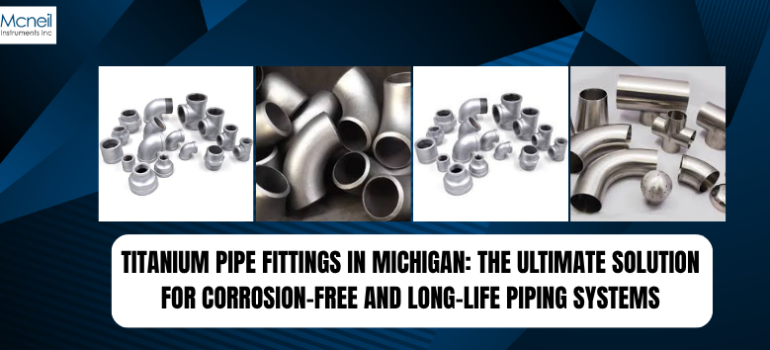
Titanium Pipe Fittings in Michigan: The Ultimate Solution for Corrosion-Free and Long-Life Piping Systems
Introduction: Where Durability Meets Zero Compromise
In industrial environments, the real problem isn’t just pressure or temperature—it’s corrosion. Over time, exposure to chemicals, moisture, and harsh conditions breaks down most materials, leading to leaks, failures, and costly downtime.
This is exactly where titanium pipe fittings stand out. Built from high-performance titanium alloys, these fittings offer exceptional corrosion resistance, strength, and longevity.
In Michigan, where industries like chemical processing, automotive manufacturing, energy, and marine systems operate in demanding conditions, titanium pipe fittings are becoming the preferred solution for reliable, long-lasting piping systems.
What Are Titanium Pipe Fittings?
Titanium pipe fittings are components used to connect, redirect, or terminate pipelines while maintaining strength and resistance to corrosion.
They are manufactured as per ASTM B363 / ASME SB363 standards, ensuring consistent performance in industrial applications.
Common Types
• Elbows – change direction of flow
• Tees – split or combine flow
• Reducers – connect different pipe sizes
• Caps – seal pipe ends
• Stub Ends – used with flange connections
These fittings are available in seamless and welded forms, depending on system requirements.
Why Titanium Is Different from Other Materials
Titanium is not just strong—it’s engineered for environments where other metals fail.
Key Characteristics
• Outstanding resistance to corrosion and chemical attack
• High strength-to-weight ratio
• Forms a natural protective oxide layer
• Performs well in both oxidizing and reducing environments
What this really means is simple: titanium fittings last longer, even in aggressive conditions.
Chemical Composition and Grades
Titanium fittings are available in different grades depending on application requirements.
Common Grades
| Grade | Features |
| Grade 1 | Excellent ductility and corrosion resistance |
| Grade 2 | Most widely used, balanced performance |
| Grade 5 (Ti-6Al-4V) | High strength and durability |
| Grade 7 / 12 | Enhanced resistance to harsh chemicals |
Each grade is selected based on the operating environment and performance needs.
Mechanical Properties of Titanium Pipe Fittings
Titanium combines lightweight structure with impressive strength.
| Property | Typical Value |
| Density | ~4.5 g/cm³ |
| Tensile Strength | Up to ~950 MPa |
| Melting Point | ~1665°C |
| Corrosion Resistance | Excellent |
These properties make titanium fittings suitable for both heavy-duty and precision applications.
Key Advantages of Titanium Pipe Fittings
Exceptional Corrosion Resistance
Performs well in seawater, acids, and chemical environments.
Lightweight with High Strength
Easier handling without compromising durability.
High Temperature Performance
Maintains stability under elevated temperatures.
Long Service Life
Reduces maintenance costs and system downtime.
Chemical Resistance
Handles aggressive media without degradation.
Technical Specifications
| Specification | Details |
| Standard | ASTM B363 / ASME SB363 |
| Grades | Gr 1, Gr 2, Gr 5, Gr 7, Gr 12 |
| Size Range | ½″ to 24″ |
| Thickness | SCH 10 to SCH XXS |
| Type | Seamless / Welded |
| Connection | Butt Weld / Socket Weld |
These specifications ensure compatibility with modern industrial systems.
Industrial Applications in Michigan
Michigan’s industries demand materials that can handle corrosion, stress, and temperature at the same time.
Chemical Processing
Used in pipelines handling corrosive chemicals.
Automotive Industry
Applied in high-performance systems and exhaust components.
Marine and Water Systems
Resistant to moisture and seawater corrosion.
Power Generation
Used in heat exchangers, condensers, and boilers.
Oil & Gas and Energy
Ensures durability in harsh operating conditions.
Types of Titanium Pipe Fittings
Buttweld Fittings
• Strong and leak-proof connections
• Used in high-pressure systems
Forged Fittings
• Ideal for small-diameter piping
• High precision and strength
Fabricated Fittings
• Custom-built for specific industrial needs
Quality Testing and Assurance
To ensure reliability, titanium pipe fittings undergo strict quality checks:
• Chemical composition testing
• Mechanical strength testing
• Hydrostatic pressure testing
• Ultrasonic and radiographic inspection
• Positive Material Identification (PMI)
• Dimensional inspection
These tests ensure consistent performance in demanding applications.
Conclusion
Titanium pipe fittings offer a powerful combination of corrosion resistance, strength, and durability. They are designed for industries where failure is not an option.
In Michigan, where industrial operations require long-term reliability, titanium fittings provide a dependable solution for modern piping systems.
If the goal is corrosion-free performance, reduced maintenance, and extended service life, titanium pipe fittings are one of the smartest investments for industrial infrastructure.