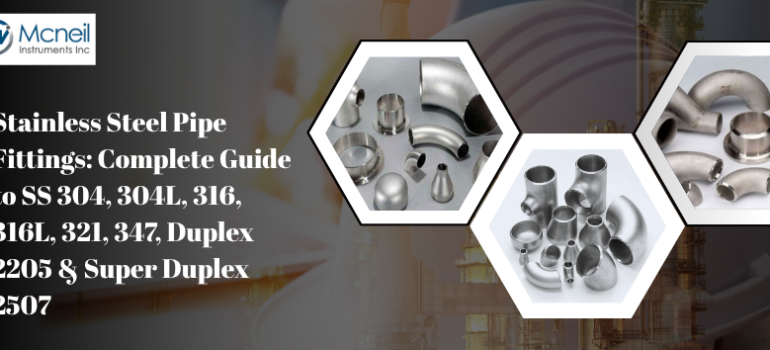
Stainless Steel Pipe Fittings: Complete Guide to SS 304, 304L, 316, 316L, 321, 347, Duplex 2205 & Super Duplex 2507
Introduction
In industrial piping systems, the pipe itself is only one part of the equation. The joints, connections, directional changes, branches, and terminations also need to withstand pressure, temperature, corrosion, and continuous operation. This is where Stainless Steel Pipe Fittings play an essential role.
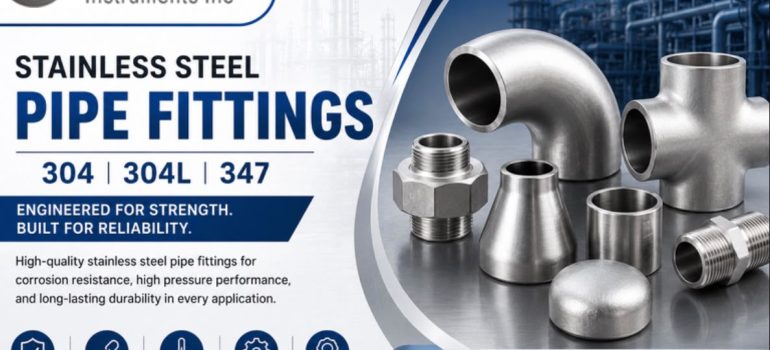
Stainless steel pipe fittings are precision-engineered components used to connect, redirect, branch, reduce, or terminate piping systems. Their combination of corrosion resistance, mechanical strength, temperature stability, weldability, and long service life makes them suitable for demanding industries ranging from oil and gas to pharmaceuticals and food processing.
Mcneil Instruments is a manufacturer, supplier, stockist, and exporter of Stainless Steel Pipe Fittings in India, offering fittings in grades including SS 304, 304L, 316, 316L, 321, 347, Duplex 2205, Super Duplex 2507, 17-4PH, and 15-5PH.
What Are Stainless Steel Pipe Fittings?
Stainless Steel Pipe Fittings are components installed between sections of pipe or at the end of a piping system to control its configuration and maintain a secure flow path.
Depending on the piping design, fittings can be used to:
- Change the direction of flow
- Create branches
- Connect different pipe diameters
- Join straight sections of pipe
- Close pipeline ends
- Connect piping to other components
- Facilitate maintenance and dismantling
In critical piping systems, fitting selection is just as important as pipe selection because joints must maintain structural integrity and prevent leakage during operation.
Why Are Stainless Steel Pipe Fittings Preferred?
Stainless steel provides a useful combination of mechanical strength, corrosion resistance, temperature stability, and fabrication characteristics.
The key advantages of Stainless Steel Pipe Fittings include:
Excellent Corrosion Resistance
Stainless steel fittings can perform reliably in environments exposed to moisture, chemicals, chlorides, and other corrosive media, depending on the selected grade.
High Temperature Resistance
Suitable grades can be used in elevated-temperature piping systems, including steam, boiler, heat exchanger, and process applications.
High Mechanical Strength
Stainless steel fittings provide the structural strength required for demanding pressure systems.
Excellent Weldability
Many stainless steel grades can be welded and fabricated for permanent piping assemblies.
Hygienic Surface
Smooth stainless steel surfaces are suitable for industries where cleanliness and contamination control are important.
Long Service Life
Their corrosion resistance and durability can reduce maintenance requirements and replacement frequency.
Types of Stainless Steel Pipe Fittings
Different fittings perform different functions within an industrial piping network.
Stainless Steel Elbows
Elbow fittings are used to change the direction of fluid flow. Common configurations include 45° and 90° elbows.
They are widely used where piping layouts require directional changes while maintaining a controlled flow path.
Stainless Steel Tees
Tees are used to create a branch connection within a pipeline.
They allow process flow to be distributed into two directions and are commonly used in process plants and utility systems.
Stainless Steel Reducers
Reducers connect pipes with different diameters.
They are commonly available as:
- Concentric reducers
- Eccentric reducers
The appropriate configuration depends on the piping layout and flow requirements.
Stainless Steel Couplings
Couplings join two sections of pipe in a straight line.
They can be useful for pipeline extensions, repairs, and maintenance applications.
Stainless Steel Caps & Plugs
Caps and plugs are used to close the end of a pipeline.
They can be used for:
- Pipeline isolation
- Pressure testing
- Temporary closure
- System termination
Stainless Steel Stub Ends
Stub ends are commonly used with lap joint flanges, particularly in piping systems where regular dismantling or maintenance is required.
Manufacturing Standards for Stainless Steel Pipe Fittings
International standards help ensure dimensional consistency, material integrity, and compatibility with industrial piping systems.
Mcneil Instruments lists the following standards for its stainless steel pipe fittings:
- ASTM A403
- ASME B16.9
- ASME B16.11
- ASME B16.28
- MSS-SP-43
- EN standards
- DIN standards
- ISO standards
ASTM A403 is specified for stainless steel wrought fittings, while ASME B16.9 covers factory-made butt weld fittings. ASME B16.11 covers forged socket weld and threaded fittings, and ASME B16.28 covers short-radius elbows.
Stainless Steel Pipe Fitting Grades
Choosing the correct stainless steel grade is critical because different operating environments require different combinations of corrosion resistance, temperature capability, strength, and weldability.
Mcneil Instruments offers a broad range of stainless steel and high-performance stainless grades.
Stainless Steel 304 Pipe Fittings
Versatile Grade for General Industrial Applications
SS 304 Pipe Fittings are widely used because of their corrosion resistance, durability, weldability, and versatility.
The source specifies an approximate composition of 18% chromium and 8% nickel, making SS 304 suitable for general industrial and commercial applications.
Applications
- Oil & gas
- Chemical processing
- Food processing
- Water treatment
- General pressure piping
Key Features
- Excellent corrosion resistance
- Good oxidation resistance
- Good weldability
- Good formability
- Hygienic and easy to clean
- Cost-effective austenitic stainless steel option
Mcneil Instruments lists SS 304 fittings in sizes from 1/2″ NB to 48″ NB, with seamless, welded, and fabricated options.
Stainless Steel 304L Pipe Fittings
Low-Carbon Grade for Welded Systems
SS 304L Pipe Fittings are the low-carbon version of SS 304. The lower carbon content improves weldability and helps reduce the risk of intergranular corrosion after welding.
The source specifies a maximum carbon content of 0.03%.
Applications
- Chemical processing
- Petrochemical plants
- Pharmaceutical facilities
- Food & beverage systems
- Sanitary piping
Key Features
- Excellent weldability
- Improved resistance to intergranular corrosion
- High strength
- Good formability
- Suitable for clean and sanitary environments
Stainless Steel 316 Pipe Fittings
Enhanced Corrosion Resistance for Aggressive Environments
SS 316 Pipe Fittings contain molybdenum, which enhances their resistance to chlorides and aggressive chemical environments.
They are particularly suitable for applications where pitting and crevice corrosion are concerns.
Applications
- Marine systems
- Chemical processing
- Pharmaceutical plants
- Food & beverage facilities
- High-temperature process systems
Key Features
- Superior corrosion resistance
- Excellent chemical resistance
- Strong performance in chloride environments
- Good weldability
- High mechanical strength
Stainless Steel 316L Pipe Fittings
Low-Carbon Solution for Corrosive and Hygienic Applications
SS 316L Pipe Fittings combine the corrosion resistance of 316 with the improved weldability associated with a low-carbon grade.
They are particularly useful where welding, cleanliness, corrosion resistance, and long-term durability are all important.
Applications
- Pharmaceutical manufacturing
- Food & beverage processing
- Petrochemical plants
- Marine applications
- Process piping
Key Features
- Excellent corrosion resistance
- Improved weldability
- Reduced risk of carbide precipitation during welding
- Strong chloride resistance
- Suitable for high-pressure and temperature applications
Stainless Steel 321 Pipe Fittings
Titanium-Stabilized Grade for High-Temperature Applications
SS 321 Pipe Fittings are titanium-stabilized austenitic stainless steel fittings designed for applications involving elevated temperatures.
The source identifies SS 321 as suitable for environments involving exposure to the chromium carbide precipitation range of approximately 427–816°C.
Applications
- Aerospace
- Heat exchangers
- Chemical processing plants
- Refineries
- Pressure vessels
- Exhaust manifolds
- Expansion joints
Key Features
- Excellent high-temperature performance
- Resistance to intergranular corrosion
- Good structural stability after welding
- Strong mechanical properties
- Suitable for high-temperature and high-stress applications
Stainless Steel 347 Pipe Fittings
High-Temperature Stability with Niobium Stabilization
SS 347 Pipe Fittings are niobium-stabilized austenitic stainless steel fittings designed for high-temperature service.
The stabilization helps reduce carbide precipitation during welding and supports structural integrity during prolonged thermal exposure.
Applications
- Aerospace
- Chemical manufacturing
- Petroleum refining
- Power generation
- Boiler systems
- Heat exchangers
Key Features
- Excellent high-temperature resistance
- Good oxidation resistance
- High creep strength
- Strong thermal stability
- Excellent resistance to intergranular corrosion
Duplex 2205 Pipe Fittings
High Strength and Corrosion Resistance
Duplex 2205 Pipe Fittings combine austenitic and ferritic stainless steel characteristics to provide high mechanical strength along with strong corrosion resistance.
Mcneil Instruments identifies Duplex 2205 as a nitrogen-enhanced duplex stainless steel with resistance to pitting, crevice corrosion, and stress corrosion cracking.
Applications
- Chemical processing
- Marine systems
- Oil & gas
- Desalination plants
- High-performance process piping
Key Features
- High mechanical strength
- Excellent corrosion resistance
- Strong resistance to stress corrosion cracking
- Suitable for demanding marine environments
- Suitable for high-pressure applications
Mcneil Instruments lists Duplex 2205 fittings in sizes from 1/2″ NB to 24″ NB under ASTM A815 / ASME SA815.
Super Duplex 2507 Pipe Fittings
For Highly Corrosive and High-Pressure Environments
Super Duplex 2507 Pipe Fittings are designed for extremely demanding applications where high strength and corrosion resistance are required simultaneously.
The source highlights their performance against chloride-induced corrosion and identifies applications including offshore platforms, petrochemical plants, and heat exchangers.
Applications
- Offshore platforms
- Petrochemical plants
- Heat exchangers
- Marine systems
- High-pressure process systems
Key Features
- Exceptional strength
- Excellent chloride corrosion resistance
- High corrosion resistance
- Suitable for aggressive environments
- Long-term durability
Mcneil Instruments lists Super Duplex 2507 under ASTM A815 / ASME SA815, with sizes from 1/2″ NB to 24″ NB.
Stainless Steel 17-4PH Pipe Fittings
High-Strength Precipitation-Hardening Stainless Steel
17-4PH Stainless Steel Pipe Fittings are precipitation-hardening stainless steel components designed for applications where high strength, toughness, and corrosion resistance are required.
The source identifies applications in aerospace, marine, chemical, pressure, and structural systems.
Key Features
- High strength
- Good corrosion resistance
- Excellent toughness
- Heat-treatable
- Suitable for demanding mechanical applications
Mcneil Instruments lists UNS S17400 under ASTM A182 / ASME SA182, with solution-treated and aged conditions from H900 to H1150.
Stainless Steel 15-5PH Pipe Fittings
High Strength with Improved Toughness
15-5PH Stainless Steel Pipe Fittings are martensitic precipitation-hardening stainless steel fittings designed for high-strength and demanding mechanical applications.
The source notes improved toughness and transverse properties compared with 17-4PH.
Applications
- Aerospace
- Nuclear industries
- Petrochemical plants
- High-pressure systems
- Structural applications
Key Features
- High mechanical strength
- Good corrosion resistance
- Excellent mechanical performance
- Low-temperature heat treatment capability
Mcneil Instruments lists UNS S15500 under ASTM A564 / ASME SA564, with conditions from H900 to H1150.
Stainless Steel Pipe Fittings: Grade Comparison
| Grade | Primary Advantage | Typical Applications |
| SS 304 | Versatility and corrosion resistance | General industrial, food, water treatment |
| SS 304L | Improved weldability | Chemical, pharmaceutical, sanitary systems |
| SS 316 | Chloride and chemical resistance | Marine, chemical, pharmaceutical |
| SS 316L | Corrosion resistance with improved weldability | Marine, pharmaceutical, petrochemical |
| SS 321 | High-temperature stability | Refineries, heat exchangers, aerospace |
| SS 347 | High-temperature and intergranular corrosion resistance | Power, refining, chemical processing |
| Duplex 2205 | High strength and corrosion resistance | Oil & gas, marine, desalination |
| Super Duplex 2507 | Extreme corrosion resistance and strength | Offshore, petrochemical, heat exchangers |
| 17-4PH | High strength and toughness | Aerospace, marine, chemical |
| 15-5PH | High strength and improved toughness | Aerospace, nuclear, petrochemical |
The appropriate grade should always be selected according to actual fluid chemistry, pressure, temperature, environmental exposure, connection method, and applicable project standards.
How Stainless Steel Pipe Fittings Are Installed
Proper installation begins with understanding the requirements of the piping system.
Step 1: Determine the Piping Requirements
Identify:
- Pipe diameter
- Wall thickness
- Fluid or gas
- Operating pressure
- Operating temperature
- Environmental exposure
Step 2: Select the Appropriate Fitting
Choose the fitting type and stainless steel grade according to the system requirements.
Step 3: Select the Connection Method
Common options include:
- Butt weld
- Socket weld
- Threaded connections
Butt weld fittings are suitable for permanent high-pressure systems, while threaded fittings can offer easier dismantling and maintenance. Socket weld fittings are commonly used in compact, high-strength assemblies.
Step 4: Inspect and Test the Joint
After installation, the system should be checked for leakage, pressure resistance, dimensional accuracy, and overall connection integrity.
Applications of Stainless Steel Pipe Fittings
Stainless steel pipe fittings are used across a broad range of industries.
Oil & Gas
They are used in upstream, midstream, and downstream systems where pressure and corrosion resistance are critical.
Chemical & Petrochemical
Stainless steel fittings provide reliable connections in systems exposed to aggressive chemicals and elevated temperatures.
Power Generation
Applications include boilers, heat exchangers, steam lines, and other process systems.
Food & Beverage
Stainless steel fittings are preferred for hygienic fluid handling and systems requiring cleanable surfaces.
Pharmaceutical Manufacturing
They support contamination-controlled process and fluid transfer systems.
Water Treatment & Desalination
Duplex and Super Duplex grades are particularly useful where salinity, moisture, and corrosion create demanding service conditions.
Marine & Offshore
Stainless steel and high-performance duplex grades can provide resistance to harsh marine environments and saltwater exposure.
How to Choose the Right Stainless Steel Pipe Fittings
Choosing a fitting based only on pipe size is not enough. Engineers should evaluate several factors before selecting the material and connection type.
1. Fluid Type
Determine whether the system carries water, chemicals, hydrocarbons, steam, food-grade fluids, gases, or another medium.
2. Operating Pressure
The fitting must be capable of safely handling the system’s working pressure.
3. Operating Temperature
High-temperature systems may require grades such as 321 or 347 rather than standard 304.
4. Corrosive Environment
For chloride-rich or aggressive environments, 316L, Duplex 2205, or Super Duplex 2507 may be appropriate depending on the specific conditions.
5. Connection Method
Choose between butt weld, socket weld, or threaded construction based on installation requirements.
6. Applicable Standards
Confirm that the fitting complies with the required ASTM, ASME, MSS, EN, DIN, or ISO specifications.
7. Maintenance Requirements
If regular dismantling is expected, the connection method should accommodate maintenance requirements without compromising system integrity.
Why Choose Mcneil Instruments for Stainless Steel Pipe Fittings?
Mcneil Instruments offers a broad range of stainless steel pipe fitting grades and configurations for industrial applications.
The company’s product range covers SS 304, 304L, 316, 316L, 321, 347, Duplex 2205, Super Duplex 2507, 17-4PH, and 15-5PH. The fittings are available in different forms, sizes, schedules, connection configurations, and manufacturing conditions according to the grade and application.
Mcneil Instruments also highlights capabilities including:
- Manufacturing and supply
- Stock availability
- Global export
- Material testing
- Dimensional inspection
- International standards compliance
- Custom requirements
For critical industrial projects, selecting the right material, fitting configuration, and applicable standard is essential for achieving reliable long-term piping performance.
Conclusion
Stainless Steel Pipe Fittings are essential components in modern industrial piping systems, providing secure connections while helping systems withstand pressure, temperature, corrosion, and demanding operating conditions.
The right grade depends on the application. SS 304 and 304L are versatile options for general industrial and hygienic applications. SS 316 and 316L provide enhanced resistance to chlorides and aggressive environments. SS 321 and 347 are suitable for elevated-temperature service, while Duplex 2205 and Super Duplex 2507 offer higher strength and corrosion resistance for demanding applications. 17-4PH and 15-5PH provide high-strength precipitation-hardening options for specialized applications.
Whether the requirement is for Stainless Steel Elbows, Tees, Reducers, Couplings, Caps, Plugs, Stub Ends, Buttweld Pipe Fittings, Socket Weld Fittings, or Threaded Fittings, choosing the correct material grade and manufacturing standard is essential for safe and reliable operation.
Mcneil Instruments provides a comprehensive range of stainless steel pipe fittings for oil & gas, chemical, petrochemical, pharmaceutical, food processing, marine, water treatment, desalination, and power generation applications.