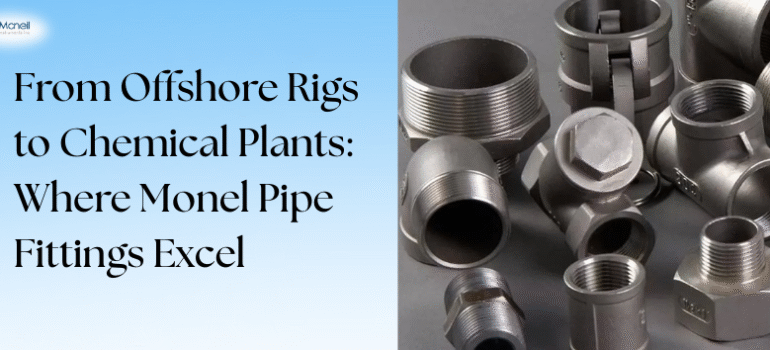
From Offshore Rigs to Chemical Plants: Where Monel Pipe Fittings Excel
Introduction: The Backbone of Corrosion-Resistant Piping Solutions
In industries where seawater, acidic environments, and extreme conditions are common, the material choice for pipe fittings becomes critical. From offshore oil platforms to chemical processing and marine engineering, pipe fittings must guarantee long-term reliability and leak-proof performance. Monel pipe fittings, made from a nickel-copper alloy, are globally recognized for their exceptional corrosion resistance, toughness, and mechanical strength across diverse industrial applications.
With increasing globalization and complex procurement networks, engineers and buyers face the challenge of selecting fittings that not only meet ASTM/ASME international standards but also align with project-specific requirements. This blog provides an in-depth overview of Monel pipe fittings, their properties, specifications, uses, and why Mcneil Instruments is a trusted manufacturer, supplier, and exporter in India.
What are Monel Pipe Fittings?
Monel is a family of nickel-copper alloys (commonly Monel 400 and Monel K500) known for their excellent resistance to seawater, hydrofluoric acid, alkalis, and stress cracking. Unlike many stainless steels, Monel maintains its strength across a wide range of temperatures, from cryogenic levels to elevated conditions.
Monel pipe fittings are available in forms such as elbows, tees, reducers, couplings, crosses, and stub ends, providing reliable connections in demanding systems. Their ability to resist chloride stress corrosion cracking makes them invaluable in marine, oil & gas, desalination, and chemical processing industries.
Key Features of Monel Pipe Fittings
- Excellent resistance to seawater and marine environments
- Superior resistance to acids and alkalis, especially hydrofluoric acid
- Strong mechanical strength at both sub-zero and high temperatures
- Leak-proof design for critical industrial applications
- Long-lasting durability, reducing maintenance costs
Importance of Standards in Monel Pipe Fittings
Just as alloy steel pipes follow ASTM A335/ASME SA335 standards, Monel fittings must comply with stringent international norms to ensure performance and reliability.
Why standards matter:
- Consistency: Guarantees uniform dimensions and performance.
- Safety: Prevents leaks and failures in critical applications.
- Compliance: Ensures global acceptance in major projects.
- Reliability: Meets project specifications for durability under stress.
Technical Specifications of Monel Pipe Fittings
| Specification | Details |
| Standards Compliance | ASTM B366, ASME SB564, MSS SP-43, ISO, DIN |
| Grades Available | Monel 400, Monel K500 |
| Size Range | ½″ to 24″ (custom sizes available) |
| Pressure Rating | Suitable for high-pressure and marine service |
| Temperature Range | -196°C to +550°C |
| Forms Available | Elbows, Tees, Reducers, Stub Ends, Crosses, Couplings |
Mechanical Properties of Monel Pipe Fittings
| Property | Monel 400 | Monel K500 |
| Tensile Strength | ≥ 550 MPa | ≥ 790 MPa |
| Yield Strength | ≥ 240 MPa | ≥ 550 MPa |
| Elongation (%) | 30 | 20 |
| Hardness (HRB) | ≤ 85 | ≤ 100 |
| Corrosion Resistance | Excellent in marine and alkaline media | Outstanding with added strength and hardness |
Common Applications of Monel Pipe Fittings
Monel 400 Pipe Fittings:
- Marine engineering and seawater piping
- Offshore drilling platforms
- Pump shafts and condenser systems
- Heat exchangers in corrosive environments
Monel K500 Pipe Fittings:
- Oil & gas exploration systems
- Pump and valve components requiring higher strength
- Fasteners and couplings in marine and aerospace applications
- Chemical processing units handling strong alkalis and acids
How to Choose the Right Monel Fittings
- Marine applications: Choose Monel 400 for its exceptional resistance to seawater.
- High-strength needs: Opt for Monel K500, offering improved mechanical strength.
- Chemical plants: Use Monel fittings in systems handling acids, alkalis, or brine.
- Cryogenic applications: Monel retains toughness at extremely low temperatures.
Global Reach of Mcneil Instruments: Monel Pipe Fittings
Mcneil Instruments is a globally recognized manufacturer, supplier, and exporter of Monel pipe fittings, serving critical industries across continents:
- In Saudi Arabia & UAE, supplied for petrochemical refineries and offshore drilling.
- In Qatar & Kuwait, exported for desalination plants and chemical projects.
- In Nigeria & Ghana, used in mining, seawater cooling, and water treatment systems.
- In the USA (Texas, Chicago), trusted in oil & gas and marine sectors.
- In Brazil, Malaysia, and Singapore, integrated into pulp & paper, desalination, and marine engineering projects.
Certifications and Testing
Every Monel pipe fitting manufactured by Mcneil Instruments undergoes rigorous quality control:
- Material Test Certificates (EN 10204 3.1/3.2)
- Hydrostatic and Pneumatic Testing
- Non-Destructive Testing (Ultrasonic, Radiography)
- API, ASTM, ASME Compliance
- ISO 9001:2015 Certified Facilities
Future Trends in Monel Pipe Fittings
With industries advancing toward renewable energy, offshore engineering, and advanced chemical processing, the demand for Monel alloys is expected to grow. Enhanced machining techniques and precision manufacturing are enabling fittings with longer service life and greater efficiency in extreme environments.
Conclusion: Durable Fittings for Critical Environments
Monel pipe fittings provide unmatched reliability in industries where seawater, alkalis, and acids pose severe challenges. By combining superior mechanical properties with international certifications, Mcneil Instruments ensures durable and leak-proof solutions trusted across global industries.As one of the leading Monel pipe fittings manufacturers, suppliers, and exporters in India,Mcneil Instruments delivers precision-engineered products designed to meet the toughest industrial requirements, from offshore platforms to chemical reactors.