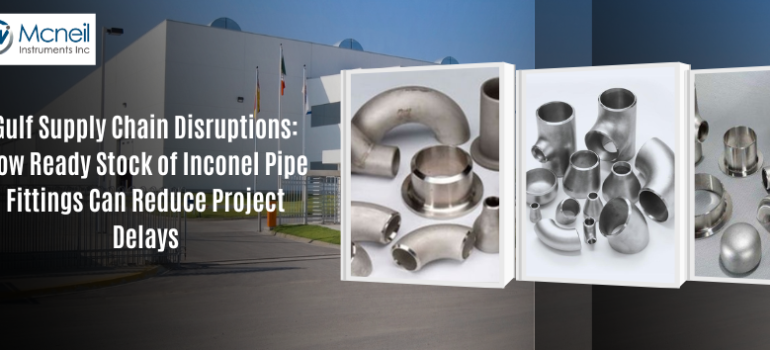
Gulf Supply Chain Disruptions: How Ready Stock of Inconel Pipe Fittings Can Reduce Project Delays
Introduction
Industrial projects across the Gulf region depend on a steady flow of specialized piping components, instrumentation materials, valves, fittings, and other critical equipment. In sectors such as oil and gas, petrochemicals, refineries, power generation, desalination, and chemical processing, even a small delay in receiving one essential component can affect installation schedules and commissioning timelines.
The current disruption to shipping routes in and around the Gulf has made this challenge more significant. Recent reports indicate that vessel traffic through the Strait of Hormuz has fallen substantially below normal pre-war levels, creating additional uncertainty for maritime logistics, delivery schedules, and freight movement.
For projects requiring specialized materials such as Inconel Pipe Fittings, relying entirely on just-in-time procurement can therefore create unnecessary exposure to logistics delays.
Maintaining ready stock of Inconel Pipe Fittings can provide an important buffer. Instead of waiting for a new manufacturing cycle and international shipment, project teams can source critical fittings from available inventory and keep installation work moving.
Why Gulf Supply Chains Are Facing Greater Pressure
The Gulf is a major center for energy, petrochemical, refining, marine, and industrial activity. A large proportion of industrial equipment and raw materials used in these projects moves through international shipping networks.
When conflict or geopolitical instability affects important maritime routes, several parts of the procurement process can be affected simultaneously.
Longer Transit Times
Ships may be forced to alter routes or wait for safer operating conditions, increasing transportation times.
Freight Uncertainty
Changes in vessel availability, routing, insurance requirements, and operating risks can affect transportation costs and delivery schedules.
Procurement Delays
A component that would normally arrive within a predictable lead time may suddenly require significantly more time.
Manufacturing Dependencies
If the required fitting is not already available, the buyer may need to wait for material procurement, manufacturing, inspection, certification, and shipment.
Project Schedule Impact
A missing piping component can prevent a particular section of a pipeline or process system from being completed, potentially affecting downstream installation and commissioning activities.
UNCTAD has highlighted the importance of the Strait of Hormuz to global maritime trade, while recent shipping developments demonstrate how geopolitical disruptions can quickly affect vessel movements.
Why Inconel Pipe Fittings Require Careful Procurement Planning
Inconel Pipe Fittings are nickel-based alloy components used in applications where high-temperature strength and corrosion resistance are important.
They are commonly considered for demanding environments involving:
- High temperatures
- Aggressive chemicals
- Chloride exposure
- Oxidizing conditions
- Thermal cycling
- High-pressure process systems
Nickel alloys are specifically used in applications where ordinary materials may not provide the required combination of corrosion resistance and high-temperature performance. ASTM’s current B462 specification, for example, covers nickel-alloy forged fittings and related components intended for corrosive, high-temperature service.
Because these are specialized engineering components, procurement cannot always be treated like buying a standard commodity fitting.
The required grade, dimensions, schedule, pressure class, connection type, specification, and certification must match the project requirement.
How Ready Stock Helps Reduce Project Delays
Maintaining ready inventory does not eliminate every supply-chain risk, but it can significantly reduce dependence on new production and long-distance transportation for urgent requirements.
1. Shorter Procurement Lead Times
If the required Inconel Pipe Fitting is already available in stock, the project does not necessarily need to wait for the complete manufacturing cycle.
The procurement process can move directly toward inspection, documentation, dispatch, and delivery.
This can be particularly valuable when a project is approaching a scheduled installation or commissioning milestone.
2. Protection Against Manufacturing Delays
Without ready stock, a new order may involve multiple stages:
Raw material → Manufacturing → Heat treatment → Machining → Inspection → Certification → Packing → Shipping → Delivery
Any disruption at one stage can affect the final delivery date.
Ready stock reduces the number of stages that need to be completed after the order is placed.
3. Reduced Exposure to Shipping Disruptions
The Gulf’s dependence on maritime logistics means international shipping disruptions can have consequences for industrial procurement.
Current conditions around the Strait of Hormuz demonstrate how quickly vessel movements can change during geopolitical disruptions. Reuters reported on August 11, 2026 that only six vessels passed through the strait on the previous day, compared with a pre-war norm of roughly 130 to 140 vessels.
Having critical fittings available before a disruption becomes a procurement emergency can reduce dependence on uncertain shipping windows.
4. Better Support for Shutdown and Maintenance Projects
Refinery and petrochemical maintenance projects often operate within tightly controlled shutdown windows.
When equipment is taken offline, installation teams may have a limited period to complete piping modifications, replacements, and repairs.
A missing fitting can create a disproportionate problem.
For example:
Planned maintenance → Component unavailable → Installation delayed → Testing delayed → Commissioning delayed
Ready stock can help reduce the possibility of this chain reaction.
5. Faster Response to Emergency Requirements
Industrial facilities can experience unexpected requirements due to:
- Damaged fittings
- Maintenance work
- Corrosion-related replacement
- Design modifications
- Construction changes
- Expansion projects
- Commissioning requirements
If suitable Inconel fittings are already available, procurement teams have an immediate sourcing option instead of starting the entire purchasing cycle from the beginning.
6. Improved Project Procurement Planning
Ready stock can also be used as part of a broader inventory strategy.
Project teams can identify components that are:
Critical
A missing component can stop installation or commissioning.
Long Lead
The component requires significant time to manufacture and deliver.
Specialized
The component is manufactured from an uncommon material or requires specific dimensions and certifications.
High Risk
The component is particularly vulnerable to transportation or geopolitical disruptions.
Inconel Pipe Fittings can fall into several of these categories depending on the project specification.
Which Inconel Fittings Should Be Considered for Stock?
The appropriate stock profile depends on the application and project requirements. Common fitting configurations can include:
- Inconel Elbows
- Inconel Tees
- Inconel Crosses
- Inconel Reducers
- Inconel Couplings
- Inconel Unions
- Inconel Caps
- Inconel Plugs
- Inconel Stub Ends
- Inconel Socket Weld Fittings
- Inconel Threaded Fittings
- Inconel Butt Weld Fittings
For specialized projects, the inventory strategy should be based on historical consumption, project drawings, maintenance requirements, and expected replacement demand rather than simply stocking every possible configuration.
Choosing the Right Inconel Grade
Ready stock is only useful if the material actually matches the application.
Different Inconel grades provide different combinations of strength, corrosion resistance, temperature performance, and fabrication characteristics.
Inconel 600
Known for its resistance to oxidation and corrosion and used in applications involving elevated temperatures and aggressive environments.
Inconel 625
Offers a combination of high strength and corrosion resistance and is widely used in demanding chemical, marine, offshore, and process applications.
Inconel 718
Known for high mechanical strength and creep resistance, making it suitable for specialized high-performance applications.
The final grade should always be selected according to the project’s technical specification and operating conditions.
Ready Stock vs Just-in-Time Procurement
| Factor | Ready Stock | Just-in-Time Procurement |
| Immediate availability | High, if the required item is stocked | Low |
| Exposure to shipping delays | Lower | Higher |
| Manufacturing lead time | Often avoided for stocked items | Usually required |
| Emergency requirements | Easier to address | More difficult |
| Inventory cost | Higher | Lower |
| Project schedule protection | Stronger | More dependent on logistics |
| Best suited for | Critical and long-lead components | Predictable routine requirements |
The objective is not necessarily to replace just-in-time procurement completely.
A better strategy can be to maintain strategic stock for critical components while continuing planned procurement for routine requirements.
How EPC Contractors Can Build a Strategic Inconel Inventory
A practical approach starts with identifying the components that could create the greatest project impact if unavailable.
Step 1: Identify Critical Components
Review piping drawings, bill of materials, maintenance records, and project schedules.
Step 2: Identify Long-Lead Materials
Highlight materials that require specialized manufacturing or international sourcing.
Step 3: Analyze Historical Consumption
Look at previous maintenance and replacement requirements to determine which fittings are regularly needed.
Step 4: Define Minimum Stock Levels
Establish minimum quantities for critical grades, sizes, and configurations.
Step 5: Verify Material Documentation
Stock should be accompanied by appropriate material identification and project-required documentation.
Step 6: Review Inventory Regularly
Avoid holding obsolete or project-specific fittings indefinitely. Inventory should be reviewed as project requirements change.
The Importance of Material Traceability
For specialized alloy fittings, having the physical component available is only part of the procurement requirement.
Project teams may also require documentation such as:
- Material Test Certificates
- Heat Number Traceability
- Chemical Composition
- Mechanical Test Results
- Dimensional Inspection Reports
- PMI Reports
- Hydrostatic Test Reports where applicable
- Third-Party Inspection Documentation where specified
For critical applications, procurement teams should confirm documentation requirements before accepting stock.
This helps prevent a situation where a fitting is physically available but cannot be released for installation because its material documentation does not satisfy the project specification.
Why Gulf Projects Should Consider Strategic Stock
The recent disruption to Gulf shipping illustrates an important procurement lesson: availability itself has become a risk-management consideration.
Shipping disruptions do not necessarily mean that every industrial component will become unavailable. However, uncertainty can make traditional lead-time assumptions less reliable.
Maritime risk around the Strait of Hormuz and Red Sea has already become an important consideration for supply-chain resilience planning.
For critical industrial components, strategic inventory can therefore act as a buffer between the project schedule and external logistics conditions.
Mcneil Instruments and Inconel Pipe Fittings
Mcneil Instruments supplies Inconel Pipe Fittings for demanding industrial applications where corrosion resistance, high-temperature performance, and reliable mechanical properties are important.
Its Inconel product range is positioned for applications across industries such as:
- Oil & Gas
- Petrochemical
- Chemical Processing
- Power Generation
- Marine
- Offshore
- Refineries
- Industrial Process Systems
For Gulf projects, sourcing specialized fittings from an experienced manufacturer and supplier can help procurement teams evaluate material grades, fitting configurations, specifications, documentation, and availability before placing an order.
Conclusion
Gulf industrial projects operate in an environment where supply-chain reliability can directly affect project schedules. Recent disruptions around major maritime routes have demonstrated how quickly geopolitical developments can affect shipping activity and create uncertainty for international procurement.
For specialized components such as Inconel Pipe Fittings, maintaining strategic ready stock can reduce dependence on new manufacturing cycles and uncertain transportation schedules.
The most effective approach is not simply to stock large quantities. It is to identify critical, specialized, and long-lead components, maintain appropriate inventory levels, verify material traceability, and establish dependable supplier relationships.
For EPC contractors, refineries, petrochemical plants, oil & gas companies, and other industrial facilities across the Gulf, this approach can provide an additional layer of protection against unexpected procurement delays and help keep critical project activities moving.
Frequently Asked Questions
Why are Inconel Pipe Fittings important for Gulf industries?
They are used in demanding industrial environments where corrosion resistance, high-temperature performance, and mechanical reliability are important.
How can ready stock reduce project delays?
Ready stock can eliminate or reduce the need to wait for a new manufacturing cycle and can provide an alternative when international shipping schedules become uncertain.
Should every Inconel fitting be kept in stock?
No. Strategic stock should focus on critical, frequently required, specialized, or long-lead components relevant to the facility or project.
What should buyers verify before purchasing stocked Inconel fittings?
Buyers should verify the alloy grade, dimensions, schedule or pressure class, fitting configuration, applicable ASTM/ASME specification, material traceability, inspection requirements, and required certification.
Is ready stock a replacement for normal procurement?
Not necessarily. A combination of planned procurement and strategic inventory is generally more practical than relying exclusively on either approach.