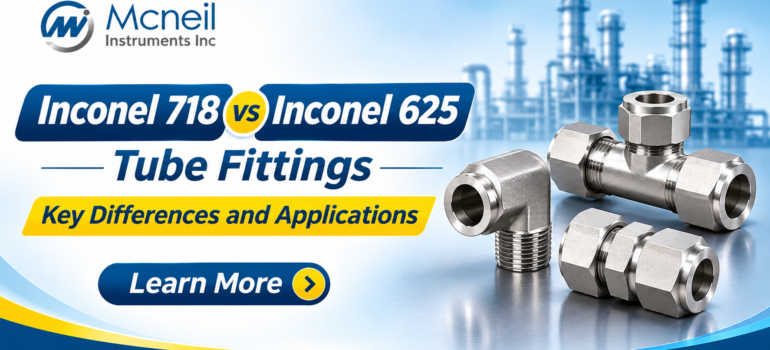
Inconel 718 vs Inconel 625 tube fittings comparison highlighting key differences, material properties, corrosion resistance, and industrial applications by Mcneil Instruments Inc.

Inconel 718 vs Inconel 625 Tube Fittings: Key Differences and Applications – Mcneil Instruments

Introduction

Selecting the right material for tube fittings is essential in industries where components are exposed to high temperatures, pressure, corrosive chemicals, and demanding operating conditions. Inconel alloys are widely used in such environments because of their excellent mechanical strength, oxidation resistance, and ability to perform under extreme service conditions.

Among the different nickel-based superalloys, Inconel 718 and Inconel 625 are two popular choices for industrial applications. Both alloys offer excellent corrosion resistance and high-temperature performance, but they differ in chemical composition, mechanical strength, heat treatment requirements, and application suitability.

Inconel 625 is primarily known for its outstanding corrosion resistance and resistance to oxidation, making it suitable for marine, chemical processing, offshore, and oil and gas applications. Inconel 718, on the other hand, is a precipitation-hardening nickel-based alloy known for its exceptionally high strength and fatigue resistance, particularly in high-pressure and high-temperature environments.

For manufacturers, engineers, and procurement professionals sourcing high-performance tube fittings, understanding these differences helps ensure better material selection, operational reliability, and long-term performance.

At Mcneil Instruments, we understand the importance of selecting suitable materials for industrial instrumentation and fluid control systems. In this blog, we explore the differences between Inconel 718 and Inconel 625 tube fittings, including their properties, corrosion resistance, advantages, and industrial applications.

What Are Inconel Tube Fittings?

Inconel tube fittings are specialized connectors manufactured using nickel-based superalloys. They are designed to connect tubing in industrial systems where conventional stainless steel materials may not provide the required performance.

These fittings are commonly used in high-pressure instrumentation systems, chemical processing facilities, offshore installations, power plants, and oil and gas operations.

Depending on the application and design requirements, Inconel tube fittings may include:
Tube connectors
Union fittings
Elbow fittings
Tee fittings
Male and female connectors
Bulkhead connectors
Reducer fittings
Instrumentation tube fittings
The selection of Inconel 625 or Inconel 718 depends on operating pressure, temperature, chemical exposure, mechanical loading, and applicable engineering specifications.

What Is Inconel 625?

Inconel 625 is a nickel-based superalloy primarily known for its excellent corrosion resistance, oxidation resistance, and high strength across a wide range of temperatures.

Its chemical composition includes nickel, chromium, molybdenum, and niobium. The combination of these elements provides excellent resistance to pitting, crevice corrosion, and many aggressive chemical environments.

Unlike precipitation-hardening alloys, Inconel 625 primarily derives its strength from solid-solution strengthening.

Key properties of Inconel 625:
Excellent resistance to general corrosion.
High resistance to pitting and crevice corrosion.
Good resistance to chloride-induced stress corrosion cracking.
Excellent oxidation resistance.
Good mechanical strength at elevated temperatures.
Suitable for demanding marine and chemical environments.
Good weldability and fabrication characteristics.

Common applications of Inconel 625 tube fittings:
Offshore oil and gas installations.
Marine engineering systems.
Chemical processing equipment.
Heat exchangers.
Seawater handling systems.
Pollution control equipment.
Aerospace components.
Industrial instrumentation systems.
Inconel 625 is particularly suitable for applications where corrosion resistance is a major consideration.

What Is Inconel 718?

Inconel 718 is a high-strength nickel-based superalloy designed for applications requiring excellent mechanical strength, fatigue resistance, and performance under elevated temperatures.

It contains nickel, chromium, iron, molybdenum, niobium, and other alloying elements. Its strength is primarily developed through precipitation hardening using controlled heat treatment.

Inconel 718 is widely used in aerospace, gas turbines, high-pressure equipment, and demanding industrial applications.

Key properties of Inconel 718:
Very high tensile and yield strength after appropriate heat treatment.
Excellent fatigue resistance.
Good creep and rupture strength.
Good oxidation resistance.
Strong performance at elevated temperatures.
Good resistance to stress corrosion cracking in many environments.
Suitable for high mechanical loading applications.

Common applications of Inconel 718 tube fittings:
Aerospace systems.
Gas turbine equipment.
High-pressure instrumentation systems.
Oil and gas equipment.
Power generation facilities.
Industrial process equipment.
High-temperature engineering applications.

Inconel 718 is particularly suitable when mechanical strength and resistance to fatigue are critical design requirements.

Inconel 718 vs Inconel 625: Chemical Composition

The chemical composition of these two alloys is responsible for their different mechanical and corrosion-resistant properties.

Chemical Element Inconel 625 Inconel 718
Nickel (Ni) 58% minimum 50–55%
Chromium (Cr) 20–23% 17–21%
Molybdenum (Mo) 8–10% 2.8–3.3%
Niobium (Nb) 3.15–4.15% 4.75–5.5%
Iron (Fe) 5% maximum Balance
Titanium (Ti) 0.4% maximum 0.65–1.15%
Aluminium (Al) 0.4% maximum 0.2–0.8%
Note: Values are approximate typical specification ranges. Exact limits depend on the applicable material standard and product specification.

The higher chromium and molybdenum content in Inconel 625 provides excellent corrosion resistance. Inconel 718 contains additional strengthening elements, including niobium, titanium, and aluminium, which contribute to its precipitation-hardening characteristics.

Corrosion Resistance: Inconel 718 vs Inconel 625

Corrosion resistance is a critical factor when selecting tube fittings for industrial applications, particularly in environments involving seawater, chemicals, moisture, and aggressive operating conditions.

Inconel 625 Corrosion Resistance
Inconel 625 offers excellent resistance to various corrosive environments. Its chromium and molybdenum content helps protect against oxidation, pitting, crevice corrosion, and localized corrosion.

It is particularly suitable for:
Marine and seawater applications.
Offshore oil and gas installations.
Chemical processing equipment.
Chloride-containing environments.
Industrial pollution control systems.

Inconel 718 Corrosion Resistance
Inconel 718 also provides good corrosion and oxidation resistance. However, its primary advantage is its high mechanical strength rather than maximum corrosion resistance.

It is suitable for applications involving elevated temperatures, mechanical stress, and demanding operating conditions. Its corrosion performance should be evaluated against the specific chemicals, temperatures, and environmental exposure involved.

Which Alloy Offers Better Corrosion Resistance?
In general, Inconel 625 offers better corrosion resistance than Inconel 718, especially in aggressive chloride-containing and marine environments. For applications where corrosion resistance is the primary requirement, Inconel 625 is often the preferred choice.

Mechanical Strength: Inconel 718 vs Inconel 625

Mechanical strength is another major difference between these two nickel-based alloys.

Inconel 718 is precipitation-hardenable, which allows it to achieve significantly higher tensile and yield strength after the specified heat treatment.

Inconel 625, meanwhile, offers good mechanical strength combined with excellent corrosion resistance and fabrication characteristics.

Mechanical Property Inconel 625 Inconel 718
Tensile Strength Around 827 MPa minimum Around 1,240 MPa minimum
Yield Strength Around 414 MPa minimum Around 1,034 MPa minimum
Strengthening Method Solid-solution strengthening Precipitation hardening
Fatigue Resistance Good Excellent
Corrosion Resistance Excellent Good
Weldability Generally excellent Requires controlled procedures

Note: Mechanical properties are indicative reference values and vary with product form, heat treatment, temperature, and applicable specifications. They should not be treated as universal tube-fitting design values.

For high-pressure applications involving substantial mechanical loading, Inconel 718 may offer an advantage because of its higher strength. However, actual fitting pressure ratings depend on geometry, wall thickness, connection design, manufacturing quality, and testing requirements.

High-Temperature Performance

Both alloys are used in high-temperature industrial environments, but their performance characteristics differ.

Inconel 625: Offers excellent oxidation resistance and maintains useful mechanical properties at elevated temperatures. It is widely used in heat exchangers, chemical processing equipment, marine systems, and industrial furnace components.

Inconel 718: Is particularly well known for maintaining high mechanical strength, fatigue resistance, and creep resistance under elevated-temperature conditions. It is widely used in gas turbines, aerospace engines, and high-performance engineering equipment.

The appropriate grade should be selected according to the actual operating temperature, mechanical load, exposure conditions, and design requirements.

Applications of Inconel 625 Tube Fittings

Inconel 625 tube fittings are commonly selected for industrial environments where corrosion resistance and reliable fluid or gas connections are important.

Major applications include:

  1. Oil and Gas Industry: Used in offshore installations, instrumentation systems, chemical injection lines, and applications exposed to corrosive fluids.
  2. Marine Industry: Suitable for seawater-related equipment and marine engineering systems because of its resistance to chloride-induced corrosion.
  3. Chemical Processing: Used in equipment handling aggressive chemicals and corrosive process media, subject to chemical compatibility.
  4. Power Generation: Applied in heat exchangers and other equipment exposed to elevated temperatures and demanding service conditions.
  5. Aerospace Industry: Used in selected engine and exhaust-related components requiring corrosion and oxidation resistance.

Applications of Inconel 718 Tube Fittings

Inconel 718 tube fittings are considered for applications where high mechanical strength and performance under demanding operating conditions are essential.

Major applications include:

  1. Aerospace Industry: Used in aircraft engine components, fuel systems, and high-performance engineering applications.
  2. Gas Turbine Systems: Suitable for components exposed to high mechanical stress and elevated temperatures.
  3. Oil and Gas Equipment: Used in selected high-strength components, instrumentation assemblies, and equipment requiring strong mechanical performance.
  4. Power Generation: Applied in demanding mechanical and high-temperature equipment.
  5. Industrial Engineering: Used in specialized systems where high tensile strength, fatigue resistance, and durability are required.

How to Choose Between Inconel 718 and Inconel 625 Tube Fittings?

Selecting the correct alloy depends on the actual operating environment and technical requirements of your industrial system.

Consider these important factors before making a decision:
Corrosion Exposure: Choose Inconel 625 when excellent resistance to chloride-induced corrosion and aggressive environments is a priority.
Mechanical Strength: Consider Inconel 718 when high tensile strength, fatigue resistance, and mechanical loading are major requirements.
Operating Temperature: Evaluate the temperature range and expected mechanical loads before selecting the material.
Chemical Compatibility: Identify the process fluids and chemicals that will come into contact with the fittings.
Pressure Requirements: Verify the fitting design, wall thickness, connection type, and applicable pressure ratings.
Manufacturing Standards: Confirm material specifications, heat treatment, inspection, and testing requirements.
Project Budget: Compare material costs with expected service life, maintenance, and replacement requirements.

It is also important to confirm whether the selected alloy is available in the required tube-fitting configuration and product specification. Material selection should always be supported by engineering calculations and application-specific requirements.

Why Choose Mcneil Instruments for Inconel Tube Fittings?

Choosing the right supplier is important when sourcing specialized nickel alloy tube fittings for industrial instrumentation and fluid control systems.

Mcneil Instruments focuses on industrial piping and instrumentation products, supporting customers across oil and gas, petrochemical, chemical processing, power generation, and other engineering industries.

We understand that different applications require different material grades, connection configurations, dimensions, and technical specifications.

Why consider Mcneil Instruments?
Expertise in industrial instrumentation and piping products.
Support for specialized alloy material requirements.
Product options based on project specifications.
Focus on material quality and dimensional requirements.
Support for domestic and international procurement.
Solutions for demanding industrial applications.
Whether your project requires Inconel 625 for corrosion-resistant applications or Inconel 718 for high-strength requirements, selecting the correct material and fitting configuration is essential.

Conclusion

Inconel 718 and Inconel 625 are both high-performance nickel-based alloys used in demanding industrial applications. However, they serve different engineering requirements.

Inconel 625 is generally preferred for applications requiring excellent corrosion resistance, particularly in marine, offshore, and chemical processing environments. Inconel 718 is better suited to applications requiring exceptionally high mechanical strength, fatigue resistance, and performance under elevated temperatures.

For industrial tube fittings, the final material selection should consider corrosion exposure, operating pressure, temperature, mechanical loading, and applicable engineering standards.

Mcneil Instruments supports industrial buyers looking for suitable instrumentation and alloy product solutions. Contact our team to discuss your Inconel 625 and Inconel 718 tube fitting requirements.

Looking for a Reliable Inconel Tube Fittings Supplier in India?

Choose Mcneil Instruments for industrial instrumentation and alloy product requirements. Whether you need Inconel 625 tube fittings for corrosion-resistant applications or Inconel 718 for high-strength engineering requirements, our team can help you explore suitable material options.

Contact Mcneil Instruments today to discuss your technical requirements and request a competitive quotation.

Frequently Asked Questions (FAQs)

  1. What is the main difference between Inconel 718 and Inconel 625?
    The main difference is their performance characteristics. Inconel 625 offers superior corrosion resistance due to its higher chromium and molybdenum content, while Inconel 718 provides significantly higher mechanical strength through precipitation hardening.
  2. Which is better for tube fittings, Inconel 718 or Inconel 625?
    The choice depends on the application. Inconel 625 is generally preferred for corrosive environments, while Inconel 718 is suitable for applications requiring high mechanical strength and fatigue resistance.
  3. Is Inconel 625 more corrosion-resistant than Inconel 718?
    Yes. Inconel 625 generally provides better resistance to pitting, crevice corrosion, and chloride-containing environments because of its higher chromium and molybdenum content.
  4. Why is Inconel 718 used in high-pressure applications?
    Inconel 718 offers high tensile strength and yield strength after appropriate heat treatment. These properties make it suitable for components exposed to significant mechanical loading. Actual pressure suitability depends on the fitting design and engineering calculations.
  5. Can Inconel 625 be used in marine applications?
    Yes. Inconel 625 is widely used in marine and offshore applications because of its excellent resistance to seawater-related corrosion, pitting, and crevice corrosion.
  6. Is Inconel 718 suitable for high-temperature applications?
    Yes. Inconel 718 offers excellent strength, fatigue resistance, and creep performance at elevated temperatures, making it suitable for gas turbines, aerospace equipment, and other demanding engineering applications.
  7. What industries use Inconel 625 tube fittings?
    Inconel 625 tube fittings are used in oil and gas, offshore engineering, marine systems, chemical processing, power generation, and selected aerospace applications.
  8. What industries use Inconel 718 tube fittings?
    Inconel 718 is used in aerospace, gas turbines, oil and gas equipment, power generation, and specialized industrial systems requiring high mechanical strength.
  9. Can Inconel 718 and Inconel 625 be welded?
    Both alloys can be welded using suitable procedures. Inconel 625 generally offers better weldability, while Inconel 718 requires more controlled welding and post-weld heat treatment considerations depending on the application.
  10. Where can I find Inconel tube fittings in India?
    You can contact Mcneil Instruments for Inconel alloy tube fitting requirements. Share your required alloy grade, fitting type, dimensions, pressure rating, and project specifications to discuss suitable supply options.
Read More
Inconel 718 pipe fittings by Mcneil Instruments with the Turkish flag, highlighting high-strength nickel alloy solutions for critical industrial applications in Turkey.

Inconel 718 Pipe Fittings: High-Strength Nickel Alloy for Critical Applications

Industrial piping systems used in high-temperature, high-pressure and demanding operating environments require materials that deliver strength, reliability and long-term performance. Inconel 718 is a nickel-based superalloy known for its high strength, good fatigue resistance and ability to maintain useful mechanical properties under challenging conditions.
Inconel 718 pipe fittings are considered for specialized industrial applications where mechanical performance, temperature resistance and material reliability are important. Industries such as oil and gas, aerospace, power generation and chemical processing may use nickel-based alloys when conventional materials do not meet the required operating conditions.


At Mcneil Instruments Inc., we understand the importance of selecting suitable piping components for critical industrial projects. We support industrial buyers looking for alloy piping solutions, including requirements associated with engineering and infrastructure projects in Turkey.

What Are Inconel 718 Pipe Fittings?

Inconel 718 is a precipitation-hardenable nickel-chromium alloy strengthened primarily through the addition of niobium, with other alloying elements contributing to its mechanical properties. It is commonly identified by the designation UNS N07718.
Pipe fittings made from this alloy connect piping sections, change flow direction, create branch connections or adapt between different pipe sizes. Depending on the piping design and manufacturing specification, these may include elbows, tees, reducers, caps and specialized fittings.


The alloy’s high strength and fatigue resistance make it useful in selected applications involving mechanical loads, elevated temperatures and demanding operating conditions. Its suitability for a particular piping system depends on the product form, heat treatment, manufacturing process and applicable engineering requirements.

Key Properties of Inconel 718 Pipe Fittings

  1. High Mechanical Strength
    One of the main advantages of Inconel 718 is its high strength after appropriate heat treatment. This property makes it valuable for components exposed to significant mechanical loads and demanding service conditions.
    For industrial piping applications, the fitting’s allowable pressure and load capacity must still be determined from its dimensions, manufacturing specification, design code and operating conditions.
  2. Performance at Elevated Temperatures
    Inconel 718 retains useful mechanical strength at elevated temperatures and is widely used in demanding high-temperature engineering applications.
    Its suitability for industrial piping depends on the actual operating temperature, exposure duration, environment and relevant design limits. Material selection should therefore be based on the project’s technical requirements rather than a general temperature rating.
  3. Good Fatigue and Creep Resistance
    Industrial components may experience repeated loading, vibration or prolonged exposure to elevated temperatures. Inconel 718 offers good fatigue resistance and useful creep resistance in appropriate service conditions.
    These characteristics make it an important material to evaluate for specialized equipment and systems where mechanical durability is essential.
  4. Oxidation and Corrosion Resistance
    The nickel-chromium composition of Inconel 718 provides oxidation resistance and resistance to various corrosive environments. However, its corrosion performance varies with chemical composition, temperature and process conditions.
    It should not automatically be considered suitable for every highly corrosive application. The actual process environment must be assessed before selecting the alloy.
  5. Reliability in Demanding Applications
    When correctly manufactured, heat-treated, inspected and installed, Inconel 718 components can provide dependable mechanical performance in demanding environments. Material certification, dimensional verification and compliance with the specified manufacturing requirements remain essential.

Common Types of Inconel 718 Pipe Fittings

Different fitting configurations support different piping arrangements and flow requirements.
Inconel 718 Elbows: Change the direction of fluid flow in piping systems.
Inconel 718 Tees: Provide branch connections in compatible piping layouts.
Inconel 718 Reducers: Connect pipes of different nominal diameters.
Inconel 718 Caps: Close pipe ends where required by the design.
Custom Alloy Fittings: Support specialized configurations when the required material, manufacturing process and engineering specification can be met.


Availability depends on the manufacturer’s product range, dimensions, material form and applicable specifications. Buyers should confirm whether the required fitting is available in the specified Inconel 718 grade and condition.

Industrial Applications of Inconel 718 Pipe Fittings

Oil and Gas Industry
Oil and gas operations may involve elevated temperatures, pressure, vibration and demanding mechanical conditions. Inconel 718 can be used in selected specialized components where its strength and fatigue resistance meet the application requirements.
Material selection must consider the actual process fluids, environmental exposure, applicable sour-service requirements and relevant industry standards.


Aerospace and Aviation
Inconel 718 is widely used in aerospace components, including selected engine and structural applications that require high strength and elevated-temperature performance.
Although the alloy is established in aerospace engineering, pipe fitting applications must be evaluated against their specific pressure, fluid and certification requirements.


Power Generation
Power generation equipment may contain components exposed to elevated temperatures, mechanical stress and demanding operating cycles. Inconel 718 can be considered for suitable specialized applications where its properties align with the design requirements.


Chemical and Process Industries
Some chemical and process facilities require high-performance alloys for selected equipment and piping components. Inconel 718 may be suitable where mechanical strength and environmental resistance are important, subject to a detailed compatibility assessment.


Industrial Engineering Projects in Turkey
Turkey has industrial activity across manufacturing, energy, petrochemicals, infrastructure and engineering. Projects in these sectors may require specialized piping components and high-performance alloy materials for demanding applications.
For procurement teams and EPC contractors in USA, Nigeria, India and other industrial centres, material selection should be based on the project’s design specifications, operating conditions, quality requirements and applicable standards.


Mcneil Instruments Inc. can assist buyers in discussing their Inconel 718 pipe fitting requirements, subject to product availability and the specified technical requirements.

Inconel 718 vs Inconel 625: What Is the Difference?

Inconel 718 and Inconel 625 are nickel-based alloys designed for demanding applications, but they offer different combinations of properties.


Inconel 718 is precipitation-hardenable and is particularly known for its high mechanical strength and fatigue performance after suitable heat treatment. Inconel 625 is strengthened primarily by solid-solution mechanisms and is widely recognized for its corrosion resistance in many aggressive environments.


The preferred alloy depends on the application. Where high mechanical strength is a major requirement, Inconel 718 may be worth evaluating. Where resistance to particular corrosive chemicals is the primary concern, Inconel 625 may be a more appropriate candidate.


The final decision should consider chemical compatibility, operating temperature, pressure, fabrication requirements and lifecycle costs.

Standards and Quality Requirements

When sourcing Inconel 718 pipe fittings, it is important to confirm that the material and finished product comply with the project’s specified requirements.


Consider the following factors:
Material identification: Confirm the specified alloy designation, such as UNS N07718, and the required heat-treatment condition.
Product specification: Verify the applicable ASTM, ASME or other approved material and manufacturing specification for the particular product form.
Dimensional requirements: Confirm fitting dimensions, wall thickness, end connections and applicable design standards.
Material certification: Request material test certificates and verify chemical composition and mechanical test results against the purchase specification.
Inspection and traceability: Establish the required inspection, testing, marking and traceability documentation.
Application suitability: Verify pressure-temperature limits, corrosion compatibility and compliance with the relevant engineering code.


Not every standard for nickel-alloy products applies to every type of pipe fitting. Buyers should confirm the precise specification before placing an order, particularly for critical-service applications.

How to Select the Right Inconel 718 Pipe Fittings

Choosing the correct fitting requires careful review of both technical and procurement requirements.

  1. Define the operating conditions: Establish design pressure, operating temperature, process fluid and expected mechanical loads.
  2. Confirm the alloy and heat treatment: Specify the required Inconel 718 material condition and mechanical properties.
  3. Select the fitting configuration: Identify the required elbows, tees, reducers, caps or custom components.
  4. Verify dimensions: Confirm nominal size, wall thickness, end preparation and compatibility with adjoining piping components.
  5. Review standards and certification: Specify material documentation, testing, traceability and applicable design-code requirements.
  6. Evaluate supplier capability: Confirm that the supplier can meet the specified material, manufacturing, inspection and delivery requirements for the project.

Why Choose Mcneil Instruments Inc.?

At Mcneil Instruments Inc., we understand that industrial buyers need piping components selected according to their project specifications and operating requirements.


Our team focuses on helping customers identify appropriate instrumentation and piping products for industrial applications. For Inconel 718 pipe fitting enquiries, we recommend confirming the required dimensions, alloy condition, applicable standards, certification requirements and intended operating environment before finalizing a purchase.


For buyers in Turkey and international procurement teams, clear technical specifications and accurate product documentation are important steps toward sourcing suitable components for critical applications.

Conclusion

Inconel 718 pipe fittings are an option for specialized applications that require high mechanical strength, fatigue resistance and useful performance at elevated temperatures. Their suitability depends on the operating environment, product condition, manufacturing specification and relevant engineering requirements.


From oil and gas operations to power generation and specialized engineering projects, choosing the right alloy requires a clear understanding of the application’s technical demands.


Mcneil Instruments Inc. is ready to discuss your industrial piping requirements. Contact our team to enquire about Inconel 718 pipe fittings for your next project in Turkey or other international markets.

Looking for Inconel 718 Pipe Fittings for Your Industrial Project?

Choose suitable high-strength nickel alloy piping components for demanding industrial applications with Mcneil Instruments Inc.
Whether your project is in Turkey or another international market, our team can discuss your technical specifications, fitting requirements and documentation needs.


Request a Quote Today to discuss your Inconel 718 pipe fitting requirements.
🌐 Website: https://mcneilinstruments.com/
📩 Email: info@mcneilinstruments.com
📞 Phone: +91-22-66518756

Frequently asked questions (FAQs)

  1. What are Inconel 718 pipe fittings used for?
    Inconel 718 pipe fittings are considered for specialized industrial applications requiring high mechanical strength, fatigue resistance and performance at elevated temperatures. Potential applications include selected oil and gas equipment, power generation systems and demanding engineering projects.
  2. What is the material designation of Inconel 718?
    Inconel 718 is commonly identified by the UNS designation N07718. Buyers should confirm the exact material specification, product form and heat-treatment condition required for their application.
  3. Are Inconel 718 pipe fittings suitable for high-temperature applications?
    They can be suitable for certain elevated-temperature applications because the alloy retains useful mechanical properties at elevated temperatures. The permitted operating conditions depend on the design, heat treatment, environment and applicable engineering requirements.
  4. What types of Inconel 718 pipe fittings are available?
    Common fitting configurations include elbows, tees, reducers, caps and specialized components. Availability should be confirmed with the supplier based on the required size, manufacturing specification and material condition.
  5. What is the difference between Inconel 718 and Inconel 625?
    Inconel 718 is precipitation-hardenable and is known for its high mechanical strength and fatigue resistance. Inconel 625 is widely used for its corrosion resistance across many demanding chemical environments. The appropriate grade depends on the service conditions and engineering requirements.
  6. Can Inconel 718 be used in corrosive environments?
    Inconel 718 provides resistance to oxidation and various corrosive environments, but it is not universally suitable for all corrosive chemicals. Chemical compatibility should be evaluated for the actual process fluid, concentration and operating temperature.
  7. What standards should be checked when buying Inconel 718 pipe fittings?
    The applicable material, manufacturing and dimensional standards depend on the specific fitting and project. Buyers should verify the specified material designation, mechanical requirements, inspection procedures and certification documentation before ordering.
  8. How can buyers in Turkey enquire about Inconel 718 pipe fittings from Mcneil Instruments?
    Buyers can prepare their fitting type, size, wall thickness, required material condition, applicable specifications, quantity and delivery location before contacting Mcneil Instruments Inc. Product availability and delivery arrangements should be confirmed directly with the company.
Read More

Inconel 718 Tube Fittings in Nigeria: Types, Applications, Specifications & Selection Guide

Nigeria’s oil & gas, petrochemical, power-generation, marine, offshore, chemical processing and industrial sectors operate tubing and instrumentation systems that can be exposed to high temperatures, high pressure, corrosive fluids, vibration, thermal cycling and demanding mechanical loads. In these environments, selecting the appropriate tube fitting material is essential for maintaining connection integrity, minimizing leakage and supporting reliable long-term operation. 

Inconel 718 Tube Fittings Nigeria are high-strength nickel-based alloy fittings designed for demanding tubing, instrumentation and fluid-handling applications. The alloy is heat-treatable and is known for its high tensile strength, fatigue resistance, creep resistance and performance at elevated temperatures.

Mcneil Instruments manufactures and supplies Inconel 718 Tube Fittings for industrial applications and exports them to Nigeria and other international markets. Its published product information identifies Inconel 718 fittings for applications including aerospace, gas turbines, marine systems, power plants, chemical processing and cryogenic systems.

What Are Inconel 718 Tube Fittings?

Inconel 718 Tube Fittings in Nigeria are precision-engineered connectors manufactured from Inconel 718, a nickel-chromium-based precipitation-hardening alloy containing molybdenum, niobium and other alloying elements.

Tube fittings are installed between sections of tubing or between tubing and equipment to create secure connections, change flow direction, provide branches, connect different connection types or terminate tubing lines.

Compared with conventional tube fitting materials, Inconel 718 is selected primarily when a combination of high mechanical strength, temperature resistance, fatigue resistance and corrosion/oxidation resistance is required.

Common Inconel tube fitting configurations offered by Mcneil Instruments include:

  • Male connectors
  • Female connectors
  • Male elbows
  • Female elbows
  • Equal tees
  • Reducing tees
  • Union crosses
  • Bulkhead unions
  • Bulkhead elbows
  • Tube caps
  • Tube plugs
  • Adapters
  • Reducers
  • Ferrule fittings
  • Nuts
  • Double-ferrule tube fittings
  • Compression tube fittings

Depending on the application, fittings can be supplied in single-ferrule, double-ferrule, compression, threaded and customized configurations.

Why Are Inconel 718 Tube Fittings Important in Nigeria?

Nigeria has significant activity across oil & gas, offshore production, refining, petrochemical processing, power generation, marine operations and industrial manufacturing.

Tubing and instrumentation systems in these industries may encounter:

  • High operating temperatures
  • High system pressures
  • Corrosive process fluids
  • Hydrocarbons
  • Chlorides and marine exposure
  • Thermal cycling
  • Mechanical vibration
  • Fatigue loading
  • Moisture and humidity
  • Aggressive chemical environments

Material selection therefore plays an important role in maintaining the integrity of small-bore tubing and instrumentation connections.

Inconel 718 can be considered where high mechanical strength and resistance to elevated-temperature service are important design requirements. Its combination of strength and fatigue resistance makes it particularly useful for pressure-critical and mechanically demanding assemblies.

Mcneil Instruments lists Nigeria, Port Harcourt, Ibadan and Kano among its export destinations and markets for its industrial products.

Inconel 718 Tube Fitting Material Composition

Inconel 718 is a nickel-based alloy strengthened through precipitation hardening.

Mcneil Instruments publishes the following approximate composition for its Inconel 718 Tube Fittings:

ElementApproximate Composition
Nickel50–55%
Chromium17–21%
Molybdenum2.8–3.3%
Niobium + Tantalum4.75–5.5%

The alloying system contributes to its high strength, corrosion resistance and elevated-temperature performance.

The exact chemistry and applicable material specification should always be confirmed against the purchase specification, material certificate and applicable ASTM/ASME requirements for the project.

Key Properties of Inconel 718 Tube Fittings

Inconel 718 is particularly useful where mechanical performance is critical.

Mcneil Instruments publishes the following indicative technical properties:

PropertyPublished Value
MaterialInconel 718
Temperature RangeApproximately –253°C to +700°C
Minimum Tensile StrengthApproximately 1240 MPa
Minimum Yield StrengthApproximately 1035 MPa
HardnessUp to approximately 35 HRC
StandardsASTM B366, ASME SB366, B564

These values are published product information and should not be treated as a substitute for the specific material certificate, design code or project specification.

High Tensile Strength

Inconel 718 provides high tensile strength, making it suitable for applications where tube fittings must withstand substantial mechanical loads and pressure-related stresses.

High Yield Strength

Its high yield strength helps fittings maintain dimensional and structural integrity under demanding loading conditions.

Fatigue Resistance

Inconel 718 is widely associated with fatigue-resistant applications where components experience repeated loading or thermal and mechanical cycling.

Creep Resistance

The alloy retains useful mechanical properties at elevated temperatures, allowing it to be considered for high-temperature systems where long-term deformation must be controlled.

Corrosion and Oxidation Resistance

Inconel 718 offers corrosion and oxidation resistance suitable for a range of demanding industrial environments. The actual performance depends on the specific process chemistry, concentration, temperature and exposure conditions.

Types of Inconel 718 Tube Fittings

The correct fitting configuration depends on the tubing layout, connection method, pressure requirements and equipment arrangement.

Inconel 718 Male Connectors

Male connectors provide a transition between tubing and equipment or threaded components. They are useful where a tube connection must interface with a male or female threaded port according to the system design.

Inconel 718 Female Connectors

Female connectors provide a threaded connection between tubing and compatible male-threaded components.

Inconel 718 Male Elbows

Male elbows combine directional change with a threaded connection. They can be used where tubing must change direction while connecting to a threaded component.

Inconel 718 Female Elbows

Female elbows provide a directional connection between tubing and compatible threaded components.

Inconel 718 Equal Tees

Equal tees provide a branch connection where the connected tubing has the same nominal size.

Inconel 718 Reducing Tees

Reducing tees allow a branch connection between tubing of different sizes.

Inconel 718 Union Crosses

Union crosses provide multiple tubing connections in systems requiring four-way flow arrangements.

Inconel 718 Bulkhead Unions

Bulkhead unions are used when tubing needs to pass through a panel, enclosure or structural barrier while maintaining a secure connection.

Inconel 718 Bulkhead Elbows

Bulkhead elbows combine directional change with a bulkhead-style installation and can be useful in compact instrumentation layouts.

Inconel 718 Tube Caps

Tube caps close the end of a tubing line where termination or isolation is required.

Inconel 718 Tube Plugs

Tube plugs are used to close or isolate tubing connections according to the requirements of the system.

Inconel 718 Adapters

Adapters provide transitions between different connection configurations, thread types or tubing arrangements.

Inconel 718 Reducers

Reducers connect tubing of different sizes where the system requires a change in tubing diameter.

Inconel 718 Ferrule Fittings

Ferrule fittings provide mechanical tube connections using ferrules that grip and seal the tubing.

Inconel 718 Compression Tube Fittings

Compression fittings provide mechanical connections without requiring conventional welding for the fitting-to-tube connection. They can be considered for instrumentation and tubing applications where reliable, repeatable installation is required.

Single-Ferrule and Double-Ferrule Inconel 718 Tube Fittings

Tube fitting design should be selected according to pressure, vibration, installation requirements and the consequences of leakage.

Single-Ferrule Fittings

Single-ferrule fittings use one ferrule to grip and seal the tube. They can be appropriate for selected instrumentation and general tubing applications.

Double-Ferrule Fittings

Double-ferrule fittings use separate front and back ferrules to provide tube gripping and sealing functions.

Mcneil Instruments identifies double-ferrule and compression tube fittings within its Inconel tube fitting portfolio.

For high-pressure or vibration-sensitive Nigerian applications, engineers should select the connection design based on the tubing material, wall thickness, pressure, temperature, vibration and applicable project requirements.

Inconel 718 Tube Fittings for Nigeria’s Oil & Gas Industry

Oil & gas facilities contain numerous instrumentation, control, hydraulic and process tubing systems.

These systems can experience combinations of:

  • High pressure
  • Elevated temperatures
  • Hydrocarbon exposure
  • Corrosive fluids
  • Vibration
  • Thermal cycling
  • Mechanical stresses
  • Offshore marine conditions

Inconel 718 tube fittings in Nigeriacan be considered for selected pressure-critical and high-performance applications where their mechanical strength and temperature capability are appropriate.

Potential applications include:

  • Instrumentation systems
  • Hydraulic tubing
  • Gas distribution systems
  • Process-control lines
  • High-pressure tubing assemblies
  • Offshore equipment
  • Gas turbine systems
  • Pressure-critical connections

The actual grade should be selected based on the process conditions rather than simply choosing Inconel 718 because it is a high-strength alloy.

Inconel 718 Tube Fittings for Offshore Applications in Nigeria

Nigeria’s offshore oil & gas sector presents additional environmental challenges.

Offshore tubing systems may encounter:

  • Seawater
  • Chlorides
  • High humidity
  • Salt exposure
  • Hydrocarbons
  • Pressure fluctuations
  • Temperature variations
  • Vibration
  • Corrosive process environments

Inconel 718 can be evaluated for applications where high mechanical strength and temperature performance are required.

However, corrosion resistance is highly dependent on the exact environment. Engineers should evaluate chloride concentration, process chemistry, temperature, pressure and exposure duration before final material selection.

For offshore projects, the fitting material should also be checked against the project’s applicable specifications, inspection requirements and material traceability requirements.

Inconel 718 Tube Fittings for Power Generation

Power-generation facilities use tubing systems for instrumentation, fuel, hydraulic, control and auxiliary services.

Gas turbines and other high-performance power equipment can operate under elevated temperatures, pressure and cyclic loading.

Inconel 718 tube fittings in Nigeria can be considered for applications such as:

  • Gas turbine systems
  • High-temperature instrumentation
  • Hydraulic systems
  • Fuel systems
  • Process monitoring
  • High-pressure control systems
  • Auxiliary power-generation equipment

Mcneil Instruments specifically identifies gas turbines and power plants among applications for Inconel 718 Tube Fittings.

Inconel 718 Tube Fittings for Chemical Processing

Chemical-processing systems may expose tubing connections to aggressive chemicals, elevated temperatures and pressure.

Potential applications include:

  • Chemical transfer systems
  • Process instrumentation
  • Chemical injection systems
  • Reactor instrumentation
  • Process-control lines
  • High-temperature process systems
  • Sampling systems

The suitability of Inconel 718 should be determined using the actual chemical composition, concentration, temperature, pressure and corrosion mechanism.

Where the primary requirement is resistance to a particular chemical environment rather than mechanical strength, other nickel alloys may also need to be evaluated.

Inconel 718 Tube Fittings for Aerospace Applications

Aerospace is one of the major application areas associated with Inconel 718.

The alloy’s combination of:

  • High strength
  • Fatigue resistance
  • Elevated-temperature capability
  • Creep resistance
  • Corrosion and oxidation resistance

makes it suitable for demanding aerospace and high-performance engineering applications.

Tube fittings can be used in selected fuel, hydraulic, instrumentation and fluid-control systems where the connection must maintain integrity under severe operating conditions.

Inconel 718 Tube Fittings for Marine Applications

Marine systems can expose tubing and fittings to moisture, salt, seawater, vibration and changing temperatures.

Inconel 718 fittings can be considered for selected marine systems requiring high mechanical strength and corrosion resistance.

Potential applications include:

  • Marine instrumentation
  • Hydraulic systems
  • Engine-related systems
  • Offshore equipment
  • High-pressure tubing
  • Fluid-control systems

Material selection should account for the actual seawater or process-fluid exposure and the operating temperature.

Inconel 718 Tube Fittings for Cryogenic Applications

Mcneil Instruments publishes an approximate temperature range extending to –253°C for Inconel 718 Tube Fittings.

This makes the material relevant for selected low-temperature and cryogenic applications where mechanical integrity at very low temperatures is required.

Potential applications may include:

  • Cryogenic process systems
  • Low-temperature instrumentation
  • Gas handling systems
  • Specialized fluid-control equipment
  • Cryogenic industrial equipment

Cryogenic projects require careful review of material properties, sealing design, thermal contraction, pressure rating and applicable standards.

Inconel 718 Tube Fitting Specifications

Mcneil Instruments’ published information provides the following general specifications for Inconel Tube Fittings, including Grade 718:

SpecificationAvailable / Published Options
Material GradeInconel 718
Other Inconel Grades600, 625, 725, 800, 800H
StandardsASTM B366, ASME SB366, B564
Size Range1/16″ OD to 2″ OD
Pressure RatingUp to 10,000 PSI
Connection TypesDouble Ferrule, Single Ferrule, Compression
Thread TypesNPT, BSP, BSPT, SAE, Metric
Surface FinishPickled, Passivated, Bright Finish
TestingPMI, Hydro Test, Leak Test, Hardness Test, NDT

Actual pressure ratings, dimensions and permissible temperature ranges depend on the fitting design, size, wall thickness, connection configuration, material condition and applicable standard.

How to Select Inconel 718 Tube Fittings for a Nigerian Project

Selecting an Inconel 718 tube fitting should involve more than choosing a fitting based on its alloy designation.

1. Identify the Application

Determine whether the fitting will be used for instrumentation, hydraulic, pneumatic, process, marine, offshore, power-generation, aerospace or another service.

2. Identify the Fluid

Determine the exact fluid or gas that will contact the tubing and fittings.

Important parameters may include:

  • Chemical composition
  • Concentration
  • pH
  • Chloride content
  • Moisture
  • Contaminants
  • Sour-service conditions

3. Determine Operating Temperature

Record both minimum and maximum operating temperatures.

For applications involving rapid temperature changes, thermal cycling should also be considered.

4. Determine System Pressure

Confirm:

  • Normal operating pressure
  • Design pressure
  • Pressure fluctuations
  • Pressure surges
  • Required safety margin

The selected fitting must be appropriately rated for the system.

5. Evaluate Mechanical Loading

Consider:

  • Vibration
  • Fatigue
  • Thermal expansion
  • Mechanical loads
  • Tube movement
  • Installation stresses

This is particularly important for offshore, gas turbine and high-performance industrial applications.

6. Select the Connection Type

Determine whether the project requires:

  • Single-ferrule
  • Double-ferrule
  • Compression
  • Threaded
  • Customized connections

The connection method should match the tubing material and equipment interface.

7. Confirm Tube Dimensions

Check:

  • Tube outside diameter
  • Wall thickness
  • Tube material
  • Bore requirements
  • Connection size
  • Thread type

Mcneil Instruments states that customized tube diameters, wall thicknesses and configurations can be supplied according to project requirements.

8. Confirm Applicable Standards

For critical projects, confirm the required:

  • ASTM specification
  • ASME specification
  • Project piping specification
  • Inspection requirements
  • Testing requirements
  • Material certification
  • Traceability requirements

9. Review Documentation

For critical industrial applications, documentation may include:

  • Mill Test Certificate
  • Positive Material Identification
  • Dimensional inspection
  • Hardness testing
  • Leak testing
  • Hydrostatic testing where applicable
  • Non-destructive testing where specified
  • Third-party inspection

Inconel 718 vs Stainless Steel Tube Fittings

Inconel 718 should not automatically replace stainless steel in every application.

The correct material depends on the operating environment and engineering requirements.

FactorStainless Steel Tube FittingsInconel 718 Tube Fittings
General industrial serviceWidely usedOften more specialized
High-temperature strengthGrade dependentExcellent for selected applications
Tensile strengthGrade dependentVery high
Fatigue performanceGrade dependentExcellent for demanding applications
Corrosion resistanceGrade dependentExcellent in selected environments
WeightGenerally comparable by designComparable
Material costGenerally lowerGenerally higher
Typical useGeneral industrial and instrumentation serviceHigh-strength, high-temperature and critical applications

For many conventional instrumentation systems, stainless steel may be sufficient and more economical. Inconel 718 becomes more relevant when the combination of strength, temperature capability, fatigue resistance and environmental performance justifies the higher material cost.

Inconel 718 vs Other Inconel Grades

Mcneil Instruments offers several Inconel grades for tube fitting applications, including 600, 625, 718, 725, 800 and 800H.

GradeGeneral CharacteristicTypical Application Focus
Inconel 600Heat and oxidation resistanceChemical and high-temperature service
Inconel 625Strong corrosion resistanceMarine, offshore and chemical applications
Inconel 718High strength and fatigue resistanceAerospace, gas turbines, power systems
Inconel 725High strength and corrosion resistanceOil & gas and subsea applications
Inconel 800High-temperature oxidation resistanceFurnace and petrochemical applications
Inconel 800HEnhanced high-temperature strengthHigh-temperature process and power systems

There is no universal “best” Inconel grade. The appropriate grade depends on the combination of temperature, pressure, mechanical loading, process chemistry and required service life.

Why Choose Mcneil Instruments for Inconel 718 Tube Fittings in Nigeria?

Mcneil Instruments manufactures, supplies and exports Inconel tube fittings for demanding industrial applications. Its published product information identifies Inconel 718 as one of its available grades and lists Nigeria among its international export destinations.

For Nigerian industrial projects, Mcneil Instruments offers:

  • Inconel 718 Tube Fittings in Nigeria
  • Single-ferrule fittings
  • Double-ferrule fittings
  • Compression tube fittings
  • Connectors
  • Elbows
  • Tees
  • Union crosses
  • Bulkhead unions
  • Bulkhead elbows
  • Caps and plugs
  • Adapters
  • Reducers
  • Ferrules and nuts
  • Customized configurations
  • Different thread options
  • Custom tube sizes and wall thicknesses
  • International export support

The company also states that its Inconel tube fittings can undergo inspections and testing including PMI, leak testing, hardness testing, hydro testing and NDT, depending on requirements.

Frequently Asked Questions

What are Inconel 718 Tube Fittings?

Inconel 718 Tube Fittings in Nigeria are high-strength nickel-based alloy connectors used to join, redirect, branch, terminate or transition tubing systems in demanding applications involving high pressure, temperature, mechanical loading or corrosive environments.

Does Mcneil Instruments supply Inconel 718 Tube Fittings in Nigeria?

Yes. Mcneil Instruments lists Nigeria among its export destinations and offers Inconel 718 Tube Fittings for international industrial applications.

What is Inconel 718 used for?

Inconel 718 is commonly selected for demanding applications requiring high strength, fatigue resistance, creep resistance and elevated-temperature performance. Mcneil Instruments identifies aerospace, gas turbines, marine systems, power plants, chemical processing and cryogenic applications.

What types of Inconel 718 Tube Fittings are available?

The available range includes male and female connectors, male and female elbows, equal and reducing tees, union crosses, bulkhead unions, bulkhead elbows, caps, plugs, adapters, reducers, ferrules, nuts, double-ferrule fittings and compression tube fittings.

What standards are applicable to Inconel 718 Tube Fittings?

Mcneil Instruments identifies ASTM B366, ASME SB366 and B564 among the standards associated with its Inconel tube fitting products. The applicable standard should be confirmed against the exact fitting design and project specification.

Are Inconel 718 Tube Fittings suitable for high-temperature applications?

Yes. Mcneil Instruments publishes an approximate service temperature range extending to 700°C for its Inconel 718 Tube Fittings. Actual allowable temperature depends on the fitting design, pressure, material condition, applicable code and project requirements.

Are Inconel 718 Tube Fittings suitable for cryogenic applications?

Inconel 718 is associated with low-temperature service, and Mcneil Instruments publishes an approximate lower temperature range of –253°C. Cryogenic applications require project-specific evaluation of pressure, sealing, thermal contraction and material requirements.

What is the pressure rating of Inconel Tube Fittings?

Mcneil Instruments publishes pressure ratings of up to 10,000 PSI for its Inconel tube fitting range. The applicable rating must be confirmed for the exact fitting size, connection type, temperature and design configuration before procurement.

Are Inconel 718 Tube Fittings available with double-ferrule connections?

Yes. Mcneil Instruments lists double-ferrule tube fittings as part of its Inconel tube fitting range.

Which Inconel grade is best for Nigerian applications?

There is no single best Inconel grade for every Nigerian project. Inconel 718 is particularly relevant where high strength, fatigue resistance and elevated-temperature performance are important. Other grades such as 600, 625, 725, 800 and 800H may be more appropriate for different combinations of corrosion, temperature and mechanical requirements.

Where are Inconel 718 Tube Fittings used in Nigeria?

They can be considered for oil & gas, offshore facilities, power generation, gas turbine systems, chemical processing, marine systems, instrumentation and other high-performance industrial applications where the alloy’s mechanical and temperature characteristics are appropriate.

Conclusion

Inconel 718 Tube Fittings in Nigeria provide a high-performance connection solution for tubing and instrumentation systems operating under demanding mechanical, temperature and environmental conditions.

Inconel 718 is a heat-treatable nickel-based alloy known for its high tensile strength, high yield strength, fatigue resistance, creep resistance and elevated-temperature capability. These properties make it suitable for selected aerospace, gas turbine, power-generation, marine, chemical-processing and cryogenic applications.

Mcneil Instruments offers Inconel 718 Tube Fittings in configurations including connectors, elbows, tees, union crosses, bulkhead fittings, caps, plugs, adapters, reducers, ferrules, nuts and compression fittings. The company’s published specifications identify ASTM B366, ASME SB366 and B564 among the applicable standards and state that customized sizes and configurations can be supplied.

For Nigerian oil & gas, offshore, power, marine and industrial projects, the correct tube fitting should be selected by evaluating the process fluid, temperature, pressure, vibration, mechanical loading, tube dimensions, connection type, corrosion environment and applicable standards.

Read More
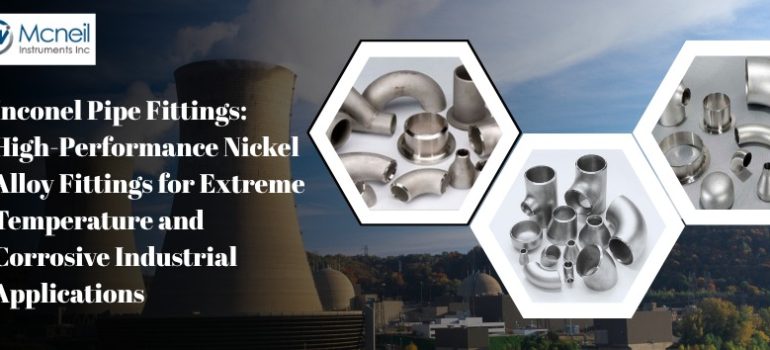
Mcneil Instruments banner showcasing Inconel pipe fittings, including elbows, tees, reducers, and end caps, designed for high-temperature and corrosive industrial applications.

Inconel Pipe Fittings: High-Performance Nickel Alloy Fittings for Extreme Temperature and Corrosive Industrial Applications

Introduction


Industrial piping systems used in oil & gas, petrochemical processing, offshore platforms, power generation, marine engineering, aerospace, and chemical manufacturing often operate under harsh conditions where high temperatures, corrosive media, and extreme pressure are constant challenges. Selecting the right pipe fittings is essential for ensuring safety, minimizing maintenance, and achieving long-term operational reliability.
Inconel Pipe Fittings are among the most dependable solutions for these demanding applications. Manufactured from nickel-chromium-based superalloys, they provide outstanding resistance to oxidation, carburization, pitting, crevice corrosion, chloride attack, and thermal fatigue while maintaining exceptional mechanical strength at elevated temperatures.
Mcneil Instruments is a trusted manufacturer, supplier, exporter, and stockist of Inconel Pipe Fittings, offering precision-engineered fittings manufactured to ASTM, ASME, ANSI, MSS, and DIN standards. With decades of manufacturing expertise and a strong global supply network, Mcneil Instruments delivers reliable piping solutions for critical industrial applications worldwide.

What Are Inconel Pipe Fittings?


Inconel Pipe Fittings are nickel alloy piping components designed to connect, redirect, branch, reduce, or terminate pipelines carrying corrosive chemicals, steam, hydrocarbons, process gases, and high-temperature fluids.
These fittings maintain their structural integrity even under continuous exposure to:

  • High temperatures
  • Aggressive chemicals
  • Oxidizing atmospheres
  • Marine environments
  • High-pressure systems
  • Thermal cycling
    Their excellent corrosion resistance and superior mechanical properties make them the preferred choice for mission-critical piping systems.

Benefits of Inconel Pipe Fittings


Industries worldwide choose Inconel Pipe Fittings because they provide:

  • Exceptional corrosion resistance
  • Excellent oxidation resistance
  • Outstanding creep resistance
  • High tensile and yield strength
  • Superior fatigue resistance
  • Excellent weldability
  • Long service life
  • Low maintenance requirements
    These properties improve plant reliability while reducing downtime and lifecycle costs.

Mcneil Instruments – Leading Manufacturer of Inconel Pipe Fittings


Mcneil Instruments manufactures and supplies a complete range of Inconel Pipe Fittings for high-performance industrial piping systems.
The product portfolio includes:

  • Inconel 600 Pipe Fittings
  • Inconel 601 Pipe Fittings
  • Inconel 625 Pipe Fittings
  • Inconel 718 Pipe Fittings
  • Inconel 725 Pipe Fittings
  • Inconel X750 Pipe Fittings
  • Inconel 800 Pipe Fittings
  • Inconel 800H Pipe Fittings
  • Inconel 800HT Pipe Fittings
  • Inconel Buttweld Pipe Fittings
  • Inconel Socket Weld Pipe Fittings
  • Inconel Threaded Pipe Fittings
  • Custom Inconel Pipe Fittings
    Mcneil Instruments manufactures fittings with precision machining, excellent dimensional accuracy, and strict quality control to ensure leak-free performance in demanding industrial environments.

Inconel 600 Pipe Fittings


Excellent Resistance to Heat and Corrosion


Inconel 600 is widely used where excellent oxidation resistance and high-temperature performance are required.
Applications

  • Chemical Processing
  • Heat Treatment Equipment
  • Nuclear Plants
  • Furnace Components
    Key Benefits
  • Excellent oxidation resistance
  • High-temperature stability
  • Good weldability
  • Long operating life

Inconel 625 Pipe Fittings


Outstanding Performance in Marine and Offshore Applications


Inconel 625 contains molybdenum and niobium, providing superior resistance to seawater corrosion and aggressive chemicals.
Applications

  • Offshore Platforms
  • Marine Systems
  • Petrochemical Plants
  • LNG Facilities
    Advantages
  • Excellent chloride resistance
  • High fatigue strength
  • Outstanding corrosion resistance

Inconel 718 Pipe Fittings


Exceptional Strength for Critical Pressure Systems


Inconel 718 is engineered for applications involving high pressure, elevated temperatures, and cyclic loading.
Applications

  • Aerospace
  • Gas Turbines
  • Power Plants
  • High-Pressure Process Lines
    Features
  • Excellent creep resistance
  • High tensile strength
  • Superior fatigue performance

Inconel 725 Pipe Fittings


Ideal for Sour Oil & Gas Service


Inconel 725 offers excellent resistance to stress corrosion cracking and harsh offshore environments.
Applications

  • Offshore Oil & Gas
  • Subsea Equipment
  • Chemical Injection Systems

Inconel 800, 800H & 800HT Pipe Fittings


Reliable Long-Term High-Temperature Performance


These grades are designed for prolonged service under elevated temperatures.
Benefits

  • Excellent oxidation resistance
  • Outstanding creep strength
  • Superior structural stability
    Applications
  • Boilers
  • Steam Pipelines
  • Heat Exchangers
  • Petrochemical Plants

Types of Inconel Pipe Fittings


Mcneil Instruments manufactures a comprehensive range of industrial pipe fittings.


Elbows


Available in:

  • 45° Elbows
  • 90° Elbows
  • 180° Return Bends

Tees

  • Equal Tees
  • Reducing Tees

Reducers

  • Concentric Reducers
  • Eccentric Reducers

End Caps
Used for safely terminating pipeline ends.

Stub Ends
Designed for use with lap joint flange assemblies.

Couplings & Unions
Provide secure and leak-free pipe connections.

Socket Weld Pipe Fittings
Recommended for compact, high-pressure piping systems.

Threaded Pipe Fittings
Suitable where welding is not practical.

Buttweld Pipe Fittings
Preferred for large-diameter pipelines requiring permanent welded joints.

Technical Specifications


Parameter Specification
Product Inconel Pipe Fittings
Standards ASTM B366 / ASME SB366
Grades 600, 601, 625, 718, 725, X750, 800, 800H, 800HT
Types Elbows, Tees, Reducers, Caps, Stub Ends, Couplings, Unions
Construction Buttweld, Socket Weld, Threaded
End Connections Beveled, Threaded, Socket Weld
Applications Oil & Gas, Marine, Chemical, Aerospace, Power

Industrial Applications


Mcneil Instruments Inconel Pipe Fittings are widely used in:


Oil & Gas

  • Refineries
  • Offshore Platforms
  • LNG Plants

Petrochemical Industry

  • Process Units
  • Reactor Systems
  • High-Temperature Pipelines

Chemical Processing

  • Acid Handling Systems
  • Corrosive Fluid Transfer
  • Heat Exchanger Networks

Marine Industry

  • Shipbuilding
  • Seawater Cooling Systems
  • Offshore Structures

Aerospace

  • Engine Components
  • Fuel Systems
  • Exhaust Assemblies

Power Generation

  • Boilers
  • Steam Pipelines
  • Turbine Installations

Quality Assurance


Every Inconel Pipe Fitting manufactured by Mcneil Instruments undergoes rigorous quality inspections, including:

  • PMI Testing
  • Hydrostatic Testing
  • Mechanical Testing
  • Chemical Analysis
  • Ultrasonic Testing
  • Dimensional Inspection
  • Hardness Testing
  • Visual Inspection
  • Material Traceability Verification
  • Third-Party Inspection
    These inspection procedures ensure compliance with international quality standards before every shipment.

Why Choose Mcneil Instruments?


Customers worldwide rely on Mcneil Instruments because of:

  • Complete range of Inconel grades
  • ASTM and ASME compliant manufacturing
  • Advanced production facilities
  • Premium-quality raw materials
  • Strict quality assurance
  • Customized engineering solutions
  • Ready stock for fast deliveries
  • Global export capability
  • Dedicated technical support
    With nearly four decades of engineering expertise, Mcneil Instruments continues to supply high-performance piping solutions that meet the requirements of critical industrial projects worldwide.

Conclusion


For applications involving extreme temperatures, aggressive chemicals, high pressure, and corrosive process environments, Inconel Pipe Fittings provide unmatched durability, mechanical strength, and corrosion resistance. Their outstanding performance makes them indispensable for industries where reliability and safety cannot be compromised.
Whether your project requires Inconel 600 Pipe Fittings, Inconel 601 Pipe Fittings, Inconel 625 Pipe Fittings, Inconel 718 Pipe Fittings, Inconel 725 Pipe Fittings, Inconel X750 Pipe Fittings, Inconel 800 Pipe Fittings, Inconel 800H Pipe Fittings, Inconel 800HT Pipe Fittings, Elbows, Tees, Reducers, End Caps, Stub Ends, Socket Weld Pipe Fittings, Threaded Pipe Fittings, or Buttweld Pipe Fittings, Mcneil Instruments delivers precision-engineered products manufactured to international standards for dependable performance across the world’s most demanding industrial applications.

Read More

Best Inconel Exporter in USA – Mcneil Instruments Inc

1. Introduction: Leading Inconel Exporter in the USA

Mcneil Instruments Inc is a leading manufacturer and exporter specializing in high-quality Inconel products.

With 37 years of expertise in product development, designing, production, management and quality control of industry experience, the company has established itself as a reliable supplier for global clients seeking durable and high-performance materials.

Key Highlights

  • Extensive expertise in Inconel manufacturing
  • Strong global export network
  • Commitment to quality and precision
  • Customer-focused approach

2. What is Inconel and Why is it in High Demand?

Inconel is a family of nickel-based superalloys designed to withstand extreme heat, pressure, and corrosion. Its unique composition—primarily nickel combined with chromium and other elements—makes it highly resistant to oxidation and mechanical stress.

Key Properties of Inconel

Exceptional heat resistance: Performs reliably at temperatures exceeding 1000°C

Corrosion resistance: Ideal for marine and chemical environments

High strength: Maintains structural integrity under pressure

Creep resistance: Prevents deformation over time

3. Inconel Grades Available – Mcneil Instruments

Mcneil Instruments Inc supplies a wide range of Inconel grades tailored for specific applications:

Key Inconel Grades Available:

Inconel 600 (UNS N06600): Known for high heat and corrosion resistance, suitable for chemical plant components.

Inconel 625 (UNS N06625): Offers superior strength, crevice corrosion resistance, and is widely used for high-pressure applications.

Inconel 718: A precipitation-hardened alloy providing high tensile and creep strength up to 650°C, common in aerospace.

Inconel 725: Provides high mechanical strength after age hardening, with corrosion resistance similar to 625.

Inconel 800 / 800H: Iron-nickel-chromium alloys designed for high-temperature structural stability.

Product Offerings & Specifications:

Fittings: Inconel 600, 625, 718 tube fittings for high-pressure and corrosive environments.

Pipes/Tubes: Available in various sizes and specifications, including ASTM B366 and ASME SB366 for fittings.

Valves: Instrument ball valves and other valves manufactured in 600, 625, 800, and 825 alloys.

Customization:  Custom sizes and specifications are available upon request.

4. Industries Served – Mcneil Instruments

Mcneil Instruments Inc caters to a wide range of industries, including:

  • Oil & Gas: Pipelines, offshore systems, and drilling equipment
  • Aerospace: Engine components and high-temperature systems
  • Chemical Processing: Reactors and heat exchangers
  • Power Generation: Gas turbines and nuclear systems
  • Marine and Offshore: Corrosion-resistant equipment

5. Types of Inconel Tube Fittings by Mcneil Instruments Inc

 provides a wide selection of high-quality fittings engineered for reliability, safety, and precision across demanding industrial applications.

Compression Tube Fittings
These fittings are designed to ensure secure, leak-proof connections in gas and fluid systems. They are easy to install, require minimal maintenance, and deliver dependable performance over time.

Elbow Tee, and Union Fittings
Ideal for controlling flow direction, these fittings are built to handle high-pressure environments. Their robust construction ensures long-lasting durability even under extreme operating conditions.

Instrumentation Tube Fittings
Engineered for accuracy, these fittings are essential for sensitive control systems. They are commonly used in critical industrial instrumentation where precision and consistency are vital.

6. Why Importers from USA choose Mcneil Instruments Inc as their Export Partner?

Choosing the right exporter can make a significant difference in project success. Mcneil Instruments offers several advantages:

  • Consistent Quality: High-grade materials with precise specifications
  • Competitive Pricing: Value-driven solutions without compromising quality
  • Timely Delivery: Efficient logistics and supply chain management
  • Technical Expertise: Guidance for selecting the right materials

7. Global Export Markets – Mcneil Instruments Inc

Mcneil Instruments has a strong presence in International markets, we can Export Inconel products to regions such as:

Saudi ArabiaUSA  KuwaitNetherlandsIranBahrainQatar
     UAE               Africa               AustraliaAbu DhabiUKColombiaArgentina
South AfricaLondonYemenHong KongVietnamEgyptMalaysia
SingaporeVenezuelaMexicoNew YorkTurkeyIndonesiaRussia
EthiopaPeruUgandaKazakhstanGhanaBahrainIran
YaoundaLuandaTobagoTrinidadOmanAngolaOther

8. Customization and Engineering Capabilities – Mcneil Instruments Inc

Every project has unique requirements, and Mcneil Instruments excels in delivering customized solutions.

Services Include

  • Tailor-made Quotation
  • Project-specific manufacturing
  • Technical consultation and support
  • Quick response to inquiries
  • Long-term relationship management
  • Consistent product quality

9. How to Place an Order at Mcneil Instruments Inc

Ordering from Mcneil Instruments is simple and efficient:

  1. Submit your inquiry with specifications at info@mcneilinstruments.com / +91 9870883613
  2. Receive a detailed quotation
  3. Confirm order and documentation
  4. Track production and delivery
  5. Items Delivered at Your Door Steps

10. Conclusion: Mcneil Instruments Your Trusted Inconel Exporter

When it comes to sourcing high-quality Inconel products, Mcneil Instruments stands out as a reliable and experienced partner. From a wide product range and multiple grades to global export capabilities and strong customer support, the company delivers value at every stage.

Whether you operate in aerospace, oil & gas, or chemical processing, choosing the right exporter is critical. With its proven track record and commitment to excellence, Mcneil Instruments is well-positioned to meet your needs for high-performance Inconel solutions.

Looking for a trusted Inconel supplier?


Contact Mcneil Instruments today for high-quality, precision-engineered solutions tailored to your requirements.

Read More