Air Header in Phoenix: Efficient Compressed Air Distribution for Industrial Systems
Introduction: Why Air Headers Are Essential in Industrial Operations
In any facility running pneumatic systems, compressed air is a core utility. The challenge isn’t just generating air—it’s distributing it efficiently across multiple instruments without pressure loss or system clutter.
That’s where an air header becomes essential. It creates a centralized distribution system that keeps airflow stable, organized, and easy to manage.
In Phoenix, where industries like manufacturing, water treatment, energy, and construction operate in demanding conditions, air headers play a key role in ensuring reliable and efficient pneumatic operations.
What Is an Air Header?
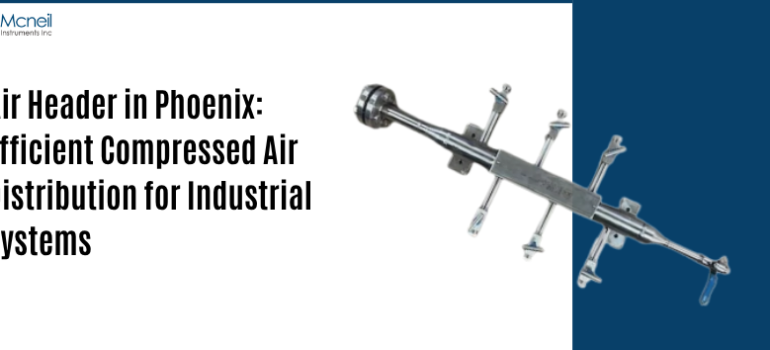
An air header is a distribution manifold that supplies compressed air from a single inlet to multiple outlets across a facility.
Think of it as a central hub—it receives air from one source and distributes it evenly to different instruments, valves, and equipment.
How It Works
• Compressed air enters through a single inlet
• Air flows through a manifold body
• Multiple outlet valves distribute air to systems
• Maintains consistent pressure across all connections
This setup helps avoid pressure drops and improves system efficiency.
Key Components of an Air Header
An air header is more than just a pipe—it’s a complete distribution unit designed for control and efficiency.
Main Components
• Header Pipe (Manifold) – central distribution unit
• Inlet Connection – receives compressed air
• Multiple Outlet Valves – typically 4 to 20 outlets
• Drain Valve – removes moisture or condensate
• Mounting Structure – wall or floor installation
Each component ensures smooth and controlled air distribution.
Types of Air Headers
Different applications require different configurations.
Instrument Air Header
• Supplies clean, dry air to instruments
• Used in process industries
Distribution Air Header
• Used for general compressed air supply
• Supports multiple tools and systems
Wall-Mounted Air Header
• Compact and space-saving
• Suitable for smaller installations
Stand-Mounted Air Header
• Used in large industrial setups
• Easier access for maintenance
Materials Used in Air Headers
Material selection depends on environment, pressure, and corrosion exposure.
Common Materials
| Material | Application |
| Stainless Steel (SS 304 / 316) | Corrosive and hygienic environments |
| Carbon Steel | General industrial use |
| Alloy Steel | High-pressure applications |
Stainless steel is ideal for clean or corrosive environments, while carbon steel is widely used in heavy industries.
Technical Specifications of Air Headers
| Specification | Details |
| Inlet Size | ½″ to 3″ |
| Outlet Connections | 4 to 20 outlets |
| Pressure Rating | Up to 1000 PSI |
| Connection Type | Threaded / Flanged |
| Valve Type | Ball Valve / Needle Valve |
| Mounting | Wall / Floor Mounted |
These specifications ensure compatibility with different industrial systems.
Key Advantages of Air Headers
Centralized Air Distribution
Simplifies piping layout and reduces system complexity.
Consistent Pressure Supply
Ensures all instruments receive stable airflow.
Reduced Leakage and Pressure Loss
Minimizes inefficiencies caused by long pipelines.
Easy Maintenance and Control
Allows isolation of individual lines without shutting down the system.
Cost and Space Efficiency
Reduces installation cost and saves space.
Industrial Applications of Air Headers in Phoenix
Phoenix has a strong industrial base, and air headers are widely used across multiple sectors.
Manufacturing Industry
Used in automation systems and pneumatic tools.
Water Treatment Plants
Controls valves and instrumentation systems.
Energy and Power Plants
Supports turbines, boilers, and control systems.
Chemical and Process Industries
Ensures safe and controlled air supply to instruments.
Construction and Infrastructure
Used in HVAC systems and pneumatic operations.
Air headers are essential wherever controlled and reliable compressed air distribution is required.
How to Choose the Right Air Header
Here’s what actually matters when selecting one:
• Material – based on environment and corrosion exposure
• Number of outlets – depends on system size
• Pressure rating – must match operating conditions
• Valve type – for precision control
• Mounting style – wall or floor
Choosing the right configuration ensures long-term performance.
Quality Testing of Air Headers
To ensure reliability and safety, air headers undergo strict testing:
• Hydrostatic pressure testing
• Leak testing
• Material verification (PMI)
• Dimensional inspection
• Functional valve testing
These checks ensure consistent performance in industrial environments.
Conclusion
Air headers are a critical part of modern pneumatic systems, offering a centralized, efficient, and reliable way to distribute compressed air.
In Phoenix, where industries demand consistency and operational efficiency, air headers help streamline systems, reduce downtime, and improve productivity.
With their ability to provide stable pressure, organized distribution, and easy maintenance, air headers remain an essential component in industrial infrastructure.