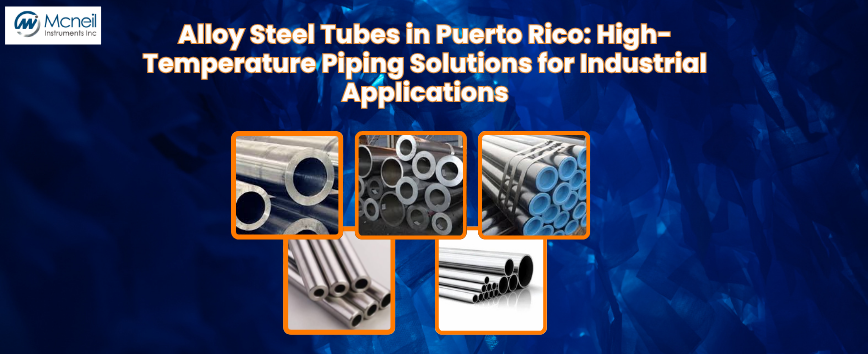
Introduction: Why Alloy Steel Tubes Are Essential in Industrial Systems
In industries where pipelines operate under extreme heat, pressure, and continuous load, material performance becomes critical. Standard steel tubes often fail under such conditions, leading to costly downtime and safety risks.
This is where alloy steel tubes come into play. Designed with elements like chromium and molybdenum, these tubes offer high strength, excellent creep resistance, and superior performance in high-temperature environments.
In Puerto Rico, industries such as pharmaceuticals, power generation, chemical processing, and manufacturing rely on alloy steel tubes for reliable heat transfer, pressure handling, and long-term durability in demanding applications.
What Are Alloy Steel Tubes?
Alloy steel tubes are hollow cylindrical components made by adding alloying elements like chromium, molybdenum, nickel, or vanadium to carbon steel. These additions enhance strength, corrosion resistance, and thermal stability.
They are typically manufactured according to ASTM A213 / ASME SA213 standards, which define seamless alloy steel tubes used in high-temperature and pressure applications.
Key Characteristics
• Seamless construction for high pressure resistance
• Designed for boilers, heat exchangers, and superheaters
• Suitable for extreme temperature environments
• Available in multiple grades like T5, T9, T11, T22, T91
These tubes are widely used in industries requiring reliable performance under thermal stress.
Chemical Composition of Alloy Steel Tubes
The enhanced performance of alloy steel tubes comes from their carefully controlled chemical composition.
Common Alloying Elements
| Element | Function |
| Chromium (Cr) | Improves oxidation and corrosion resistance |
| Molybdenum (Mo) | Enhances high-temperature strength |
| Carbon (C) | Provides hardness and strength |
| Manganese (Mn) | Improves toughness |
| Silicon (Si) | Enhances oxidation resistance |
Chrome-moly alloys used in ASTM A213 tubes are known for their strength and resistance to creep and oxidation at elevated temperatures.
Mechanical Properties of Alloy Steel Tubes
Alloy steel tubes are engineered to maintain structural integrity under extreme conditions.
| Property | Typical Value |
| Tensile Strength | ≥ 415 MPa |
| Yield Strength | ≥ 205 MPa |
| Heat Resistance | Up to ~750°C |
| Creep Resistance | Excellent |
These properties make them ideal for long-term use in high-pressure and high-temperature systems.
Key Advantages of Alloy Steel Tubes
High Temperature Performance
Designed for boilers, superheaters, and heat exchangers operating under extreme heat.
Superior Strength and Durability
Maintains mechanical integrity under pressure and stress.
Excellent Creep Resistance
Prevents deformation during prolonged high-temperature exposure.
Oxidation and Corrosion Resistance
Chromium content protects against environmental damage.
Long Service Life
Reduces maintenance and replacement costs in industrial systems.
Technical Specifications of Alloy Steel Tubes
| Specification | Details |
| Standard | ASTM A213 / ASME SA213 |
| Grades | T5, T9, T11, T22, T91 |
| Tube Type | Seamless Alloy Steel Tube |
| Size Range | ½″ to 5″ OD |
| Wall Thickness | 0.4 mm to 12.7 mm |
| Manufacturing Process | Hot Rolled / Cold Drawn |
ASTM A213 tubes are specifically designed for boilers, heat exchangers, and high-pressure applications.
Industrial Applications of Alloy Steel Tubes in Puerto Rico
Puerto Rico has a strong industrial base, especially in pharmaceuticals, energy, and manufacturing. These industries require reliable piping systems that can withstand demanding conditions.
Power Generation Plants
Used in boilers, superheaters, and steam pipelines.
Pharmaceutical Industry
Ensures clean and durable piping systems for sensitive processes.
Chemical Processing Plants
Handles high-temperature and corrosive fluids.
Oil and Gas Industry
Used in refining and processing systems.
Heat Exchangers and Condensers
Ensures efficient heat transfer and durability.
Alloy steel tubes are widely used in heat exchangers, condensers, and pressure equipment due to their strength and thermal resistance.
Major Alloy Steel Tube Grades
ASTM A213 T5 Tubes
T5 tubes offer good oxidation resistance and are suitable for moderate high-temperature applications.
Applications
• Refineries
• Chemical plants
• Industrial piping
ASTM A213 T9 Tubes
T9 tubes provide enhanced resistance to heat and corrosion.
Applications
• Petrochemical plants
• High-temperature systems
ASTM A213 T11 Tubes
A widely used grade with good strength and thermal performance.
Key Characteristics
• High durability
• Good wear resistance
• Reliable performance
Applications
• Boilers
• Heat exchangers
• Power plants
ASTM A213 T22 Tubes
Known for excellent creep resistance and high-pressure handling.
Applications
• Steam pipelines
• Pressure vessels
• Power plants
ASTM A213 T91 Tubes
Advanced alloy steel designed for extreme temperature environments.
Key Characteristics
• Exceptional creep strength
• High thermal stability
• Long service life
Applications
• Thermal power plants
• Nuclear facilities
• High-pressure systems
Comparison of Alloy Steel Tube Grades
| Grade | Alloy Composition | Key Advantage | Typical Applications |
| T5 | Cr-Mo alloy | Oxidation resistance | Refineries |
| T9 | High chromium | Heat resistance | Petrochemical plants |
| T11 | 1.25Cr-0.5Mo | Strength & durability | Boilers |
| T22 | 2.25Cr-1Mo | Creep resistance | Power plants |
| T91 | Advanced Cr-Mo | Extreme temperature performance | Energy sector |
Quality Testing of Alloy Steel Tubes
To ensure safety and performance, alloy steel tubes undergo strict quality control procedures:
• Chemical composition testing
• Mechanical strength testing
• Hydrostatic pressure testing
• Ultrasonic testing
• Radiographic inspection
• Positive Material Identification (PMI)
• Dimensional inspection
These tests ensure compliance with international standards and reliable industrial performance.
Conclusion
Alloy steel tubes (ASTM A213 T5, T9, T11, T22, T91) are essential for industries operating under extreme temperature and pressure conditions. Their chromium-molybdenum composition provides excellent strength, corrosion resistance, and thermal stability.
In Puerto Rico, industries such as pharmaceuticals, power generation, and chemical processing depend on alloy steel tubes for efficient and safe operations.
With their ability to perform in harsh environments and deliver long-term reliability, alloy steel tubes remain a critical component in modern industrial piping systems.