Introduction: The Heart of Efficient Compressed Air Distribution
In modern industrial environments, compressed air is a critical utility — powering pneumatic tools, control systems, instrumentation, automation lines, and process machines. However, compressed air systems are only as efficient as their distribution networks. One component stands out for ensuring smooth, balanced airflow across multiple branch lines: the Air Header.
An air header is more than just a manifold. It is an engineered distribution assembly that consolidates compressed air from a compressor or storage vessel and delivers it to various downstream points with controlled pressure, minimized drop, and balanced flow. Whether in manufacturing plants, chemical processing units, power generation facilities, or food and beverage operations, air headers play a vital role in operational efficiency.
As a trusted manufacturer, supplier, and exporter, Mcneil Instruments offers high-quality air headers engineered for industrial precision, pressure stability, and long-term reliability. This blog provides a detailed look at what air headers are, how they are specified, where they are used, and why they are essential for industrial compressed air systems.
What Is an Air Header?
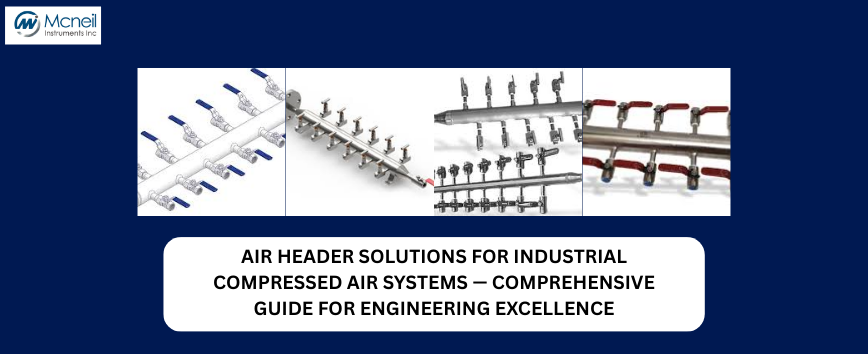
An air header is a pipe or manifold assembly designed to distribute compressed air from a central source to multiple points of use. It acts as a central junction where:
- Compressed air lines are joined
- Flow is balanced across branches
- Pressure drop is minimized
- Moisture and condensate can be managed
Unlike simple tees or manifolds, industrial air headers are engineered assemblies often incorporating:
- Pressure gauges
- Drain valves
- Isolation valves
- Flow control elements
- Properly sized headers to prevent shock, noise, or turbulence
By consolidating flows in a stable and predictable way, air headers enhance system performance and protect downstream equipment.
Why Air Headers Are Critical in Industrial Systems
Compressed air underpins many industrial processes, but misuse or poorly designed distribution can lead to:
- Pressure imbalances across workstations
- Higher energy costs due to inefficient flow
- Increased wear on pneumatic tools
- Moisture and condensate buildup
- Unplanned downtime
Air headers address these challenges by:
Balancing Pressure and Flow
In systems where multiple users draw air simultaneously, pressure fluctuations can cause inconsistencies in tool performance, control systems, and instrument accuracy. An air header stabilizes pressure by acting as a reservoir and distribution node.
Reducing Pressure Drop
Correctly sized headers limit excessive pressure drop across distances, ensuring that the delivered pressure at the point of use is as intended.
Managing Condensate
Moisture carried with compressed air can damage downstream components. Headers often integrate drip legs and drain valves to collect and remove condensate effectively.
Improving Equipment Life
Balanced, clean, and dry air reduces stress on actuators, valves, instruments, air motors, and other pneumatic devices — extending their service life.
Key Features of Mcneil Instruments Air Headers
Mcneil Instruments ’s air headers are engineered for industrial environments with the following design and performance considerations:
Precision Machining
Headers are fabricated with high dimensional accuracy to ensure consistent airflow and pressure stability.
Robust Material Selection
Constructed from carbon steel or stainless steel depending on application and corrosion resistance needs.
High Pressure Ratings
Designed to withstand industrial compressed air pressures with safety margins.
Iso and ANSI Compliance
Manufactured per international standards ensuring compatibility and safety in global applications.
Drain and Control Integration
Provision for automatic or manual drains, pressure gauges, and isolation valves for maintenance and control.
Technical Specifications — Industrial Air Header
| Specification | Details |
| Material | Carbon Steel / Stainless Steel |
| Standard | ISO, ANSI / ASME |
| End Connections | Butt Weld, Socket Weld, Threaded |
| Size Range | Custom — typically 1/2″ to 12″ OD |
| Pressure Rating | Up to 6000 psi (grade dependent) |
| Temperature Range | -20°C to +200°C (depending on material) |
| Surface Finish | Painted, Pickled, Passivated |
| Testing | Hydrostatic / Pneumatic / NDT |
These specifications can be tailored to project requirements — whether for manufacturing lines, offshore facilities, or energy systems.
How Air Headers Are Designed
Designing an air header is not simply a matter of joining pipes. It considers:
Flow Requirements
Determining the total compressed air demand in cubic feet per minute (CFM) or equivalent metric units.
Pressure Levels
Specifying maximum working pressure and ensuring headers maintain target pressure at all outlets.
Condensate Management
Inclusion of drain points at low spots to remove moisture and prevent water hammer or corrosion.
Line Balancing
Ensuring uniform flow distribution to all downstream branches to avoid bottlenecks.
Safety Standards
Adhering to industrial codes for pressure vessel design, wall thickness, and safety valves where required.
Mcneil Instruments ’s expert engineering teams assist with design validation and specification optimization based on plant needs.
Advantages of Using Engineered Air Headers
Industrial customers choose engineered air headers over ad-hoc piping assemblies due to:
Operational Efficiency
Balanced distribution leads to consistent tool performance and process control.
Energy Savings
Reduced pressure drop means compressors work less hard to maintain required pressure — lowering energy costs.
Lower Maintenance
Integration of drains and control valves reduces water-related wear and pneumatic line blockages.
Safety and Compliance
Manufacturing per standards ensures compliance with safety norms and reduces the risk of failures.
Modular Scalability
Header systems can be expanded or modified as plant demand grows or changes.
Applications Across Industries
Air headers find use in a broad range of industrial sectors:
Manufacturing & Assembly Lines
Automotive assembly, stamping, packaging, and tooling operations with multiple pneumatic zones.
Chemical and Petrochemical Plants
Compressors feed multiple control valves, actuators, and instrumentation requiring consistent air quality and pressure.
Oil & Gas & Offshore Platforms
Header systems distribute air for instrumentation, valve actuation, and maintenance tools on rigs and plants.
Power Generation
Compressed air headers are used for turbine control systems, valve actuation, instrumentation, and maintenance services.
Food & Beverage Processing
Air headers support pneumatic filling, cleaning systems, control valves, and automation while maintaining hygiene standards.
Pharmaceutical & Electronics
Ultra-clean air headers integration with dryers and filters deliver controlled air quality for sensitive processes.
Installation, Maintenance, and Best Practices
Installing and maintaining air headers ensures system longevity and performance:
Proper Sizing
Ensure header diameter and length are sized to handle peak flow without excessive pressure drop.
Positioning of Drains
Locate drains at the lowest points to effectively capture condensate and prevent accumulation.
Isolation Valves
Include isolation valves on each outlet for ease of maintenance without disrupting the entire system.
Regular Inspection
Periodic checks for leaks, corrosion, and valve operation will sustain performance.
Integration with Filtration and Drying
Combine headers with filters and dryers upstream to improve air quality and remove moisture before distribution.
Why Choose Mcneil Instruments as Your Air Header Partner
Manufacturing Excellence
Headers are precision-engineered using quality materials and tight tolerances, ensuring performance in demanding industrial environments.
Comprehensive Product Range
From standard headers for shop floors to customized solutions for specialized systems, options are available for diverse requirements.
Global Supply and Documentation
As a manufacturer, supplier, and exporter, Mcneil Instruments supports global projects with complete documentation — including test certificates, material traceability, and export compliance.
Technical Support
Expert guidance is provided during specification, design review, installation, and maintenance planning — helping engineering teams make informed decisions.
Certified Quality
Adherence to ISO 9001:2015 and other relevant industrial standards strengthens reliability and reduces audit risk.
Conclusion: A Smart Investment for Industrial Pneumatic Systems
Air headers are essential components of industrial compressed air distribution systems. When engineered correctly, they stabilize pressure, balance flow, manage condensate, and extend the life of pneumatic systems. For manufacturing plants, oil & gas facilities, power stations, and process industries, the right air header plays a key role in operational uptime and efficiency.
As a leading air header manufacturer, supplier, and exporter, Mcneil Instruments combines engineering expertise with a commitment to quality and standards compliance — delivering solutions that support performance, safety, and long-term reliability across industrial applications.