Hastelloy Pipe Fittings in Singapore: High-Performance Nickel Alloy Solutions for Corrosive Industrial Environments
Introduction: Why Hastelloy Pipe Fittings Are Essential in Critical Industries
In industries where pipelines are exposed to highly corrosive chemicals, extreme temperatures, and aggressive process conditions, standard materials simply don’t last. Failures in such environments can lead to costly downtime and safety risks.
This is where Hastelloy pipe fittings stand out. These fittings are made from advanced nickel-based alloys designed to handle corrosion, oxidation, and high-temperature stress without compromising performance.
In a highly industrialized hub like Singapore, where petrochemical refining, offshore engineering, and chemical processing dominate, Hastelloy pipe fittings are widely used for their unmatched reliability in harsh environments.
Grades like Hastelloy C276, C22, B2, and C2000 are commonly used across industries due to their excellent resistance to acids, seawater, and chemical reactions.
What Are Hastelloy Pipe Fittings?
Hastelloy pipe fittings are corrosion-resistant piping components used to connect, control, or redirect flow in industrial piping systems. These fittings are manufactured from nickel-based alloys that provide exceptional resistance to chemical attack and high temperatures.
They are typically produced according to ASTM B366 / ASME SB366 standards, ensuring high performance in demanding industrial applications.
Common Types of Hastelloy Pipe Fittings
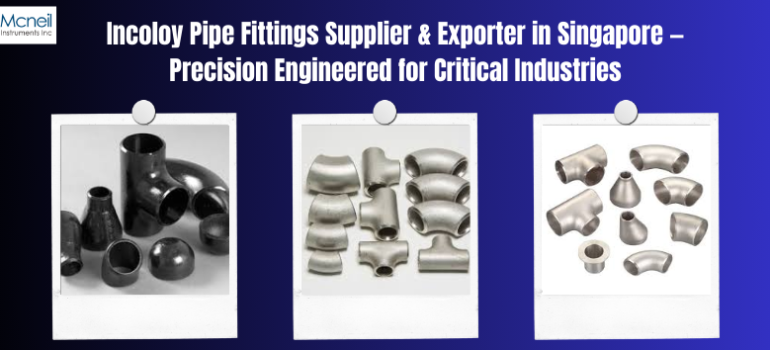
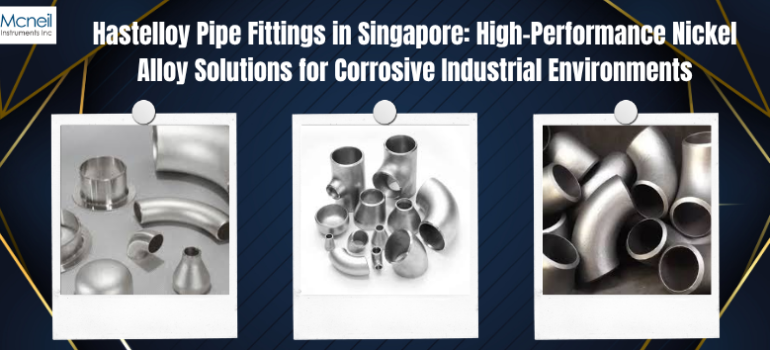
• Elbows – change flow direction
• Tees – split or combine flow
• Reducers – connect different pipe sizes
• Caps – seal pipe ends
• Stub Ends – used with lap joint flanges
• Cross fittings – connect multiple pipelines
These fittings are available in seamless, welded, and fabricated forms for different industrial requirements.
What Makes Hastelloy Unique?
Hastelloy is a nickel-chromium-molybdenum alloy designed for extreme environments. Its composition gives it superior resistance to:
• Pitting and crevice corrosion
• Stress corrosion cracking
• Oxidizing and reducing environments
Unlike conventional stainless steel, Hastelloy performs reliably in highly acidic and chemical-rich environments, making it a preferred choice in critical industries.
Chemical Composition of Hastelloy Pipe Fittings
The strength and corrosion resistance of Hastelloy come from its alloying elements.
Typical Elements
| Element | Function |
| Nickel (Ni) | Base element providing corrosion resistance |
| Chromium (Cr) | Improves oxidation resistance |
| Molybdenum (Mo) | Enhances resistance to chemical corrosion |
| Iron (Fe) | Adds structural stability |
| Tungsten (W) | Improves strength in some grades |
For example, Hastelloy C276 contains significant amounts of chromium and molybdenum, which provide resistance to a wide range of corrosive environments.
Mechanical Properties of Hastelloy Pipe Fittings
Hastelloy alloys are known for their strong mechanical performance even under extreme conditions.
| Property | Typical Value |
| Tensile Strength | ≥ 790 MPa |
| Yield Strength | ≥ 355 MPa |
| Density | ~8.9 g/cm³ |
| Melting Point | ~1325–1370°C |
These properties allow Hastelloy pipe fittings to maintain structural integrity in high-temperature and high-pressure environments.
Key Advantages of Hastelloy Pipe Fittings
Exceptional Corrosion Resistance
Hastelloy alloys resist strong acids, chlorides, and chemical environments.
High Temperature Stability
Maintains strength and oxidation resistance at elevated temperatures.
Resistance to Stress Corrosion Cracking
Performs well under mechanical stress and corrosive conditions.
Excellent Weldability
Can be welded without losing corrosion resistance properties.
Long Service Life
Reduces maintenance and replacement costs in industrial systems.
Hastelloy fittings are widely used in demanding environments because they resist corrosion, cracking, and chemical damage.
Technical Specifications of Hastelloy Pipe Fittings
| Specification | Details |
| Standard | ASTM B366 / ASME SB366 |
| Grades | C276, C22, B2, C2000 |
| Size Range | ½″ to 48″ |
| Wall Thickness | SCH 5 to SCH XXS |
| Manufacturing Type | Seamless / Welded / Fabricated |
| Pressure Standard | ASME B16.9 / B16.11 |
These fittings are designed to meet global industrial standards and ensure compatibility with piping systems worldwide.
Industrial Applications of Hastelloy Pipe Fittings in Singapore
Singapore is a global hub for petrochemicals, offshore engineering, and advanced manufacturing. Industries here require materials that can withstand aggressive environments.
Petrochemical Industry
Used in pipelines handling corrosive chemicals and acids.
Oil and Gas Sector
Essential for offshore platforms and refinery piping systems.
Chemical Processing Plants
Handles highly reactive and corrosive substances safely.
Marine and Offshore Applications
Provides resistance to seawater and saline environments.
Pharmaceutical Industry
Ensures contamination-free and corrosion-resistant systems.
Hastelloy fittings are widely used in oil & gas, chemical processing, and offshore industries due to their durability and corrosion resistance.
Major Hastelloy Pipe Fitting Grades
Hastelloy C276 Pipe Fittings
One of the most widely used grades with excellent resistance to corrosion and oxidation.
Key Characteristics
• Resistant to pitting and crevice corrosion
• Performs well in both oxidizing and reducing environments
• High mechanical strength
Applications
• Chemical processing
• Oil & gas pipelines
• Heat exchangers
Hastelloy C22 Pipe Fittings
Known for superior resistance to oxidizing chemicals.
Applications
• Chemical reactors
• Pollution control systems
• Acid processing plants
Hastelloy B2 Pipe Fittings
Designed for reducing environments and resistance to hydrochloric acid.
Applications
• Chemical processing
• Acid handling systems
Hastelloy C2000 Pipe Fittings
Provides improved corrosion resistance in mixed chemical environments.
Applications
• Advanced chemical processing
• Industrial piping systems
Comparison of Hastelloy Grades
| Grade | Key Alloy Element | Key Advantage | Typical Applications |
| C276 | Ni-Cr-Mo | Excellent overall corrosion resistance | Chemical & oil industries |
| C22 | Ni-Cr-Mo | Superior oxidation resistance | Acid processing |
| B2 | Ni-Mo | Strong resistance to reducing acids | Chemical plants |
| C2000 | Ni-Cr-Mo-Cu | Enhanced versatility | Mixed chemical environments |
Quality Testing of Hastelloy Pipe Fittings
To ensure reliability and compliance, these fittings undergo strict quality checks.
Common Testing Methods
• Chemical composition testing
• Mechanical strength testing
• Hydrostatic pressure testing
• Ultrasonic testing
• Radiographic inspection
• Positive Material Identification (PMI)
• Dimensional inspection
These tests ensure the fittings meet international standards and perform reliably in critical applications.
Conclusion
Hastelloy pipe fittings are among the most advanced solutions for industrial piping systems exposed to extreme corrosion and temperature conditions. Their nickel-based composition provides unmatched resistance to chemical attack, oxidation, and mechanical stress.
In Singapore, where industries like petrochemicals, offshore energy, and chemical manufacturing demand high-performance materials, Hastelloy pipe fittings are a trusted choice for long-lasting and reliable piping systems.
With multiple grades like C276, C22, B2, and C2000, these fittings offer flexibility, durability, and superior performance—making them essential for modern industrial applications.