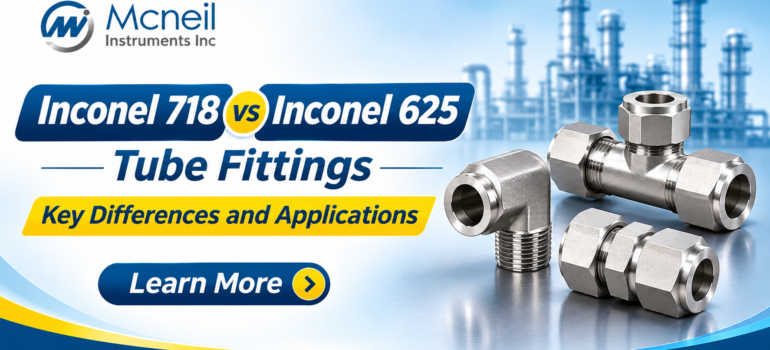
Inconel 718 vs Inconel 625 Tube Fittings: Key Differences and Applications – Mcneil Instruments
Introduction
Selecting the right material for tube fittings is essential in industries where components are exposed to high temperatures, pressure, corrosive chemicals, and demanding operating conditions. Inconel alloys are widely used in such environments because of their excellent mechanical strength, oxidation resistance, and ability to perform under extreme service conditions.
Among the different nickel-based superalloys, Inconel 718 and Inconel 625 are two popular choices for industrial applications. Both alloys offer excellent corrosion resistance and high-temperature performance, but they differ in chemical composition, mechanical strength, heat treatment requirements, and application suitability.
Inconel 625 is primarily known for its outstanding corrosion resistance and resistance to oxidation, making it suitable for marine, chemical processing, offshore, and oil and gas applications. Inconel 718, on the other hand, is a precipitation-hardening nickel-based alloy known for its exceptionally high strength and fatigue resistance, particularly in high-pressure and high-temperature environments.
For manufacturers, engineers, and procurement professionals sourcing high-performance tube fittings, understanding these differences helps ensure better material selection, operational reliability, and long-term performance.
At Mcneil Instruments, we understand the importance of selecting suitable materials for industrial instrumentation and fluid control systems. In this blog, we explore the differences between Inconel 718 and Inconel 625 tube fittings, including their properties, corrosion resistance, advantages, and industrial applications.
What Are Inconel Tube Fittings?
Inconel tube fittings are specialized connectors manufactured using nickel-based superalloys. They are designed to connect tubing in industrial systems where conventional stainless steel materials may not provide the required performance.
These fittings are commonly used in high-pressure instrumentation systems, chemical processing facilities, offshore installations, power plants, and oil and gas operations.
Depending on the application and design requirements, Inconel tube fittings may include:
Tube connectors
Union fittings
Elbow fittings
Tee fittings
Male and female connectors
Bulkhead connectors
Reducer fittings
Instrumentation tube fittings
The selection of Inconel 625 or Inconel 718 depends on operating pressure, temperature, chemical exposure, mechanical loading, and applicable engineering specifications.
What Is Inconel 625?
Inconel 625 is a nickel-based superalloy primarily known for its excellent corrosion resistance, oxidation resistance, and high strength across a wide range of temperatures.
Its chemical composition includes nickel, chromium, molybdenum, and niobium. The combination of these elements provides excellent resistance to pitting, crevice corrosion, and many aggressive chemical environments.
Unlike precipitation-hardening alloys, Inconel 625 primarily derives its strength from solid-solution strengthening.
Key properties of Inconel 625:
Excellent resistance to general corrosion.
High resistance to pitting and crevice corrosion.
Good resistance to chloride-induced stress corrosion cracking.
Excellent oxidation resistance.
Good mechanical strength at elevated temperatures.
Suitable for demanding marine and chemical environments.
Good weldability and fabrication characteristics.
Common applications of Inconel 625 tube fittings:
Offshore oil and gas installations.
Marine engineering systems.
Chemical processing equipment.
Heat exchangers.
Seawater handling systems.
Pollution control equipment.
Aerospace components.
Industrial instrumentation systems.
Inconel 625 is particularly suitable for applications where corrosion resistance is a major consideration.
What Is Inconel 718?
Inconel 718 is a high-strength nickel-based superalloy designed for applications requiring excellent mechanical strength, fatigue resistance, and performance under elevated temperatures.
It contains nickel, chromium, iron, molybdenum, niobium, and other alloying elements. Its strength is primarily developed through precipitation hardening using controlled heat treatment.
Inconel 718 is widely used in aerospace, gas turbines, high-pressure equipment, and demanding industrial applications.
Key properties of Inconel 718:
Very high tensile and yield strength after appropriate heat treatment.
Excellent fatigue resistance.
Good creep and rupture strength.
Good oxidation resistance.
Strong performance at elevated temperatures.
Good resistance to stress corrosion cracking in many environments.
Suitable for high mechanical loading applications.
Common applications of Inconel 718 tube fittings:
Aerospace systems.
Gas turbine equipment.
High-pressure instrumentation systems.
Oil and gas equipment.
Power generation facilities.
Industrial process equipment.
High-temperature engineering applications.
Inconel 718 is particularly suitable when mechanical strength and resistance to fatigue are critical design requirements.
Inconel 718 vs Inconel 625: Chemical Composition
The chemical composition of these two alloys is responsible for their different mechanical and corrosion-resistant properties.
Chemical Element Inconel 625 Inconel 718
Nickel (Ni) 58% minimum 50–55%
Chromium (Cr) 20–23% 17–21%
Molybdenum (Mo) 8–10% 2.8–3.3%
Niobium (Nb) 3.15–4.15% 4.75–5.5%
Iron (Fe) 5% maximum Balance
Titanium (Ti) 0.4% maximum 0.65–1.15%
Aluminium (Al) 0.4% maximum 0.2–0.8%
Note: Values are approximate typical specification ranges. Exact limits depend on the applicable material standard and product specification.
The higher chromium and molybdenum content in Inconel 625 provides excellent corrosion resistance. Inconel 718 contains additional strengthening elements, including niobium, titanium, and aluminium, which contribute to its precipitation-hardening characteristics.
Corrosion Resistance: Inconel 718 vs Inconel 625
Corrosion resistance is a critical factor when selecting tube fittings for industrial applications, particularly in environments involving seawater, chemicals, moisture, and aggressive operating conditions.
Inconel 625 Corrosion Resistance
Inconel 625 offers excellent resistance to various corrosive environments. Its chromium and molybdenum content helps protect against oxidation, pitting, crevice corrosion, and localized corrosion.
It is particularly suitable for:
Marine and seawater applications.
Offshore oil and gas installations.
Chemical processing equipment.
Chloride-containing environments.
Industrial pollution control systems.
Inconel 718 Corrosion Resistance
Inconel 718 also provides good corrosion and oxidation resistance. However, its primary advantage is its high mechanical strength rather than maximum corrosion resistance.
It is suitable for applications involving elevated temperatures, mechanical stress, and demanding operating conditions. Its corrosion performance should be evaluated against the specific chemicals, temperatures, and environmental exposure involved.
Which Alloy Offers Better Corrosion Resistance?
In general, Inconel 625 offers better corrosion resistance than Inconel 718, especially in aggressive chloride-containing and marine environments. For applications where corrosion resistance is the primary requirement, Inconel 625 is often the preferred choice.
Mechanical Strength: Inconel 718 vs Inconel 625
Mechanical strength is another major difference between these two nickel-based alloys.
Inconel 718 is precipitation-hardenable, which allows it to achieve significantly higher tensile and yield strength after the specified heat treatment.
Inconel 625, meanwhile, offers good mechanical strength combined with excellent corrosion resistance and fabrication characteristics.
Mechanical Property Inconel 625 Inconel 718
Tensile Strength Around 827 MPa minimum Around 1,240 MPa minimum
Yield Strength Around 414 MPa minimum Around 1,034 MPa minimum
Strengthening Method Solid-solution strengthening Precipitation hardening
Fatigue Resistance Good Excellent
Corrosion Resistance Excellent Good
Weldability Generally excellent Requires controlled procedures
Note: Mechanical properties are indicative reference values and vary with product form, heat treatment, temperature, and applicable specifications. They should not be treated as universal tube-fitting design values.
For high-pressure applications involving substantial mechanical loading, Inconel 718 may offer an advantage because of its higher strength. However, actual fitting pressure ratings depend on geometry, wall thickness, connection design, manufacturing quality, and testing requirements.
High-Temperature Performance
Both alloys are used in high-temperature industrial environments, but their performance characteristics differ.
Inconel 625: Offers excellent oxidation resistance and maintains useful mechanical properties at elevated temperatures. It is widely used in heat exchangers, chemical processing equipment, marine systems, and industrial furnace components.
Inconel 718: Is particularly well known for maintaining high mechanical strength, fatigue resistance, and creep resistance under elevated-temperature conditions. It is widely used in gas turbines, aerospace engines, and high-performance engineering equipment.
The appropriate grade should be selected according to the actual operating temperature, mechanical load, exposure conditions, and design requirements.
Applications of Inconel 625 Tube Fittings
Inconel 625 tube fittings are commonly selected for industrial environments where corrosion resistance and reliable fluid or gas connections are important.
Major applications include:
- Oil and Gas Industry: Used in offshore installations, instrumentation systems, chemical injection lines, and applications exposed to corrosive fluids.
- Marine Industry: Suitable for seawater-related equipment and marine engineering systems because of its resistance to chloride-induced corrosion.
- Chemical Processing: Used in equipment handling aggressive chemicals and corrosive process media, subject to chemical compatibility.
- Power Generation: Applied in heat exchangers and other equipment exposed to elevated temperatures and demanding service conditions.
- Aerospace Industry: Used in selected engine and exhaust-related components requiring corrosion and oxidation resistance.
Applications of Inconel 718 Tube Fittings
Inconel 718 tube fittings are considered for applications where high mechanical strength and performance under demanding operating conditions are essential.
Major applications include:
- Aerospace Industry: Used in aircraft engine components, fuel systems, and high-performance engineering applications.
- Gas Turbine Systems: Suitable for components exposed to high mechanical stress and elevated temperatures.
- Oil and Gas Equipment: Used in selected high-strength components, instrumentation assemblies, and equipment requiring strong mechanical performance.
- Power Generation: Applied in demanding mechanical and high-temperature equipment.
- Industrial Engineering: Used in specialized systems where high tensile strength, fatigue resistance, and durability are required.
How to Choose Between Inconel 718 and Inconel 625 Tube Fittings?
Selecting the correct alloy depends on the actual operating environment and technical requirements of your industrial system.
Consider these important factors before making a decision:
Corrosion Exposure: Choose Inconel 625 when excellent resistance to chloride-induced corrosion and aggressive environments is a priority.
Mechanical Strength: Consider Inconel 718 when high tensile strength, fatigue resistance, and mechanical loading are major requirements.
Operating Temperature: Evaluate the temperature range and expected mechanical loads before selecting the material.
Chemical Compatibility: Identify the process fluids and chemicals that will come into contact with the fittings.
Pressure Requirements: Verify the fitting design, wall thickness, connection type, and applicable pressure ratings.
Manufacturing Standards: Confirm material specifications, heat treatment, inspection, and testing requirements.
Project Budget: Compare material costs with expected service life, maintenance, and replacement requirements.
It is also important to confirm whether the selected alloy is available in the required tube-fitting configuration and product specification. Material selection should always be supported by engineering calculations and application-specific requirements.
Why Choose Mcneil Instruments for Inconel Tube Fittings?
Choosing the right supplier is important when sourcing specialized nickel alloy tube fittings for industrial instrumentation and fluid control systems.
Mcneil Instruments focuses on industrial piping and instrumentation products, supporting customers across oil and gas, petrochemical, chemical processing, power generation, and other engineering industries.
We understand that different applications require different material grades, connection configurations, dimensions, and technical specifications.
Why consider Mcneil Instruments?
Expertise in industrial instrumentation and piping products.
Support for specialized alloy material requirements.
Product options based on project specifications.
Focus on material quality and dimensional requirements.
Support for domestic and international procurement.
Solutions for demanding industrial applications.
Whether your project requires Inconel 625 for corrosion-resistant applications or Inconel 718 for high-strength requirements, selecting the correct material and fitting configuration is essential.
Conclusion
Inconel 718 and Inconel 625 are both high-performance nickel-based alloys used in demanding industrial applications. However, they serve different engineering requirements.
Inconel 625 is generally preferred for applications requiring excellent corrosion resistance, particularly in marine, offshore, and chemical processing environments. Inconel 718 is better suited to applications requiring exceptionally high mechanical strength, fatigue resistance, and performance under elevated temperatures.
For industrial tube fittings, the final material selection should consider corrosion exposure, operating pressure, temperature, mechanical loading, and applicable engineering standards.
Mcneil Instruments supports industrial buyers looking for suitable instrumentation and alloy product solutions. Contact our team to discuss your Inconel 625 and Inconel 718 tube fitting requirements.
Looking for a Reliable Inconel Tube Fittings Supplier in India?
Choose Mcneil Instruments for industrial instrumentation and alloy product requirements. Whether you need Inconel 625 tube fittings for corrosion-resistant applications or Inconel 718 for high-strength engineering requirements, our team can help you explore suitable material options.
Contact Mcneil Instruments today to discuss your technical requirements and request a competitive quotation.
Frequently Asked Questions (FAQs)
- What is the main difference between Inconel 718 and Inconel 625?
The main difference is their performance characteristics. Inconel 625 offers superior corrosion resistance due to its higher chromium and molybdenum content, while Inconel 718 provides significantly higher mechanical strength through precipitation hardening. - Which is better for tube fittings, Inconel 718 or Inconel 625?
The choice depends on the application. Inconel 625 is generally preferred for corrosive environments, while Inconel 718 is suitable for applications requiring high mechanical strength and fatigue resistance. - Is Inconel 625 more corrosion-resistant than Inconel 718?
Yes. Inconel 625 generally provides better resistance to pitting, crevice corrosion, and chloride-containing environments because of its higher chromium and molybdenum content. - Why is Inconel 718 used in high-pressure applications?
Inconel 718 offers high tensile strength and yield strength after appropriate heat treatment. These properties make it suitable for components exposed to significant mechanical loading. Actual pressure suitability depends on the fitting design and engineering calculations. - Can Inconel 625 be used in marine applications?
Yes. Inconel 625 is widely used in marine and offshore applications because of its excellent resistance to seawater-related corrosion, pitting, and crevice corrosion. - Is Inconel 718 suitable for high-temperature applications?
Yes. Inconel 718 offers excellent strength, fatigue resistance, and creep performance at elevated temperatures, making it suitable for gas turbines, aerospace equipment, and other demanding engineering applications. - What industries use Inconel 625 tube fittings?
Inconel 625 tube fittings are used in oil and gas, offshore engineering, marine systems, chemical processing, power generation, and selected aerospace applications. - What industries use Inconel 718 tube fittings?
Inconel 718 is used in aerospace, gas turbines, oil and gas equipment, power generation, and specialized industrial systems requiring high mechanical strength. - Can Inconel 718 and Inconel 625 be welded?
Both alloys can be welded using suitable procedures. Inconel 625 generally offers better weldability, while Inconel 718 requires more controlled welding and post-weld heat treatment considerations depending on the application. - Where can I find Inconel tube fittings in India?
You can contact Mcneil Instruments for Inconel alloy tube fitting requirements. Share your required alloy grade, fitting type, dimensions, pressure rating, and project specifications to discuss suitable supply options.