ASTM A234 WP11 alloy steel tube fittings including elbows, tees, reducers and caps for oil and gas, petrochemical and power generation industries by Mcneil Instruments Inc.

ASTM A234 WP11 Tube Fittings for Oil & Gas, Petrochemical, and Power Generation Industries

Introduction

Industrial piping systems operating under high temperatures and pressures require materials that can deliver strength, durability, and reliable performance. In industries such as oil and gas, petrochemical processing, and power generation, selecting the right pipe fittings is essential for maintaining operational efficiency and minimizing the risk of equipment failure.

ASTM A234 WP11 is a chromium-molybdenum alloy steel grade widely used for manufacturing wrought pipe fittings designed for elevated-temperature service. These fittings are suitable for applications where conventional carbon steel may not provide the required high-temperature strength and resistance to oxidation.

Mcneil Instruments supplies industrial alloy products for demanding applications, helping businesses identify suitable materials for their piping system requirements.

What Are ASTM A234 WP11 Tube Fittings?

ASTM A234 WP11 is a specification covering wrought carbon steel and alloy steel pipe fittings intended for moderate and high-temperature service.

WP11 is a chromium-molybdenum alloy steel grade containing approximately 1.0–1.5% chromium and 0.44–0.65% molybdenum, depending on the applicable product specification and class.

The chromium content improves oxidation resistance, while molybdenum contributes to high-temperature strength and resistance to creep deformation.

ASTM A234 WP11 fittings are commonly manufactured in different configurations, including elbows, tees, reducers, and caps. They are designed to connect piping sections, change flow direction, and accommodate variations in pipe diameter.

These fittings are commonly used in piping systems that transport steam, hydrocarbons, and other fluids under demanding operating conditions.

Key Features of ASTM A234 WP11 Pipe Fittings

  1. Excellent High-Temperature Strength
    ASTM A234 WP11 fittings are designed for applications involving elevated temperatures. Their chromium-molybdenum composition helps maintain mechanical strength and structural stability during high-temperature service.

This makes them suitable for industrial piping systems where temperature fluctuations and continuous operation are common.

  1. Improved Oxidation Resistance
    The chromium content in WP11 alloy steel provides improved resistance to oxidation compared with conventional carbon steel.

This characteristic is particularly important in applications involving hot gases, steam, and elevated operating temperatures.

  1. Reliable Mechanical Properties
    ASTM A234 WP11 fittings offer a combination of tensile strength, yield strength, and toughness suitable for demanding industrial environments.

These properties help support piping system integrity under specified operating conditions.

  1. Suitable for High-Pressure Piping Systems
    When manufactured and selected according to applicable design requirements, WP11 fittings can be used in high-pressure industrial piping systems.

Their suitability depends on factors such as wall thickness, temperature, pressure, material class, and applicable piping codes.

  1. Compatibility With Alloy Steel Piping
    ASTM A234 WP11 fittings are commonly used with compatible chromium-molybdenum alloy steel pipes, including ASTM A335 P11.

This compatibility makes them suitable for piping systems designed for high-temperature service.

Applications of ASTM A234 WP11 Tube Fittings

Oil and Gas Industry
The oil and gas industry requires piping components capable of handling demanding operating temperatures, pressures, and fluid conditions.
ASTM A234 WP11 fittings are used in applications such as:
Refinery piping systems
Hydrocarbon processing units
High-temperature process lines
Steam piping systems
Industrial heating equipment
Their high-temperature mechanical properties make them suitable for selected applications in oil and gas processing facilities.
Petrochemical Industry
Petrochemical plants operate with complex processes involving high temperatures, pressure variations, and potentially corrosive fluids.
ASTM A234 WP11 fittings are used in:
Petrochemical processing units
Heat exchanger piping systems
Process heating systems
High-temperature transfer lines
Industrial steam distribution networks
Selecting the appropriate fitting material helps maintain piping system reliability and supports safe plant operations.
Power Generation Industry
Power generation facilities rely on piping systems that can withstand elevated temperatures and pressure during continuous operation.
ASTM A234 WP11 fittings are commonly used in:
Steam distribution systems
Boiler piping applications
Thermal power plants
High-temperature feedwater systems
Industrial turbine piping
Their chromium-molybdenum composition makes them suitable for selected high-temperature power generation applications.

Common Types of ASTM A234 WP11 Pipe Fittings

ASTM A234 WP11 fittings are available in different configurations to meet industrial piping requirements.

WP11 Elbows: Used to change the direction of fluid flow, commonly at 45° and 90° angles.
WP11 Tees: Used to create branch connections in piping systems.
WP11 Reducers: Used to connect pipes of different diameters while maintaining appropriate flow conditions.
WP11 Caps: Used to close the end of a piping section.

The selection of a fitting depends on piping layout, operating conditions, and applicable engineering specifications.

ASTM A234 WP11 Material Classes

ASTM A234 WP11 fittings are available in different material classes, including Class 1, Class 2, and Class 3.

These classes have different chemical composition and mechanical property requirements.

The appropriate class should be selected according to the applicable material specification, piping design requirements, and service conditions.

It is important to verify the material grade and class before purchasing fittings for critical industrial applications.

Quality Standards and Inspection Requirements

Quality assurance is essential when selecting ASTM A234 WP11 fittings for industrial piping systems.

The fittings should comply with the applicable ASTM A234 material requirements and relevant piping design codes.

Important quality checks include:
Chemical Composition Analysis: Confirms that the material meets the required chromium, molybdenum, and other alloying element specifications.
Mechanical Testing: Verifies tensile strength, yield strength, and other required mechanical properties.
Dimensional Inspection: Ensures that fitting dimensions, wall thickness, and tolerances meet the applicable standards.
Heat Treatment Verification: Confirms that the required heat treatment has been performed according to the applicable specification.
Material Traceability: Ensures that material identification and documentation are available for verification.

For critical applications, buyers should confirm the required inspection documentation, including material test certificates and any additional testing specified by the project.

Why Choose Mcneil Instruments for ASTM A234 WP11 Tube Fittings?

Mcneil Instruments provides industrial alloy products for applications across oil and gas, petrochemical, and power generation industries.

Selecting the right alloy steel fittings is essential for maintaining piping system performance under demanding operating conditions.

When sourcing ASTM A234 WP11 fittings, buyers should consider material specifications, dimensional requirements, pressure ratings, and quality documentation.

Mcneil Instruments can help customers identify suitable products based on their project requirements and applicable industry standards.

Conclusion

ASTM A234 WP11 tube fittings play an important role in industrial piping systems that operate under elevated temperatures and demanding pressure conditions.

Their chromium-molybdenum composition provides useful high-temperature strength and oxidation resistance, making them suitable for selected applications in oil and gas, petrochemical processing, and power generation.

Looking for reliable ASTM A234 WP11 tube fittings for oil and gas, petrochemical, or power generation applications?
Contact Mcneil Instruments to discuss your material specifications, dimensions, and project requirements.
Choose quality alloy steel fittings designed to support dependable performance in demanding industrial environments.

Frequently Asked Questions (FAQs)

  1. What are ASTM A234 WP11 tube fittings?
    ASTM A234 WP11 fittings are wrought chromium-molybdenum alloy steel pipe fittings designed for moderate and high-temperature service in industrial piping systems.
  2. What are ASTM A234 WP11 fittings used for?
    They are commonly used in oil and gas refineries, petrochemical plants, power generation facilities, steam piping systems, and other high-temperature industrial applications.
  3. What is the chemical composition of ASTM A234 WP11?
    ASTM A234 WP11 typically contains approximately 1.0–1.5% chromium and 0.44–0.65% molybdenum. The exact composition depends on the applicable material class and specification requirements.
  4. What is the difference between ASTM A234 WP11 and ASTM A234 WP22?
    Both are chromium-molybdenum alloy steel grades. WP11 generally contains lower chromium and molybdenum levels than WP22, making them suitable for different operating conditions and design requirements.
  5. Are ASTM A234 WP11 fittings suitable for high-pressure applications?
    Yes. They can be used in high-pressure piping systems when the fitting dimensions, material class, temperature, and pressure ratings meet the applicable design requirements.
  6. What types of ASTM A234 WP11 fittings are available?
    Common types include elbows, tees, reducers, and caps. These fittings are available in different dimensions and configurations to meet industrial piping requirements.
  7. Which pipe grade is commonly used with ASTM A234 WP11 fittings?
    ASTM A335 P11 alloy steel pipe is commonly used with ASTM A234 WP11 fittings in compatible high-temperature piping systems.
  8. What inspection documents should be requested when purchasing WP11 fittings?
    Buyers should verify material test certificates, chemical composition reports, mechanical test results, dimensional inspection records, and heat treatment documentation as required by the project specification.
Read More
ASTM A234 WP11 tube fittings by Mcneil Instruments Inc., featuring industrial steel elbows, tees, reducers, and end caps.

ASTM A234 WP11 Tube Fittings: Quality Standards, Testing, and Inspection Requirements

ASTM A234 WP11 fittings are used in industrial piping systems that require suitable mechanical strength and resistance to elevated temperatures. These fittings are commonly associated with power generation, petrochemical processing, refineries, and other industries where piping components must perform reliably under demanding operating conditions. To maintain quality and safety, selecting the appropriate material grade and verifying compliance with applicable standards are essential.

Quality standards, material testing, and inspection procedures help ensure that ASTM A234 WP11 fittings meet specified requirements for chemical composition, mechanical properties, dimensions, and manufacturing quality. For buyers, engineers, and project managers, understanding these requirements can help reduce material selection errors and improve piping system reliability.

Mcneil Instruments supports industrial piping and instrumentation requirements by helping customers identify components suited to their project specifications and operating conditions.

What Are ASTM A234 WP11 Tube Fittings?

ASTM A234 WP11 is a specification for wrought carbon steel and alloy steel piping fittings intended for moderate and elevated-temperature service. WP11 is a chromium-molybdenum alloy steel grade commonly used in applications requiring suitable high-temperature strength and resistance to oxidation.

The specification covers fittings such as elbows, tees, reducers, and caps manufactured for welded piping systems. Although the term “tube fittings” is sometimes used commercially, ASTM A234 WP11 generally refers to butt-welding pipe fittings. Buyers should verify the product type and applicable specification before placing an order.

These fittings are used in power plants, refineries, petrochemical facilities, and industrial processing systems where the material must meet the relevant design and operating requirements.

Understanding ASTM A234 WP11 Quality Standards

ASTM A234 establishes requirements for wrought carbon steel and alloy steel piping fittings intended for specified temperature applications. ASTM A234 WP11 fittings must comply with the applicable edition of the specification, the ordered grade and class, and the requirements stated in the purchase order.

In addition to ASTM material requirements, project specifications may reference applicable ASME piping codes, such as ASME B31.1 for power piping or ASME B31.3 for process piping. ASME B16.9 may apply to factory-made wrought butt-welding fittings within its scope.

The relevant requirements depend on the piping system, fitting dimensions, manufacturing method, and service conditions. Buyers should confirm the applicable standards with the engineering or procurement team rather than assuming that every standard applies to every product.

Important quality considerations include:
Compliance with the specified ASTM A234 WP11 grade and applicable material class.
Chemical composition and mechanical property requirements.
Correct dimensions, wall thickness, and fitting configuration.
Appropriate heat treatment and manufacturing processes.
Required inspection, testing, traceability, and documentation.

Chemical Composition Testing

Chemical composition testing verifies that the material contains the required alloying elements within the limits specified by the applicable material standard.

For WP11 alloy steel, chromium and molybdenum are important alloying elements that contribute to its performance at elevated temperatures. Other elements, including carbon, manganese, silicon, phosphorus, and sulfur, are also controlled according to the applicable specification.

Chemical analysis may be conducted using suitable laboratory methods. Product analysis may also be required when specified by the applicable standard, purchase order, or inspection plan.

Material verification helps confirm that the supplied fitting matches the ordered grade and reduces the risk of material mix-ups.

Why it matters: Incorrect chemical composition can affect mechanical properties, heat-treatment response, weldability, and performance in service.

Mechanical Property Testing

Mechanical testing helps establish whether the material meets the specified strength and ductility requirements.

Depending on the applicable specification and inspection requirements, mechanical testing may include tensile testing and other specified tests. The required tests, acceptance criteria, and sampling frequency should be confirmed against the applicable edition of ASTM A234 and the relevant material requirements.

Mechanical properties are important because industrial fittings may experience internal pressure, thermal cycling, vibration, and mechanical loads during operation.

Testing records provide evidence that the material meets the applicable acceptance requirements. Buyers should verify that the reported results correspond to the supplied material and relevant heat or lot.

Heat Treatment Requirements

Heat treatment is an important part of manufacturing alloy steel fittings, particularly when the components are intended for elevated-temperature service.

The required heat treatment depends on the specified grade, class, manufacturing process, material thickness, and applicable edition of the standard. For WP11 fittings, the manufacturer must follow the relevant heat-treatment provisions and any additional requirements in the purchase order.

Heat-treatment records may include details such as the process used, relevant temperatures, holding periods, and batch identification, as applicable to the procedure and inspection requirements.

Proper heat treatment helps achieve the required material properties and can reduce the risk of unacceptable variations caused by manufacturing.

Buyer recommendation: Confirm that the manufacturer can provide the required heat-treatment documentation and traceability when these records are specified for the project.

Dimensional Inspection

Dimensional inspection confirms that the fitting matches the ordered size, shape, wall thickness, and applicable dimensional standard.

Typical inspection points include:
Outside diameter and fitting dimensions.
Wall thickness at specified locations.
Elbow angle and center-to-end dimensions.
Tee branch dimensions and alignment.
Reducer end dimensions and overall length.
Bevel preparation and end condition.
Surface condition and visible manufacturing defects.

For factory-made butt-welding fittings, ASME B16.9 may define applicable dimensions and tolerances when specified. Other standards or project requirements may apply to fittings outside its scope.

Correct dimensions help ensure fit-up during installation, support weld quality, and reduce problems during piping fabrication.

Non-Destructive Testing (NDT)

Non-destructive testing methods are used to examine components for certain types of discontinuities without destroying the inspected item. The need for NDT depends on the applicable product requirements, purchase order, engineering specification, and inspection plan.

Common methods include:

Visual Testing (VT): Checks accessible surfaces for visible defects, damage, irregularities, and workmanship concerns.
Liquid Penetrant Testing (PT): Helps identify surface-breaking discontinuities in suitable non-porous materials.
Magnetic Particle Testing (MT): Detects surface and near-surface discontinuities in suitable ferromagnetic materials.
Ultrasonic Testing (UT): Uses sound waves to examine material for internal discontinuities or assess thickness, depending on the procedure.
Radiographic Testing (RT): Uses X-rays or gamma rays to produce an image that can reveal certain internal discontinuities.

Not every ASTM A234 WP11 fitting automatically requires all these methods. The applicable specification and purchase order determine which examinations are required, the inspection extent, and the acceptance criteria.

Visual Inspection and Surface Quality

Visual inspection is an important step in confirming the general condition and workmanship of ASTM A234 WP11 fittings.

Inspectors may examine the fitting surface for cracks, laps, seams, excessive scale, dents, corrosion, and other visible irregularities. The inspection should also confirm that identification markings are legible and that the fitting has the correct configuration.

Where surface imperfections are identified, their acceptability must be evaluated against the applicable standard and project requirements. Any permitted repair must follow the relevant approved procedure and documentation requirements.

A thorough visual inspection can help identify obvious problems before the fittings reach installation or welding stages.

Hydrostatic Testing and Pressure Requirements

Hydrostatic testing involves applying liquid pressure to equipment or piping to verify pressure integrity under a specified test procedure. However, hydrostatic testing is not automatically a mandatory individual fitting test for every ASTM A234 WP11 order.

The need for pressure testing depends on the component design, applicable code, product specification, purchase order, and project inspection requirements. In many piping systems, pressure testing is performed on the completed piping system or a designated assembly rather than on every individual butt-welding fitting.

Buyers should clarify whether individual fitting pressure tests, system-level pressure tests, or other verification procedures are required for their application.

Pressure tests must be conducted using an approved procedure, appropriate equipment, and suitable safety controls.

Material Test Certificates and Documentation

Documentation provides traceability and helps demonstrate that the supplied fittings meet the ordered requirements.

Depending on the contract and applicable standards, documentation may include:

Material Test Certificates (MTCs) or inspection certificates.
Chemical composition test results.
Mechanical test results.
Heat-treatment records, where required.
Dimensional and visual inspection reports.
NDT reports, when specified.
Product identification and heat or lot traceability.
Certificates of conformity and other project-required documents.

Buyers should verify that certificate details match the actual fittings, including material grade, size, schedule or wall thickness, heat number, quantity, and applicable specification.

Traceability is particularly important in critical industrial installations, where materials may need to be verified during fabrication, commissioning, or future maintenance.

How to Choose a Reliable ASTM A234 WP11 Fittings Supplier

Selecting a supplier involves more than comparing product prices. Buyers should verify that the supplier understands the relevant material specifications and can provide products and documentation consistent with the project requirements.

Consider the following factors:
Material specification: Confirm that the offered fittings meet the ordered ASTM A234 WP11 grade and applicable class.
Quality control: Ask about manufacturing controls, inspection procedures, testing arrangements, and traceability systems.
Documentation: Confirm the availability of material certificates and other required inspection records.
Dimensional compliance: Verify that the fittings match the specified dimensions, wall thickness, end preparation, and applicable standards.
Application suitability: Ensure that the material and fitting design are appropriate for the operating pressure, temperature, fluid, and service environment.
Order requirements: Specify quantities, sizes, delivery expectations, documentation, marking, and any additional inspection requirements before placing an order.

A clear purchase specification helps reduce misunderstandings and improves the likelihood of receiving fittings that meet the intended application requirements.

Industries Using ASTM A234 WP11 Fittings

ASTM A234 WP11 fittings may be used in a variety of industrial applications when their material properties and specifications are suitable for the service conditions.

Power generation: Used in designated piping systems where elevated-temperature alloy steel components are required.
Oil and gas: Applied in suitable process and utility piping systems, subject to engineering and material selection requirements.
Petrochemical plants: Used in piping that must meet specified material and operating requirements.
Refineries: Installed in appropriate process piping systems designed for elevated-temperature service.
Industrial processing: Used in applications where the specified alloy steel grade is compatible with the operating environment.

The suitability of WP11 fittings should always be assessed against the design code, temperature, pressure, process fluid, corrosion conditions, and required service life.

Conclusion

Quality standards, testing, and inspection are essential when purchasing ASTM A234 WP11 alloy steel fittings for industrial piping systems. Chemical analysis, mechanical testing, heat-treatment verification, dimensional inspection, and appropriate non-destructive examinations can help establish whether the supplied components meet their specified requirements.

Equally important are accurate material identification, traceability, and complete documentation. Buyers should define the applicable standards, inspection extent, testing requirements, and acceptance criteria before placing an order.

Mcneil Instruments supports industrial piping and instrumentation requirements by helping customers identify suitable products for their applications. Contact the team to discuss your ASTM A234 WP11 fitting requirements and the documentation needed for your project.

Looking for ASTM A234 WP11 alloy steel fittings for your industrial piping project?

Contact Mcneil Instruments to discuss your required sizes, specifications, inspection requirements, and material documentation. Our team can help you identify suitable products for your project needs.

Frequently Asked Questions (FAQs)

  1. What is ASTM A234 WP11?
    ASTM A234 WP11 is a chromium-molybdenum alloy steel grade covered by ASTM A234 for wrought piping fittings intended for specified moderate and elevated-temperature service.
  2. Which industries use ASTM A234 WP11 fittings?
    These fittings may be used in power generation, refineries, petrochemical facilities, oil and gas installations, and other industrial piping systems where the grade is suitable for the design conditions.
  3. What tests are performed on ASTM A234 WP11 fittings?
    Depending on the applicable specification and purchase requirements, testing may include chemical analysis, mechanical testing, dimensional inspection, visual examination, and specified non-destructive testing.
  4. Is heat treatment required for ASTM A234 WP11 fittings?
    Heat-treatment requirements depend on the applicable grade, class, manufacturing process, and edition of the specification. Buyers should verify the relevant requirements and obtain supporting records when specified.
  5. Is hydrostatic testing mandatory for every ASTM A234 WP11 fitting?
    Not necessarily. Hydrostatic testing requirements depend on the product specification, applicable code, purchase order, and project inspection plan. Testing may be required at the piping-system or assembly level rather than for every individual fitting.
  6. What documents should accompany ASTM A234 WP11 fittings?
    Required documents may include material test certificates, chemical and mechanical test results, heat-treatment records, dimensional inspection reports, NDT reports, and traceability information, depending on the purchase requirements.
  7. What is the purpose of non-destructive testing?
    NDT helps identify certain surface or internal discontinuities without damaging the component. The required method and inspection extent depend on the specification and project requirements.
  8. What is the difference between ASTM A234 WP11 and WP22?
    Both are chromium-molybdenum alloy steel fitting grades, but they differ in chemical composition and specified material properties. The appropriate grade depends on the design requirements, operating conditions, and applicable engineering code.
  9. How can buyers verify the quality of ASTM A234 WP11 fittings?
    Buyers should check material identification, applicable standards, material certificates, required test results, dimensional compliance, inspection records, and traceability against the purchase order.
  10. How do I select the right ASTM A234 WP11 fittings supplier?
    Choose a supplier that can meet your specified grade, dimensions, quality requirements, documentation needs, and delivery expectations. Confirm all technical and inspection requirements before placing an order.
Read More

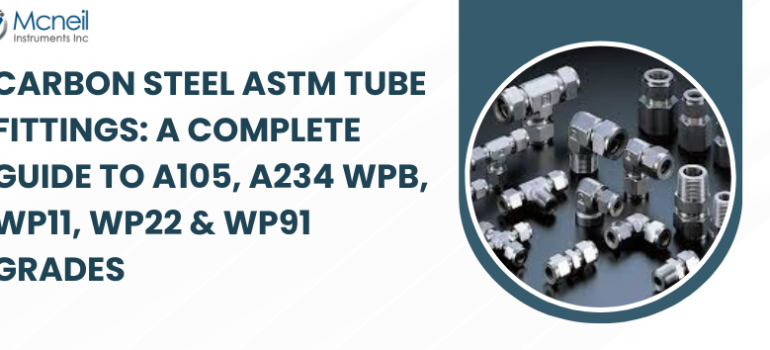
Carbon Steel ASTM Tube Fittings: A Complete Guide to A105, A234 WPB, WP11, WP22 & WP91 Grades

Introduction — Critical Connectors for Industrial Piping Systems

In any industrial piping network, whether it’s transporting steam in power plants, chemical feeds in petrochemical plants, water in treatment facilities, or hydrocarbons in oil and gas refineries, tube fittings are essential. They join sections of pipe and tubing, adapt changes in direction or diameter, and provide secure, leak-proof connections in demanding environments.

Carbon steel ASTM tube fittings — manufactured under stringent industry standards — provide a robust and reliable solution for medium and high pressure, elevated temperature, and corrosive conditions. As a leading manufacturer, supplier, and exporter, Mcneil Instruments  offers a complete range of these fittings in different grades, each engineered to support specific industrial requirements.

This guide covers the most commonly used carbon steel tube fitting grades:

  • ASTM A105
  • ASTM A234 WPB
  • ASTM A234 WP11
  • ASTM A234 WP22
  • ASTM A234 WP91

We will explore their chemical and mechanical properties, applications, specifications, and differences — helping engineers and buyers make informed decisions.

Standard Overview — What Is ASTM Tube Fitting Material?

Carbon steel tube fittings covered in this guide adhere to recognized ASTM and ASME specifications. These standards define acceptable chemical compositions, mechanical properties, and performance criteria. The most relevant standards include:

  • ASTM A105 – Forged carbon steel for moderate and high-temperature service.
  • ASTM A234 WPB / WP11 / WP22 / WP91 – Carbon and alloy steel buttweld tube fittings designed for elevated temperature and pressure services.

These fittings are typically produced via forging and machining to achieve uniform strength and dimensional accuracy.

Types of Carbon Steel Tube Fittings

Before diving into grades, here are the common tube fittings typically offered by Mcneil Instruments :

  • Elbows (45°, 90°) – change direction of flow.
  • Tees & Crosses – branch flows or connect three/four lines.
  • Reducers (Concentric & Eccentric) – join two sizes of piping.
  • Caps & Plugs – close pipe ends.
  • Couplings & Adapters – join sections in different configurations.
  • Custom Machined Fittings – for special application requirements.

Each fitting type is produced to match the required grade, wall thickness, and dimensional tolerance.

Grade Profiles

1. ASTM A105 Tube Fittings

ASTM A105 is a forged carbon steel grade commonly used for moderate and high-temperature applications. These fittings offer good weldability and mechanical strength.

Chemical Composition (Typical)

ElementComposition (%)
Carbon (C)0.35 max
Manganese (Mn)0.60–1.05
Phosphorus (P)0.035 max
Sulfur (S)0.040 max
Silicon (Si)0.10–0.35

Applications:

  • Pressure and high-temperature services
  • Refining and petrochemical plants
  • Boiler systems

2. ASTM A234 WPB Tube Fittings

ASTM A234 WPB represents the most widely used grade of carbon steel buttweld fittings. These are suitable for moderate temperature and standard industrial applications.

Key Features:

  • Excellent weldability
  • Reliable performance in conventional process systems
  • Cost-effective for standard applications

Applications:

  • Pipeline connections in general plant services
  • Low/medium temperature fluid lines
  • HVAC systems

3. ASTM A234 WP11 Tube Fittings

ASTM A234 WP11 fittings are made from carbon steel alloyed with chromium and molybdenum, giving them better resistance in higher temperature environments compared to WPB.

Applications:

  • High temperature steam lines
  • Industrial boilers
  • Medium-pressure systems requiring oxidation resistance

4. ASTM A234 WP22 Tube Fittings

ASTM A234 WP22 is a higher alloy grade than WP11, with improved creep and oxidation resistance. These tube fittings perform better under sustained high temperatures and pressures.

Applications:

  • Superheaters and reheaters
  • High-pressure steam piping
  • Chemical processing lines

5. ASTM A234 WP91 Tube Fittings

ASTM A234 WP91 fittings represent one of the most advanced carbon steel grades. They are engineered for extreme conditions involving both high temperature and pressure.

Key Advantages:

  • Superior creep strength
  • High mechanical toughness
  • Reliability in prolonged elevated temperature service

Applications:

  • High-pressure boiler systems
  • Thermal power plant piping
  • Heavy industrial applications

Mechanical Properties Comparison

The following table summarizes typical mechanical properties for these carbon steel fitting grades:

PropertyA105A234 WPBA234 WP11A234 WP22A234 WP91
Tensile Strength (min)≥ 485 MPa≥ 415 MPa≥ 415 MPa≥ 520 MPa≥ 620 MPa
Yield Strength (min)≥ 240 MPa≥ 240 MPa≥ 205 MPa≥ 310 MPa≥ 415 MPa
Elongation (%)~20–25~22~22~22~20

Note: Actual mechanical values depend on manufacturing process, heat treatment, and test outcomes.

Chemical Composition Overview

Different grades are alloyed with varying levels of chromium, molybdenum and other elements to enhance high-temperature strength and corrosion resistance.

GradeKey Alloying Elements
A105Carbon, Manganese
WPBCarbon, Manganese
WP11Cr, Mo
WP22Higher Cr, Mo
WP91Cr, Mo with added elements for creep strength

Dimensions & Wall Thickness Standards

Carbon steel ASTM tube fittings are typically produced according to ASME B16.9 and/or ASME B16.11 dimensional standards. These define fitting geometry based on Nominal Pipe Size (NPS) and Schedule (SCH) designations.

Typical Size Range

  • 1/2″ NB to 48″ NB or larger (depending on product)
  • Wall thicknesses: SCH 10 to SCH XXS
  • Fittings manufactured for both buttweld and socket-weld connections

Certifications & Quality Assurance

Mcneil Instruments  ensures that all carbon steel ASTM tube fittings meet rigorous quality parameters. Each product undergoes:

  • Material Test Certificates (MTCs) (EN 10204 3.1 / 3.2)
  • Positive Material Identification (PMI)
  • Hydrostatic Pressure Testing
  • Dimensional Inspection
  • Weld Integrity & Hardness Tests

This makes them suitable for critical industrial services where safety and reliability are non-negotiable.

Applications Across Industries

Carbon steel ASTM tube fittings are used in:

  • Oil & Gas Production & Refining
    Fittings in crude handling, steam systems, gas lines
  • Power Plants & Boilers
    High temperature steam lines, superheated fluid circuits
  • Petrochemical & Chemical Processing
    Process piping with elevated temperature and pressure
  • Industrial Manufacturing
    Heavy equipment cooling lines, process fluid transportation
  • Water Treatment & Infrastructure
    Main lines, distribution systems, plant utilities

Each grade has its niche depending on operational temperature, pressure, and fluid characteristics.

Why Choose Mcneil Instruments  — Manufacturer, Supplier & Exporter

Mcneil Instruments  stands out due to:

  • Broad Product Range: Comprehensive offering covering all major ASTM carbon steel grades from A105 to WP91.
  • Global Standards Compliance: Manufacturing to ASTM, ASME, and international norms.
  • Quality Tracking & Documentation: Full traceability with certified test reports.
  • Custom Solutions: Machined fittings tailored to unique project needs.
  • Export Capability: Serving global markets with expertise in packaging, logistics, and export documentation.

This combination makes Mcneil Instruments  a reliable partner for global EPC contractors, industrial end-users, and procurement teams.

Conclusion — Fit for Purpose and Built to Last

Choosing the right carbon steel ASTM tube fitting is a key engineering decision. Each grade — from A105 through A234 WPB, WP11, WP22, and WP91 — is designed for specific use cases ranging from general service to high temperature and high pressure.

As industries in oil & gas, power, petrochemical, and manufacturing continue to evolve, having a supplier that delivers quality, consistency, and certified performance is essential. Mcneil Instruments  meets these expectations as a trusted manufacturer, supplier, and exporter, offering tube fittings designed for performance, longevity, and project success.

Read More