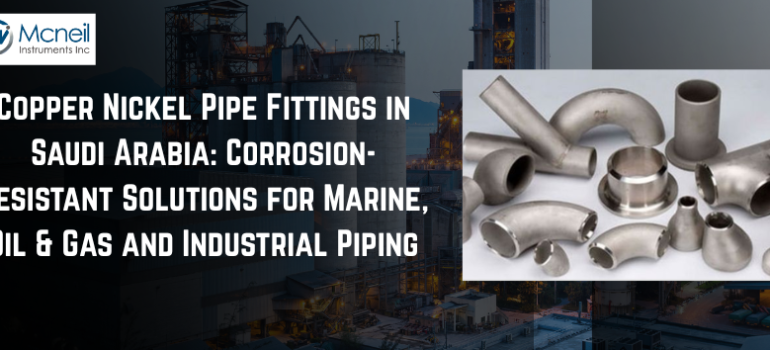
Copper Nickel Pipe Fittings in Saudi Arabia: Corrosion-Resistant Solutions for Marine, Oil & Gas and Industrial Piping
Saudi Arabia’s oil and gas, petrochemical, power generation, desalination, marine, and water-treatment industries require piping components that can withstand demanding operating environments. Exposure to seawater, chlorides, high temperatures, pressure, and corrosive process fluids makes material selection particularly important.
Copper Nickel Pipe Fittings are widely considered for applications where corrosion resistance, durability, and reliable performance in marine and water-handling environments are required. Mcneil Instruments offers copper nickel pipe fittings for industrial applications, with the product range covering commonly used Cu-Ni grades and multiple fitting configurations.
What Are Copper Nickel Pipe Fittings?
Copper nickel pipe fittings, also called Cu-Ni or cupronickel pipe fittings, are piping components manufactured from copper-nickel alloys.
They are used to connect, redirect, reduce, or terminate piping systems while providing resistance to corrosion and erosion.
Common types include:
- Elbows
- Tees
- Reducers
- Caps
- Stub ends
- Cross fittings
- Couplings
- Buttweld fittings
- Threaded fittings
- Socket weld fittings
These fittings are particularly useful where piping systems are exposed to seawater, saline water, chlorides, or other corrosive environments.
Why Copper Nickel Fittings Are Suitable for Saudi Arabian Industries
Saudi Arabia has extensive industrial infrastructure across the oil and gas, petrochemical, desalination, power, marine, and water-treatment sectors.
Copper nickel alloys can be valuable in applications where corrosion resistance is a major concern.
Key characteristics include:
- Excellent resistance to seawater corrosion
- Resistance to chloride-containing environments
- Natural resistance to marine biofouling
- Good thermal conductivity
- High durability
- Good ductility and toughness
- Resistance to erosion-corrosion
These properties make Cu-Ni fittings suitable for selected marine, cooling-water, desalination, and industrial piping systems.
Copper Nickel 90/10 Pipe Fittings
Copper Nickel 90/10 (C70600) contains approximately 90% copper and 10% nickel.
It is one of the most widely used copper-nickel alloys for marine and seawater applications.
Key benefits
- Strong seawater corrosion resistance
- Good resistance to biofouling
- Good ductility
- Reliable performance in water systems
- Suitable for general marine applications
Typical applications
- Seawater piping
- Marine cooling systems
- Heat exchangers
- Condenser systems
- Desalination equipment
- Water-treatment systems
Mcneil Instruments identifies C70600 90/10 copper nickel as one of its commonly specified grades.
Copper Nickel 70/30 Pipe Fittings
Copper Nickel 70/30 (C71500) contains approximately 70% copper and 30% nickel.
Compared with 90/10 copper nickel, the 70/30 grade offers higher strength and is suited to more demanding service conditions.
Key characteristics
- Higher mechanical strength
- Excellent corrosion resistance
- Strong seawater performance
- Good erosion-corrosion resistance
- Suitable for demanding marine environments
Typical applications include:
- Offshore systems
- Desalination plants
- Marine piping
- Heat exchangers
- Condensers
- Seawater cooling systems
Mcneil Instruments lists C71500 70/30 copper nickel within its copper nickel pipe fitting range.
90/10 vs 70/30 Copper Nickel
| Grade | Composition | Strength | Typical Application |
| 90/10 C70600 | 90% Cu / 10% Ni | Medium | General marine and seawater systems |
| 70/30 C71500 | 70% Cu / 30% Ni | Higher | Offshore, desalination and demanding seawater applications |
The appropriate grade should be selected according to the actual fluid chemistry, velocity, pressure, temperature, and project specification.
ASTM Standards for Copper Nickel Pipe Fittings
Mcneil Instruments’ published information identifies ASTM B366 / ASME SB366 among the standards associated with its copper nickel pipe fittings. The range includes seamless, welded, and forged forms depending on application requirements.
For procurement in Saudi Arabia, buyers should verify the exact standard required by the EPC contractor, end user, or project specification.
Important parameters include:
- Material grade
- Nominal size
- Wall thickness
- Schedule
- Fitting configuration
- End connection
- Pressure rating
- Temperature range
- Inspection requirements
Types of Copper Nickel Pipe Fittings
Copper Nickel Elbows
Elbows are used to change the direction of flow within a piping system.
Common configurations include:
- 45° elbows
- 90° elbows
- Long-radius elbows
They are commonly used in seawater, cooling-water, marine, and industrial piping systems.
Copper Nickel Tees
Tees provide branch connections from a primary pipeline.
They can be used to divide or combine process flow in cooling, water-treatment, and industrial systems.
Copper Nickel Reducers
Reducers connect pipes of different diameters.
They can be supplied in configurations such as:
- Concentric reducers
- Eccentric reducers
Copper Nickel Caps
Caps close the end of a pipeline and can be used during permanent installation or system modification.
Copper Nickel Stub Ends
Stub ends can be used in conjunction with lap-joint flange arrangements where the piping design calls for them.
Copper Nickel Pipe Fittings for Desalination in Saudi Arabia
Desalination is particularly important in Saudi Arabia, where seawater treatment provides a major source of potable and industrial water.
Seawater contains chlorides and other constituents that can create corrosion challenges for piping systems.
Copper nickel alloys are well suited to selected seawater applications because of their corrosion resistance and resistance to marine biofouling.
Applications can include:
- Seawater intake systems
- Cooling-water systems
- Heat exchangers
- Condenser systems
- Desalination equipment
- Water-treatment piping
The final material selection should still be based on the actual water chemistry, flow velocity, temperature, and system design.
Copper Nickel Pipe Fittings for Oil & Gas
Saudi Arabia’s oil and gas industry operates extensive processing and supporting infrastructure.
Copper nickel fittings can be considered for selected applications involving:
- Cooling-water systems
- Seawater systems
- Offshore equipment
- Heat exchangers
- Condensers
- Utility piping
Where hydrocarbons or chemicals are involved, the material must be evaluated against the complete process chemistry rather than selected solely because it is copper nickel.
Copper Nickel Fittings for Power Plants
Power-generation facilities use extensive cooling and heat-transfer systems.
Copper nickel fittings can be used in appropriate:
- Condenser systems
- Cooling-water lines
- Seawater circuits
- Heat exchangers
- Utility systems
Their thermal conductivity and seawater corrosion resistance can make them useful for heat-transfer applications.
Copper Nickel Fittings for Marine Applications
Marine environments expose piping components to seawater and chloride-rich conditions.
Copper nickel’s natural resistance to marine biofouling and seawater corrosion makes it a commonly considered material for marine piping.
Potential applications include:
- Shipbuilding
- Marine cooling systems
- Offshore platforms
- Seawater piping
- Firewater systems
- Heat exchangers
- Desalination systems
Technical Specifications
Based on Mcneil Instruments’ published copper nickel product information, the range includes the following general specifications:
| Parameter | Specification |
| Product | Copper Nickel Pipe Fittings |
| Grades | C70600 / C71500 |
| Copper Nickel Types | 90/10 and 70/30 |
| Standards | ASTM B366 / B467 / ASME SB466 |
| Size Range | ½” to 48″ NB |
| Thickness | SCH 10 to SCH XXS |
| Forms | Seamless / Welded / Forged |
| End Connections | Threaded / Socket Weld / Buttweld |
| Pressure Classes | 2000–9000 LBS |
Exact availability, dimensions, pressure ratings, and manufacturing form should be confirmed for the specific project requirement.
Quality Testing of Copper Nickel Pipe Fittings
Industrial piping components need to meet the required material and dimensional specifications.
Depending on the project, inspection may include:
- Chemical composition analysis
- Mechanical testing
- Hydrostatic testing
- Ultrasonic inspection
- Dimensional inspection
- Visual inspection
- Material identification
- Documentation and traceability
For critical Saudi Arabian projects, additional inspection or third-party verification may be required by the purchaser or EPC contractor.
How to Select Copper Nickel Fittings for a Saudi Arabia Project
Before purchasing copper nickel pipe fittings, consider the following.
1. Select the Correct Grade
Choose between 90/10 C70600 and 70/30 C71500 based on the service conditions.
2. Check the Fluid
Determine whether the fitting will handle:
- Seawater
- Freshwater
- Cooling water
- Process fluids
- Chemicals
- Hydrocarbons
3. Evaluate Temperature
Confirm both normal and maximum operating temperatures.
4. Check Pressure
The fitting’s pressure capability must correspond with the piping system’s design requirements.
5. Confirm Dimensions
Specify:
- Nominal pipe size
- Wall thickness
- Schedule
- Fitting type
- End connection
6. Verify Applicable Standards
Confirm ASTM, ASME, project, EPC, and end-user requirements before procurement.
Why Choose Mcneil Instruments for Copper Nickel Pipe Fittings?
Mcneil Instruments supplies a broad range of industrial pipe and tube fittings and identifies Copper Nickel among its available pipe fitting materials. Its Saudi Arabia-focused product information also covers instrumentation pipe and tube fittings for industries including oil and gas, petrochemical, and other demanding applications.
The company’s published copper nickel range includes 90/10 C70600 and 70/30 C71500, along with multiple fitting types, sizes, connection configurations, and manufacturing forms.
Conclusion
Copper Nickel Pipe Fittings in Saudi Arabia are an important option for piping systems exposed to seawater, chlorides, marine environments, and demanding industrial conditions.
The two principal grades are Copper Nickel 90/10 C70600 and Copper Nickel 70/30 C71500. The former is widely used for general marine and seawater applications, while the latter provides higher strength and is suited to more demanding environments.
For Saudi Arabia’s desalination, oil and gas, petrochemical, power generation, marine, and water-treatment industries, the correct copper nickel fitting should be selected according to the actual operating temperature, pressure, fluid chemistry, flow conditions, dimensions, and applicable standards.
Frequently Asked Questions
What are copper nickel pipe fittings used for?
They are used to connect and redirect piping systems, particularly in applications involving seawater, cooling water, marine environments, desalination, heat exchangers, and industrial process systems.
What copper nickel grades are available?
The commonly used grades are 90/10 C70600 and 70/30 C71500. Mcneil Instruments lists both grades in its published copper nickel pipe fitting range.
Which is stronger, 90/10 or 70/30 copper nickel?
70/30 C71500 generally provides higher strength than 90/10 C70600 and is used for more demanding applications.
Are copper nickel fittings suitable for seawater?
Yes. Copper nickel alloys are known for their resistance to seawater corrosion and marine biofouling, which makes them suitable for many seawater applications when properly designed and installed.
Which industries use copper nickel pipe fittings in Saudi Arabia?
Applications can include oil and gas, desalination, marine, power generation, water treatment, petrochemical, and heat-transfer systems.
What standards are associated with copper nickel pipe fittings?
Mcneil Instruments’ published information references ASTM B366 / B467 / ASME SB466 for its copper nickel product range.
Who supplies copper nickel pipe fittings in Saudi Arabia?
Mcneil Instruments supplies copper nickel and other industrial pipe fitting materials for international industrial applications, including the Saudi Arabian market.