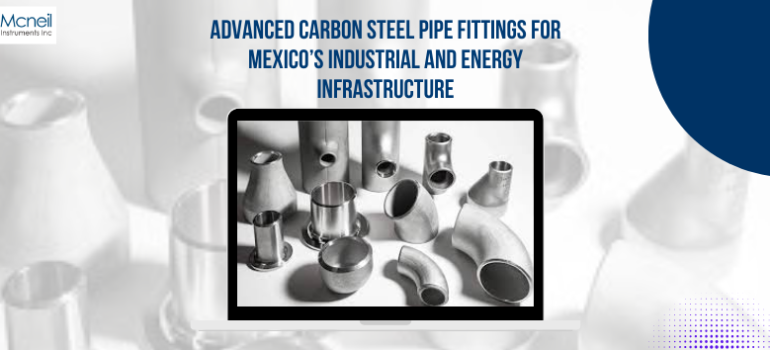
Advanced Carbon Steel Pipe Fittings for Mexico’s Industrial and Energy Infrastructure
Material Science, Specifications, and Application Insights
Introduction: Engineering Strength into Mexico’s Piping Systems
Across Mexico’s expanding industrial ecosystem — from offshore oil platforms in the Gulf of Mexico to petrochemical complexes, power plants, automotive manufacturing hubs, and municipal infrastructure — piping systems serve as the circulatory network of operations. The performance of these systems depends not only on pipes but on the integrity of their connecting elements: pipe fittings.
Carbon steel pipe fittings remain one of the most widely specified solutions for industrial piping due to their mechanical strength, weldability, cost efficiency, and structural reliability. When manufactured according to ASTM and ASME standards, these fittings provide predictable performance under pressure, temperature fluctuations, and mechanical stress.
As a trusted manufacturer, supplier, and exporter, Mcneil Instruments delivers ASTM-compliant carbon steel pipe fittings engineered to support Mexico’s energy, infrastructure, and industrial development.
This blog explores the theoretical foundations of carbon steel as a material, explains major ASTM grades, presents technical specifications, and highlights their industrial relevance within Mexico.
Theoretical Foundations of Carbon Steel
Carbon steel is fundamentally an alloy of iron and carbon, where carbon content directly influences strength, hardness, and ductility. The interaction between carbon atoms and iron’s crystalline lattice structure enhances tensile strength by restricting dislocation movement, increasing resistance to deformation under stress.
Classification by Carbon Content
Carbon steels are typically categorized into:
- Low Carbon Steel (0.05–0.30% C)
High ductility, good weldability, commonly used in piping systems - Medium Carbon Steel (0.30–0.60% C)
Higher strength with moderate ductility - High Carbon Steel (0.60–1.00% C)
Increased hardness but reduced weldability
Industrial pipe fittings primarily use low to medium carbon steels, ensuring structural strength without compromising fabrication flexibility.
The addition of trace elements such as manganese improves toughness, while controlled sulfur and phosphorus levels prevent brittleness and cracking — essential for pressure-retaining components.
What Are Carbon Steel Pipe Fittings?
Carbon steel pipe fittings are engineered components that:
- Change pipeline direction (elbows)
- Split or combine flow (tees and crosses)
- Adjust pipe diameter (reducers)
- Seal pipeline ends (caps and plugs)
- Connect different systems (adapters and couplings)
In high-pressure systems, fittings must maintain dimensional precision and metallurgical integrity to prevent leakage or mechanical failure. Carbon steel’s balance of strength and ductility makes it an optimal material for such structural applications.
Key ASTM Grades and Their Technical Significance
Carbon steel pipe fittings are manufactured according to internationally recognized ASTM standards. Each grade corresponds to specific chemical composition limits, heat treatment requirements, and mechanical properties.
ASTM A105 Pipe Fittings
- Forged carbon steel
- Designed for high-pressure and elevated-temperature service
- Commonly used in refineries and steam lines
A105 offers strong pressure resistance with reliable weldability, making it suitable for critical connections.
ASTM A234 WPB Pipe Fittings
- Wrought carbon steel for butt-weld applications
- Suitable for moderate temperature systems
- Widely specified in industrial process piping
WPB remains one of the most versatile grades in general-purpose industrial systems.
ASTM A234 WP11 Pipe Fittings
- Chromium-molybdenum alloyed steel
- Improved high-temperature oxidation resistance
- Used in thermal and power systems
Alloy additions increase creep strength and durability under sustained heat exposure.
ASTM A234 WP22 Pipe Fittings
- Higher chromium and molybdenum content
- Enhanced creep resistance
- Suitable for boilers and superheater applications
WP22 delivers greater performance in elevated temperature service.
ASTM A234 WP91 Pipe Fittings
- High-alloy chromium-molybdenum steel with vanadium and niobium
- Designed for extreme pressure and temperature environments
- Used in advanced thermal power and refinery systems
WP91 demonstrates superior long-term stability and fatigue resistance.
Technical Specifications and Compliance
Carbon steel pipe fittings supplied by Mcneil Instruments meet global engineering standards, ensuring safe integration into Mexican industrial systems.
| Category | Specification |
| Material Standards | ASTM A105, ASTM A234 WPB/WP11/WP22/WP91 |
| Dimensional Standards | ASME B16.9, ASME B16.11 |
| Pressure Classes | 150 to 2500 |
| Manufacturing Types | Seamless, Welded, Forged |
| Size Range | 1/8″ to 48″ NB |
| Testing | Hydrostatic, PMI, UT, RT |
| Certification | ISO 9001:2015, EN 10204 3.1/3.2 |
These standards ensure compatibility with globally engineered systems used in Mexico’s industrial facilities.
Mechanical Performance Overview
| Property | A105 / WPB | WP11 / WP22 | WP91 |
| Tensile Strength | ~415 MPa | ~415 MPa | ~585 MPa |
| Yield Strength | ~205–240 MPa | ~205 MPa | ~415 MPa |
| Elongation | ≥ 22% | ≥ 20% | ≥ 20% |
| Hardness | ≤ 197 HB | ≤ 200 HB | ≤ 250 HB |
| Thermal Stability | Moderate | High | Very High |
The progression from A105 to WP91 reflects increasing resistance to temperature-induced creep and pressure-induced stress.
Industrial Relevance in Mexico
Mexico’s industrial growth has increased demand for reliable piping components in:
Oil & Gas and Refining
Carbon steel fittings connect pipelines, separators, and process units in onshore and offshore facilities.
Power Generation
Steam lines, boiler feedwater systems, and turbine circuits rely on high-strength carbon steel fittings.
Petrochemical Manufacturing
Process piping systems handling hydrocarbons and industrial chemicals depend on durable welded connections.
Infrastructure and Utilities
Municipal water treatment and industrial utilities utilize carbon steel fittings for reliable service at moderate pressure.
Manufacturing and Fabrication
Industrial assembly lines and plant utilities incorporate carbon steel fittings for structural reliability.
Representative Weight Chart for Planning
| NPS | OD (mm) | SCH 40 Weight (kg/m) | SCH 80 Weight (kg/m) |
| 1/2″ | 21.3 | 2.02 | 2.63 |
| 1″ | 33.4 | 3.65 | 5.03 |
| 2″ | 60.3 | 9.27 | 13.09 |
| 4″ | 114.3 | 27.7 | 39.9 |
| 6″ | 168.3 | 56.3 | 89.2 |
Weight data assists engineers in load calculations and structural support planning.
Quality Control and Testing Procedures
Mcneil Instruments applies rigorous quality assurance practices to all carbon steel pipe fittings exported to Mexico:
- Chemical composition verification
- Tensile and yield strength testing
- Ultrasonic and radiographic inspection
- Hydrostatic pressure testing
- Positive Material Identification
- Dimensional inspection and documentation
These procedures ensure compliance with project specifications and engineering codes.
Why Carbon Steel Remains a Preferred Material in Mexico
Carbon steel pipe fittings offer:
- High structural strength
- Economical installation and lifecycle cost
- Excellent weldability
- Compatibility with standard carbon steel pipelines
- Conformance to ASTM and ASME standards
For many industrial applications in Mexico, carbon steel represents the optimal balance between performance and cost.
Why Choose Mcneil Instruments
As an experienced manufacturer, supplier, and exporter, Mcneil Instruments supports Mexico’s industrial sector with:
- Full range of ASTM carbon steel grades
- Consistent quality control
- Complete material traceability
- Export documentation and compliance support
- Technical assistance for specification alignment
- Custom production capabilities
Conclusion: Reliable Carbon Steel Solutions for Mexico’s Industrial Progress
Carbon steel pipe fittings play a central role in ensuring the mechanical and operational integrity of industrial piping systems. From general-purpose installations to high-pressure and elevated-temperature applications, ASTM-compliant carbon steel fittings provide predictable performance and structural reliability.
By combining metallurgical precision with international standards compliance, Mcneil Instruments delivers carbon steel pipe fittings that support Mexico’s industrial growth — ensuring durability, safety, and long-term operational efficiency.