Introduction: In Michigan, Efficiency Starts Inside the Pipe
Let’s get straight to it—Michigan industries don’t just need materials that work, they need materials that perform consistently through temperature changes, pressure variations, and long operational cycles.
That’s exactly why copper tubes continue to be a preferred choice. A trusted manufacturer, supplier, and exporter ensures these tubes deliver high thermal efficiency, corrosion resistance, and long-term reliability across applications.
From HVAC systems to industrial fluid transport, businesses across Michigan rely on experienced copper tube manufacturers, suppliers, and exporters to maintain performance without interruption.
What Are Copper Tubes?
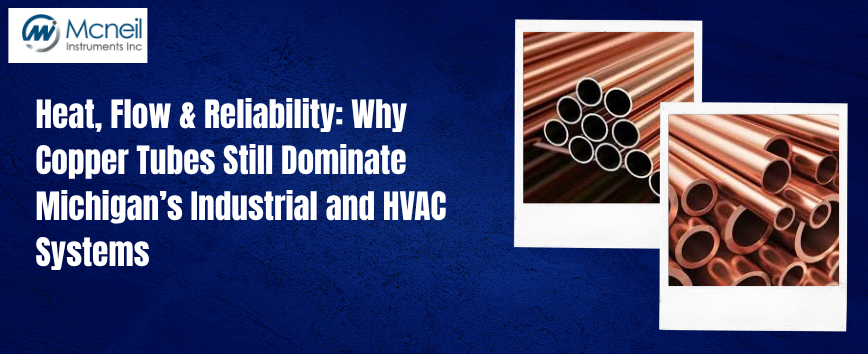
Copper tubes are seamless or welded tubes made from high-purity copper, widely used for fluid transport, heating systems, and industrial applications.
They are known for their durability, flexibility, and excellent heat transfer properties, making them suitable for both residential and industrial systems.
Key Characteristics
• High thermal and electrical conductivity
• Strong corrosion resistance
• Long service life
• Easy to fabricate and install
A reliable supplier and exporter ensures availability in multiple sizes and specifications for different industrial needs.
Why Copper Tubes Are Widely Used in Michigan
Michigan’s climate and industrial environment demand materials that can handle both cold winters and high-temperature systems. Copper tubes meet these demands effectively.
Key Benefits
Excellent Heat Transfer
Ideal for HVAC and refrigeration systems
Corrosion Resistance
Performs well in water and industrial environments
Durability
Long lifespan even under continuous operation
Antimicrobial Properties
Suitable for clean water systems
Flexibility & Workability
Easy to bend, cut, and install
This is why industries prefer sourcing from trusted manufacturers, suppliers, and exporters.
Technical Specifications Table
| Parameter | Specification |
| Product Type | Copper Tubes |
| Standards | ASTM B68 / B75 / B88 / B280 |
| Size Range | 1/8″ to 12″ |
| Type | Seamless / Welded |
| Form | Round / Coil / Straight Length |
| Temper | Annealed (Soft) / Drawn (Hard) |
| Wall Thickness | Standard / Custom |
Leading manufacturers, suppliers, and exporters ensure these tubes meet global industrial standards.
Types of Copper Tubes
Copper tubes are available in different types depending on application:
Based on Application
Plumbing Tubes
Used for water supply systems
ACR Tubes (Air Conditioning & Refrigeration)
Designed for HVAC systems
Industrial Copper Tubes
Used in heat exchangers and process industries
Copper tubing is widely used in water systems, HVAC, and fuel transfer due to its corrosion resistance and durability.
Type Comparison Table (K, L, M)
| Type | Wall Thickness | Strength | Best Application |
| Type K | Thickest | High | Underground & high-pressure |
| Type L | Medium | Medium-High | Plumbing & HVAC |
| Type M | Thinnest | Medium | Residential systems |
Type K offers the highest durability, while Type M is more cost-effective for lighter applications.
Mechanical Properties Overview
| Property | Typical Value |
| Tensile Strength | 200–250 MPa |
| Melting Point | ~1085°C |
| Density | 8.9 g/cm³ |
| Conductivity | Very High |
Copper’s high strength and conductivity make it ideal for industrial and building applications.
Why Copper Tubes Perform Well in Michigan Conditions
Michigan’s environment creates specific challenges:
• Temperature fluctuations (extreme cold to high heat)
• Moisture exposure
• Industrial chemical exposure
• Continuous system usage
Copper tubes handle these conditions because:
• They resist corrosion over long periods
• They maintain performance under thermal stress
• They provide reliable flow without degradation
Copper can last decades in water systems due to its natural resistance to environmental reactions.
Industrial Applications in Michigan
Copper tubes are used across key industries:
HVAC & Refrigeration
Cooling systems, air conditioning units
Automotive Industry
Fuel lines and heat exchangers
Power Generation
Thermal systems and condensers
Construction & Plumbing
Water supply and drainage systems
Manufacturing
Fluid transport and process systems
Industries depend on reliable suppliers and exporters to ensure uninterrupted operations.
Manufacturing Process
Top manufacturers, suppliers, and exporters follow strict production standards:
Process Flow
• High-purity copper selection
• Extrusion or drawing process
• Heat treatment (annealing)
• Surface finishing
• Dimensional inspection
This ensures durability, precision, and long service life.
Key Advantages of Copper Tubes
Thermal Efficiency
Excellent for heat transfer applications
Corrosion Resistance
Long-lasting performance
Ease of Installation
Flexible and easy to work with
Hygienic Properties
Safe for potable water systems
Durability
Long service life with minimal maintenance
These benefits make them a preferred choice from leading manufacturers, suppliers, and exporters.
Quality Testing and Assurance
To ensure performance, copper tubes undergo strict testing:
• Hydrostatic testing
• Eddy current testing
• Chemical composition analysis
• Mechanical testing
• Dimensional verification
A trusted manufacturer and exporter ensures every product meets industrial standards.
Conclusion
Copper tubes continue to be one of the most reliable and efficient solutions for fluid transport and thermal systems.
In Michigan, where industries demand durability, efficiency, and long-term performance, working with a trusted manufacturer, supplier, and exporter ensures consistent quality and reliability.
If your systems require high conductivity, corrosion resistance, and performance across varying conditions, choosing the right copper tube supplier and exporter is what keeps everything running smoothly.