Introduction: Built for Conditions Where Regular Materials Fail
Here’s the reality—when your piping system is exposed to extreme heat, corrosive chemicals, and pressure cycles, standard materials don’t last. You start seeing cracks, corrosion, and failures much earlier than expected.
That’s exactly where Inconel tube fittings come into play. These fittings are engineered using nickel-based superalloys, designed to perform in environments where even stainless steel struggles.
In Michigan, with its strong presence in automotive manufacturing, chemical processing, power generation, and heavy industry, Inconel tube fittings are widely used for applications that demand durability, precision, and long-term reliability.
What Are Inconel Tube Fittings?
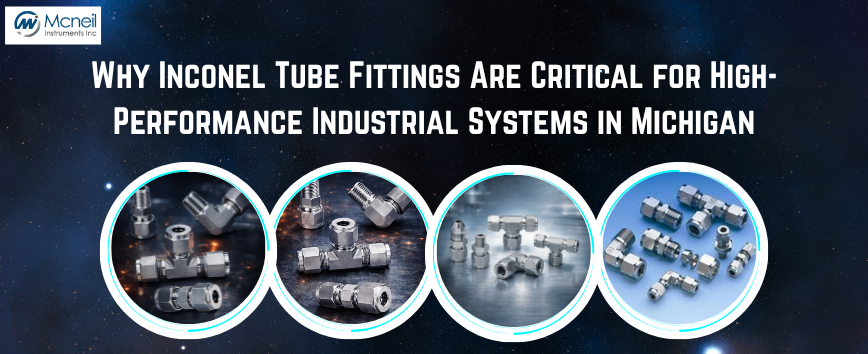
Inconel tube fittings are high-performance components used to connect tubing systems in extreme environments. They ensure leak-proof, corrosion-resistant, and high-strength connections in critical piping setups.
These fittings are typically manufactured under ASTM B366 / ASME SB366 standards, making them suitable for high-temperature and high-pressure applications.
Common Types
• Elbows – change flow direction
• Tees – split or combine flow
• Reducers – connect different tube sizes
• Unions – allow easy disconnection
• Caps and plugs – seal tube ends
They are available in compression, threaded, and welded configurations, depending on system requirements.
What Makes Inconel Unique?
Inconel is a nickel-chromium superalloy known for its ability to perform under extreme conditions.
Key Characteristics
• Excellent resistance to corrosion and oxidation
• Maintains strength at very high temperatures
• Resistant to stress-corrosion cracking
• Performs well in both oxidizing and reducing environments
Inconel forms a protective oxide layer when exposed to heat, which helps prevent further damage and ensures long-term durability.
Chemical Composition of Inconel Tube Fittings
The performance of these fittings comes from their carefully balanced alloy composition.
Typical Composition (Inconel 625 Example)
| Element | Composition (%) |
| Nickel (Ni) | ≥ 58 |
| Chromium (Cr) | 20 – 23 |
| Molybdenum (Mo) | 8 – 10 |
| Niobium (Nb) | 3 – 4 |
| Iron (Fe) | ≤ 5 |
Nickel provides corrosion resistance, chromium protects against oxidation, and molybdenum enhances strength in aggressive environments.
Mechanical Properties of Inconel Tube Fittings
These fittings are built to perform under high stress and temperature.
| Property | Typical Value |
| Tensile Strength | ≥ 650 MPa |
| Yield Strength | ≥ 300 MPa |
| Elongation | ~30–40% |
| Melting Point | ~1290–1410°C |
They maintain strength and toughness even under continuous exposure to heat and pressure.
Key Advantages of Inconel Tube Fittings
Exceptional Corrosion Resistance
Handles acids, chlorides, and harsh chemical environments without degradation.
High Temperature Stability
Maintains structural integrity even above 1000°C in many applications.
Resistance to Creep and Fatigue
Prevents deformation during long-term exposure to stress and heat.
Strong Mechanical Performance
Offers high tensile strength and durability.
Long Service Life
Reduces downtime and maintenance costs.
Inconel fittings are known for delivering high strength, corrosion resistance, and durability in aggressive environments.
Technical Specifications of Inconel Tube Fittings
| Specification | Details |
| Standard | ASTM B366 / ASME SB366 |
| Grades | 600, 625, 800, 825 |
| Size Range | ½″ to 24″ |
| Schedule | SCH 5 to SCH XXS |
| Manufacturing Type | Seamless / Welded / Fabricated |
| Connection Type | Compression / Threaded / Welded |
These fittings are designed to integrate seamlessly with industrial piping systems.
Industrial Applications in Michigan
Michigan’s industrial ecosystem demands materials that can handle both mechanical stress and environmental exposure.
Automotive Industry
Used in high-temperature exhaust and fluid systems.
Chemical Processing
Handles corrosive chemicals and reactive fluids.
Power Generation
Used in boilers, turbines, and heat exchangers.
Oil & Gas and Energy
Reliable for pipelines and processing units.
Aerospace & Advanced Manufacturing
Used in precision and high-performance systems.
Inconel fittings are widely used across industries like oil & gas, chemical processing, and power plants due to their durability and resistance.
Major Inconel Tube Fitting Grades
Inconel 600
• Good oxidation resistance
• Performs well in high-temperature environments
Inconel 625
• Excellent corrosion resistance
• High strength and fatigue resistance
Inconel 800 / 800H / 800HT
• Designed for high-temperature stability
• Improved creep resistance
Inconel 825
• Strong resistance to acids
• Suitable for chemical processing systems
Quick Grade Comparison
| Grade | Key Strength | Best Use Case |
| 600 | Heat resistance | Furnace systems |
| 625 | Corrosion resistance | Chemical plants |
| 800 Series | High temp strength | Power plants |
| 825 | Acid resistance | Chemical processing |
Quality Testing of Inconel Tube Fittings
To ensure reliability, these fittings undergo strict testing:
• Chemical composition analysis
• Mechanical strength testing
• Hydrostatic pressure testing
• Ultrasonic and radiographic inspection
• Positive Material Identification (PMI)
• Dimensional inspection
These checks ensure performance in critical applications.
Conclusion
Inconel tube fittings are built for environments where heat, pressure, and corrosion are constant challenges. Their nickel-based composition gives them unmatched durability compared to standard materials.
In Michigan, where industries demand performance and reliability, these fittings play a crucial role in maintaining efficient and long-lasting piping systems.
If the goal is high strength, corrosion resistance, and long-term stability, Inconel tube fittings are one of the most dependable choices available.