Incoloy Pipe Fittings in USA: Grades, Types, Applications & Selection Guide

Incoloy Pipe Fittings are engineered for industrial piping systems where high temperature, corrosion, oxidation, carburization, and mechanical stress can make conventional materials unsuitable. Manufactured from nickel-iron-chromium-based alloys, Incoloy fittings provide a combination of thermal stability, corrosion resistance, strength, and long-term service performance.

In the United States, these fittings are relevant to demanding industries such as oil and gas, petrochemical processing, chemical processing, power generation, marine engineering, desalination, and high-temperature industrial equipment.

Mcneil Instruments manufactures, supplies, and exports Incoloy Pipe Fittings in grades including Incoloy 800, Incoloy 800H, Incoloy 825, and Incoloy 925, providing solutions for demanding piping applications in the USA.

What Are Incoloy Pipe Fittings?

Incoloy Pipe Fittings are nickel-iron-chromium alloy components used to connect, redirect, branch, reduce, or terminate piping systems. They are designed for environments where piping components may be exposed to elevated temperatures, corrosive chemicals, seawater, oxidation, carburization, or prolonged mechanical stress.

Compared with conventional materials, Incoloy alloys can maintain useful mechanical and corrosion-resistant properties under demanding operating conditions.

Typical Incoloy Pipe Fittings include:

  • 45° Elbows
  • 90° Long Radius Elbows
  • Short Radius Elbows
  • Equal Tees
  • Reducing Tees
  • Crosses
  • Concentric Reducers
  • Eccentric Reducers
  • Couplings
  • Unions
  • Caps
  • Plugs
  • Stub Ends
  • Nipples
  • Custom Fabricated Fittings

Mcneil Instruments supplies standard configurations as well as customized fittings according to project requirements.

Why Are Incoloy Pipe Fittings Important for US Industries?

Industrial facilities throughout the USA operate across a wide range of demanding environments. Refineries, chemical plants, petrochemical facilities, power plants, offshore installations, and marine systems may experience high temperatures, corrosive media, pressure fluctuations, and continuous thermal cycling.

Incoloy Pipe Fittings can be selected where the combination of temperature resistance and corrosion protection is more important than simply choosing a conventional stainless steel or alloy steel fitting.

Major advantages include:

  • Excellent high-temperature performance
  • Strong oxidation resistance
  • Resistance to carburization
  • Excellent corrosion resistance
  • Resistance to acidic environments
  • Resistance to chloride-related corrosion
  • Good mechanical strength
  • Long operational service life
  • Reliable performance under thermal cycling
  • Suitability for demanding process environments

The correct Incoloy grade should always be selected according to the actual temperature, pressure, process chemistry, and mechanical requirements of the application.

Major Grades of Incoloy Pipe Fittings

Different Incoloy grades provide different combinations of temperature resistance, corrosion resistance, strength, and creep performance. Mcneil Instruments offers four major grades for its Incoloy Pipe Fittings range.

Incoloy 800 Pipe Fittings

Incoloy 800, also identified as UNS N08800, is an iron-nickel-chromium alloy designed for high-temperature structural applications.

It offers resistance to oxidation, carburization, and high-temperature corrosion, making it suitable for process systems exposed to elevated temperatures.

Technical Specifications

PropertyIncoloy 800
MaterialIncoloy 800
UNSN08800
StandardASTM B366 / ASME SB366
Size Range½” to 24″
TemperatureUp to 1100°F (593°C)
Key PropertyHigh-temperature creep strength
ApplicationsHeat exchangers, furnace parts, nuclear plants

Typical applications include:

  • Heat exchangers
  • Process piping
  • Superheaters
  • Furnace components
  • Petrochemical processing equipment
  • High-temperature industrial systems

Mcneil Instruments specifically identifies Incoloy 800 for applications where thermal stability and resistance to oxidation are important.

Incoloy 800H Pipe Fittings

Incoloy 800H, or UNS N08810, is developed for higher-temperature service where improved creep and rupture strength are required.

Its controlled carbon content provides enhanced high-temperature strength compared with standard Incoloy 800.

Technical Specifications

PropertyIncoloy 800H
MaterialIncoloy 800H
UNSN08810
StandardASTM B366 / ASME SB366
Size Range½” to 24″
TemperatureUp to 1000°C
Carbon Content0.05–0.10%
ApplicationsReformer tubing, pressure vessels, heat-treat baskets

Incoloy 800H is suitable for applications involving prolonged elevated-temperature exposure, including reformers, pressure vessels, reheaters, and thermal processing equipment.

Incoloy 825 Pipe Fittings

Incoloy 825, or UNS N08825, is selected primarily for its corrosion resistance.

It is particularly useful where piping systems encounter acids, chlorides, marine environments, and other aggressive process conditions.

Typical applications include:

  • Chemical processing
  • Acid production
  • Marine systems
  • Pollution-control equipment
  • Offshore installations
  • Heat exchangers
  • Seawater-related applications

Its corrosion-resistant characteristics make Incoloy 825 an important option for US chemical, petrochemical, marine, and process industries.

Incoloy 925 Pipe Fittings

Incoloy 925, or UNS N09925, is a high-strength nickel-iron-chromium alloy designed for demanding corrosion and sour-service environments.

It combines mechanical strength with resistance to corrosion and sulfide-related service conditions.

Typical applications include:

  • Oilfield piping
  • Offshore equipment
  • Valve components
  • Sour-service systems
  • Industrial fasteners
  • High-pressure process systems

For applications involving demanding oilfield and offshore conditions, Incoloy 925 can provide a useful combination of strength and corrosion resistance.

Incoloy Pipe Fittings Grade Comparison

GradeMain AdvantageTypical Applications
Incoloy 800High-temperature oxidation and carburization resistanceHeat exchangers, furnaces, process piping
Incoloy 800HImproved creep and rupture strengthReformer systems, pressure vessels, thermal processing
Incoloy 825Excellent acid and chloride corrosion resistanceChemical, marine, pollution control
Incoloy 925High strength with corrosion resistanceOilfield, offshore and sour-service applications

Selecting the grade should be based on actual operating temperature, pressure, chemical exposure, stress levels, and expected service life.

Types of Incoloy Pipe Fittings Available

A piping system requires different fitting geometries depending on flow direction, pipe size, branching requirements, and connection arrangement.

Incoloy Elbows

Elbows change the direction of a pipeline. Mcneil Instruments offers standard elbow configurations including 45° and 90° designs.

They are commonly used in:

  • Process piping
  • High-temperature piping
  • Chemical plants
  • Petrochemical systems
  • Heat-transfer systems

Incoloy Tees

Tees create branch connections within piping systems.

Both equal and reducing configurations can be used depending on the main pipe and branch-line dimensions.

Incoloy Crosses

Cross fittings provide multiple branch connections from a common intersection and can be useful in complex process piping layouts.

Incoloy Reducers

Reducers provide a transition between different pipe diameters.

They may be:

  • Concentric reducers
  • Eccentric reducers

The appropriate configuration depends on the piping layout and flow requirements.

Incoloy Couplings and Unions

Couplings and unions provide straight-line connections between piping components. They can be useful where compact connections or easier maintenance are required.

Incoloy Caps and Plugs

Caps and plugs provide secure termination of piping lines and can be selected according to the connection and service requirements.

Incoloy Stub Ends

Stub ends can be used with lap-joint flange arrangements and provide a practical solution where frequent dismantling or maintenance is expected.

Applications of Incoloy Pipe Fittings in the USA

Oil & Gas Industry

The US oil and gas industry uses piping components in environments involving pressure, hydrocarbons, temperature fluctuations, and corrosive media.

Incoloy fittings can be considered for:

  • Refinery piping
  • Offshore systems
  • Process lines
  • Oilfield equipment
  • High-temperature piping
  • Sour-service applications

Incoloy 925 is particularly relevant where high strength and corrosion resistance are required.

Chemical and Petrochemical Processing

Chemical processing plants can expose piping components to aggressive chemicals and elevated temperatures.

Incoloy fittings can support:

  • Chemical transfer lines
  • Reactor piping
  • Process systems
  • Heat exchangers
  • Petrochemical processing equipment
  • Acid-handling systems

Incoloy 825 can be particularly useful for applications where corrosion resistance is a major selection criterion.

Power Generation

Power-generation facilities require materials that can withstand elevated temperatures and continuous thermal exposure.

Incoloy Pipe Fittings can be used in:

  • Heat-transfer systems
  • High-temperature process lines
  • Furnace systems
  • Superheater-related applications
  • Boiler and auxiliary systems

Incoloy 800 and 800H are relevant where elevated-temperature performance is a major requirement.

Marine and Offshore Industry

Marine installations are exposed to seawater, chlorides, humidity, pressure, and temperature variations.

Incoloy fittings can be used in:

  • Offshore platforms
  • Marine process piping
  • Seawater systems
  • Desalination equipment
  • Subsea-related systems
  • Offshore instrumentation

Incoloy 825 and 925 are useful options for selected corrosive marine and offshore applications.

Heat Exchangers and Thermal Equipment

Heat exchangers and thermal processing equipment require components that can maintain performance during repeated heating and cooling cycles.

Incoloy 800 and 800H can be considered for:

  • Heat exchangers
  • Furnaces
  • Reformer systems
  • Superheaters
  • Thermal processing equipment

How to Select the Right Incoloy Pipe Fitting

Choosing an Incoloy fitting should involve more than simply selecting a grade based on temperature.

Consider the following factors:

1. Operating Temperature

Determine the normal and maximum process temperature. High-temperature applications may require Incoloy 800 or 800H depending on the service conditions.

2. Process Chemistry

Identify acids, chlorides, seawater, hydrocarbons, or other corrosive media that the fitting will encounter.

3. Pressure

The fitting must be capable of handling the operating and design pressure of the piping system.

4. Grade

Select the Incoloy grade according to the combined temperature, corrosion, strength, and service requirements.

5. Pipe Size

Confirm the nominal pipe size, wall thickness, schedule, and fitting dimensions before ordering.

6. Fitting Configuration

Choose the correct elbow, tee, reducer, cap, stub end, coupling, union, or customized configuration according to the piping design.

7. Applicable Standards

Specify the required material and dimensional standards. Mcneil Instruments lists ASTM B366 / ASME SB366 for several Incoloy fitting grades on its product page.

Why Choose Mcneil Instruments for Incoloy Pipe Fittings in USA?

Mcneil Instruments manufactures, supplies, and exports Incoloy Pipe Fittings for demanding industrial applications. Its product range includes Incoloy 800, 800H, 825, and 925.

The company highlights:

  • Precision manufacturing
  • Dimensional accuracy
  • Custom manufacturing
  • International export support
  • Material traceability
  • Mill Test Certificates (MTC)
  • Third-party inspection support
  • Global delivery capabilities

Mcneil Instruments also identifies the United States, including Texas and Chicago, among its export markets for Incoloy Pipe Fittings.

For US industrial projects, fittings can be selected according to the required alloy grade, dimensions, connection type, operating conditions, and project documentation requirements.

Benefits of Incoloy Pipe Fittings

The major benefits include:

  • High-temperature performance
  • Excellent oxidation resistance
  • Resistance to carburization
  • Strong corrosion resistance
  • Good mechanical strength
  • Resistance to aggressive chemical environments
  • Long service life
  • Reliable performance under thermal cycling
  • Suitability for demanding industrial applications
  • Availability in multiple grades and configurations

These characteristics make Incoloy Pipe Fittings a suitable material option when conventional piping alloys cannot provide the required combination of temperature and corrosion performance.

Frequently Asked Questions

What are Incoloy Pipe Fittings?

Incoloy Pipe Fittings are nickel-iron-chromium alloy components used to connect, redirect, branch, reduce, or terminate piping systems operating under demanding temperature and corrosion conditions.

Which Incoloy grades does Mcneil Instruments supply?

Mcneil Instruments lists Incoloy 800, 800H, 825, and 925 for its Incoloy Pipe Fittings range.

Which Incoloy grade is suitable for high-temperature applications?

Incoloy 800 and 800H are commonly associated with high-temperature applications. Incoloy 800H provides enhanced creep and rupture strength for prolonged elevated-temperature service.

Where are Incoloy Pipe Fittings used in the USA?

They can be used across oil and gas, chemical and petrochemical processing, power generation, marine, offshore, heat-transfer, and high-temperature industrial applications.

What standards are available for Incoloy Pipe Fittings?

The Mcneil Instruments product page lists ASTM B366 / ASME SB366 for Incoloy 800 and 800H fittings. Specific standards should be confirmed against the selected grade and project specification.

Can Mcneil Instruments supply Incoloy Pipe Fittings to the USA?

Yes. Mcneil Instruments identifies the USA as an export market and specifically references Texas and Chicago for its Incoloy Pipe Fittings supply.

Conclusion

Incoloy Pipe Fittings provide a high-performance solution for industrial piping systems exposed to elevated temperatures, corrosive chemicals, oxidation, carburization, seawater, and demanding mechanical conditions.

For US industries, the selection between Incoloy 800, 800H, 825, and 925 should be based on the actual operating environment. Incoloy 800 and 800H are well suited to high-temperature applications, while Incoloy 825 emphasizes corrosion resistance and Incoloy 925 combines high strength with corrosion resistance for demanding service.

With its range of grades, standard configurations, custom manufacturing capabilities, documentation support, and export experience, Mcneil Instruments provides Incoloy Pipe Fittings for demanding industrial applications across the USA.
Read More

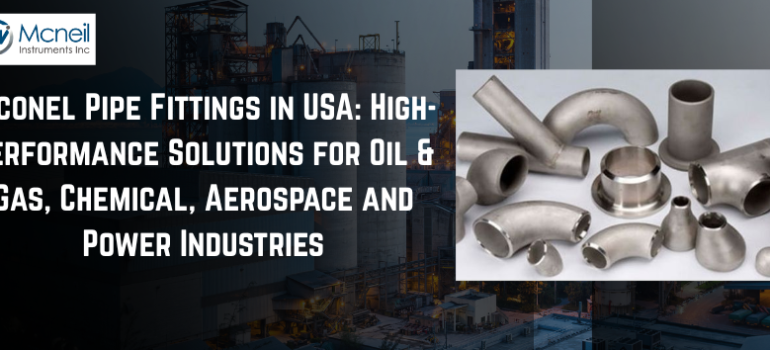
Inconel Pipe Fittings in USA: High-Performance Solutions for Oil & Gas, Chemical, Aerospace and Power Industries

Industrial piping systems across the United States often operate under demanding conditions involving high temperatures, pressure, corrosive chemicals, seawater, and cyclic mechanical stress. In such environments, conventional materials may not provide the required combination of strength and corrosion resistance.

Inconel Pipe Fittings are nickel-based alloy fittings developed for these demanding applications. Their resistance to oxidation, corrosion, thermal stress, and high-temperature degradation makes them suitable for critical piping systems across industries such as oil and gas, petrochemical processing, aerospace, power generation, marine engineering, and chemical processing. Mcneil Instruments manufactures and exports Inconel pipe fittings in grades including 600, 625, 718, 725, 800, and 800H.

What Are Inconel Pipe Fittings?

Inconel pipe fittings are high-performance piping components manufactured from nickel-chromium-based alloys. They are used to connect, redirect, reduce, or terminate piping systems carrying fluids or gases under challenging service conditions.

Mcneil Instruments’ range includes:

  • Inconel 45° Elbows
  • Inconel 90° Long Radius Elbows
  • Short Radius Elbows
  • Equal Tees
  • Reducing Tees
  • Crosses
  • Concentric Reducers
  • Eccentric Reducers
  • Pipe Caps
  • Stub Ends
  • Couplings
  • Nipples
  • Unions
  • Laterals
  • Custom Fabricated Pipe Fittings

The fittings are available in seamless, welded, fabricated, threaded, socket weld, and butt-weld configurations depending on the product and project requirements.


Why Inconel Pipe Fittings Are Important for USA Industries

The United States has extensive infrastructure in oil and gas, refining, petrochemicals, chemical processing, aerospace, nuclear power, thermal power, marine engineering, and industrial manufacturing.

Many of these applications involve conditions where material performance is critical.

Inconel alloys offer properties such as:

  • High-temperature strength
  • Oxidation resistance
  • Corrosion resistance
  • Resistance to pitting and crevice corrosion
  • Resistance to chloride environments
  • Resistance to thermal fatigue
  • Good mechanical strength
  • Performance under demanding pressure conditions

This makes Inconel fittings a suitable material option for selected critical piping applications.


Inconel 600 Pipe Fittings in USA

Inconel 600 (UNS N06600) is a nickel-chromium alloy known for its resistance to oxidation and corrosion across a broad temperature range.

Mcneil Instruments describes Inconel 600 fittings as suitable for high-temperature and oxidizing environments, including applications involving heat exchangers, furnaces, chemical processing, and nuclear systems.

Typical applications

  • Chemical processing equipment
  • Heat exchangers
  • Furnace components
  • Nuclear systems
  • High-temperature piping
  • Petrochemical equipment

Inconel 625 Pipe Fittings in USA

Inconel 625 (UNS N06625) provides a combination of high strength and corrosion resistance.

Its resistance to chloride attack, pitting, crevice corrosion, and aggressive environments makes it particularly relevant to marine, offshore, chemical, and oil and gas applications.

Typical applications

  • Offshore platforms
  • Marine piping
  • Chemical processing
  • Oil and gas systems
  • Seawater applications
  • Cryogenic systems

Inconel 718 Pipe Fittings in USA

Inconel 718 is a precipitation-hardenable nickel alloy recognized for high mechanical strength, creep resistance, and fatigue resistance.

It is particularly relevant where mechanical performance is critical at elevated temperatures.

Typical applications

  • Aerospace systems
  • Gas turbines
  • Power generation
  • High-pressure assemblies
  • Thermal equipment

Mcneil Instruments also supplies Inconel 718 components for aerospace, offshore, nuclear, petrochemical, marine, and power-generation applications.


Inconel 725 Pipe Fittings in USA

Inconel 725 is a high-strength nickel alloy with strong corrosion resistance.

It can be considered for pressure-critical applications where resistance to pitting and crevice corrosion is important.

Typical applications include:

  • Oilfield equipment
  • Offshore systems
  • Subsea applications
  • Chemical processing
  • High-pressure piping

Mcneil Instruments includes Inconel 725 among its pipe fitting grades.


Inconel 800 Pipe Fittings in USA

Inconel 800 is designed for elevated-temperature service and provides resistance to oxidation and high-temperature degradation.

It can be used in suitable:

  • Furnace systems
  • Petrochemical equipment
  • Heat exchangers
  • Refinery systems
  • High-temperature process piping

Inconel 800H Pipe Fittings in USA

Inconel 800H is intended for applications where prolonged exposure to elevated temperatures makes creep and rupture resistance important.

Potential applications include:

  • High-temperature process systems
  • Petrochemical plants
  • Heat-treatment equipment
  • Furnace systems
  • Pressure-containing equipment

Mcneil Instruments lists both Inconel 800 and 800H among its available pipe fitting grades.


Inconel Pipe Fittings for the US Oil & Gas Industry

The US oil and gas sector includes upstream production, midstream transportation, refineries, LNG facilities, and downstream processing.

Inconel fittings can be used in selected applications where piping components are exposed to:

  • High temperatures
  • High pressure
  • Corrosive process fluids
  • Sour environments
  • Chlorides
  • Offshore seawater exposure

Applications can include upstream and downstream oil and gas systems, offshore platforms, process piping, and specialized high-temperature equipment.

Material selection should always be based on the actual process chemistry and operating conditions.


Inconel Pipe Fittings for US Chemical and Petrochemical Plants

Chemical processing can expose piping components to aggressive chemicals and elevated temperatures.

Inconel alloys can provide advantages where corrosion resistance and high-temperature mechanical performance are required.

Potential applications include:

  • Chemical reactors
  • Process piping
  • Heat exchangers
  • Chemical transfer systems
  • Petrochemical processing units
  • High-temperature process equipment

Inconel 600 and 625 are particularly relevant to different chemical-processing environments depending on the process conditions.


Inconel Fittings for Aerospace Applications

The aerospace sector requires materials capable of maintaining mechanical performance under demanding temperature, pressure, and fatigue conditions.

Inconel 718 is particularly associated with high-strength applications such as gas turbines and aerospace systems.

Applications can include:

  • Aircraft engine systems
  • Gas turbines
  • High-temperature assemblies
  • Fuel systems
  • Hydraulic systems
  • Pressure-critical components

Inconel Pipe Fittings for Power Generation

Power-generation facilities operate equipment under elevated temperatures and pressure.

Inconel fittings can be considered for selected:

  • Boiler systems
  • Turbine systems
  • Heat-transfer circuits
  • High-temperature piping
  • Gas turbine systems
  • Nuclear power applications

The appropriate grade depends on the temperature, pressure, process medium, and applicable engineering specification.


Inconel Fittings for Marine and Offshore Applications

Marine environments expose piping components to seawater and chloride-rich conditions.

Inconel 625, for example, provides strong resistance to chloride-related corrosion and is used in marine and offshore applications.

Applications may include:

  • Offshore platforms
  • Subsea systems
  • Marine piping
  • Seawater systems
  • Offshore process equipment
  • Shipboard systems

ASTM and ASME Standards for Inconel Pipe Fittings

Industrial Inconel fittings should be specified according to the appropriate material, manufacturing, dimensional, and pressure requirements.

Mcneil Instruments states that its Inconel pipe fittings are manufactured and tested according to ASTM, ASME, ANSI, DIN, and international standards, depending on the product and application.

Project procurement should verify the exact standard required for:

  • Material grade
  • Fitting dimensions
  • Manufacturing method
  • Pressure class
  • Welding
  • Testing
  • Inspection

How to Choose Inconel Pipe Fittings for a US Project

Choosing the correct Inconel grade requires more than simply identifying the fitting size.

1. Operating Temperature

Determine normal, maximum, and cyclic operating temperatures.

2. Operating Pressure

Confirm the design and operating pressure of the piping system.

3. Process Chemistry

Review the fluid or gas being transported and identify potential corrosion mechanisms.

4. Corrosion Exposure

Consider:

  • Chlorides
  • Acids
  • Seawater
  • Oxidizing environments
  • Sour-gas conditions
  • High-temperature oxidation

5. Fitting Configuration

Specify whether the system requires:

  • Elbows
  • Tees
  • Reducers
  • Caps
  • Stub ends
  • Couplings
  • Unions
  • Custom fittings

6. Connection Type

Confirm whether the application requires:

  • Butt weld
  • Socket weld
  • Threaded
  • Fabricated
  • Seamless

7. Inspection Requirements

Critical US projects may require specific testing, documentation, material traceability, or third-party inspection.


Quality and Testing

Quality control is especially important when Inconel fittings are used in critical piping systems.

Depending on the project requirements, inspection may include:

  • Chemical composition testing
  • PMI testing
  • Mechanical testing
  • Dimensional inspection
  • Pressure testing
  • Leak testing
  • Non-destructive testing
  • Visual inspection
  • Material traceability
  • Mill Test Certificates

Mcneil Instruments states that its manufacturing process includes quality checks, material traceability, and testing aligned with ASTM/ASME and international standards.


Why Source Inconel Pipe Fittings from Mcneil Instruments?

Mcneil Instruments manufactures, supplies, stocks, and exports Inconel pipe fittings in multiple grades.

Its published range includes:

Inconel 600, 625, 718, 725, 800, and 800H.

The company states that its advantages include:

  • ISO-certified manufacturing
  • Precision machining
  • Ready stock availability
  • Custom manufacturing
  • Third-party inspection
  • Mill Test Certificates
  • Material traceability
  • International quality standards
  • Global shipping

Mcneil Instruments also explicitly lists the United States among the countries to which it exports Inconel pipe fittings.


Inconel Pipe Fittings Manufacturer, Supplier & Exporter for USA

For US industrial buyers, EPC contractors, distributors, and procurement teams, the right Inconel fitting should combine the correct alloy grade with the required dimensions, connection type, manufacturing standard, inspection requirements, and documentation.

Mcneil Instruments supplies Inconel pipe fittings from India for international industrial applications, including the United States, with grades and configurations suited to demanding oil and gas, chemical, petrochemical, aerospace, marine, and power-generation applications.


Conclusion

Inconel Pipe Fittings in USA are used in applications where ordinary materials may not provide sufficient resistance to high temperature, corrosion, pressure, and mechanical stress.

The Mcneil Instruments range includes Inconel 600, 625, 718, 725, 800, and 800H, allowing different grades to be selected for different service conditions.

From US oil and gas and petrochemical facilities to aerospace, power generation, chemical processing, marine, and offshore systems, Inconel fittings can provide the high-performance material properties required for demanding piping environments.

The correct grade should always be selected according to the application’s temperature, pressure, process chemistry, corrosion exposure, mechanical requirements, dimensions, and applicable ASTM/ASME specifications.

Frequently Asked Questions

What are Inconel pipe fittings used for?

Inconel pipe fittings are used for demanding piping applications involving high temperatures, pressure, corrosive chemicals, seawater, and mechanical stress across oil and gas, chemical, petrochemical, aerospace, marine, and power industries.

Which Inconel grades does Mcneil Instruments supply?

Mcneil Instruments lists Inconel 600, 625, 718, 725, 800, and 800H pipe fittings.

Are Inconel 625 fittings suitable for marine applications?

Inconel 625 offers strong resistance to chloride, pitting, crevice corrosion, and seawater-related environments, making it suitable for selected marine and offshore applications.

Which Inconel grade is used for aerospace applications?

Inconel 718 is widely associated with high-strength, heat-resistant applications such as aerospace and gas turbine systems. Mcneil Instruments includes 718 among its Inconel fitting grades.

Can Mcneil Instruments supply Inconel pipe fittings to the USA?

Yes. Mcneil Instruments explicitly lists the United States among its export markets for Inconel pipe fittings.

Are custom Inconel pipe fittings available?

Mcneil Instruments states that it offers custom fabrication and sizing for project-specific requirements.

What industries in the USA use Inconel pipe fittings?

Major applications include oil and gas, petrochemical, chemical processing, aerospace, power generation, marine, offshore, and nuclear-related systems.

Read More

Incoloy Pipe Fittings in the USA: High-Temperature & Corrosion-Resistant Solutions for Industrial Piping

Introduction: Why Incoloy Pipe Fittings Are Critical in Industrial Systems

In industries where pipelines face extreme heat, corrosive chemicals, and continuous pressure, standard materials often fail over time. That’s why high-performance alloys are essential.

This is where Incoloy pipe fittings stand out. These fittings are made from nickel-chromium-based superalloys, specifically designed to resist corrosion and maintain strength at elevated temperatures.

In the USA, industries such as oil & gas, petrochemicals, power generation, and chemical processing rely heavily on Incoloy pipe fittings because they deliver long-term reliability in demanding environments.

Common grades like Incoloy 800, 800H, 800HT, and 825 are widely used due to their excellent resistance to oxidation, carburization, and chemical corrosion.

What Are Incoloy Pipe Fittings?

Incoloy pipe fittings are piping components used to connect, redirect, or terminate pipelines while maintaining strength and corrosion resistance under extreme conditions.

They are typically manufactured as per ASTM B366 / ASME SB366 standards, ensuring durability and compatibility with industrial piping systems.

Common Types of Incoloy Pipe Fittings

• Elbows – change flow direction
• Tees – split or combine flow
• Reducers – connect different pipe sizes
• Caps – seal pipeline ends
• Stub Ends – used with lap joint flanges

These fittings are available in seamless, welded, and fabricated forms depending on application needs.

What Makes Incoloy Unique?

Incoloy is a family of nickel-iron-chromium alloys designed for high-temperature strength and corrosion resistance.

Key Characteristics

• Excellent resistance to oxidation and carburization
• Strong performance in acidic and chemical environments
• Maintains mechanical strength at high temperatures
• Good weldability without loss of corrosion resistance

Unlike standard stainless steel, Incoloy alloys are engineered to perform in extreme thermal and chemical conditions.

Chemical Composition of Incoloy Pipe Fittings

The performance of Incoloy pipe fittings comes from their balanced alloy composition.

Typical Elements

ElementFunction
Nickel (Ni)Provides corrosion resistance and strength
Chromium (Cr)Improves oxidation resistance
Iron (Fe)Adds structural stability
Molybdenum (Mo)Enhances resistance to chemical attack

For example, Incoloy 800 contains nickel and chromium, offering excellent resistance to oxidation and high-temperature environments.

Mechanical Properties of Incoloy Pipe Fittings

Incoloy alloys are designed to maintain strength under extreme conditions.

PropertyTypical Value
Tensile Strength~520 MPa
Yield Strength~205 MPa
Elongation~30%
Melting Point~1385°C

These properties allow Incoloy pipe fittings to perform reliably in high-pressure and high-temperature environments.

Key Advantages of Incoloy Pipe Fittings

Exceptional Corrosion Resistance

Resists acids, chlorides, and harsh chemical environments.

High Temperature Stability

Maintains strength even above 1000°C in certain grades.

Resistance to Oxidation and Carburization

Ideal for furnace and heat-processing applications.

Excellent Mechanical Strength

Performs well under pressure and stress.

Long Service Life

Reduces maintenance and replacement costs.

Incoloy fittings are widely used because they combine corrosion resistance with high-temperature durability.

Technical Specifications of Incoloy Pipe Fittings

SpecificationDetails
StandardASTM B366 / ASME SB366
Grades800, 800H, 800HT, 825
Size Range½″ to 48″
Wall ThicknessSCH 5 to SCH XXS
Manufacturing TypeSeamless / Welded / Fabricated
Pressure StandardASME B16.9 / B16.11

These specifications ensure compatibility with global piping systems.

Industrial Applications of Incoloy Pipe Fittings in the USA

The USA has a strong industrial base with demanding operating conditions. Incoloy pipe fittings are widely used across multiple sectors.

Oil and Gas Industry

Used in pipelines, refineries, and offshore platforms.

Petrochemical Industry

Handles high-temperature and corrosive chemicals.

Power Generation

Used in boilers, heat exchangers, and steam systems.

Chemical Processing Plants

Ideal for acidic and aggressive environments.

Aerospace and Heat Treatment

Used in furnace components and high-temperature systems.

Incoloy fittings are commonly used in oil & gas pipelines, chemical plants, and power plants due to their durability and resistance.

Major Incoloy Pipe Fitting Grades

Incoloy 800 Pipe Fittings

Widely used for general high-temperature applications.

Key Characteristics

• Good oxidation resistance
• Stable structure at high temperatures
• Excellent mechanical strength

Applications

• Heat exchangers
• Chemical plants
• Furnace components

Incoloy 800H Pipe Fittings

Designed for improved creep resistance at elevated temperatures.

Applications

• Petrochemical plants
• High-temperature pipelines
• Industrial furnaces

Incoloy 800HT Pipe Fittings

Enhanced version with superior strength and thermal stability.

Applications

• Power plants
• Heat treatment systems
• High-temperature equipment

Incoloy 825 Pipe Fittings

Offers excellent resistance to acids and corrosion.

Applications

• Chemical processing
• Acid handling systems
• Marine environments

Comparison of Incoloy Grades

GradeKey FeatureAdvantageTypical Applications
800Ni-Cr alloyOxidation resistanceHeat exchangers
800HControlled carbonBetter creep strengthHigh-temp pipelines
800HTRefined compositionSuperior thermal stabilityPower plants
825Ni-Fe-Cr-MoExcellent corrosion resistanceChemical processing

Quality Testing of Incoloy Pipe Fittings

To ensure safety and performance, these fittings undergo strict testing procedures:

• Chemical composition testing
• Mechanical strength testing
• Hydrostatic pressure testing
• Ultrasonic testing
• Radiographic inspection
• Positive Material Identification (PMI)
• Dimensional inspection

These tests ensure compliance with international standards and reliable performance.

Conclusion

Incoloy pipe fittings are among the most reliable solutions for industrial piping systems exposed to extreme heat, pressure, and corrosive environments. Their nickel-based composition provides excellent resistance to oxidation, corrosion, and mechanical stress.

In the USA, industries like oil & gas, petrochemicals, and power generation depend on Incoloy pipe fittings (800, 800H, 800HT, 825) for safe and efficient operations.

With their ability to perform in harsh environments and deliver long-term durability, Incoloy fittings remain a critical component in modern industrial infrastructure.

Read More