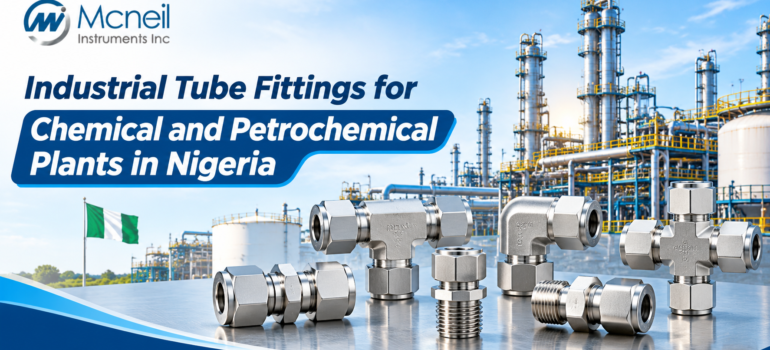
Stainless Steel Tube Fittings are essential components in industrial instrumentation, hydraulic, pneumatic, and fluid-handling systems. Designed to connect tubing securely, these fittings help maintain reliable flow paths for liquids and gases across demanding industrial applications. Their corrosion resistance, mechanical strength, and precision-engineered connections make them suitable for environments where dependable performance and leak prevention are important.
Mcneil Instruments offers Stainless Steel Tube Fittings in multiple grades, including SS 304, SS 304L, SS 316, SS 316L, SS 321, SS 347, Duplex 2205, Super Duplex 2507, 17-4PH, and 15-5PH. These fittings support industrial requirements across oil and gas, petrochemical processing, marine engineering, pharmaceuticals, food processing, power generation, and instrumentation systems.
For Nigerian industries, choosing the appropriate tube fitting requires careful consideration of material grade, tube dimensions, connection type, pressure requirements, and operating conditions. Mcneil Instruments supplies tube fitting solutions for projects requiring precision, durability, and compliance with applicable technical specifications.
What Are Stainless Steel Tube Fittings?
Stainless Steel Tube Fittings are precision-engineered connectors used to join, redirect, branch, or terminate tubing in industrial systems. They are commonly installed in instrumentation panels, hydraulic circuits, pneumatic systems, process control equipment, and fluid distribution networks.
Depending on the design, tube fittings may use compression ferrules, threaded connections, or other specified connection arrangements. Compression fittings are particularly useful in instrumentation systems because they can provide secure tubing connections without requiring the tube to be welded directly to the fitting.
Stainless steel construction offers a combination of mechanical strength and corrosion resistance. The suitability of a fitting depends on the grade, pressure rating, tube material, fluid compatibility, temperature, and installation procedure.
Key Functions of Stainless Steel Tube Fittings
Connect stainless steel tubing to instruments, valves, and other equipment.
Provide connections for liquid and gas transmission systems.
Support pressure-containing instrumentation applications.
Enable branching, direction changes, and transitions between connection types.
Simplify installation and maintenance of tubing networks.
Help reduce leakage risks when correctly selected and installed.
Mcneil Instruments lists several stainless steel and specialty alloy options for industrial tube fitting applications. Each grade has different properties, making material selection dependent on the intended service environment.
- Stainless Steel 304 Tube Fittings
SS 304 is a widely used austenitic stainless steel grade that offers good general corrosion resistance, strength, and fabrication characteristics.
Typical applications:
General industrial instrumentation
Manufacturing equipment
Food and beverage processing systems
Utility lines
Suitable fluid and gas handling applications
SS 304 is a practical option for many general-purpose applications where the environment does not require the additional corrosion resistance of a higher-alloy grade.
- Stainless Steel 304L Tube Fittings
SS 304L is the low-carbon version of SS 304. Its lower carbon content helps reduce the risk of sensitization during welding under appropriate fabrication conditions.
Typical applications:
Fabricated instrumentation assemblies
Industrial process equipment
Chemical processing systems
Applications requiring welded stainless steel components
The choice between SS 304 and SS 304L should reflect the fabrication method, service environment, and applicable material specification.
- Stainless Steel 316 Tube Fittings
SS 316 contains molybdenum, which improves resistance to pitting and crevice corrosion in many chloride-containing environments compared with SS 304.
Typical applications:
Marine and offshore equipment
Oil and gas instrumentation
Chemical processing plants
Petrochemical facilities
Water treatment systems
SS 316 is commonly considered for applications where moisture, chlorides, or corrosive process conditions make enhanced corrosion resistance important.
- Stainless Steel 316L Tube Fittings
SS 316L combines the corrosion-resistance characteristics of SS 316 with a lower carbon content. It is frequently selected for applications involving welded assemblies and demanding industrial environments.
Typical applications:
Offshore instrumentation systems
Chemical processing equipment
Pharmaceutical production systems
Marine installations
Selected water treatment applications
- Stainless Steel 321 Tube Fittings
SS 321 is a titanium-stabilized austenitic stainless steel grade. It is used in selected applications where elevated-temperature service and resistance to intergranular corrosion are relevant considerations.
Typical applications:
Industrial heating systems
Selected high-temperature process equipment
Thermal processing installations
Applications specified for stabilized stainless steel
- Stainless Steel 347 Tube Fittings
SS 347 is a niobium-stabilized stainless steel grade used in applications where elevated-temperature properties and resistance to intergranular corrosion are important.
Typical applications:
Selected high-temperature process systems
Power generation equipment
Industrial thermal systems
Applications requiring a stabilized stainless steel grade
- Duplex 2205 Tube Fittings
Duplex 2205 combines austenitic and ferritic microstructures. It offers higher strength than many conventional austenitic stainless steels and enhanced resistance to several forms of corrosion.
Typical applications:
Oil and gas processing
Offshore installations
Chemical processing systems
Water treatment facilities
Selected marine applications
- Super Duplex 2507 Tube Fittings
Super Duplex 2507 is a high-alloy duplex stainless steel developed for demanding environments requiring high strength and enhanced corrosion resistance, particularly in suitable chloride-containing services.
Typical applications:
Offshore oil and gas systems
Seawater handling equipment
Desalination installations
Marine engineering
Aggressive industrial process environments
- 17-4PH and 15-5PH Tube Fittings
These precipitation-hardening stainless steel grades are associated with applications requiring high strength and specific mechanical properties. Their suitability depends on the required material condition, corrosion exposure, and engineering specification.
For all grades, the final selection should be based on actual operating conditions rather than the grade name alone.
Types of Stainless Steel Tube Fittings
Different fitting configurations support different tubing layouts and equipment connections.
Stainless Steel Compression Tube Fittings
Compression fittings use components such as a fitting body, nut, and ferrule system to create a connection around the tube. Correct tube preparation, dimensional compatibility, and installation procedure are essential to achieve reliable sealing.
They are widely used in instrumentation, pneumatic, and fluid handling systems.
Stainless Steel Double Ferrule Tube Fittings
Double ferrule fittings use two ferrules designed to perform different functions within the connection assembly. The front ferrule helps establish the seal, while the back ferrule provides gripping and support according to the fitting design.
These fittings are commonly selected for instrumentation applications that require dependable tube connections. Their performance depends on compatibility between the fitting, tubing dimensions, material, and installation method.
Stainless Steel Male Connectors
Male connectors connect tubing to female-threaded ports on valves, instruments, manifolds, and other equipment.
Connection options may include NPT, BSPT, BSPP, or metric threads, depending on the specified configuration.
Stainless Steel Male Elbows
Male elbows allow tubing to connect to threaded ports while changing the direction of the flow path. They can help reduce the space required for tubing arrangements in compact instrumentation installations.
Stainless Steel Tees
Tube fitting tees create branch connections within a tubing network. Different configurations are available according to the required run and branch connections.
Stainless Steel Bulkhead Connectors
Bulkhead connectors provide tubing connections through panels, enclosures, or equipment walls. They are useful in instrumentation cabinets and process control assemblies where tubing must pass through a mounting surface.
Stainless Steel Reducing Connectors
Reducing connectors accommodate specified transitions between different tube sizes or connection dimensions. The fitting must be compatible with both connected components and the intended operating pressure.
Technical Specifications of Stainless Steel Tube Fittings
Mcneil Instruments publishes the following specifications for its tube fitting range. Confirm the exact grade, dimensions, pressure rating, and connection configuration for the specific product before ordering.
Parameter Published details
Product Stainless Steel Tube Fittings
Material grades SS 304, 304L, 316, 316L, 321, 347, Duplex 2205, Super Duplex 2507, 17-4PH and 15-5PH
Tube size range 1/16 inch OD to 2 inches OD, with metric sizes up to 50 mm OD listed for the broader tube fitting range
Stainless steel pressure rating Up to 6,000 PSI for the broader tube fitting range
Thread types NPT/NPTF, BSP, JIS PT, SAE and metric tapered or parallel threads
Fitting configurations Compression fittings, connectors, elbows, tees, bulkhead fittings and adapters
Applications Instrumentation, hydraulic, pneumatic and fluid handling systems
Pressure ratings vary according to the fitting design, material, tube dimensions, temperature, and connection configuration. The published maximum should not be interpreted as the allowable working pressure of every fitting.
Stainless Steel Tube Fittings for Nigerian Industries
Nigeria has industrial requirements across oil and gas, petrochemicals, power generation, marine operations, manufacturing, and water treatment. Stainless Steel Tube Fittings can support these sectors when the selected material and connection are appropriate for the operating environment.
Oil and Gas Industry
Instrumentation tubing systems are used to connect pressure instruments, control equipment, sampling systems, and process monitoring devices. Stainless steel tube fittings may be specified for suitable liquid and gas services in onshore and offshore facilities.
Material selection should account for pressure, temperature, process media, corrosion exposure, and project-specific requirements.
Petrochemical and Chemical Processing
Chemical plants require tubing connections compatible with the fluids and operating conditions involved. SS 316, SS 316L, Duplex 2205, and Super Duplex 2507 may be considered for suitable applications where enhanced corrosion resistance is required.
The process fluid and possible corrosion mechanisms must be evaluated before selecting the material.
Marine and Offshore Engineering
Coastal and offshore facilities may expose fittings to salt-laden atmospheres and chloride-containing environments. SS 316 and suitable duplex grades may provide advantages over general-purpose stainless steel in some applications.
The required grade should be determined by the actual exposure conditions and engineering specification.
Power Generation
Power plants use instrumentation systems to monitor pressure, temperature, and other operating parameters. Stainless steel tube fittings help connect instruments and tubing assemblies used in these systems.
The fitting’s pressure and temperature limits must match the intended service.
Pharmaceutical and Food Processing
Stainless steel components are used in suitable pharmaceutical and food processing systems because of their corrosion resistance and cleanability characteristics. The required grade, surface finish, and cleaning compatibility depend on the particular application.
Water Treatment and Desalination
Water treatment facilities use tubing and instrumentation connections throughout process monitoring and control systems. For seawater and chloride-rich environments, higher-alloy materials may be considered where justified by the service conditions.
Benefits of Stainless Steel Tube Fittings
Corrosion Resistance
Suitable stainless steel grades resist corrosion in a range of industrial environments. Higher-alloy grades may be required where chloride exposure or aggressive process media are present.
Secure Connections
Correctly selected and installed tube fittings provide reliable connections for instrumentation and fluid handling systems. Proper installation is critical to sealing performance.
Mechanical Strength
Stainless steel fittings offer useful strength for industrial service. The allowable pressure depends on the fitting design, material, dimensions, temperature, and connected tubing.
Installation Flexibility
Threaded, compression, and other connection configurations allow tubing to be integrated with instruments, valves, manifolds, and equipment ports.
Maintenance Convenience
Suitable fitting designs can simplify tubing assembly, inspection, and replacement during planned maintenance.
Material Versatility
The availability of multiple stainless steel and duplex grades allows engineers to select materials according to corrosion exposure, mechanical requirements, and operating conditions.
How to Select the Right Stainless Steel Tube Fittings
Selecting the correct fitting is essential for maintaining the integrity of an instrumentation or fluid handling system.
- Confirm the tube outside diameter
Specify the tube outside diameter accurately. A fitting designed for a different tube dimension may not seal or grip correctly.
- Select the material grade
Choose SS 304, SS 316, a suitable stabilized grade, or a duplex alloy according to corrosion conditions, process media, and mechanical requirements.
- Determine operating pressure and temperature
Confirm normal and maximum design conditions. Check the fitting’s allowable pressure at the intended operating temperature.
- Specify the connection type
Identify the required thread standard, compression connection, adapter, or other configuration. Do not assume that different thread standards are interchangeable.
- Check fluid compatibility
Consider the chemical composition, concentration, temperature, and other characteristics of the process fluid or gas.
- Confirm tubing compatibility
The tubing material, hardness, wall thickness, outside diameter, and surface condition must be compatible with the fitting design.
- Review testing and documentation
Define material certification, inspection, traceability, and any required pressure or leak testing before placing the order.
Quality Assurance and Inspection
Quality verification helps ensure that Stainless Steel Tube Fittings conform to the specified material and dimensional requirements.
Depending on the product and project specification, relevant checks may include:
Material verification: Confirms the specified grade and material identification.
Dimensional inspection: Verifies tube connection dimensions, thread details, and fitting geometry.
Thread inspection: Checks thread type, dimensions, and conformity with the specified connection standard.
Chemical analysis: Verifies material chemistry where required.
Mechanical testing: Confirms specified mechanical properties where applicable.
Positive Material Identification (PMI): Helps verify alloy composition when required by the project.
Pressure or leak testing: Conducted according to the fitting design and applicable inspection requirements.
Material Test Certificates: Provide relevant material and test information as specified.
Traceability documentation: Helps link supplied products to their material and inspection records.
Not every test applies to every fitting. Testing and acceptance criteria should be agreed upon according to the applicable standard and purchase order.
Mcneil Instruments offers a range of stainless steel and specialty alloy tube fittings for industrial applications. Its product range includes SS 304, SS 304L, SS 316, SS 316L, SS 321, SS 347, Duplex 2205, Super Duplex 2507, 17-4PH, and 15-5PH.
For Nigerian procurement teams, specifying the complete technical requirements helps identify the appropriate fitting for each application.
When requesting a quotation, provide:
Required material grade
Tube outside diameter and wall thickness
Fitting type and configuration
Thread type and size
Design pressure and operating temperature
Process fluid or gas
Applicable standards
Testing and certification requirements
Required quantity and delivery location
Mcneil Instruments supports industrial supply and export enquiries for customers seeking stainless steel tube fittings for Nigerian projects. Product availability, delivery schedules, and documentation should be confirmed for each order.
Frequently Asked Questions
What are Stainless Steel Tube Fittings used for?
Stainless Steel Tube Fittings connect tubing to other tubes, instruments, valves, manifolds, and equipment. They are used in instrumentation, hydraulic, pneumatic, and industrial fluid handling systems.
Which stainless steel tube fitting grades are available?
Mcneil Instruments lists SS 304, SS 304L, SS 316, SS 316L, SS 321, SS 347, Duplex 2205, Super Duplex 2507, 17-4PH, and 15-5PH for its tube fitting range. Confirm the required grade and product availability when enquiring.
What is the difference between SS 304 and SS 316 tube fittings?
SS 304 is widely used for general industrial applications. SS 316 contains molybdenum, which generally improves resistance to pitting and crevice corrosion in chloride-containing environments. The suitable grade depends on the service conditions.
What are double ferrule tube fittings?
Double ferrule tube fittings use two ferrules within the connection assembly to provide sealing and gripping functions. They are commonly used in instrumentation tubing systems where reliable connections are required.
What sizes are available?
The broader Mcneil Instruments tube fitting range lists sizes from 1/16 inch OD to 2 inches OD, with metric sizes up to 50 mm OD. Confirm availability for the specific fitting design and material.
What pressure rating can Stainless Steel Tube Fittings support?
Mcneil Instruments lists pressure ratings up to 6,000 PSI for its broader stainless steel tube fitting range. The applicable working pressure must be verified for the specific fitting, tube dimensions, temperature, and connection configuration.
Are Stainless Steel Tube Fittings suitable for Nigerian oil and gas projects?
They can be suitable for oil and gas instrumentation systems when the selected grade, connection, pressure rating, and material documentation meet the project’s requirements. Offshore and chloride-rich applications may require more corrosion-resistant materials.
Which thread types can be specified?
The broader tube fitting range lists NPT/NPTF, BSP, JIS PT, SAE, and metric tapered or parallel threads. Confirm the exact thread standard and dimensions before ordering.
What information is required to order tube fittings?
Provide the material grade, tube outside diameter, wall thickness, fitting configuration, thread type, pressure and temperature requirements, process medium, inspection requirements, quantity, and delivery location.
Conclusion
Stainless Steel Tube Fittings are important components in industrial instrumentation and fluid handling systems, where secure connections, material compatibility, and dependable performance are essential. Grades such as SS 304, SS 316, SS 316L, Duplex 2205, and Super Duplex 2507 serve different operating environments and should be selected according to the project’s technical requirements.
Mcneil Instruments offers stainless steel tube fitting options for industrial buyers seeking a Stainless Steel Tube Fittings Manufacturer, Supplier & Exporter in Nigeria. By confirming tube dimensions, material grade, connection type, pressure rating, and inspection requirements, procurement teams can make more informed decisions for their industrial projects.