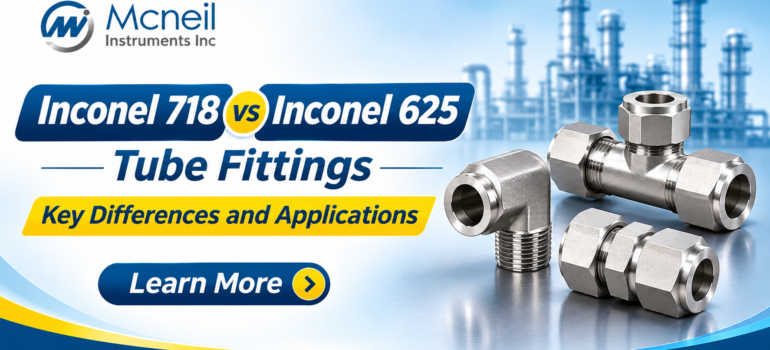
Inconel 718 vs Inconel 625 tube fittings comparison highlighting key differences, material properties, corrosion resistance, and industrial applications by Mcneil Instruments Inc.

Inconel 718 vs Inconel 625 Tube Fittings: Key Differences and Applications – Mcneil Instruments

Introduction

Selecting the right material for tube fittings is essential in industries where components are exposed to high temperatures, pressure, corrosive chemicals, and demanding operating conditions. Inconel alloys are widely used in such environments because of their excellent mechanical strength, oxidation resistance, and ability to perform under extreme service conditions.

Among the different nickel-based superalloys, Inconel 718 and Inconel 625 are two popular choices for industrial applications. Both alloys offer excellent corrosion resistance and high-temperature performance, but they differ in chemical composition, mechanical strength, heat treatment requirements, and application suitability.

Inconel 625 is primarily known for its outstanding corrosion resistance and resistance to oxidation, making it suitable for marine, chemical processing, offshore, and oil and gas applications. Inconel 718, on the other hand, is a precipitation-hardening nickel-based alloy known for its exceptionally high strength and fatigue resistance, particularly in high-pressure and high-temperature environments.

For manufacturers, engineers, and procurement professionals sourcing high-performance tube fittings, understanding these differences helps ensure better material selection, operational reliability, and long-term performance.

At Mcneil Instruments, we understand the importance of selecting suitable materials for industrial instrumentation and fluid control systems. In this blog, we explore the differences between Inconel 718 and Inconel 625 tube fittings, including their properties, corrosion resistance, advantages, and industrial applications.

What Are Inconel Tube Fittings?

Inconel tube fittings are specialized connectors manufactured using nickel-based superalloys. They are designed to connect tubing in industrial systems where conventional stainless steel materials may not provide the required performance.

These fittings are commonly used in high-pressure instrumentation systems, chemical processing facilities, offshore installations, power plants, and oil and gas operations.

Depending on the application and design requirements, Inconel tube fittings may include:
Tube connectors
Union fittings
Elbow fittings
Tee fittings
Male and female connectors
Bulkhead connectors
Reducer fittings
Instrumentation tube fittings
The selection of Inconel 625 or Inconel 718 depends on operating pressure, temperature, chemical exposure, mechanical loading, and applicable engineering specifications.

What Is Inconel 625?

Inconel 625 is a nickel-based superalloy primarily known for its excellent corrosion resistance, oxidation resistance, and high strength across a wide range of temperatures.

Its chemical composition includes nickel, chromium, molybdenum, and niobium. The combination of these elements provides excellent resistance to pitting, crevice corrosion, and many aggressive chemical environments.

Unlike precipitation-hardening alloys, Inconel 625 primarily derives its strength from solid-solution strengthening.

Key properties of Inconel 625:
Excellent resistance to general corrosion.
High resistance to pitting and crevice corrosion.
Good resistance to chloride-induced stress corrosion cracking.
Excellent oxidation resistance.
Good mechanical strength at elevated temperatures.
Suitable for demanding marine and chemical environments.
Good weldability and fabrication characteristics.

Common applications of Inconel 625 tube fittings:
Offshore oil and gas installations.
Marine engineering systems.
Chemical processing equipment.
Heat exchangers.
Seawater handling systems.
Pollution control equipment.
Aerospace components.
Industrial instrumentation systems.
Inconel 625 is particularly suitable for applications where corrosion resistance is a major consideration.

What Is Inconel 718?

Inconel 718 is a high-strength nickel-based superalloy designed for applications requiring excellent mechanical strength, fatigue resistance, and performance under elevated temperatures.

It contains nickel, chromium, iron, molybdenum, niobium, and other alloying elements. Its strength is primarily developed through precipitation hardening using controlled heat treatment.

Inconel 718 is widely used in aerospace, gas turbines, high-pressure equipment, and demanding industrial applications.

Key properties of Inconel 718:
Very high tensile and yield strength after appropriate heat treatment.
Excellent fatigue resistance.
Good creep and rupture strength.
Good oxidation resistance.
Strong performance at elevated temperatures.
Good resistance to stress corrosion cracking in many environments.
Suitable for high mechanical loading applications.

Common applications of Inconel 718 tube fittings:
Aerospace systems.
Gas turbine equipment.
High-pressure instrumentation systems.
Oil and gas equipment.
Power generation facilities.
Industrial process equipment.
High-temperature engineering applications.

Inconel 718 is particularly suitable when mechanical strength and resistance to fatigue are critical design requirements.

Inconel 718 vs Inconel 625: Chemical Composition

The chemical composition of these two alloys is responsible for their different mechanical and corrosion-resistant properties.

Chemical Element Inconel 625 Inconel 718
Nickel (Ni) 58% minimum 50–55%
Chromium (Cr) 20–23% 17–21%
Molybdenum (Mo) 8–10% 2.8–3.3%
Niobium (Nb) 3.15–4.15% 4.75–5.5%
Iron (Fe) 5% maximum Balance
Titanium (Ti) 0.4% maximum 0.65–1.15%
Aluminium (Al) 0.4% maximum 0.2–0.8%
Note: Values are approximate typical specification ranges. Exact limits depend on the applicable material standard and product specification.

The higher chromium and molybdenum content in Inconel 625 provides excellent corrosion resistance. Inconel 718 contains additional strengthening elements, including niobium, titanium, and aluminium, which contribute to its precipitation-hardening characteristics.

Corrosion Resistance: Inconel 718 vs Inconel 625

Corrosion resistance is a critical factor when selecting tube fittings for industrial applications, particularly in environments involving seawater, chemicals, moisture, and aggressive operating conditions.

Inconel 625 Corrosion Resistance
Inconel 625 offers excellent resistance to various corrosive environments. Its chromium and molybdenum content helps protect against oxidation, pitting, crevice corrosion, and localized corrosion.

It is particularly suitable for:
Marine and seawater applications.
Offshore oil and gas installations.
Chemical processing equipment.
Chloride-containing environments.
Industrial pollution control systems.

Inconel 718 Corrosion Resistance
Inconel 718 also provides good corrosion and oxidation resistance. However, its primary advantage is its high mechanical strength rather than maximum corrosion resistance.

It is suitable for applications involving elevated temperatures, mechanical stress, and demanding operating conditions. Its corrosion performance should be evaluated against the specific chemicals, temperatures, and environmental exposure involved.

Which Alloy Offers Better Corrosion Resistance?
In general, Inconel 625 offers better corrosion resistance than Inconel 718, especially in aggressive chloride-containing and marine environments. For applications where corrosion resistance is the primary requirement, Inconel 625 is often the preferred choice.

Mechanical Strength: Inconel 718 vs Inconel 625

Mechanical strength is another major difference between these two nickel-based alloys.

Inconel 718 is precipitation-hardenable, which allows it to achieve significantly higher tensile and yield strength after the specified heat treatment.

Inconel 625, meanwhile, offers good mechanical strength combined with excellent corrosion resistance and fabrication characteristics.

Mechanical Property Inconel 625 Inconel 718
Tensile Strength Around 827 MPa minimum Around 1,240 MPa minimum
Yield Strength Around 414 MPa minimum Around 1,034 MPa minimum
Strengthening Method Solid-solution strengthening Precipitation hardening
Fatigue Resistance Good Excellent
Corrosion Resistance Excellent Good
Weldability Generally excellent Requires controlled procedures

Note: Mechanical properties are indicative reference values and vary with product form, heat treatment, temperature, and applicable specifications. They should not be treated as universal tube-fitting design values.

For high-pressure applications involving substantial mechanical loading, Inconel 718 may offer an advantage because of its higher strength. However, actual fitting pressure ratings depend on geometry, wall thickness, connection design, manufacturing quality, and testing requirements.

High-Temperature Performance

Both alloys are used in high-temperature industrial environments, but their performance characteristics differ.

Inconel 625: Offers excellent oxidation resistance and maintains useful mechanical properties at elevated temperatures. It is widely used in heat exchangers, chemical processing equipment, marine systems, and industrial furnace components.

Inconel 718: Is particularly well known for maintaining high mechanical strength, fatigue resistance, and creep resistance under elevated-temperature conditions. It is widely used in gas turbines, aerospace engines, and high-performance engineering equipment.

The appropriate grade should be selected according to the actual operating temperature, mechanical load, exposure conditions, and design requirements.

Applications of Inconel 625 Tube Fittings

Inconel 625 tube fittings are commonly selected for industrial environments where corrosion resistance and reliable fluid or gas connections are important.

Major applications include:

  1. Oil and Gas Industry: Used in offshore installations, instrumentation systems, chemical injection lines, and applications exposed to corrosive fluids.
  2. Marine Industry: Suitable for seawater-related equipment and marine engineering systems because of its resistance to chloride-induced corrosion.
  3. Chemical Processing: Used in equipment handling aggressive chemicals and corrosive process media, subject to chemical compatibility.
  4. Power Generation: Applied in heat exchangers and other equipment exposed to elevated temperatures and demanding service conditions.
  5. Aerospace Industry: Used in selected engine and exhaust-related components requiring corrosion and oxidation resistance.

Applications of Inconel 718 Tube Fittings

Inconel 718 tube fittings are considered for applications where high mechanical strength and performance under demanding operating conditions are essential.

Major applications include:

  1. Aerospace Industry: Used in aircraft engine components, fuel systems, and high-performance engineering applications.
  2. Gas Turbine Systems: Suitable for components exposed to high mechanical stress and elevated temperatures.
  3. Oil and Gas Equipment: Used in selected high-strength components, instrumentation assemblies, and equipment requiring strong mechanical performance.
  4. Power Generation: Applied in demanding mechanical and high-temperature equipment.
  5. Industrial Engineering: Used in specialized systems where high tensile strength, fatigue resistance, and durability are required.

How to Choose Between Inconel 718 and Inconel 625 Tube Fittings?

Selecting the correct alloy depends on the actual operating environment and technical requirements of your industrial system.

Consider these important factors before making a decision:
Corrosion Exposure: Choose Inconel 625 when excellent resistance to chloride-induced corrosion and aggressive environments is a priority.
Mechanical Strength: Consider Inconel 718 when high tensile strength, fatigue resistance, and mechanical loading are major requirements.
Operating Temperature: Evaluate the temperature range and expected mechanical loads before selecting the material.
Chemical Compatibility: Identify the process fluids and chemicals that will come into contact with the fittings.
Pressure Requirements: Verify the fitting design, wall thickness, connection type, and applicable pressure ratings.
Manufacturing Standards: Confirm material specifications, heat treatment, inspection, and testing requirements.
Project Budget: Compare material costs with expected service life, maintenance, and replacement requirements.

It is also important to confirm whether the selected alloy is available in the required tube-fitting configuration and product specification. Material selection should always be supported by engineering calculations and application-specific requirements.

Why Choose Mcneil Instruments for Inconel Tube Fittings?

Choosing the right supplier is important when sourcing specialized nickel alloy tube fittings for industrial instrumentation and fluid control systems.

Mcneil Instruments focuses on industrial piping and instrumentation products, supporting customers across oil and gas, petrochemical, chemical processing, power generation, and other engineering industries.

We understand that different applications require different material grades, connection configurations, dimensions, and technical specifications.

Why consider Mcneil Instruments?
Expertise in industrial instrumentation and piping products.
Support for specialized alloy material requirements.
Product options based on project specifications.
Focus on material quality and dimensional requirements.
Support for domestic and international procurement.
Solutions for demanding industrial applications.
Whether your project requires Inconel 625 for corrosion-resistant applications or Inconel 718 for high-strength requirements, selecting the correct material and fitting configuration is essential.

Conclusion

Inconel 718 and Inconel 625 are both high-performance nickel-based alloys used in demanding industrial applications. However, they serve different engineering requirements.

Inconel 625 is generally preferred for applications requiring excellent corrosion resistance, particularly in marine, offshore, and chemical processing environments. Inconel 718 is better suited to applications requiring exceptionally high mechanical strength, fatigue resistance, and performance under elevated temperatures.

For industrial tube fittings, the final material selection should consider corrosion exposure, operating pressure, temperature, mechanical loading, and applicable engineering standards.

Mcneil Instruments supports industrial buyers looking for suitable instrumentation and alloy product solutions. Contact our team to discuss your Inconel 625 and Inconel 718 tube fitting requirements.

Looking for a Reliable Inconel Tube Fittings Supplier in India?

Choose Mcneil Instruments for industrial instrumentation and alloy product requirements. Whether you need Inconel 625 tube fittings for corrosion-resistant applications or Inconel 718 for high-strength engineering requirements, our team can help you explore suitable material options.

Contact Mcneil Instruments today to discuss your technical requirements and request a competitive quotation.

Frequently Asked Questions (FAQs)

  1. What is the main difference between Inconel 718 and Inconel 625?
    The main difference is their performance characteristics. Inconel 625 offers superior corrosion resistance due to its higher chromium and molybdenum content, while Inconel 718 provides significantly higher mechanical strength through precipitation hardening.
  2. Which is better for tube fittings, Inconel 718 or Inconel 625?
    The choice depends on the application. Inconel 625 is generally preferred for corrosive environments, while Inconel 718 is suitable for applications requiring high mechanical strength and fatigue resistance.
  3. Is Inconel 625 more corrosion-resistant than Inconel 718?
    Yes. Inconel 625 generally provides better resistance to pitting, crevice corrosion, and chloride-containing environments because of its higher chromium and molybdenum content.
  4. Why is Inconel 718 used in high-pressure applications?
    Inconel 718 offers high tensile strength and yield strength after appropriate heat treatment. These properties make it suitable for components exposed to significant mechanical loading. Actual pressure suitability depends on the fitting design and engineering calculations.
  5. Can Inconel 625 be used in marine applications?
    Yes. Inconel 625 is widely used in marine and offshore applications because of its excellent resistance to seawater-related corrosion, pitting, and crevice corrosion.
  6. Is Inconel 718 suitable for high-temperature applications?
    Yes. Inconel 718 offers excellent strength, fatigue resistance, and creep performance at elevated temperatures, making it suitable for gas turbines, aerospace equipment, and other demanding engineering applications.
  7. What industries use Inconel 625 tube fittings?
    Inconel 625 tube fittings are used in oil and gas, offshore engineering, marine systems, chemical processing, power generation, and selected aerospace applications.
  8. What industries use Inconel 718 tube fittings?
    Inconel 718 is used in aerospace, gas turbines, oil and gas equipment, power generation, and specialized industrial systems requiring high mechanical strength.
  9. Can Inconel 718 and Inconel 625 be welded?
    Both alloys can be welded using suitable procedures. Inconel 625 generally offers better weldability, while Inconel 718 requires more controlled welding and post-weld heat treatment considerations depending on the application.
  10. Where can I find Inconel tube fittings in India?
    You can contact Mcneil Instruments for Inconel alloy tube fitting requirements. Share your required alloy grade, fitting type, dimensions, pressure rating, and project specifications to discuss suitable supply options.
Read More

Inconel 600 vs 625 vs 718 vs 725: Which Grade Is Right for Your Application?

Inconel Tube Fittings in USA are used in instrumentation, tubing, fluid-handling, and process systems where conventional materials may not provide the required combination of corrosion resistance, high-temperature strength, mechanical performance, and reliability.

Manufactured from nickel-based alloys, Inconel tube fittings are suitable for demanding environments involving elevated temperatures, corrosive chemicals, seawater, pressure, vibration, and thermal cycling. They are widely relevant to industries such as oil and gas, aerospace, chemical processing, petrochemical, power generation, marine, offshore, and high-temperature process industries.

Mcneil Instruments manufactures, supplies, and exports Inconel Tube Fittings in grades including Inconel 600, 625, 718, 725, 800, and 800H. Its USA-focused tube-fitting information covers instrumentation fittings for high-pressure gases, liquids, and vacuum systems.

What Are Inconel Tube Fittings?

Inconel Tube Fittings are precision-engineered fittings manufactured from nickel-based alloys and used to connect and control tubing in fluid, gas, instrumentation, hydraulic, pneumatic, and process systems.

They provide secure connections between tubing sections and instrumentation components without requiring welding for many compression-fitting configurations.

Common Inconel tube fitting configurations include:

  • Straight Unions
  • Union Elbows
  • Union Tees
  • Union Crosses
  • Reducing Unions
  • Reducing Tees
  • Bulkhead Unions
  • Bulkhead Union Elbows
  • NPT Connectors
  • Male NPT Connectors
  • Male Elbow NPT
  • Male Bulkhead Connectors
  • Male Branch Tees

Mcneil Instruments lists these configurations within its broader USA tube-fitting range.

Why Are Inconel Tube Fittings Important in the USA?

US industries such as aerospace, oil and gas, chemical processing, power generation, petrochemicals, and marine engineering operate equipment under demanding temperature, pressure, and corrosion conditions.

Inconel alloys are often selected when tubing systems require enhanced resistance to:

  • High temperatures
  • Oxidation
  • Chlorides
  • Seawater
  • Acidic environments
  • Corrosive process fluids
  • Mechanical stress
  • Thermal cycling
  • High-pressure service

The appropriate Inconel grade depends on the actual operating environment. Different grades provide different combinations of corrosion resistance, strength, temperature capability, and creep resistance. Mcneil Instruments lists six grades for its Inconel Tube Fittings range.

Inconel Tube Fitting Grades Offered by Mcneil Instruments

Mcneil Instruments’ published range includes:

  • Inconel 600
  • Inconel 625
  • Inconel 718
  • Inconel 725
  • Inconel 800
  • Inconel 800H

Each grade has different characteristics and should be selected according to the application requirements.

Inconel 600 Tube Fittings

Inconel 600 Tube Fittings are nickel-chromium alloy fittings designed for high-temperature and corrosive environments.

Mcneil Instruments publishes the following specifications:

ParameterInconel 600
CompositionNi 72%, Cr 14–17%, Fe 6–10%
Temperature Range−253°C to +1100°C
Tensile Strength≥550 MPa
Yield Strength≥250 MPa
Hardness≤84 HRB
StandardsASTM B366, ASME SB366

The company identifies applications including heat exchanger tubes, nuclear piping, chemical reactors, and high-temperature process tubing.

Key Features

  • Excellent oxidation resistance
  • High-temperature capability
  • Good corrosion resistance
  • Good weldability and formability
  • Resistance to alkaline and acidic environments

Inconel 625 Tube Fittings

Inconel 625 Tube Fittings provide a combination of high strength and corrosion resistance.

Mcneil Instruments lists the following technical specifications:

ParameterInconel 625
CompositionNi 58%, Cr 20–23%, Mo 8–10%, Nb 3–4%
Temperature Range−254°C to +982°C
Tensile Strength≥827 MPa
Yield Strength≥414 MPa
Hardness≤90 HRB
StandardsASTM B366, ASME SB366, B564

The grade is identified for marine, offshore, chemical, cryogenic, and sour-gas applications.

Key Features

  • Strong resistance to chlorides
  • Excellent corrosion resistance
  • High mechanical strength
  • Good ductility
  • Good weldability
  • Suitable for marine environments

Inconel 718 Tube Fittings

Inconel 718 Tube Fittings are high-strength, heat-treatable fittings designed for applications requiring significant mechanical performance.

Mcneil Instruments publishes:

ParameterInconel 718
CompositionNi 50–55%, Cr 17–21%, Mo 2.8–3.3%, Nb + Ta 4.75–5.5%
Temperature Range−253°C to +700°C
Tensile Strength≥1240 MPa
Yield Strength≥1035 MPa
Hardness≤35 HRC
StandardsASTM B366, ASME SB366, B564

Applications include gas turbines, marine systems, aerospace-related applications, power systems, and pressure-critical assemblies.

Key Features

  • High tensile strength
  • High yield strength
  • High fatigue resistance
  • Heat resistance
  • Creep resistance
  • Suitable for high-performance systems

Inconel 725 Tube Fittings

Inconel 725 Tube Fittings are designed for applications requiring high strength combined with corrosion resistance.

Mcneil Instruments publishes:

ParameterInconel 725
CompositionNi ~57%, Cr ~20%, Mo 8–9%, Co 2.5–3.5%, Ti + Al ~1.8%
Temperature Range−196°C to +650°C
Tensile Strength≥1380 MPa
Yield Strength≥1100 MPa

The grade is positioned for pressure-critical and marine applications.

It can be considered for demanding applications where mechanical strength, corrosion resistance, and pressure performance are important.

Inconel 800 Tube Fittings

Inconel 800 is designed for high-temperature applications where resistance to oxidation and thermal degradation is important.

Typical applications include:

  • Heat exchangers
  • High-temperature process systems
  • Furnaces
  • Petrochemical equipment
  • Power-generation equipment

Inconel 800H Tube Fittings

Inconel 800H Tube Fittings are designed for continuous high-temperature service where enhanced creep and thermal stability are required.

Mcneil Instruments publishes the following specifications:

ParameterInconel 800H
CompositionNi 30–35%, Cr 19–23%, Fe ≤39.5%, C 0.05–0.10%, Al ≥1.0%
Temperature Range−200°C to +1150°C
Tensile Strength≥550 MPa
Yield Strength≥310 MPa
Hardness≤100 HRC
StandardsASTM B516, ASME SB516

The company identifies applications including superheaters, turbine tubing, petrochemical reactor tubes, furnaces, and other continuous high-temperature systems.

Inconel Tube Fittings Grade Comparison

GradeMain CharacteristicTypical Applications
Inconel 600Oxidation and high-temperature resistanceChemical, nuclear, heat exchangers
Inconel 625Corrosion resistance and strengthMarine, offshore, chemical
Inconel 718High mechanical and fatigue strengthAerospace, power, turbines
Inconel 725High strength and corrosion resistancePressure-critical, marine
Inconel 800High-temperature performanceHeat exchangers, thermal systems
Inconel 800HCreep and thermal stabilityFurnaces, petrochemical, power

The correct grade should be selected according to temperature, pressure, process chemistry, mechanical loads, corrosion conditions, and project specifications.

Types of Inconel Tube Fittings

Inconel Straight Union

A straight union connects two tubes in a straight line and is commonly used when extending or joining tubing sections.

Inconel Union Elbow

Union elbows change the direction of tubing, typically through a 90-degree connection.

Inconel Union Tee

Union tees provide a branch connection from the main tubing run and are useful for instrumentation and process distribution.

Inconel Union Cross

Union crosses provide multiple tubing connections at a common intersection.

Inconel Reducing Union

Reducing unions connect tubes having different outside diameters.

Inconel Reducing Tee

Reducing tees combine a branch connection with different tubing sizes.

Inconel Bulkhead Union

Bulkhead unions allow tubing connections through panels, walls, or equipment boundaries.

Inconel NPT Connectors

NPT connectors provide threaded connections between tubing and components with compatible NPT interfaces.

Mcneil Instruments lists these configurations within its instrumentation tube-fitting product range.

Technical Specifications of Tube Fittings

Mcneil Instruments’ USA tube-fitting information provides a broader technical range applicable to its instrumentation fittings:

ParameterPublished Specification
Tube Size1/16″ OD to 2″ OD
Metric SizeUp to 50 mm OD
Pressure RatingUp to 6000 psi for stainless-steel fittings
Thread TypesNPT/NPTF, BSP, JIS PT, SAE, Metric
MaterialsTitanium, Monel, Nickel, Stainless Steel, Inconel, Hastelloy and others
FormsSeamless, welded and fabricated
Connection TypeCompression / threaded configurations depending on fitting

Exact pressure capability for an Inconel-specific fitting should be confirmed against the selected grade, fitting design, tube size, wall thickness, connection configuration, and project specification rather than assuming the general stainless-steel rating applies.

Double Ferrule Inconel Tube Fittings

Double ferrule tube fittings are designed to create reliable mechanical connections without welding.

The Mcneil Instruments USA page identifies its instrumentation tube fittings as suitable for:

  • High-pressure gases
  • High-pressure liquids
  • Vacuum systems
  • Impulse lines
  • Vibration environments
  • Instrumentation systems

The published design includes a double-ferrule arrangement and silver-plated nuts intended to help prevent galling during installation and operation.

For demanding applications, proper tube preparation, fitting installation, tightening procedures, and compatibility between the tube and fitting materials remain essential.

Applications of Inconel Tube Fittings in the USA

Oil & Gas

Inconel Tube Fittings are used in suitable instrumentation and process applications where tubing systems encounter high pressure, corrosive media, temperature fluctuations, or offshore conditions.

Applications can include:

  • Instrumentation tubing
  • Hydraulic systems
  • Process control systems
  • Offshore equipment
  • Sour-gas environments
  • High-pressure process systems

Inconel 625 and 725 can be considered where corrosion resistance and mechanical strength are important.

Aerospace

Aerospace applications demand materials capable of handling high temperatures, mechanical loads, vibration, and demanding operating conditions.

Inconel 718 is particularly associated with high-strength applications, while other Inconel grades can be selected for specific thermal and corrosion requirements.

Chemical Processing

Chemical facilities can expose tubing systems to acids, alkalis, chlorides, and other aggressive process media.

Inconel 600 and 625 can be considered for applications where corrosion and temperature resistance are required.

Petrochemical Industry

Petrochemical facilities use instrumentation tubing throughout process units, heat-transfer systems, reactors, and control systems.

Inconel Tube Fittings can provide connections for suitable:

  • Process instrumentation
  • High-temperature tubing
  • Reactor systems
  • Heat exchangers
  • Pressure-control systems

Power Generation

Power plants use high-temperature systems and instrumentation for monitoring and controlling process parameters.

Inconel 718, 800, and 800H can be considered for appropriate applications depending on temperature and mechanical requirements.

Marine and Offshore

Marine environments expose equipment to seawater, chloride-rich conditions, humidity, and mechanical loading.

Inconel 625 is particularly relevant to applications where resistance to seawater and chloride corrosion is important.

How to Select Inconel Tube Fittings

Selecting the correct Inconel Tube Fittings in USA requires consideration of several engineering factors.

1. Temperature

Determine the minimum, normal, and maximum operating temperature.

High-temperature systems may require grades such as 600, 800, or 800H depending on the complete service conditions.

2. Pressure

Confirm the design and operating pressure of the tubing system.

For high-pressure applications, the fitting rating must be evaluated together with tube OD, wall thickness, connection type, and fitting configuration.

3. Corrosion Environment

Identify exposure to:

  • Chlorides
  • Seawater
  • Acids
  • Alkalis
  • Sour gas
  • Hydrocarbons
  • Process chemicals

4. Mechanical Loads

Consider:

  • Vibration
  • Fatigue
  • Tensile loading
  • Thermal expansion
  • Pressure cycling

Inconel 718 and 725 can be considered for applications where high mechanical strength is a major requirement.

5. Tube Dimensions

Confirm:

  • Tube outside diameter
  • Wall thickness
  • Metric or imperial dimensions
  • Connection type
  • Thread specification

6. Material Compatibility

The tube and fitting materials should be compatible with the process environment and each other.

7. Documentation

For critical US projects, buyers may require:

  • Material Test Certificates
  • PMI reports
  • Dimensional inspection reports
  • Chemical composition
  • Mechanical test results
  • Traceability documentation
  • Third-party inspection

Why Choose Mcneil Instruments for Inconel Tube Fittings in USA?

Mcneil Instruments offers a broad range of Inconel Tube Fittings in 600, 625, 718, 725, 800, and 800H grades. Its published manufacturing capabilities include CNC machining, precision thread cutting, forging, PMI checks, quality inspections, material traceability, and customized tube diameters, wall thicknesses, and tooling.

The company’s USA-focused tube-fitting information also states that it supplies instrumentation fittings for high-pressure gases, liquids, and vacuum systems, with applications spanning oil and gas, chemical processing, pharmaceuticals, aerospace, hydraulic, and pneumatic systems.

Key Advantages

  • Multiple Inconel grades
  • Precision machining
  • CNC manufacturing
  • Precision thread cutting
  • Custom dimensions
  • Material traceability
  • PMI inspection
  • Metallurgical documentation
  • Double-ferrule tube-fitting options
  • International export capability

Mcneil Instruments’ published information specifically references US industrial markets including Houston, Texas, New York, Chicago, and California.

Benefits of Inconel Tube Fittings

High-Temperature Performance

Several Inconel grades maintain useful mechanical properties at elevated temperatures.

Corrosion Resistance

Inconel alloys offer resistance to various corrosive environments, with individual grades optimized for different service conditions.

High Mechanical Strength

Grades such as Inconel 718 and 725 provide particularly high tensile and yield strength according to Mcneil Instruments’ published specifications.

Reliable Instrumentation Connections

Properly installed tube fittings provide secure connections for fluid and gas systems.

No-Weld Installation

Compression-type instrumentation fittings can provide leak-resistant connections without welding, simplifying installation and maintenance.

Wide Industrial Applicability

The combination of corrosion resistance, temperature capability, and mechanical performance makes Inconel suitable for a wide range of demanding industries.

Quality Considerations When Buying Inconel Tube Fittings

US buyers should verify the following before procurement:

  • Inconel grade
  • UNS designation
  • Tube OD
  • Wall thickness
  • Fitting configuration
  • Thread specification
  • Pressure rating
  • Temperature requirement
  • Applicable ASTM/ASME standard
  • Material certification
  • Inspection requirements
  • Traceability
  • Delivery requirements

For critical applications, the fitting specification should be matched to the complete tubing system rather than selecting the material based solely on its alloy name.

Frequently Asked Questions

What are Inconel Tube Fittings?

Inconel Tube Fittings are nickel-based alloy fittings used to connect tubing in high-temperature, corrosive, high-pressure, instrumentation, hydraulic, pneumatic, and process applications.

Which Inconel grades does Mcneil Instruments offer?

Mcneil Instruments lists Inconel 600, 625, 718, 725, 800, and 800H for its tube-fitting range.

Which Inconel grade is suitable for high-temperature applications?

The appropriate grade depends on the actual service conditions. Mcneil Instruments identifies Inconel 600, 800, and 800H for high-temperature applications, with 800H specifically associated with continuous high-temperature tubing service.

Are Inconel Tube Fittings suitable for oil and gas applications?

Yes. Depending on the process conditions, Inconel Tube Fittings can be used in suitable oil and gas, offshore, process instrumentation, and sour-service applications.

What types of Inconel Tube Fittings are available?

The Mcneil Instruments range includes straight unions, union elbows, union tees, union crosses, reducing unions, reducing tees, bulkhead unions, bulkhead union elbows, NPT connectors, male connectors, male elbows, male bulkhead connectors, and male branch tees.

Can Mcneil Instruments supply Inconel Tube Fittings to the USA?

Yes. Mcneil Instruments lists the United States among its export markets and maintains a USA-focused tube-fitting offering.

What is the typical size range for Mcneil Instruments tube fittings?

The company’s USA tube-fitting page publishes a range from 1/16″ OD to 2″ OD, with metric tubing up to 50 mm OD. Exact Inconel fitting availability should be confirmed for the selected configuration.

Are Inconel Tube Fittings suitable for vacuum systems?

Mcneil Instruments states that its tube fittings are suitable for high-pressure gases, liquids, and vacuum systems.

Conclusion

Inconel Tube Fittings in USA provide a high-performance connection solution for instrumentation and tubing systems operating in demanding environments.

The Mcneil Instruments range covers Inconel 600, 625, 718, 725, 800, and 800H, allowing users to select different alloy grades according to temperature, corrosion exposure, pressure, mechanical loading, and application requirements.

From aerospace and oil & gas to chemical processing, petrochemicals, power generation, marine, and offshore industries, Inconel Tube Fittings can provide the combination of corrosion resistance, high-temperature performance, and mechanical strength required for critical systems.

Mcneil Instruments supports its Inconel Tube Fittings with precision machining, inspection, material traceability, customization, and international supply capabilities for industrial customers in the USA.

Read More

Inconel Tube Fittings in USA: Grades, Types, Applications & Selection Guide

Inconel Tube Fittings are engineered for industrial tubing systems that operate under demanding conditions involving high temperatures, corrosive chemicals, pressure, seawater, and mechanical stress. Unlike conventional tubing materials, nickel-based Inconel alloys provide a combination of corrosion resistance, high-temperature strength, durability, and reliable performance in critical applications.

In the United States, Inconel tube fittings are used across industries such as oil & gas, petrochemical processing, aerospace, power generation, marine engineering, chemical processing, and high-temperature industrial systems.

Mcneil Instruments manufactures, supplies, and exports Inconel Tube Fittings in grades including Inconel 600, 625, 718, 725, 800, and 800H, providing solutions for demanding instrumentation and tubing applications.

What Are Inconel Tube Fittings?

Inconel Tube Fittings are precision-engineered components used to connect, terminate, redirect, branch, or transition tubing systems. They are particularly valuable in applications where the tubing must maintain a reliable connection while exposed to high temperatures, corrosive media, pressure, or cyclic operating conditions.

Typical Inconel tube fittings include:

  • Straight Unions
  • Union Elbows
  • Union Tees
  • Union Crosses
  • Reducing Unions
  • Reducing Tees
  • Bulkhead Unions
  • Bulkhead Union Elbows
  • Male Connectors
  • Female Connectors
  • NPT Connectors
  • Male Elbows
  • Male Branch Tees
  • Custom Tube Fittings

These configurations allow engineers to design compact and reliable instrumentation, hydraulic, pneumatic, process, and industrial tubing systems.

Why Use Inconel Tube Fittings in the USA?

Many US industrial facilities operate with aggressive process conditions. Oil and gas facilities, chemical plants, refineries, power-generation systems, aerospace equipment, and marine installations may expose tubing connections to elevated temperatures, pressure, chlorides, acids, seawater, or thermal cycling.

Inconel alloys are selected because they can provide:

  • High-temperature mechanical strength
  • Excellent oxidation resistance
  • Strong corrosion resistance
  • Resistance to chloride-related corrosion
  • Resistance to pitting and crevice corrosion
  • Good fatigue performance
  • High mechanical strength
  • Reliable performance in demanding environments

The appropriate Inconel grade should always be selected according to the actual operating temperature, pressure, process chemistry, and mechanical requirements.

Major Inconel Tube Fitting Grades

Mcneil Instruments publishes six major Inconel grades for tube fittings: 600, 625, 718, 725, 800 and 800H. Each grade has different alloy chemistry and performance characteristics, making grade selection important for US industrial applications.

Inconel 600 Tube Fittings

Inconel 600, identified as UNS N06600, is a nickel-chromium alloy offering oxidation and corrosion resistance.

Mcneil Instruments lists Inconel 600 tube fittings for applications including heat exchanger tubing, nuclear piping, chemical reactors, and high-temperature process systems. The published specifications include ASTM B366 and ASME SB366.

Typical applications include:

  • Chemical processing
  • Heat exchangers
  • Nuclear-related systems
  • High-temperature tubing
  • Petrochemical equipment
  • Furnace applications

Inconel 625 Tube Fittings

Inconel 625, UNS N06625, combines high mechanical strength with strong corrosion resistance. Its resistance to chloride environments, acids, pitting, crevice corrosion, and seawater makes it particularly useful for demanding marine, offshore, chemical, and oil & gas applications.

Mcneil Instruments publishes ASTM B366, ASME SB366 and B564 among the applicable standards for its Inconel 625 tube fittings.

Common applications include:

  • Offshore tubing systems
  • Marine equipment
  • Seawater systems
  • Chemical processing
  • Cryogenic systems
  • Oil & gas equipment
  • Sour-gas applications

Inconel 718 Tube Fittings

Inconel 718 is a precipitation-hardenable nickel alloy recognized for its high strength and resistance to creep and fatigue.

It is particularly suitable for applications where mechanical performance is critical at elevated temperatures.

Typical applications include:

  • Aerospace systems
  • Gas turbines
  • Power-generation equipment
  • High-pressure assemblies
  • Marine systems
  • Pressure-critical tubing

Mcneil Instruments lists ASTM B366, ASME SB366 and B564 for its published Inconel 718 tube fitting specifications.

Inconel 725 Tube Fittings

Inconel 725 is a high-strength nickel alloy designed for applications requiring a combination of mechanical strength and corrosion resistance.

It is particularly relevant for pressure-critical, marine, subsea, oilfield, and chemical applications.

Typical applications include:

  • Oil drilling equipment
  • Subsea systems
  • Offshore tubing
  • Chemical processing
  • High-pressure tubing
  • Marine equipment

Mcneil Instruments lists ASTM B534 and ASME SB534 for its Inconel 725 tube fittings.

Inconel 800 Tube Fittings

Inconel 800 is intended for elevated-temperature applications where resistance to oxidation and thermal degradation is important.

It can be used in:

  • Furnace tubing
  • Heat exchangers
  • Petrochemical systems
  • Refinery equipment
  • High-temperature process systems

Mcneil Instruments lists ASTM B516 and ASME SB516 for its Inconel 800 tube fitting range.

Inconel 800H Tube Fittings

Inconel 800H is designed for applications involving prolonged exposure to elevated temperatures where creep and thermal stability are important.

Potential applications include:

  • Industrial furnaces
  • Superheater systems
  • Turbine tubing
  • Petrochemical reactors
  • Nuclear power systems
  • High-temperature process equipment

Mcneil Instruments specifies ASTM B516 and ASME SB516 for its published Inconel 800H tube fittings.

Inconel Tube Fittings Grade Comparison

GradeKey CharacteristicsTypical Applications
Inconel 600Oxidation and corrosion resistanceChemical, nuclear, heat exchangers
Inconel 625High strength and chloride resistanceMarine, offshore, oil & gas
Inconel 718Very high strength and fatigue resistanceAerospace, turbines, power
Inconel 725High strength and corrosion resistanceSubsea, oilfield, chemical
Inconel 800High-temperature oxidation resistanceFurnace, petrochemical, refining
Inconel 800HEnhanced high-temperature and creep performanceSuperheaters, reactors, power

Types of Inconel Tube Fittings for US Industries

The correct fitting configuration depends on the tubing arrangement, connection requirements, installation space, and operating conditions.

Straight Union

Straight unions connect two tubes of the same or compatible size in a straight-line configuration.

Union Elbow

Union elbows allow tubing to change direction while maintaining a compact connection.

Union Tee

Union tees provide a branch connection for distributing process fluids or instrumentation lines.

Union Cross

Union crosses allow multiple tubing connections from a central point and can be used in complex instrumentation systems.

Reducing Union

Reducing unions connect tubing with different outside diameters.

Bulkhead Union

Bulkhead unions are useful when tubing must pass through panels, enclosures, instrument cabinets, or structural barriers.

NPT Connectors

NPT connectors provide a transition between tubing and threaded equipment or piping connections. Mcneil Instruments lists NPT connectors, male NPT connectors, male elbows, and other instrumentation fitting configurations within its tube-fitting range.

Applications of Inconel Tube Fittings in the USA

Oil & Gas Industry

US oil and gas facilities require tubing connections capable of handling pressure, corrosive fluids, temperature variations, and demanding service conditions.

Inconel tube fittings can be used in:

  • Instrumentation systems
  • Downhole equipment
  • Process tubing
  • Offshore systems
  • Sour-gas applications
  • High-pressure tubing assemblies

Inconel 625 and 725 can be considered for applications where corrosion resistance and mechanical strength are particularly important.

Chemical & Petrochemical Processing

Chemical processing equipment can expose fittings to aggressive chemicals and elevated temperatures.

Inconel fittings can support:

  • Process instrumentation
  • Chemical transfer systems
  • Reactor instrumentation
  • Heat exchangers
  • High-temperature process tubing
  • Petrochemical equipment

Aerospace Applications

Aerospace systems require materials capable of maintaining mechanical performance under demanding temperature and fatigue conditions.

Inconel 718 is particularly suited to high-strength applications involving:

  • Fuel systems
  • Hydraulic tubing
  • Gas turbines
  • High-temperature assemblies
  • Pressure-critical components

Power Generation

Power plants use high-performance tubing systems for instrumentation, control, steam, fuel, and auxiliary systems.

Inconel tube fittings can be considered for:

  • High-temperature instrumentation
  • Turbine systems
  • Boiler-related applications
  • Heat-transfer systems
  • Power-generation equipment

Marine & Offshore Applications

Marine systems can expose components to seawater, chlorides, humidity, pressure, and temperature fluctuations.

Inconel 625 and 725 can provide valuable resistance in selected marine and offshore tubing applications.

Typical applications include:

  • Offshore platforms
  • Marine process systems
  • Seawater systems
  • Subsea equipment
  • Offshore instrumentation

How to Select the Right Inconel Tube Fittings

Choosing an Inconel tube fitting should involve more than simply selecting the alloy name. Engineers and procurement teams should evaluate the complete service environment.

1. Identify the Inconel Grade

Select the grade based on:

  • Temperature
  • Pressure
  • Corrosive media
  • Chloride exposure
  • Mechanical loading
  • Creep requirements
  • Marine or subsea conditions

2. Confirm Tube Size

The fitting should precisely match the tubing outside diameter and wall thickness.

3. Select the Connection Type

Depending on the system, requirements may include:

  • Compression-style connections
  • Threaded connections
  • NPT connections
  • Union connections
  • Bulkhead connections
  • Custom configurations

4. Check Applicable Standards

For critical industrial applications, confirm the required ASTM, ASME, or project-specific specification before ordering.

Mcneil Instruments publishes ASTM and ASME standards for its different Inconel tube-fitting grades.

5. Review Documentation

For critical US industrial projects, buyers may require:

  • Material Test Certificates
  • Material traceability
  • PMI reports
  • Inspection documentation
  • Dimensional inspection
  • Quality certificates
  • Third-party inspection

Quality Requirements for Inconel Tube Fittings

Because tube fittings are often installed in instrumentation and high-pressure systems, dimensional accuracy and material traceability are important.

Mcneil Instruments states that its Inconel tube fitting operations include quality inspections and PMI checks, precision machining, thread cutting and forging, customization, and metallurgical documentation.

Important quality checks may include:

  • Material identification
  • Positive Material Identification (PMI)
  • Dimensional inspection
  • Thread inspection
  • Surface examination
  • Hardness verification where required
  • Documentation and traceability

Why Choose Mcneil Instruments for Inconel Tube Fittings in USA?

Mcneil Instruments manufactures and exports Inconel tube fittings for international industrial applications and lists the United States among its export markets. Its published product range includes Inconel 600, 625, 718, 725, 800 and 800H.

Key advantages include:

  • Multiple Inconel grades
  • Precision-machined fittings
  • Custom tube diameters and wall thicknesses
  • CNC machining and precision thread cutting
  • PMI and quality inspections
  • Material traceability
  • Metallurgical documentation
  • International export capability
  • Applications across aerospace, oil & gas, power, marine, chemical and petrochemical industries

Mcneil Instruments also publishes a broader US tube-fitting offering covering straight unions, union elbows, union tees, crosses, reducing unions, reducing tees, bulkhead unions, connectors and other instrumentation configurations.

Inconel Tube Fittings Supplier for Major US Industrial Markets

Mcneil Instruments supplies tube fittings for industrial customers across the United States, with its published US-facing information referencing markets including Houston, Texas, New York, Chicago, California and other industrial regions.

This makes Inconel tube fittings relevant to US-based:

  • EPC contractors
  • Oil & gas companies
  • Chemical manufacturers
  • Refinery operators
  • Aerospace companies
  • Power-generation companies
  • Marine engineering companies
  • Instrumentation distributors
  • Industrial equipment manufacturers

Frequently Asked Questions

What are Inconel tube fittings used for?

Inconel tube fittings are used to connect and control tubing systems exposed to demanding conditions such as high temperature, corrosion, pressure, seawater, and mechanical stress.

Which Inconel grades are available for tube fittings?

Mcneil Instruments lists Inconel 600, 625, 718, 725, 800 and 800H for tube fittings.

Which Inconel grade is suitable for marine applications?

Inconel 625 is particularly relevant to marine and offshore applications because of its resistance to chloride, pitting, crevice corrosion, and seawater exposure.

Which Inconel grade is commonly associated with aerospace applications?

Inconel 718 is a high-strength nickel alloy associated with aerospace and gas-turbine applications where strength, fatigue resistance, and elevated-temperature performance are important.

Are Inconel tube fittings suitable for high-temperature applications?

Yes. Several Inconel grades are designed for elevated-temperature service. Inconel 600, 800 and 800H are among the grades listed by Mcneil Instruments for high-temperature tubing applications.

Can Mcneil Instruments supply Inconel tube fittings to the USA?

Yes. Mcneil Instruments lists the USA among its export markets and maintains a dedicated US tube-fitting presence.

Can Inconel tube fittings be customized?

Mcneil Instruments states that custom tube diameters, wall thicknesses, and tooling can be provided for project-specific requirements.

Conclusion

Inconel Tube Fittings in USA provide a high-performance connection solution for tubing systems exposed to demanding temperatures, pressure, corrosive chemicals, seawater, and mechanical loads. Different Inconel grades offer different combinations of corrosion resistance, strength, thermal stability, and creep resistance.

Mcneil Instruments offers Inconel 600, 625, 718, 725, 800 and 800H Tube Fittings for applications spanning oil & gas, chemical processing, petrochemicals, aerospace, power generation, marine, offshore, and high-temperature industrial systems.

Selecting the correct fitting requires careful consideration of alloy grade, tube dimensions, connection type, operating conditions, applicable standards, and documentation requirements.

Read More
✔ Premium-grade Inconel materials ✔ Advanced manufacturing technology ✔ Strict quality testing & inspection ✔ Custom sizes and configurations ✔ Competitive pricing with global supply ✔ Reliable delivery timelines

Inconel Tube Fittings Manufacturer & Supplier – High-Performance Solutions by Mcneil instruments

Introduction

In today’s advanced industrial ecosystem, the demand for materials that can withstand extreme temperatures, pressure, and corrosive environments is rapidly increasing. Industries such as aerospace, chemical processing, marine, and oil & gas require components that deliver unmatched reliability and durability.

If you are searching for a trusted Inconel tube fittings manufacturer, Mcneil instruments stands at the forefront, offering precision-engineered Inconel fittings designed for high-performance and long-term efficiency.

Inconel tube fittings are known for their superior heat resistance, excellent oxidation resistance, and outstanding mechanical strength, making them the ideal solution for critical and demanding applications.


Why Choose Mcneil instruments for Inconel Tube Fittings?

Selecting the right manufacturer is essential to ensure performance, safety, and durability. Mcneil instruments has built a strong reputation as a leading Inconel tube fittings supplier delivering consistent quality across global industries.

Key Highlights

✔ Premium-grade Inconel materials
✔ Advanced manufacturing technology
✔ Strict quality testing & inspection
✔ Custom sizes and configurations
✔ Competitive pricing with global supply
✔ Reliable delivery timelines

Their commitment lies in delivering high-performance tube fittings that meet international standards and exceed industrial expectations.


What are Inconel Tube Fittings?

Inconel tube fittings are manufactured using nickel-based superalloys that are specifically designed to perform in extreme environments.

Key Properties of Inconel

  • Exceptional resistance to high temperatures
  • Outstanding corrosion and oxidation resistance
  • High mechanical strength under stress
  • Resistance to scaling and thermal fatigue
  • Long-lasting durability in harsh conditions

These characteristics make Inconel fittings ideal for applications where standard stainless steel may fail.


Types of Inconel Tube Fittings Offered

Mcneil instruments provides a comprehensive range of Inconel fittings to meet diverse industrial requirements:

  • Inconel Compression Tube Fittings
  • Inconel Ferrule Fittings
  • Inconel Elbow Fittings
  • Inconel Tee Fittings
  • Inconel Union Fittings
  • Inconel Bulkhead Fittings

Each fitting is engineered with precision to ensure leak-proof performance and superior reliability.


Inconel Grades Available

Mcneil instruments manufactures fittings in various Inconel grades, including:

  • Inconel 600 Tube Fittings
  • Inconel 625 Tube Fittings
  • Inconel 718 Tube Fittings

Each grade is tailored for specific environments, offering enhanced resistance to corrosion, heat, and pressure.


Applications of Inconel Tube Fittings

Due to their exceptional properties, Inconel fittings are widely used across industries such as:

  • Oil & Gas Industry
  • Chemical Processing Plants
  • Aerospace & Aviation
  • Marine & Offshore Applications
  • Power Generation Plants
  • Petrochemical Industries

Their ability to perform under extreme conditions ensures operational safety and efficiency.


Features of Inconel Tube Fittings

1. Superior Heat Resistance

Performs exceptionally well in high-temperature environments without losing strength.

2. Excellent Corrosion Resistance

Resistant to oxidation, chemical corrosion, and harsh industrial fluids.

3. High Mechanical Strength

Maintains structural integrity under pressure and stress.

4. Leak-Proof Performance

Precision engineering ensures secure and tight connections.

5. Long Service Life

Reduced maintenance and extended durability improve cost efficiency.


Manufacturing & Quality Assurance

Mcneil instruments follows stringent manufacturing and testing processes:

  • High-quality raw material sourcing
  • Advanced machining & fabrication
  • Non-destructive testing (NDT)
  • Hydrostatic & pressure testing
  • Compliance with international standards

This ensures every Inconel tube fitting delivers consistent performance and reliability.


Custom Inconel Tube Fittings Solutions

Understanding that every project has unique requirements, Mcneil instruments offers:

  • Custom dimensions and specifications
  • Bulk supply capabilities
  • Tailored industrial solutions
  • Export-grade packaging

This flexibility makes them a preferred Inconel tube fittings exporter globally.


Benefits of Choosing Inconel Tube Fittings

By choosing Inconel fittings from Mcneil instruments, you gain:

📊 Enhanced durability and strength
💰 Reduced maintenance costs
📉 Superior resistance to extreme environments
⚙️ Reliable long-term performance
🌍 High efficiency in critical applications


Why Mcneil instruments is a Trusted Name

Industries worldwide trust Mcneil instruments for precision, quality, and performance.

Key Reasons

  • Proven industry expertise
  • Advanced infrastructure
  • Competitive pricing
  • Timely delivery
  • Strong global presence

Their focus is on delivering high-quality, performance-driven tube fittings for critical industries.


Results You Can Expect

With premium Inconel tube fittings, your operations benefit from:

📈 Improved efficiency
📊 Reduced downtime
💼 Increased system reliability
💰 Long-term cost savings


Get the Best Inconel Tube Fittings

Looking for a reliable Inconel tube fittings manufacturer & supplier?

Company Name: Mcneil instruments
Website: https://mcneilinstruments.com/

👉 Partner with Mcneil instruments for durable, corrosion-resistant, and high-performance Inconel tube fittings.


FAQs – Inconel Tube Fittings

1. What are Inconel tube fittings used for?
They are used in high-temperature and corrosive environments such as aerospace, oil & gas, and chemical industries.

2. Why choose Inconel over stainless steel?
Inconel offers better heat resistance and corrosion protection in extreme conditions.

3. Does Mcneil instruments offer custom fittings?
Yes, customized sizes and specifications are available.

4. Which Inconel grades are available?
Inconel 600, 625, and 718 are commonly offered.

5. Are these fittings suitable for offshore applications?
Yes, they perform exceptionally well in marine and offshore environments.

6. Do they export globally?
Yes, Mcneil instruments supplies worldwide.

Read More