Stainless steel instrumentation tube fittings for high-pressure industrial systems

How to Prevent Instrumentation Tube Fitting Failures in High-Pressure Systems

Instrumentation tube fittings are small components, but they perform a critical function in high-pressure fluid and gas systems. A fitting must maintain a secure mechanical grip and leak-tight connection while handling pressure, temperature changes, vibration, corrosion, and repeated maintenance.
Failure of an instrumentation tube fitting can result in leakage, pressure loss, inaccurate instrument readings, contamination, equipment damage, production downtime, and serious safety risks. In high-pressure applications, even a small installation error can become a significant reliability issue.
The good news is that many tube fitting failures can be prevented through correct tube selection, fitting selection, preparation, installation, system design, inspection, and maintenance.
Mcneil Instruments manufactures and supplies instrumentation tube fittings in materials including stainless steel, alloy steel, Monel, Inconel, Hastelloy, brass, titanium and other engineering alloys. Its instrumentation tube fitting range covers applications involving high-pressure gases, liquids and vacuum systems.

What Causes Instrumentation Tube Fitting Failures?

Tube fitting failures rarely occur because of one factor alone. The most common causes include:
Incorrect tube material or wall thickness
Improper tube preparation
Incorrect fitting size
Under-tightening
Over-tightening
Poor tube alignment
Excessive vibration
Incorrect pressure or temperature selection
Corrosion or material incompatibility
Damaged tube surfaces
Improper thread assembly
Mixing components from different manufacturers
Insufficient inspection and maintenance
Improper installation and poor tubing selection are widely identified as major causes of leakage in industrial fluid systems.

  1. Select the Correct Tube for the Application
    The fitting cannot compensate for an incorrectly selected tube.
    Before installing an instrumentation fitting, evaluate:
    Tube outside diameter
    Wall thickness
    Tube material
    Hardness
    Pressure rating
    Temperature range
    Corrosion resistance
    Fluid compatibility
    Surface finish
    Application environment
    Tubing must have the appropriate mechanical properties for the fitting to grip it correctly. Surface defects such as scratches, dents, raised sections or ovality can interfere with sealing and gripping, particularly in gas applications.
    For high-pressure systems, tube wall thickness is particularly important because the tube itself must safely withstand the system pressure.
    Why Tube Hardness Matters
    The relationship between tube and ferrule hardness affects the ability of the fitting to create a reliable mechanical connection.
    If the tube is unsuitable for the fitting design, the ferrule may not grip the tube correctly. Therefore, tubing should always be selected according to the fitting manufacturer’s technical requirements and the application’s pressure and temperature conditions.
  2. Match the Fitting Size to the Tube
    A surprisingly common source of failure is incorrect sizing.
    The fitting and tube should match in:
    Outside diameter
    Thread configuration
    Connection type
    Material
    Pressure class
    Application requirements
    Mcneil Instruments lists instrumentation tube fittings from 1/16-inch OD to 2-inch OD, with metric sizes available up to 50 mm OD. Its published pressure range includes 300, 1000 and 3000 psi ratings for brass configurations and up to 6000 psi for stainless-steel configurations.
    The actual pressure rating should always be verified against the specific fitting, tube, material, temperature and configuration being used.
  3. Prepare the Tube Correctly Before Installation
    A high-quality fitting can still fail if the tube is poorly prepared.
    Before assembly:
    Measure and cut the tube accurately.
    Make a clean, square cut.
    Remove burrs from the tube end.
    Clean the tube thoroughly.
    Inspect the outside surface.
    Check for dents, scratches and ovality.
    Ensure the tube is free from contamination.
    Burrs can interfere with fitting assembly and may also enter the fluid system, potentially damaging sensitive components such as valve seats or seals.
    Avoid Damaged Tube Ends
    Never install a fitting over a tube end that has:
    Deep scratches
    Severe dents
    Cracks
    Excessive corrosion
    Distortion
    Heavy burrs
    The sealing and gripping surfaces need to be in suitable condition before assembly.
  4. Avoid Under-Tightening
    Under-tightening is one of the most common installation problems.
    If the fitting nut is not tightened according to the manufacturer’s specified procedure, the ferrules may not properly grip and seal against the tubing.
    Potential consequences include:
    Leakage
    Tube pullout
    Pressure loss
    Vibration-related loosening
    Gas leakage
    Reduced service life
    Installers should not rely only on “feel” when tightening a fitting. Tube diameter, wall thickness, material and hardness can change how a fitting feels during assembly.
    Always follow the installation procedure supplied by the fitting manufacturer.
  5. Avoid Over-Tightening
    More tightening does not necessarily mean a better connection.
    Excessive tightening can damage:
    Tube walls
    Ferrules
    Threads
    Fitting bodies
    Sealing surfaces
    It can also make future maintenance difficult.
    For this reason, manufacturers provide specific installation procedures rather than recommending unlimited tightening. Installation instructions may specify a defined number of turns, a torque value, a gap measurement or another controlled assembly method.
    For example, Swagelok’s published installation guidance uses a defined nut rotation and a gap inspection method rather than relying solely on installer judgment.
    Important: Installation procedures are manufacturer-specific. Do not apply the installation turns or torque of one manufacturer’s fitting to another manufacturer’s fitting.
  6. Use the Correct Double-Ferrule Configuration
    Double-ferrule instrumentation fittings are widely used where reliable gripping and sealing are required.
    Mcneil Instruments specifically lists double-ferrule tube fittings as a product feature for demanding applications involving impulse, vibration, high-pressure gases and vacuum service.
    A properly engineered double-ferrule design can provide:
    Mechanical tube grip
    Leak-tight sealing
    Vibration resistance
    Reliable connection integrity
    Easier assembly compared with welded connections
    However, the benefits depend on using the correct fitting, compatible tubing and proper installation.
  7. Never Mix Tube Fitting Components From Different Manufacturers
    Intermixing and interchange can create an untested connection.
    For example, combining:
    Body from Manufacturer A
    Nut from Manufacturer B
    Ferrules from Manufacturer C
    may produce a connection that was never designed or validated as a complete assembly.
    Tube fitting geometries, tolerances, ferrule designs and materials can vary between manufacturers. Swagelok similarly cautions that interchange and intermixing can result in unpredictable performance because there is no universal commercial design standard covering these components.
    For critical high-pressure applications, use the complete fitting assembly from one approved manufacturer.
  8. Control Vibration in High-Pressure Systems
    Vibration can gradually affect tubing and fittings, particularly in:
    Compressors
    Pumps
    Gas systems
    Hydraulic systems
    Offshore equipment
    Process machinery
    Power-generation equipment
    Poorly supported tubing can experience repeated mechanical movement at the fitting connection.
    To reduce vibration-related failures:
    Support long tubing runs.
    Avoid unnecessary unsupported spans.
    Keep tubing properly aligned.
    Avoid forcing tubing into position.
    Provide suitable support near connections.
    Consider vibration-resistant fitting designs for severe service.
    Proper tubing support is an important part of system design because it can reduce vibration and help extend tubing and fitting service life.
  9. Maintain Proper Tube Alignment
    Never use the fitting to correct badly misaligned tubing.
    Forcing a tube into alignment can place unnecessary mechanical stress on the fitting and connection.
    A reliable installation should allow the tube to enter the fitting naturally without:
    Bending the tube excessively
    Applying side loads
    Twisting the fitting
    Pulling the tube into position
    Creating permanent stress at the connection
    The tube should be properly routed and supported before the final fitting connection is made.
  10. Consider Pressure and Temperature Together
    Pressure rating cannot always be considered independently from temperature.
    Material strength, sealing performance and component ratings can change as operating temperature changes.
    When selecting instrumentation tube fittings, verify:
    Parameter What to Check
    Pressure Normal and maximum system pressure
    Temperature Minimum and maximum operating temperature
    Tube OD Exact outside diameter
    Wall thickness Suitable for pressure service
    Material Tube and fitting compatibility
    Fluid Gas, liquid, steam or chemical media
    Connection NPT, BSP, metric or other specified thread
    Environment Indoor, offshore, marine, corrosive, etc.
    Vibration Static or dynamic service
    Safety factor Project or engineering requirements
    The fitting should be selected based on the complete operating envelope rather than pressure alone.
  11. Select Materials for Corrosion Resistance
    Material compatibility is especially important in chemical, marine, offshore and oil & gas applications.
    Mcneil Instruments offers instrumentation tube fittings in several material families, including:
    Stainless Steel
    Alloy Steel
    Monel
    Inconel
    Hastelloy
    Nickel
    Titanium
    Brass
    Bronze
    Carbon Steel
    Stainless Steel
    Stainless steel fittings such as 304 and 316/316L are commonly selected for corrosion-resistant instrumentation systems.
    Monel
    Monel can be considered where nickel-copper alloy performance is required, particularly in demanding marine and chemical environments.
    Inconel
    Inconel grades can be selected for applications requiring high-temperature strength and corrosion resistance.
    Hastelloy
    Hastelloy is used where highly aggressive chemical environments demand specialized corrosion resistance.
    The correct material should always be selected according to the actual process medium, temperature, pressure and environmental conditions.
  12. Choose the Correct Thread Type
    Thread configuration is another important factor in preventing leaks.
    Mcneil Instruments lists several thread options for its instrumentation tube fittings, including:
    NPT
    NPTF
    BSP
    JIS PT
    SAE
    Metric tapered
    Metric parallel
    Do not assume that visually similar threads are interchangeable.
    Before assembly, confirm:
    Thread standard
    Thread size
    Male/female configuration
    Taper or parallel geometry
    Sealing method
    Required thread sealant, where applicable
    Incorrect thread selection can result in leakage, thread damage or connection failure.
  13. Protect the Fitting From External Corrosion
    Even corrosion-resistant fittings can be affected by the surrounding environment.
    External corrosion can become a concern in:
    Coastal installations
    Offshore platforms
    Marine environments
    Chemical plants
    Humid locations
    Outdoor process systems
    Regular inspection should look for:
    Surface corrosion
    Pitting
    Discoloration
    Thread deterioration
    Mechanical damage
    Evidence of leakage
    Mcneil Instruments also emphasizes appropriate protection, inspection and maintenance practices for tube fitting systems.
  14. Inspect the System Before Pressurization
    Never assume that a newly assembled connection is automatically ready for full operating pressure.
    Before commissioning:
    Inspect all connections visually.
    Confirm tube insertion and alignment.
    Verify fitting assembly.
    Check the correct components were used.
    Confirm pressure and temperature ratings.
    Conduct the specified leak or pressure test.
    Correct any detected problems before putting the system into service.
    Testing requirements should be established according to the project specification, applicable standards and the fitting manufacturer’s recommendations.
  15. Never Tighten a Pressurized Fitting
    A fitting should not be tightened, loosened or adjusted while the system is pressurized.
    Before performing maintenance:
    Isolate the section.
    Depressurize the system.
    Confirm zero pressure.
    Follow the site’s lockout/tagout and safety procedures.
    Only then perform fitting maintenance.
    Swagelok’s installation guidance specifically warns against loosening fittings to bleed system pressure and against tightening fittings while the system is pressurized.

Common Instrumentation Tube Fitting Failures and Their Prevention

Failure Likely Cause Prevention
Leakage at fitting Incorrect assembly Follow manufacturer procedure
Tube pullout Insufficient gripping Correct installation and tube selection
Ferrule damage Over-tightening or incorrect assembly Use specified installation method
Thread leakage Wrong thread or sealing method Verify thread standard
Vibration failure Poor tube support Support tubing correctly
Corrosion Material incompatibility Select suitable alloy
Gas leakage Tube surface defects Inspect and prepare tubing
Tube cracking Excessive bending or stress Maintain proper routing
Pressure failure Incorrect rating Verify complete pressure envelope
Repeated maintenance leaks Damaged components Replace damaged fittings/components
Assembly problems Mixed components Use complete compatible assemblies
Premature wear Poor environmental protection Inspect and protect system

How Mcneil Instruments Helps Prevent Tube Fitting Failures

Choosing the right fitting is the first step toward creating a reliable instrumentation system.
Mcneil Instruments manufactures and supplies instrumentation tube fittings designed for applications involving high-pressure gases, liquids and vacuum systems. Its product range includes stainless steel, alloy steel, Monel, Inconel, Hastelloy, titanium, brass and other materials.
The company lists instrumentation tube fittings in sizes from 1/16-inch OD to 2-inch OD, with metric options up to 50 mm OD and pressure ratings extending to 6000 psi for stainless-steel configurations. Available thread options include NPT/NPTF, BSP, JIS PT, SAE and metric connections.
For demanding applications, proper product selection should be combined with correct tubing, installation procedures, inspection and maintenance.

Best Practices Checklist for High-Pressure Instrumentation Fittings

Before commissioning a high-pressure instrumentation tubing system, verify:
Tube Selection
Correct material selected
Correct outside diameter
Appropriate wall thickness
Pressure rating verified
Temperature rating verified
Tube surface inspected
Fitting Selection
Correct fitting type
Correct material
Correct size
Correct pressure rating
Correct thread type
Compatible tube and fitting combination
Installation
Tube cut square
Burrs removed
Tube cleaned
Tube fully inserted
Correct tightening procedure followed
Fitting body held correctly during assembly
No excessive tube stress or misalignment
Commissioning
Connections visually inspected
Pressure/leak testing completed as specified
No visible leakage
Tubing adequately supported
System safely pressurized
Maintenance
Regular inspection performed
Corrosion monitored
Vibration checked
Damaged components replaced
System depressurized before maintenance

Frequently Asked Questions

What causes high-pressure tube fitting failure?
Common causes include incorrect tubing selection, improper installation, inadequate tightening, excessive tightening, damaged tube surfaces, vibration, corrosion, incorrect pressure ratings and incompatible components.
How can tube fitting leaks be prevented?
Use compatible tubing and fittings, prepare the tube correctly, follow the manufacturer’s installation procedure, maintain proper alignment and support, and inspect and test the completed connection before operation.
Are double-ferrule fittings suitable for high-pressure applications?
Double-ferrule instrumentation fittings are commonly used for demanding fluid and gas applications because their design provides mechanical gripping and sealing. The suitability of a particular fitting depends on its specific pressure rating, material, size, temperature and installation requirements.
Why does tube surface condition matter?
Scratches, dents, ovality and other surface defects can interfere with ferrule gripping and sealing. This is particularly important in gas service, where even small imperfections can contribute to leakage.
Can tube fitting components from different manufacturers be mixed?
Mixing components is generally not recommended unless the combination has been specifically validated by the responsible manufacturer or engineering authority. Different manufacturers can use different geometries, tolerances and ferrule designs, making intermixed assemblies unpredictable.
What pressure range is available for Mcneil Instruments tube fittings?
Mcneil Instruments publishes instrumentation tube fittings in pressure ratings including 300, 1000 and 3000 psi for brass configurations and up to 6000 psi for stainless-steel configurations. The exact rating depends on the fitting, material, size and configuration.

Conclusion

Preventing instrumentation tube fitting failures in high-pressure systems requires more than selecting a high-quality fitting. Reliable performance depends on the complete connection, including the tube material, tube dimensions, fitting design, pressure and temperature ratings, installation procedure, system alignment, vibration control and maintenance practices.
Proper tube preparation and controlled installation are particularly important because leakage is frequently associated with incorrect installation or unsuitable tubing.
For demanding industrial applications, Mcneil Instruments provides instrumentation tube fittings in a broad range of materials, sizes, connection types and pressure ratings for applications involving high-pressure gases, liquids and vacuum systems.
Selecting the right fitting and following a controlled installation and maintenance procedure can significantly improve connection reliability and help reduce leakage, downtime and premature component replacement.
Read More
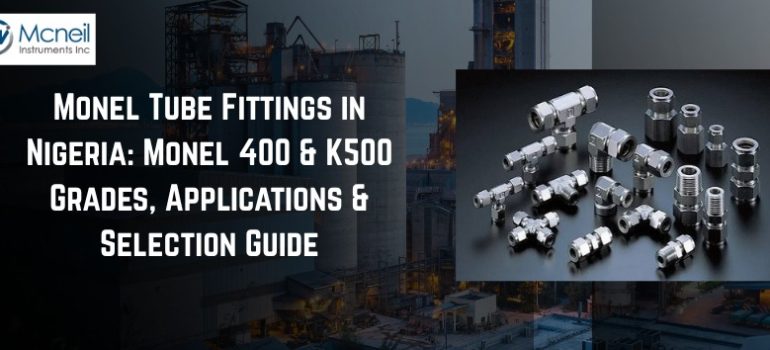
Monel tube fittings in Nigeria, featuring Monel 400 and K500 grades for industrial applications.

Monel Tube Fittings in Nigeria: Monel 400 & K500 Grades, Applications & Selection Guide

Monel Tube Fittings are widely used in industrial instrumentation and fluid-handling systems where high corrosion resistance, mechanical strength, and reliable performance are required. In Nigeria, these fittings are particularly relevant to coastal oil & gas facilities, water treatment stations, marine systems, chemical processing plants, and offshore applications where chloride-rich environments can create severe corrosion challenges. Mcneil Instruments supplies Monel 400 and Monel K500 Tube Fittings in Nigeria for demanding instrumentation and process applications.

What Are Monel Tube Fittings?

Monel tube fittings are precision-engineered components manufactured from nickel-copper alloys. They are designed to provide secure connections between instrumentation tubing and process systems while offering strong resistance to corrosive environments.
Mcneil Instruments offers Monel 400 Tube Fittings and Monel K500 Tube Fittings, with applications including offshore systems, chemical processing, cryogenic pipelines, oil & gas installations, instrumentation, and high-pressure tubing.

Monel 400 Tube Fittings in Nigeria

Monel 400 Tube Fittings are manufactured from UNS N04400 nickel-copper alloy and are known for their corrosion resistance and mechanical strength.
According to Mcneil Instruments, Monel 400 offers resistance to seawater, hydrofluoric acid, and sulfuric acid, while maintaining useful strength across cryogenic and elevated-temperature applications.
Key Properties of Monel 400
Excellent seawater resistance
Strong corrosion resistance
Good mechanical strength
Good ductility
Good weldability
Suitable for cryogenic applications
Suitable for elevated-temperature service
Long-term durability in demanding environments
Applications in Nigeria
Monel 400 tube fittings can be used in:
Coastal oil & gas facilities
Offshore platforms
Marine systems
Water treatment plants
Desalination systems
Chemical processing
Heat exchangers
Instrumentation systems
Oil & gas pipelines
Mcneil specifically identifies coastal oil & gas fields and water treatment stations in Nigeria as applications for its Monel tube fittings.

Monel K500 Tube Fittings in Nigeria

Monel K500 Tube Fittings, manufactured from UNS N05500, provide higher strength and hardness than Monel 400 while retaining strong corrosion resistance.
Mcneil Instruments states that Monel K500 uses precipitation hardening to achieve enhanced mechanical performance and is suitable for applications involving mechanical loads and high-pressure tubing.
Advantages of Monel K500
Higher tensile strength
Higher yield strength
Improved hardness
Excellent wear resistance
Strong corrosion resistance
Good fatigue performance
Suitable for high-pressure tubing
Suitable for saline and hydrocarbon environments
Monel K500 Applications
Typical applications include:
Oilfield equipment
Offshore oil & gas
Marine equipment
Pump components
Valve bodies
Instrumentation systems
High-pressure hydraulic tubing
Desalination systems
Chemical processing

Monel 400 vs Monel K500 Tube Fittings

Property Monel 400 Monel K500
UNS N04400 N05500
Main Advantage Corrosion resistance Higher strength + corrosion resistance
Tensile Strength 550–750 MPa ≥965 MPa
Yield Strength ≥240 MPa ≥585 MPa
Elongation ≥30% ≥20%
Hardness ~200 HB ≤328 HB
Temperature Range −200°C to +315°C −196°C to +315°C
Typical Applications Marine, chemical, heat exchangers Oilfield, high-pressure tubing, marine equipment
The values above reflect the specifications published on Mcneil Instruments’ product page.

Monel Tube Fittings for Oil & Gas Industry in Nigeria

Nigeria’s oil & gas industry includes both onshore and coastal operations where equipment can be exposed to saltwater, moisture, hydrocarbons, chemicals, and demanding operating conditions.
Monel tube fittings can be used for suitable:
Instrumentation tubing
Hydraulic systems
Process control systems
Oilfield equipment
Offshore platforms
Chemical injection systems
High-pressure tubing
Process measurement systems
For coastal facilities, Monel’s resistance to chloride-containing environments can make it a suitable material option where the process and engineering specifications call for it. Mcneil specifically identifies Nigerian coastal oil & gas fields as an application for its Monel tube fittings.

Monel Tube Fittings for Water Treatment in Nigeria

Water treatment facilities can expose metal components to moisture, chlorides, chemicals, and other corrosive conditions.
Monel 400 and Monel K500 tube fittings can be considered for suitable instrumentation and fluid-control applications where material compatibility has been established.
Applications may include:
Water treatment instrumentation
Seawater systems
Desalination equipment
Process control tubing
Pump systems
High-pressure fluid systems
Mcneil Instruments specifically lists water treatment stations in Nigeria among the applications it serves with Monel tube fittings.

Monel Tube Fittings for Offshore Applications

Offshore systems require materials capable of handling demanding marine environments.
Monel tube fittings can be used in suitable:
Offshore platforms
Marine manifolds
Seawater systems
Hydraulic systems
Instrumentation systems
Oilfield equipment
Process control systems
Monel 400 is particularly known for seawater corrosion resistance, while Monel K500 provides additional strength for applications subject to higher mechanical loads.

Types of Monel Tube Fittings

Mcneil Instruments supplies a broad range of instrumentation tube fitting configurations. Its tube fitting range includes products such as:
Straight Unions
Union Elbows
Union Tees
Union Crosses
Reducing Unions
Reducing Tees
Bulkhead Unions
Bulkhead Elbows
NPT Connectors
Male Connectors
Male Elbows
Male Bulkhead Connectors
Male Branch Tees
The exact configuration should be selected according to tube dimensions, connection requirements, pressure rating, and project specifications.

Monel Compression Tube Fittings

Monel Compression Tube Fittings provide mechanical connections for instrumentation and fluid-control tubing without requiring conventional welding.
They can be used in:
Instrumentation systems
Hydraulic tubing
Pneumatic systems
Process control
Oil & gas equipment
High-pressure fluid systems
Mcneil Instruments describes its Monel tube fittings as precision-engineered compression fittings designed for instrumentation, hydraulic, pneumatic, and process-control applications.

Technical Specifications of Monel 400 Tube Fittings

According to Mcneil Instruments:
Parameter Monel 400
UNS N04400
Nickel ≥63%
Copper ≤28%
Iron ≤2.5%
Manganese ≤2%
Carbon ≤0.3%
Tensile Strength 550–750 MPa
Yield Strength ≥240 MPa
Elongation ≥30%
Hardness ~200 HB
Standards ASTM B163 / ASME SB163, B171
Operating Range −200°C to +315°C

Technical Specifications of Monel K500 Tube Fittings

Parameter Monel K500
UNS N05500
Nickel ~63%
Copper ~28%
Aluminium 2.15–3.15%
Titanium 0.35–0.85%
Iron ≤2%
Tensile Strength ≥965 MPa
Yield Strength ≥585 MPa
Elongation ≥20%
Hardness ≤328 HB
Standard ASTM B164 / ASME SB164
Operating Range −196°C to +315°C

How to Select Monel Tube Fittings in Nigeria

Before ordering Monel tube fittings in Nigeria, consider the following:

  1. Material Grade
    Choose between Monel 400 and Monel K500 according to corrosion, strength, wear, and mechanical requirements.
  2. Tube Size
    Confirm the outside diameter and wall thickness of the tubing.
  3. Connection Type
    Specify the required connection, such as NPT or another applicable thread configuration.
  4. Pressure
    Confirm the system’s operating and design pressure.
  5. Temperature
    Check normal and maximum operating temperatures.
  6. Process Medium
    Consider whether the fittings will handle:
    Seawater
    Hydrocarbons
    Chemicals
    Hydraulic fluids
    Gas
    Process fluids
  7. Corrosion Conditions
    Evaluate chloride exposure, seawater, acids, alkalis, and other corrosive media.
  8. Standards and Certification
    Confirm the required ASTM, ASME, project, EPC, inspection, and material certification requirements.

Why Choose Mcneil Instruments for Monel Tube Fittings in Nigeria?

Mcneil Instruments supplies Monel 400 and Monel K500 Tube Fittings for demanding industrial applications and specifically identifies Nigeria as an export market serving coastal oil & gas fields and water treatment stations.
The product range is positioned around:
Precision-machined fittings
Corrosion resistance
Dimensional accuracy
Leak-resistant connections
High-pressure applications
Instrumentation systems
International export support
Custom manufacturing capabilities
Mcneil Instruments also states that customized tube fittings can be manufactured according to customer drawings, tube sizes, specifications, and thread configurations.

Conclusion

Monel Tube Fittings in Nigeria are suitable for demanding instrumentation and fluid-control applications where corrosion resistance, mechanical strength, and reliable connections are essential.
Monel 400 Tube Fittings are particularly suited to corrosive and marine environments, while Monel K500 Tube Fittings offer higher strength and hardness for applications involving greater mechanical loads.
For Nigerian oil & gas, offshore, marine, water treatment, chemical processing, and instrumentation applications, Mcneil Instruments supplies Monel 400 and K500 tube fittings according to required material, dimensions, connection configuration, and project specifications.

Frequently Asked Questions

What are Monel Tube Fittings?
Monel tube fittings are nickel-copper alloy fittings designed for connecting tubing in instrumentation, hydraulic, pneumatic, and process-control systems.
Which Monel grades are available?
Mcneil Instruments supplies Monel 400 (UNS N04400) and Monel K500 (UNS N05500) tube fittings.
What are Monel 400 Tube Fittings used for?
They are used in suitable marine, offshore, chemical processing, desalination, heat exchanger, oil & gas, and instrumentation applications.
What is the advantage of Monel K500?
Monel K500 provides higher strength, hardness, and wear resistance than Monel 400 while retaining strong corrosion resistance.
Are Monel Tube Fittings suitable for Nigerian oil & gas applications?
Yes. Mcneil Instruments specifically identifies coastal oil & gas fields in Nigeria as an application for its Monel tube fittings.
Are Monel fittings suitable for water treatment plants?
They can be used for suitable water treatment and seawater applications where the material is compatible with the actual service conditions. Mcneil identifies water treatment stations in Nigeria among its application markets.
Can Mcneil Instruments manufacture customized Monel tube fittings?
Yes. Mcneil Instruments states that custom fittings can be manufactured according to customer drawings, tube sizes, specifications, and thread configurations.

Read More

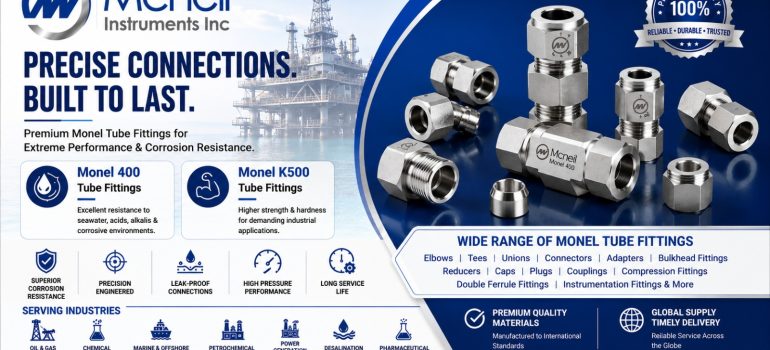
Monel 400 & Monel K500 Tube Fittings Manufacturer & Supplier – Mcneil Instruments

Premium Nickel Alloy Tube Fittings for Corrosion-Resistant Instrumentation Systems

Industrial instrumentation systems operating in corrosive environments demand tube fittings that offer exceptional sealing performance, superior mechanical strength, and long-term durability. Monel tube fittings are widely recognized for their outstanding resistance to seawater, chemicals, alkalis, and harsh industrial conditions, making them the preferred choice across numerous industries.

Mcneil Instruments is a trusted manufacturer and supplier of Monel 400 Tube Fittings and Monel K500 Tube Fittings, offering precision-engineered compression fittings for instrumentation, hydraulic, pneumatic, and process control applications. Manufactured using premium nickel-copper alloys, our fittings ensure reliable performance even under extreme pressure and challenging operating conditions.


Why Choose Mcneil Instruments?

Selecting premium tube fittings is essential for maintaining leak-free systems, reducing maintenance costs, and maximizing operational efficiency. Mcneil Instruments combines advanced manufacturing technology with stringent quality standards to deliver products that exceed customer expectations.

Why Industries Trust Us

✔ Precision-machined Monel tube fittings

✔ High corrosion and erosion resistance

✔ Excellent dimensional accuracy

✔ Leak-proof double ferrule design

✔ Superior pressure handling capability

✔ International quality standards

✔ Fast production and delivery

✔ Worldwide export support

Our products are engineered to provide dependable performance in the most demanding industrial environments.


Our Monel Tube Fittings Range

Monel 400 Tube Fittings

Monel 400 is a solid-solution nickel-copper alloy known for its remarkable resistance to seawater, acids, alkalis, and reducing environments.

Key Features

  • Excellent corrosion resistance
  • Outstanding seawater resistance
  • High mechanical strength
  • Superior thermal conductivity
  • Excellent weldability
  • Long service life

Applications

  • Marine Engineering
  • Offshore Platforms
  • Chemical Processing Plants
  • Desalination Systems
  • Heat Exchangers
  • Oil & Gas Pipelines

Monel K500 Tube Fittings

Monel K500 enhances the properties of Monel 400 by providing greater strength, hardness, and wear resistance while maintaining excellent corrosion resistance.

Advantages

  • Higher tensile strength
  • Exceptional wear resistance
  • Excellent fatigue performance
  • Improved hardness
  • Outstanding corrosion protection
  • Reliable long-term durability

Common Applications

  • Pump Shafts
  • Marine Equipment
  • Chemical Processing
  • Oilfield Equipment
  • Instrumentation Systems
  • High-Pressure Hydraulic Lines

Types of Monel Tube Fittings We Manufacture

Mcneil Instruments manufactures an extensive selection of Monel tube fittings suitable for instrumentation and fluid control systems.

Our product range includes:

  • Compression Tube Fittings
  • Double Ferrule Tube Fittings
  • Tube Unions
  • Union Elbows
  • Male Elbows
  • Female Elbows
  • Equal Tees
  • Branch Tees
  • Bulkhead Unions
  • Tube Connectors
  • Male Connectors
  • Female Connectors
  • Tube Adapters
  • Reducers
  • Tube Caps
  • Tube Plugs
  • Couplings
  • Instrumentation Tube Fittings

Each fitting is manufactured to provide secure, vibration-resistant, and leak-proof connections.


Key Features of Monel Tube Fittings

Mcneil Instruments designs Monel tube fittings to meet the highest industrial performance standards.

Product Highlights

✔ Exceptional corrosion resistance

✔ High-pressure capability

✔ Excellent mechanical strength

✔ Precision-machined components

✔ Leak-free sealing performance

✔ Excellent resistance to seawater

✔ Long operational life

✔ Easy installation

✔ Low maintenance requirements

✔ Suitable for critical instrumentation systems


Available Sizes & Configurations

Our Monel tube fittings are available in a wide variety of configurations to suit different industrial applications.

Available in:

  • 1/8″ to 2″ Tube Sizes
  • Metric Sizes
  • BSP Threads
  • NPT Threads
  • Socket Weld Connections
  • Custom Configurations

Custom dimensions are also available as per customer specifications.


Industries We Serve

Mcneil Instruments supplies Monel tube fittings to industries where corrosion resistance and reliability are critical.

Major Industries

  • Oil & Gas
  • Petrochemical Plants
  • Marine & Offshore
  • Shipbuilding
  • Chemical Processing
  • Power Generation
  • Pharmaceutical Industry
  • Water Treatment Plants
  • Desalination Facilities
  • Instrumentation Systems
  • Hydraulic Equipment
  • Food Processing
  • Fertilizer Plants
  • LNG Projects

International Standards

All Monel tube fittings are manufactured according to globally accepted quality specifications.

Standards

  • ASTM Standards
  • ASME Standards
  • ANSI Standards
  • DIN Standards
  • ISO Standards
  • BS Standards

Every fitting is produced with strict dimensional accuracy and quality assurance.


Advantages of Using Monel Tube Fittings

Compared to conventional stainless steel fittings, Monel alloys provide significantly better performance in corrosive and marine environments.

Business Benefits

🌊 Outstanding seawater resistance

⚙ Superior mechanical strength

🛡 Excellent corrosion protection

📈 Longer equipment life

💰 Reduced maintenance costs

🚀 Improved operational efficiency

🌍 Reliable performance in harsh environments


Quality Assurance at Mcneil Instruments

Quality is the foundation of every product manufactured by Mcneil Instruments.

Each Monel tube fitting undergoes rigorous inspection before dispatch.

Quality Tests Include

  • Raw Material Inspection
  • PMI Testing
  • Hydrostatic Testing
  • Dimensional Inspection
  • Pressure Testing
  • Chemical Analysis
  • Mechanical Testing
  • Surface Finish Inspection
  • Visual Examination

Material Test Certificates (MTC) are supplied upon customer request.


Why Customers Choose Mcneil Instruments

Thousands of customers rely on Mcneil Instruments for premium-quality Monel tube fittings because of our commitment to quality and customer satisfaction.

Our Strengths

✔ Premium-grade raw materials

✔ Modern manufacturing facility

✔ Experienced engineering team

✔ Competitive pricing

✔ Large inventory

✔ Quick delivery

✔ Customized solutions

✔ Technical support


Benefits of Choosing Our Monel Tube Fittings

When you choose Mcneil Instruments, you receive products designed for maximum efficiency and long-term performance.

Customer Benefits

📊 Leak-proof connections

⚙ Reliable instrumentation systems

🌍 Worldwide export capability

🛠 Durable nickel alloy fittings

📈 Improved plant productivity

💼 Trusted manufacturing expertise


Applications of Monel Tube Fittings

Our tube fittings are extensively used in:

  • Instrumentation Panels
  • Hydraulic Systems
  • Pneumatic Systems
  • Process Control Equipment
  • Gas Distribution Networks
  • Chemical Transfer Lines
  • Offshore Platforms
  • Heat Exchangers
  • Marine Pipelines
  • Laboratory Systems
  • High-Pressure Fluid Systems
  • Industrial Automation

📞 Contact Mcneil Instruments Today

Looking for premium Monel 400 Tube Fittings or Monel K500 Tube Fittings for your industrial project?

Mcneil Instruments

📧 info@mcneilinstruments.com

📞 +91 9870883613

Our experts are ready to assist you with product specifications, pricing, technical support, and bulk order requirements.


Frequently Asked Questions (FAQs)

1. What is the difference between Monel 400 and Monel K500 tube fittings?

Monel 400 offers excellent corrosion resistance, while Monel K500 provides higher strength, improved hardness, and better wear resistance, making it ideal for more demanding applications.

2. Where are Monel tube fittings commonly used?

Monel tube fittings are widely used in marine, offshore, chemical processing, oil & gas, desalination, hydraulic systems, and instrumentation industries.

3. What types of Monel tube fittings does Mcneil Instruments manufacture?

We manufacture compression tube fittings, double ferrule fittings, elbows, tees, unions, connectors, adapters, reducers, plugs, caps, couplings, and customized instrumentation fittings.

4. Are Monel tube fittings suitable for high-pressure applications?

Yes. Our Monel tube fittings are designed to withstand high-pressure fluid and gas systems while providing secure and leak-proof performance.

5. Can Mcneil Instruments manufacture customized Monel tube fittings?

Yes. We offer custom manufacturing based on customer drawings, specifications, tube sizes, and thread configurations.

6. Why choose Mcneil Instruments for Monel tube fittings?

Mcneil Instruments is known for precision manufacturing, premium quality materials, strict quality testing, competitive pricing, timely delivery, and reliable customer support.

Read More